PUBLISHER: Global Market Insights Inc. | PRODUCT CODE: 2083275

PUBLISHER: Global Market Insights Inc. | PRODUCT CODE: 2083275
Antiparasitic Drugs Market Opportunity, Growth Drivers, Industry Trend Analysis, and Forecast 2026 - 2035
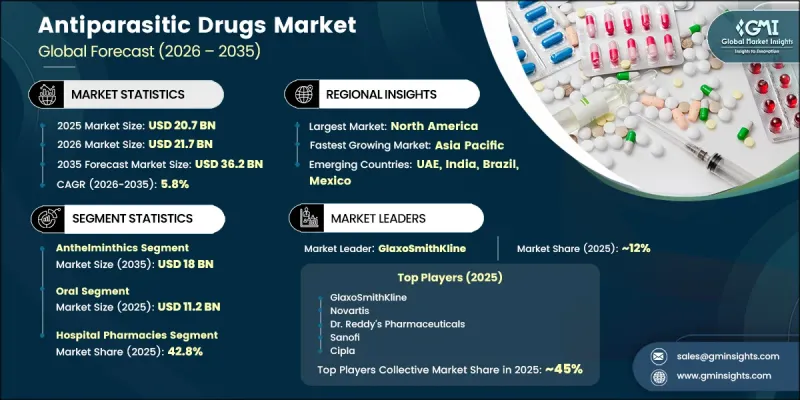
The Global Antiparasitic Drugs Market was valued at USD 20.7 billion in 2025 and is estimated to grow at a CAGR of 5.8% to reach USD 36.2 billion by 2035.
The antiparasitic drugs market is experiencing expansion, driven by the rising incidence of parasitic diseases, growing international travel, increasing migration, and stronger public awareness regarding timely diagnosis and treatment. Antiparasitic drugs are pharmaceutical agents developed to treat infections caused by parasitic organisms that rely on human or animal hosts for survival and reproduction. These medications function through multiple therapeutic mechanisms, including eliminating parasites, preventing their growth, disrupting reproduction, or blocking their ability to infect the host. Growing demand for innovative treatment options, combined with continuous improvements in diagnostic capabilities, is supporting market growth across both developed and emerging economies. Increased investment in pharmaceutical research, broader availability of advanced therapies, and ongoing regulatory approvals for new formulations continue to strengthen the competitive landscape. In addition, expanding government funding and public health initiatives aimed at controlling parasitic diseases are accelerating access to effective treatment options. As healthcare systems place greater emphasis on disease prevention and improved therapeutic outcomes, the antiparasitic drugs market is expected to maintain stable growth throughout the forecast period.
| Market Scope | |
|---|---|
| Start Year | 2025 |
| Forecast Year | 2026-2035 |
| Start Value | $20.7 Billion |
| Forecast Value | $36.2 Billion |
| CAGR | 5.8% |
The antiparasitic drugs market continues to benefit from increasing investments in pharmaceutical innovation and broader access to advanced treatment solutions. Continuous progress in diagnostic technologies has improved the early identification of parasitic infections, enabling faster treatment and better patient outcomes. At the same time, expanding healthcare infrastructure, stronger disease surveillance programs, and rising healthcare expenditure are contributing to wider adoption of antiparasitic medications. Favorable regulatory support for new drug development and growing awareness of parasite-related health risks is further enhancing long-term market growth.
The anthelmintics segment is projected to generate USD 18 billion by 2035. The segment's growth is supported by the broad therapeutic effectiveness of anthelmintic medications in treating multiple parasitic worm infections. Their ability to address a wide range of parasitic conditions through effective treatment protocols has increased their clinical utilization across healthcare settings. Rising demand for comprehensive treatment options and expanding healthcare access continue to strengthen the segment's market position.
The hospital pharmacies segment accounted for 42.8% share in 2025, making it the leading distribution channel. Hospital pharmacies maintain extensive inventories of antiparasitic medications, allowing healthcare providers to deliver appropriate treatment for diverse parasitic infections. They also play a critical role in supporting patients requiring specialized care by ensuring accurate medication dispensing, dosage management, patient monitoring, and supervision throughout treatment. The presence of experienced healthcare professionals and well-established pharmaceutical services further contributes to the continued growth of this segment.
U.S. Antiparasitic Drugs Market was valued at USD 6.8 billion in 2025. Market expansion is supported by advanced healthcare infrastructure, high treatment accessibility, and well-established disease surveillance systems that enable effective diagnosis and management of parasitic infections. Increasing adoption of digital healthcare services, including telemedicine and electronic prescribing, is improving patient access to antiparasitic therapies across both urban and underserved communities. In addition, ongoing clinical research focused on enhancing treatment effectiveness, addressing drug resistance, and introducing innovative therapies continues to support long-term market development, while an efficient regulatory framework facilitates timely approval of new pharmaceutical products.
Major companies operating in the global antiparasitic drugs market include Sanofi, Novartis, Cipla, GlaxoSmithKline, Zydus Lifesciences, Dr. Reddy's Laboratories, Teva Pharmaceuticals, Alkem Laboratories, Mankind Pharma, Cadila Pharmaceuticals, Ajanta Pharma, Intas Pharmaceuticals, Ipca Laboratories, AdvaCare Pharma, and Weefsel Pharma. Leading companies in the antiparasitic drugs market are strengthening their market position through continuous investment in research and development aimed at introducing more effective and safer treatment options. Manufacturers are expanding their product portfolios by developing innovative formulations and improving existing therapies to enhance patient outcomes. Strategic collaborations, licensing agreements, and partnerships with healthcare organizations are helping companies broaden their global reach and improve product availability. Businesses are also increasing investments in manufacturing capabilities and regulatory compliance to accelerate product approvals across international markets.
Table of Contents
Chapter 1 Methodology and Scope
- 1.1 Market scope and definition
- 1.2 Research approach
- 1.3 Quality commitments
- 1.3.1 GMI AI policy and data integrity commitment
- 1.3.1.1 Source consistency protocol
- 1.3.1 GMI AI policy and data integrity commitment
- 1.4 Research trail and confidence scoring
- 1.4.1 Research trail components
- 1.4.2 Scoring components
- 1.5 Data collection
- 1.5.1 Partial list of primary sources
- 1.6 Data mining sources
- 1.6.1 Paid sources
- 1.6.1.1 Sources, by region
- 1.6.1 Paid sources
- 1.7 Base estimates and calculations
- 1.7.1 Revenue share analysis
- 1.7.2 Base year calculation
- 1.8 Forecast model
- 1.8.1 Quantified market impact analysis
- 1.8.1.1 Mathematical impact of growth parameters on forecast
- 1.8.1 Quantified market impact analysis
- 1.9 Research transparency addendum
- 1.9.1 Source attribution framework
- 1.9.2 Quality assurance metrics
- 1.9.3 Our commitment to trust
Chapter 2 Executive Summary
- 2.1 Industry 360° synopsis
- 2.2 Key market trends
- 2.2.1 Business trends
- 2.2.2 Regional trends
- 2.2.3 Drug type trends
- 2.2.4 Route of administration trends
- 2.2.5 End use trends
- 2.3 CXO perspectives: Strategic imperatives
Chapter 3 Industry Insights
- 3.1 Industry ecosystem analysis
- 3.2 Industry impact forces
- 3.2.1 Growth drivers
- 3.2.1.1 Rising prevalence of parasitic infection
- 3.2.1.2 Increasing government initiatives and funding
- 3.2.1.3 Increasing global travel and migration
- 3.2.1.4 Growing awareness and early diagnosis of parasitic diseases
- 3.2.2 Industry pitfalls and challenges
- 3.2.2.1 Increasing drug resistance
- 3.2.2.2 Limited availability of novel drug pipelines
- 3.2.3 Market opportunities
- 3.2.3.1 Development of next generation antiparasitic drugs and combination therapies
- 3.2.3.2 Expansion in emerging markets with high disease burden
- 3.2.1 Growth drivers
- 3.3 Growth potential analysis
- 3.4 Regulatory landscape (Driven by Primary Research)
- 3.4.1 North America
- 3.4.2 Europe
- 3.4.3 Asia Pacific
- 3.4.4 Latin America
- 3.4.5 MEA
- 3.5 Technology and innovation landscape (Driven by Primary Research)
- 3.5.1 Novel drug discovery technologies
- 3.5.2 High-throughput screening platforms
- 3.5.3 Genomics & proteomics applications
- 3.5.4 Nanotechnology-based drug delivery systems
- 3.5.5 Drug repurpose & combination therapy strategies
- 3.6 Disease epidemiology (Driven by Primary Research)
- 3.7 Impact of AI and Generative AI on the market (Driven by Primary Research)
- 3.8 Pricing analysis (Driven by Primary Research)
- 3.9 Porter's analysis
- 3.10 PESTEL analysis
Chapter 4 Competitive Landscape, 2025
- 4.1 Introduction
- 4.2 Company market share analysis
- 4.2.1 North America
- 4.2.2 Europe
- 4.2.3 Asia Pacific
- 4.3 Company matrix analysis
- 4.4 Competitive analysis of major market players
- 4.5 Competitive positioning matrix
- 4.6 Key developments
- 4.6.1 Merger and acquisition
- 4.6.2 Partnership and collaboration
- 4.6.3 New product launches
- 4.6.4 Expansion plans
Chapter 5 Market Estimates and Forecast, By Drug Type, 2022 - 2035 ($ Mn)
- 5.1 Key trends
- 5.2 Anthelmintics
- 5.3 Antiprotozoal
- 5.4 Ectoparasiticides
- 5.5 Other drug types
Chapter 6 Market Estimates and Forecast, By Route of Administration, 2022 - 2035 ($ Mn)
- 6.1 Key trends
- 6.2 Injectable
- 6.3 Oral
- 6.4 Topical
Chapter 7 Market Estimates and Forecast, By Distribution Channel, 2022 - 2035 ($ Mn)
- 7.1 Key trends
- 7.2 Hospital pharmacies
- 7.3 Retail pharmacies
- 7.4 Online pharmacies
Chapter 8 Market Estimates and Forecast, By Region, 2022 - 2035 ($ Mn)
- 8.1 Key trends
- 8.2 North America
- 8.2.1 U.S.
- 8.2.2 Canada
- 8.3 Europe
- 8.3.1 Germany
- 8.3.2 UK
- 8.3.3 France
- 8.3.4 Spain
- 8.3.5 Italy
- 8.3.6 Netherlands
- 8.4 Asia Pacific
- 8.4.1 China
- 8.4.2 Japan
- 8.4.3 India
- 8.4.4 Australia
- 8.4.5 South Korea
- 8.5 Latin America
- 8.5.1 Brazil
- 8.5.2 Mexico
- 8.5.3 Argentina
- 8.6 Middle East and Africa
- 8.6.1 South Africa
- 8.6.2 Saudi Arabia
- 8.6.3 UAE
Chapter 9 Company Profiles
- 9.1 AdvaCare Pharma
- 9.2 Ajanta Pharma
- 9.3 Alkem Laboratories
- 9.4 Cadila Pharmaceuticals
- 9.5 Cipla
- 9.6 Dr. Reddy's Laboratories
- 9.7 GlaxoSmithKline
- 9.8 Intas Pharmaceuticals
- 9.9 Ipca Laboratories
- 9.10 Mankind Pharma
- 9.11 Novartis
- 9.12 Sanofi
- 9.13 Teva Pharmaceuticals
- 9.14 Weefsel Pharma
- 9.15 Zydus Lifesciences

