PUBLISHER: Mordor Intelligence | PRODUCT CODE: 2116480

PUBLISHER: Mordor Intelligence | PRODUCT CODE: 2116480
Global Antiparasitic Drugs - Market Share Analysis, Industry Trends & Statistics, Growth Forecasts (2026 - 2031)
According to Mordor Intelligence, the antiparasitic drugs market size is expected to grow from USD 25.97 billion in 2025 to USD 27.39 billion in 2026 and is forecast to reach USD 35.75 billion by 2031 at 5.47% CAGR over 2026-2031.
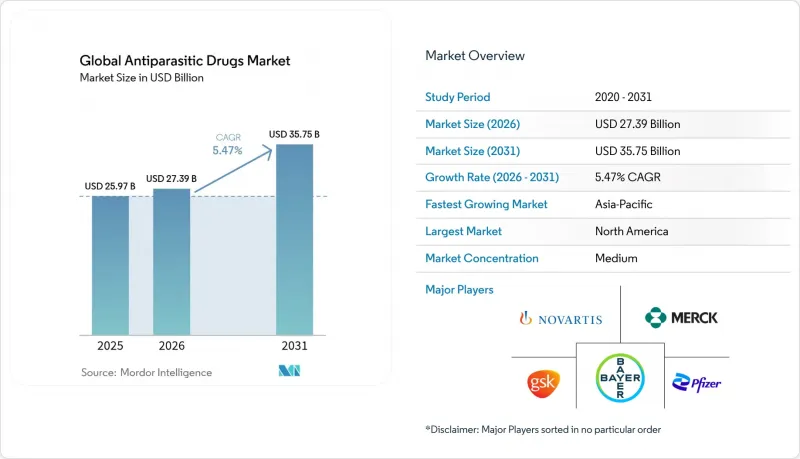
This report is Segmented by Drug Type (Anthelmintics [Benzimidazoles and More], Antiprotozoals, Antimalarials [ACTs and More], and Others), Route of Administration (Oral and More), Distribution Channel (Hospital Pharmacy, Retail Pharmacy, and Online Pharmacy), End-User (Hospitals, Clinics, and Home-Care Settings), and Geography (North America, Europe, Asia-Pacific, Middle East and Africa, South America).
Global Antiparasitic Drugs Market Trends and Insights
Expansion of mass drug-administration (MDA) campaigns
Worldwide MDA initiatives now reach more than 860 million people annually, with triple-drug regimens achieving 74% coverage-well above the 65% WHO benchmark. Scale-up in India alone covers 17.5 crore residents across 111 districts, amplifying volume demand for anthelmintics. Community-directed delivery models are improving adherence in remote areas, translating into reliable, repeat-cycle procurement for manufacturers. Early adoption of triple-drug strategies in developing nations delivered superior efficacy, encouraging additional donor funding and accelerating elimination targets.
Climate-driven spread of vector-borne parasitic diseases
Rising temperatures are extending mosquito and tick ranges, making malaria, babesiosis and Lyme disease more common in regions that once saw negligible incidence. Vector-borne illnesses now constitute over 17% of global infectious disease cases and claim 700,000 lives each year, boosting both prophylactic and therapeutic consumption. Pharmaceutical pipelines increasingly emphasize broad-spectrum agents and combination therapies suitable for populations lacking prior immunity.
Escalating helminth drug resistance
Resistance-conferring B-tubulin mutations-F167Y, Q134H, E198K/V and F200Y/L-are now widespread in regions with frequent MDA cycles. Albendazole efficacy against Trichuris trichiura has dropped to 38.6%, forcing higher doses and costlier combination regimens. Limited arrival of new mechanisms of action jeopardizes the WHO roadmap for neglected-disease elimination.
Other drivers and restraints analyzed in the detailed report include:
- Accelerating R&D funding for novel anthelmintic classes
- Commercialization of long-acting human macrocyclic lactones
- Integrated vector management dampening prophylactic volumes
For complete list of drivers and restraints, kindly check the Table Of Contents.
Segment Analysis
Anthelmintics secured a 54.27% slice of antiparasitic drugs market share in 2025, reflecting the scale of helminthiasis worldwide. Benzimidazoles dominate sub-segment sales, though mounting resistance is sparking interest in macrocyclic lactones and enzymatic-pathway inhibitors. The antiparasitic drugs market size for macrocyclic lactones has grown on the back of moxidectin's long-acting profile, while imidazothiazoles hold a niche role in combination regimens. Antiprotozoals, forecast to expand at 6.36% CAGR, are benefiting from novel delivery platforms and repurposed oncology compounds that target protozoal metabolism. Artemisinin-based combinations remain the cornerstone of malaria therapy, yet pipeline candidates aimed at resistant Plasmodium strains promise to diversify this revenue stream. Cutting-edge biologics for leishmaniasis and trypanosomiasis further reinforce the segment's fast-growth status. Cross-resistance among parasite classes is also steering R&D toward multi-mechanism molecules to safeguard long-term efficacy.
Second-generation benzimidazole nano-formulations now exhibit improved solubility and bioavailability, extending product life cycles without altering active moieties. Macrocyclic lactone R&D is concentrating on polymer-based implants capable of releasing drug loads over several months-an approach expected to elevate adherence in endemic regions with limited healthcare access. Meanwhile, targeted screening platforms are leveraging AI to identify new chemotypes that bypass existing resistance pathways, adding depth to a historically narrow pipeline.
Injectables commanded 42.35% of the antiparasitic drugs market in 2025, driven by their utility in acute, hospital-managed infections. Intravenous artesunate remains the only severe-malaria option in the United States, validating the hospital-centric distribution model. Long-acting depot formulations of moxidectin are set to reinforce injectable relevance by ensuring plasma levels for six months with a single dose. Oral products, while convenient, are grappling with absorption challenges; nano-emulsion strategies now aim to boost bioavailability for highly lipophilic molecules like ivermectin. The antiparasitic drugs market size for topical & implants is forecast to expand fastest at 6.72% CAGR, propelled by sustained-release skin patches and subdermal devices that simplify dosing schedules and heighten compliance.
Transdermal microneedle arrays are under study as an alternative to conventional syringes, potentially democratizing access in low-resource settings. Polymeric implants embedding slow-release moxidectin have cleared early safety studies, suggesting that implantable systems could transition from veterinary to human use within the decade. Innovations in oral solid dispersions are likewise prolonging market life for legacy compounds, highlighting formulation science as a competitive lever.
Complete Report Scope:
- By Drug Type
- Anthelmintics
- Benzimidazoles
- Macrocyclic Lactones
- Imidazothiazoles
- Other Anthelmintics
- Antiprotozoals
- Antimalarials
- ACTs
- Nitroimidazoles
- Other Antimalarials
- Others
- Anthelmintics
- By Route of Administration
- Oral
- Injectable
- Topical & Implants
- By Distribution Channel
- Hospital Pharmacy
- Retail Pharmacy
- Online Pharmacy
- By End-User
- Hospitals
- Clinics
- Home-Care Settings
- By Geography (Value)
- North America
- United States
- Canada
- Mexico
- Europe
- Germany
- United Kingdom
- France
- Italy
- Spain
- Rest of Europe
- Asia-Pacific
- China
- India
- Japan
- Australia
- South Korea
- Rest of Asia-Pacific
- Middle East & Africa
- GCC
- South Africa
- Rest of Middle East & Africa
- South America
- Brazil
- Argentina
- Rest of South America
- North America
Geography Analysis
North America held 39.75% of antiparasitic drugs market share in 2025, propelled by robust R&D ecosystems, stringent quality controls and early adoption of next-generation agents. Commercial uptake skews toward premium formulations, mitigating lower volume demand. FDA guidance on off-label ivermectin communications underscores the nuanced regulatory climate. The region's forecast CAGR of 4.39% reflects a mature yet innovation-driven environment, with new combination therapies aimed at resistance hot-spots.
Asia Pacific, expanding at 6.32% CAGR, combines high disease prevalence with widening healthcare coverage. India's national lymphatic-filariasis campaign exemplifies public-sector purchasing heft, while China's manufacturing base reshapes global supply chains for active ingredients. Japan's research heritage continues to influence macrocyclic lactone innovations. Financial and geographic barriers-documented in Bihar's visceral-leishmaniasis patient study-signal opportunities for low-cost, long-acting products.
Europe enjoys strong stewardship frameworks and eco-toxicology oversight, translating into cautious yet steady 4.05% CAGR growth. Regulatory emphasis on environmental sustainability is prompting companies to adopt greener chemistries early in development. The Middle East & Africa region gains momentum through mass-drug-administration success stories such as Zimbabwe's 73% coverage campaign against lymphatic filariasis, while South America leverages PAHO's Strategic Fund to stabilize procurement and entry pricing. These regions offer volume-driven growth potential despite funding constraints.
- 60 Degrees Pharmaceuticals
- Alkem Laboratories Limited
- Bayer
- Cipla
- Dr. Reddy's Laboratories
- Fresenius
- GlaxoSmithKline
- Ipca Laboratories Ltd
- J.B. Chemicals and Pharmaceuticals Limited
- Johnson & Johnson
- Lupin
- Mankind Pharma Ltd
- Merck
- Novartis
- Pfizer
- Sanofi
- Sun Pharmaceuticals Industries
- Takeda Pharmaceuticals
- Teva Pharmaceutical Industries
- Zydus Lifesciences Ltd
Additional Benefits:
- The market estimate (ME) sheet in Excel format
- 3 months of analyst support
TABLE OF CONTENTS
1 Introduction
- 1.1 Study Assumptions & Market Definition
- 1.2 Scope of the Study
2 Research Methodology
3 Executive Summary
4 Market Landscape
- 4.1 Market Overview
- 4.2 Market Drivers
- 4.2.1 Expansion of Mass Drug-Administration (MDA) Campaigns
- 4.2.2 Climate-Driven Spread of Vector-Borne Parasitic Diseases
- 4.2.3 Accelerating R&D Funding for Novel Anthelmintic Classes
- 4.2.4 Commercialization of Long-Acting Human Macrocyclic Lactones
- 4.2.5 Government-Mandated Leishmaniasis Treatment Programs
- 4.2.6 Rising International Travel & Migration Boosting Imported Parasitic Cases
- 4.3 Market Restraints
- 4.3.1 Escalating Helminth Drug Resistance
- 4.3.2 Integrated Vector Management Dampening Prophylactic Volumes
- 4.3.3 Eco-Toxicology Scrutiny Slowing Isoxazoline Approvals
- 4.3.4 API Supply Disruptions in Benzimidazole Manufacturing Hubs
- 4.4 Supply-Chain Analysis
- 4.5 Porter's Five Forces Analysis
- 4.5.1 Threat of New Entrants
- 4.5.2 Bargaining Power of Buyers
- 4.5.3 Bargaining Power of Suppliers
- 4.5.4 Threat of Substitutes
- 4.5.5 Competitive Rivalry
5 Market Size & Growth Forecasts (Value, USD)
- 5.1 By Drug Type
- 5.1.1 Anthelmintics
- 5.1.1.1 Benzimidazoles
- 5.1.1.2 Macrocyclic Lactones
- 5.1.1.3 Imidazothiazoles
- 5.1.1.4 Other Anthelmintics
- 5.1.2 Antiprotozoals
- 5.1.3 Antimalarials
- 5.1.3.1 ACTs
- 5.1.3.2 Nitroimidazoles
- 5.1.3.3 Other Antimalarials
- 5.1.4 Others
- 5.1.1 Anthelmintics
- 5.2 By Route of Administration
- 5.2.1 Oral
- 5.2.2 Injectable
- 5.2.3 Topical & Implants
- 5.3 By Distribution Channel
- 5.3.1 Hospital Pharmacy
- 5.3.2 Retail Pharmacy
- 5.3.3 Online Pharmacy
- 5.4 By End-User
- 5.4.1 Hospitals
- 5.4.2 Clinics
- 5.4.3 Home-Care Settings
- 5.5 By Geography (Value)
- 5.5.1 North America
- 5.5.1.1 United States
- 5.5.1.2 Canada
- 5.5.1.3 Mexico
- 5.5.2 Europe
- 5.5.2.1 Germany
- 5.5.2.2 United Kingdom
- 5.5.2.3 France
- 5.5.2.4 Italy
- 5.5.2.5 Spain
- 5.5.2.6 Rest of Europe
- 5.5.3 Asia-Pacific
- 5.5.3.1 China
- 5.5.3.2 India
- 5.5.3.3 Japan
- 5.5.3.4 Australia
- 5.5.3.5 South Korea
- 5.5.3.6 Rest of Asia-Pacific
- 5.5.4 Middle East & Africa
- 5.5.4.1 GCC
- 5.5.4.2 South Africa
- 5.5.4.3 Rest of Middle East & Africa
- 5.5.5 South America
- 5.5.5.1 Brazil
- 5.5.5.2 Argentina
- 5.5.5.3 Rest of South America
- 5.5.1 North America
6 Competitive Landscape
- 6.1 Market Concentration
- 6.2 Competitive Benchmarking
- 6.3 Market Share Analysis
- 6.4 Company Profiles (includes Global level Overview, Market level overview, Core Segments, Financials as available, Strategic Information, Market Rank/Share for key companies, Products & Services, and Recent Developments)
- 6.4.1 60 Degrees Pharmaceuticals
- 6.4.2 Alkem Laboratories Limited
- 6.4.3 Bayer AG
- 6.4.4 Cipla Ltd
- 6.4.5 Dr. Reddy's Laboratories Ltd
- 6.4.6 Fresenius Kabi
- 6.4.7 GSK plc
- 6.4.8 Ipca Laboratories Ltd
- 6.4.9 J.B. Chemicals and Pharmaceuticals Limited
- 6.4.10 Johnson & Johnson
- 6.4.11 Lupin Ltd
- 6.4.12 Mankind Pharma Ltd
- 6.4.13 Merck & Co., Inc.
- 6.4.14 Novartis AG
- 6.4.15 Pfizer Inc.
- 6.4.16 Sanofi S.A.
- 6.4.17 Sun Pharmaceutical Industries Ltd
- 6.4.18 Takeda Pharmaceutical Co. Ltd
- 6.4.19 Teva Pharmaceutical Industries Ltd
- 6.4.20 Zydus Lifesciences Ltd
7 Market Opportunities & Future Outlook
- 7.1 White-space & Unmet-Need Assessment

