PUBLISHER: Global Market Insights Inc. | PRODUCT CODE: 2083285

PUBLISHER: Global Market Insights Inc. | PRODUCT CODE: 2083285
Omega-3 Fatty Acids Market Opportunity, Growth Drivers, Industry Trend Analysis, and Forecast 2026 - 2035
The Global Omega-3 Fatty Acids Market was valued at USD 3.5 billion in 2025 and is estimated to grow at a CAGR of 4.1% to reach USD 5.2 billion by 2035.
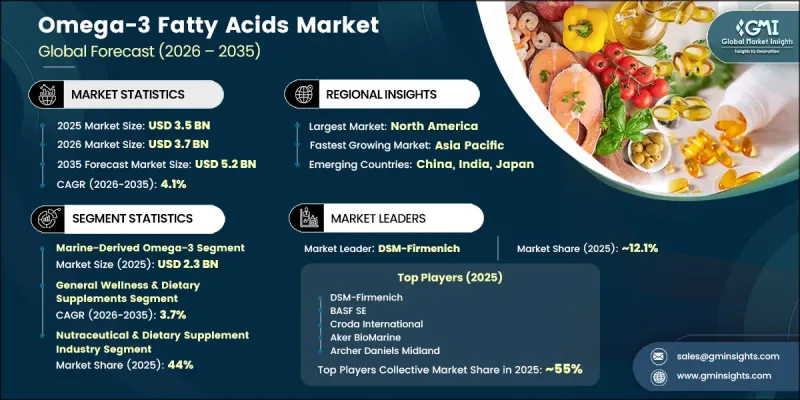
The omega-3 fatty acids market continues to expand as consumers become increasingly aware of the health benefits associated with these essential nutrients. Growing interest in preventive healthcare, nutritional supplementation, and overall wellness is driving demand across multiple consumer segments. Scientific research supporting the role of omega-3 fatty acids in cardiovascular health, cognitive function, and general well-being has significantly strengthened consumer confidence and product adoption worldwide. At the same time, the market is experiencing a shift toward plant-based and sustainable omega-3 sources as changing dietary preferences encourage the adoption of vegetarian and vegan nutrition solutions. Demand is also being fueled by the increasing incorporation of omega-3 ingredients into functional foods and beverages, extending market opportunities beyond traditional dietary supplements. Food and beverage manufacturers are actively integrating omega-3 fatty acids into a broader range of consumer products to enhance nutritional value and meet evolving health-conscious consumption trends. Additionally, source diversification is becoming a major industry focus as companies seek sustainable alternatives to conventional raw material sources. This transition is encouraging innovation across production technologies and supply chains, creating new growth opportunities throughout the global omega-3 fatty acids market during the forecast period.
| Market Scope | |
|---|---|
| Start Year | 2025 |
| Forecast Year | 2026-2035 |
| Start Value | $3.5 Billion |
| Forecast Value | $5.2 Billion |
| CAGR | 4.1% |
The marine-derived omega-3 segment generated USD 2.3 billion in 2025 and is anticipated to grow at a CAGR of 3.5% between 2026 and 2035. This segment continues to hold a substantial share of the omega-3 fatty acids market due to its naturally high concentration of essential fatty acids that are widely utilized in dietary supplements, functional nutrition products, and pharmaceutical applications. Meanwhile, alternative omega-3 sources are gaining momentum as consumers increasingly seek sustainable and plant-based nutritional solutions. Although plant-derived omega-3 ingredients remain attractive to cost-conscious consumers, their functional characteristics differ from marine-based alternatives, influencing their adoption across specific end-use applications.
The nutraceutical and dietary supplement segment accounted for USD 1.5 billion in 2025 and represented 44% share. Its strong market position is supported by rising consumer focus on preventive healthcare, daily nutritional support, and natural wellness products. Expanding product availability, increasing consumer awareness, and a growing preference for health-focused lifestyles continue to drive demand within this segment. As consumers increasingly prioritize long-term health management, the nutraceutical and dietary supplement industry is expected to remain a major contributor to market growth.
North America Omega-3 Fatty Acids Market generated USD 1 billion in 2025. The region maintains a leading position due to high consumer awareness regarding nutritional health, robust demand for dietary supplements, and a well-developed healthcare infrastructure. Growing interest in functional nutrition, preventive healthcare strategies, and premium wellness products continues to support market expansion across the region. In addition, increasing the incorporation of omega-3 ingredients into a wide variety of health and nutrition products is further strengthening regional demand and creating new opportunities for market participants.
Major companies operating in the global omega-3 fatty acids market include DSM-Firmenich, BASF SE, Croda International, Aker BioMarine, Archer Daniels Midland, Cargill, Corbion, Omega Protein Corporation, Epax, KD Pharma Group, Polaris Nutritional Lipids, Solutex, Veramaris, Yield10 Bioscience, AlgaeCytes, Fermentalg, Qualitas Health, and other industry participants. Companies operating in the omega-3 fatty acids market are focusing on innovation, sustainability, and portfolio diversification to strengthen their competitive position. Significant investments in research and development are enabling manufacturers to improve product purity, bioavailability, and formulation effectiveness while addressing evolving consumer preferences. Many companies are expanding their presence in plant-based and alternative omega-3 sources to meet growing demand for sustainable and vegan nutrition products. Strategic partnerships, acquisitions, and collaborations are being utilized to enhance production capabilities, strengthen supply chains, and expand geographic reach. Businesses are also increasing investments in functional food and beverage applications to diversify revenue streams beyond traditional dietary supplements.
Table of Contents
Chapter 1 Methodology & Scope
- 1.1 Market scope and definition
- 1.2 Research design
- 1.2.1 Research approach
- 1.2.2 Data collection methods
- 1.3 Data mining sources
- 1.3.1 Global
- 1.3.2 Regional/Country
- 1.4 Base estimates and calculations
- 1.4.1 Base year calculation
- 1.4.2 Key trends for market estimation
- 1.5 Primary research and validation
- 1.5.1 Primary sources
- 1.6 Forecast model
- 1.7 Research assumptions and limitations
Chapter 2 Executive Summary
- 2.1 Industry 360° synopsis
- 2.2 Key market trends
- 2.2.1 Regional
- 2.2.2 Product Type
- 2.2.3 Application
- 2.2.4 End Use Industry
- 2.3 TAM Analysis, 2026-2035
- 2.4 CXO perspectives: Strategic imperatives
Chapter 3 Industry Insights
- 3.1 Industry ecosystem analysis
- 3.1.1 Supplier landscape
- 3.1.2 Profit margin
- 3.1.3 Value addition at each stage
- 3.1.4 Factor affecting the value chain
- 3.1.5 Disruptions
- 3.2 Industry impact forces
- 3.2.1 Growth drivers
- 3.2.2 Industry pitfalls and challenges
- 3.2.3 Market opportunities
- 3.3 Growth potential analysis
- 3.4 Regulatory landscape
- 3.4.1 North America
- 3.4.2 Europe
- 3.4.3 Asia Pacific
- 3.4.4 Latin America
- 3.4.5 Middle East & Africa
- 3.5 Porter's analysis
- 3.6 PESTEL analysis
- 3.7 Price trends
- 3.7.1 By region
- 3.7.2 By type
- 3.8 Future market trends
- 3.9 Technology and Innovation landscape
- 3.9.1 Current technological trends
- 3.9.2 Emerging technologies
- 3.10 Patent Landscape
- 3.11 Trade statistics (HS code)
- 3.11.1 Major importing countries
- 3.11.2 Major exporting countries
- 3.12 Sustainability and environmental aspects
- 3.12.1 Sustainable practices
- 3.12.2 Waste reduction strategies
- 3.12.3 Energy efficiency in production
- 3.12.4 Eco-friendly initiatives
- 3.13 Carbon footprint consideration
Chapter 4 Competitive Landscape, 2025
- 4.1 Introduction
- 4.2 Company market share analysis
- 4.2.1 By region
- 4.2.1.1 North America
- 4.2.1.2 Europe
- 4.2.1.3 Asia Pacific
- 4.2.1.4 LATAM
- 4.2.1.5 MEA
- 4.2.1 By region
- 4.3 Company matrix analysis
- 4.4 Competitive analysis of major market players
- 4.5 Competitive positioning matrix
- 4.6 Key developments
- 4.6.1 Mergers & acquisitions
- 4.6.2 Partnerships & collaborations
- 4.6.3 New Product Launches
- 4.6.4 Expansion Plans
Chapter 5 Market Estimates and Forecast, By Product Type, 2022-2035 (USD Billion) (Kilo Tons)
- 5.1 Key trends
- 5.2 Marine-derived omega-3
- 5.2.1 Fish oil
- 5.2.2 Concentrated fish oil
- 5.2.3 Krill oil & phospholipid forms
- 5.2.4 Others
- 5.3 Algal-derived omega-3
- 5.3.1 Microalgae oil
- 5.3.2 Fermentation-derived EPA & DHA
- 5.4 Plant-based omega-3 (ala)
- 5.4.1 Flaxseed oil
- 5.4.2 Chia seed oil
- 5.4.3 Others
- 5.5 Prescription omega-3 drugs
- 5.6 Concentrated & purified forms
Chapter 6 Market Estimates and Forecast, By Application, 2022-2035 (USD Billion) (Kilo Tons)
- 6.1 Key trends
- 6.2 Cardiovascular health
- 6.2.1 Primary prevention products
- 6.2.2 Secondary prevention formulations
- 6.2.3 Blood pressure management
- 6.2.4 Arrhythmia prevention
- 6.3 Hypertriglyceridemia treatment
- 6.3.1 Severe hypertriglyceridemia
- 6.3.2 Moderate hypertriglyceridemia
- 6.4 General wellness & dietary supplements
- 6.4.1 Daily nutrition
- 6.4.2 Brain health & cognitive function
- 6.4.3 Eye health & vision support
- 6.4.4 Joint health & inflammation
- 6.5 Functional foods & fortification
- 6.5.1 Dairy product
- 6.5.2 Bakery & confectionery
- 6.5.3 Beverage fortification
- 6.5.4 Meat & poultry
- 6.6 Infant & maternal nutrition
- 6.6.1 Infant formula applications
- 6.6.2 Prenatal & postnatal supplements
- 6.6.3 Pediatric nutrition products
- 6.7 Animal feed & aquaculture
- 6.7.1 Aquaculture feed
- 6.7.2 Pet food
- 6.7.3 Livestock feed
Chapter 7 Market Estimates and Forecast, By End Use Industry, 2022-2035 (USD Billion) (Kilo Tons)
- 7.1 Key trends
- 7.2 Pharmaceutical industry
- 7.3 Nutraceutical & dietary supplement industry
- 7.4 Food & beverage industry
- 7.5 Animal feed industry
Chapter 8 Market Estimates and Forecast, By Region, 2022-2035 (USD Billion) (Kilo Tons)
- 8.1 Key trends
- 8.2 North America
- 8.2.1 U.S.
- 8.2.2 Canada
- 8.3 Europe
- 8.3.1 Germany
- 8.3.2 UK
- 8.3.3 France
- 8.3.4 Spain
- 8.3.5 Italy
- 8.3.6 Rest of Europe
- 8.4 Asia Pacific
- 8.4.1 China
- 8.4.2 India
- 8.4.3 Japan
- 8.4.4 Australia
- 8.4.5 South Korea
- 8.4.6 Rest of Asia Pacific
- 8.5 Latin America
- 8.5.1 Brazil
- 8.5.2 Mexico
- 8.5.3 Argentina
- 8.5.4 Rest of Latin America
- 8.6 Middle East and Africa
- 8.6.1 Saudi Arabia
- 8.6.2 South Africa
- 8.6.3 UAE
- 8.6.4 Rest of Middle East and Africa
Chapter 9 Company Profiles
- 9.1 DSM-Firmenich
- 9.2 BASF SE
- 9.3 Croda International
- 9.4 Aker BioMarine
- 9.5 Archer Daniels Midland
- 9.6 Cargill
- 9.7 Corbion
- 9.8 Omega Protein Corporation
- 9.9 Epax
- 9.10 KD Pharma Group
- 9.11 Polaris Nutritional Lipids
- 9.12 Solutex
- 9.13 Veramaris
- 9.14 Yield10 Bioscience
- 9.15 AlgaeCytes
- 9.16 Fermentalg
- 9.17 Qualitas Health

