PUBLISHER: Global Market Insights Inc. | PRODUCT CODE: 2083296

PUBLISHER: Global Market Insights Inc. | PRODUCT CODE: 2083296
Cellular V2X (C-V2X) Hardware Components and Telematics Control Units (TCU) Market Opportunity, Growth Drivers, Industry Trend Analysis, and Forecast 2026 - 2035
The Global Cellular V2X (C-V2X) Hardware Components and Telematics Control Units (TCU) Market was valued at USD 1.2 billion in 2025 and is estimated to grow at a CAGR of 23.6% to reach USD 9.5 billion by 2035.
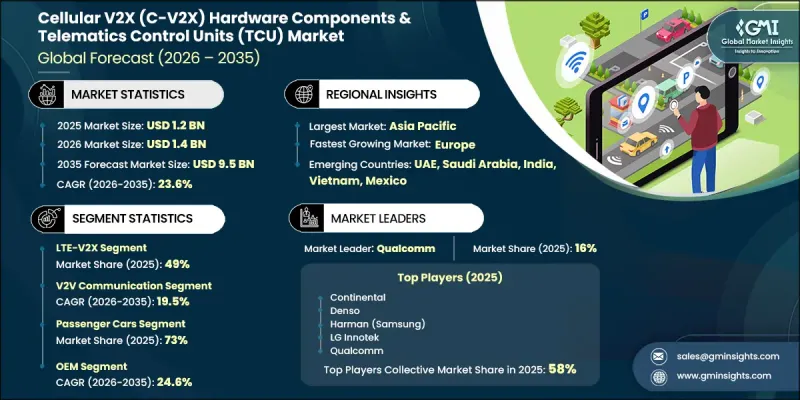
Market growth is driven by the evolution of connected vehicle technologies from pilot-stage deployments to large-scale commercial implementation across passenger vehicles, commercial transportation fleets, intelligent transportation infrastructure, and advanced roadway systems. One of the most significant developments within the industry is the integration of C-V2X functionality directly into telematics platforms, vehicle control systems, and roadside communication infrastructure rather than relying on standalone communication devices. As software-defined vehicle architectures become increasingly prevalent, demand is rising for advanced communication chipsets, automotive-grade telematics control units, roadside communication equipment, secure hardware modules, and high-precision positioning technologies. Government initiatives supporting intelligent transportation systems and connected mobility infrastructure are accelerating investments in both vehicle-based and roadside communication hardware. Regulatory frameworks aimed at improving connectivity standards, interoperability, and transportation network modernization are providing greater visibility for long-term investment planning. At the same time, the growing adoption of connected and software-defined vehicles is increasing demand for factory-installed telematics solutions, as automotive manufacturers prioritize secure, integrated, and over-the-air update-capable connectivity systems. Rising vehicle digitalization and expanding connectivity requirements continue to strengthen the role of C-V2X hardware and telematics control units within the broader automotive technology ecosystem.
| Market Scope | |
|---|---|
| Start Year | 2025 |
| Forecast Year | 2026-2035 |
| Start Value | $1.2 Billion |
| Forecast Value | $9.5 Billion |
| CAGR | 23.6% |
The LTE-V2X segment accounted for 49% share in 2025 and is expected to grow at a CAGR of 21.2% through 2035. Technology remains a leading connectivity platform due to its ability to support direct communication between vehicles and transportation infrastructure while maintaining operational effectiveness across diverse deployment environments. Its widespread adoption is being supported by increasing demand for advanced safety applications, enhanced situational awareness, and real-time communication capabilities that improve transportation efficiency and road safety. Continued investment in connected mobility infrastructure is expected to further strengthen the position of LTE-V2X within the market throughout the forecast period.
The passenger cars segment held a 73% share in 2025 and is forecast to grow at a CAGR of 24.2% through 2035. The segment benefits from high global vehicle production volumes and the increasing integration of embedded connectivity systems within modern automotive platforms. Electrified vehicle architecture plays a particularly important role in market expansion, as these platforms are often designed around centralized electronic systems, connected services, and software-driven functionality. Such design approaches facilitate the integration of advanced communication technologies and support the growing demand for connected vehicle ecosystems.
Asia Pacific Cellular V2X (C-V2X) Hardware Components and Telematics Control Units (TCU) Market held 55% share and is projected to grow at a CAGR of 23.3% through 2035. China represented 75.5% of regional revenue, supported by large-scale investments in intelligent transportation systems, connected mobility infrastructure, communication networks, and advanced roadway modernization initiatives. The broader Asia Pacific region continues to benefit from expanding connected vehicle programs, increasing deployment of transportation communication infrastructure, and growing collaboration between automotive manufacturers, technology providers, and government agencies. Ongoing investments in digital transportation ecosystems are expected to support long-term regional market growth.
Key companies operating in the Global Cellular V2X (C-V2X) Hardware Components and Telematics Control Units (TCU) Market include Aptiv, Huawei Technologies, Denso, Qualcomm Incorporated, LG Innotek, Valeo, NXP Semiconductors, Robert Bosch, FICOSA International, and HARMAN International. Companies participating in the Cellular V2X (C-V2X) Hardware Components and Telematics Control Units (TCU) Market are focusing on technology innovation, strategic partnerships, and product portfolio expansion to strengthen their competitive position. Leading market participants are investing heavily in next-generation communication technologies, advanced semiconductor development, secure connectivity platforms, and intelligent transportation solutions. Collaborations with automotive manufacturers, infrastructure providers, telecommunications companies, and government agencies are helping accelerate deployment and expand market reach. Businesses are also prioritizing research and development efforts aimed at improving communication reliability, cybersecurity, interoperability, and vehicle-to-everything connectivity performance. Geographic expansion, manufacturing capacity enhancement, and compliance with evolving transportation standards remain key strategic priorities. In addition, companies are developing integrated hardware and software ecosystems that support connected, autonomous, and software-defined vehicle architectures.
Table of Contents
Chapter 1 Methodology & Scope
- 1.1 Research approach
- 1.2 Quality Commitments
- 1.2.1 GMI AI policy & data integrity commitment
- 1.2.1.1 Source consistency protocol
- 1.2.1 GMI AI policy & data integrity commitment
- 1.3 Research Trail & Confidence Scoring
- 1.3.1 Research Trail Components
- 1.3.2 Scoring Components
- 1.4 Data Collection
- 1.4.1 Partial list of primary sources
- 1.5 Data mining sources
- 1.5.1 Paid sources
- 1.5.1.1 Sources, by region
- 1.5.1 Paid sources
- 1.6 Base estimates and calculations
- 1.6.1 Base year calculation
- 1.7 Forecast model
- 1.7.1 Quantified market impact analysis
- 1.7.1.1 Mathematical impact of growth parameters on forecast
- 1.7.1 Quantified market impact analysis
- 1.8 Research transparency addendum
- 1.8.1 Source attribution framework
- 1.8.2 Quality assurance metrics
- 1.8.3 Our commitment to trust
Chapter 2 Executive Summary
- 2.1 Industry 360° synopsis
- 2.2 Key market trends
- 2.2.1 Regional
- 2.2.2 System
- 2.2.3 Component
- 2.2.4 Technology
- 2.2.5 Vehicle
- 2.2.6 Communication Mode
- 2.2.7 Sales Channel
- 2.3 TAM Analysis, 2026-2035
- 2.4 CXO perspectives: Strategic imperatives
Chapter 3 Industry Insights
- 3.1 Industry ecosystem analysis
- 3.1.1 Supplier landscape
- 3.1.1.1 Raw material suppliers
- 3.1.1.2 Technology suppliers
- 3.1.1.3 OEM
- 3.1.1.4 Service providers
- 3.1.1.5 End Use
- 3.1.2 Cost structure
- 3.1.3 Profit margin
- 3.1.4 Value addition at each stage
- 3.1.5 Vertical integration trends
- 3.1.6 Disruptors
- 3.1.1 Supplier landscape
- 3.2 Industry impact forces
- 3.2.1 Growth drivers
- 3.2.1.1 Government-Led C-V2X Deployment Mandates
- 3.2.1.2 Rising Integration of Connected & Software-Defined Vehicles (SDVs)
- 3.2.1.3 Expansion of 5G NR-V2X Infrastructure
- 3.2.1.4 Growing Road Safety & Collision Avoidance Requirements
- 3.2.2 Industry pitfalls & challenges
- 3.2.2.1 High Deployment & Infrastructure Costs
- 3.2.2.2 Fragmented Global Regulatory Frameworks
- 3.2.3 Market opportunities
- 3.2.3.1 Migration from LTE-V2X to 5G NR-V2X Platforms
- 3.2.3.2 Integration of V2X into Centralized Domain Controllers
- 3.2.3.3 Increasing Deployment of Smart Roadside Infrastructure
- 3.2.3.4 Rising Adoption of High-Precision Positioning Technologies
- 3.2.1 Growth drivers
- 3.3 Growth potential analysis
- 3.4 Pricing Analysis (Driven by Primary Research)
- 3.4.1 Historical Price Trend Analysis
- 3.4.2 Pricing Strategy by Player Type (Premium / Value / Cost-plus)
- 3.5 Regulatory landscape
- 3.5.1 North America
- 3.5.1.1 U.S.: National Highway Traffic Safety Administration (NHTSA)
- 3.5.1.2 U.S.: Vehicle Safety Standards (FMVSS)
- 3.5.1.3 Canada: Motor Vehicle Safety Regulations ( SOR /2013-198)
- 3.5.2 Europe
- 3.5.2.1 German Road Traffic Licensing Regulations
- 3.5.2.2 UK: Ministry of Transport (MOT) Test
- 3.5.2.3 EU Vehicle Labeling Regulation
- 3.5.2.4 REACH Compliance & Sustainable Material Standards
- 3.5.3 Asia-Pacific
- 3.5.3.1 Japan Low Rolling Resistance Vehicle Certification
- 3.5.3.2 Malaysia: JPJ Puspakom Mandatory Tread Depth
- 3.5.3.3 Australia: HVNL Defect Management
- 3.5.3.4 China Vehicle Quality Certification Standards
- 3.5.4 Latin America
- 3.5.4.1 Brazil INMETRO Vehicle Labeling Program
- 3.5.4.2 Mexico NOM Vehicle Safety Regulations
- 3.5.5 Middle East & Africa
- 3.5.5.1 GCC Tire Quality & Import Regulations
- 3.5.5.2 South Africa Vehicle Safety Compliance Standards
- 3.5.1 North America
- 3.6 Technology and Innovation landscape
- 3.6.1 Current technologies
- 3.6.2 Emerging technologies
- 3.7 Porter’s analysis
- 3.8 PESTEL analysis
- 3.9 Patent analysis (Driven by Primary Research)
- 3.10 Trade Data Analysis (Based on Paid Database)
- 3.10.1 Import/Export Volume & Value Trends
- 3.10.2 Key Trade Corridors & Tariff Impact
- 3.11 Capacity & Production Landscape (Driven by Primary Research)
- 3.11.1 Production Capacity by Region & Key Producer
- 3.11.2 Capacity Utilization Rates & Expansion Pipelines
- 3.12 Impact of AI & generative AI on the market
- 3.12.1 AI-Driven Disruption of Existing Business Models
- 3.12.2 Automated design optimization
- 3.12.3 Supply chain AI for demand forecasting
- 3.12.4 GenAI use cases & adoption roadmap by segment
- 3.12.5 Risks, Limitations & Regulatory Considerations
- 3.13 Forecast assumptions & scenario analysis (Driven by Primary Research)
- 3.13.1 Base Case - key macro & industry variables driving CAGR
- 3.13.2 Optimistic Scenarios - Favorable Macro and Industry Tailwinds
- 3.13.3 Pessimistic Scenario - Macroeconomic slowdown or industry headwinds
- 3.14 Sustainability and environmental aspects
- 3.14.1 Sustainable practices
- 3.14.2 Waste reduction strategies
- 3.14.3 Energy efficiency in production
- 3.14.4 Eco-friendly Initiatives
- 3.14.5 Carbon footprint considerations
Chapter 4 Competitive Landscape, 2025
- 4.1 Introduction
- 4.2 Company market share analysis
- 4.2.1 North America
- 4.2.2 Europe
- 4.2.3 Asia-Pacific
- 4.2.4 Latin America
- 4.2.5 Middle East & Africa
- 4.3 Competitive positioning matrix
- 4.4 Key developments
- 4.4.1 Mergers & acquisitions
- 4.4.2 Partnerships & collaborations
- 4.4.3 New product launches
- 4.4.4 Expansion plans and funding
- 4.5 Company tier benchmarking
- 4.5.1 Tier classification criteria & qualifying thresholds
- 4.5.2 Tier positioning matrix by revenue, geography & innovation
Chapter 5 Market Estimates & Forecast, By System, 2022 - 2035 ($Mn, Units)
- 5.1 Key trends
- 5.2 Telematics Control Units (TCUs)
- 5.3 On-Board Units (OBUs)
- 5.4 Roadside Units (RSUs)
- 5.5 Others
Chapter 6 Market Estimates & Forecast, By Component, 2022 - 2035 ($Mn, Units)
- 6.1 Key trends
- 6.2 V2X Chipsets & Communication Modules
- 6.3 Antenna Systems
- 6.4 HSMs
- 6.5 GNSS & Positioning Modules
- 6.6 Others
Chapter 7 Market Estimates & Forecast, By Technology, 2022 - 2035 ($Mn, Units)
- 7.1 Key trends
- 7.2 LTE-V2X
- 7.3 NR-V2X
- 7.4 Dual-Mode
Chapter 8 Market Estimates & Forecast, By Vehicle, 2022 - 2035 ($Mn, Units)
- 8.1 Key trends
- 8.2 Passenger Cars
- 8.2.1 SUV
- 8.2.2 Sedan
- 8.2.3 Hatchback
- 8.3 Commercial Vehicle
- 8.3.1 Light Commercial Vehicle (LCV)
- 8.3.2 Medium Commercial Vehicle (MCV)
- 8.3.3 Heavy Commercial Vehicle (HCV)
Chapter 9 Market Estimates & Forecast, By Communication Mode, 2022 - 2035 ($Mn, Units)
- 9.1 Key trends
- 9.2 V2V (Vehicle-to-Vehicle)
- 9.3 V2I (Vehicle-to-Infrastructure)
- 9.4 V2N (Vehicle-to-Network)
- 9.5 V2P (Vehicle-to-Pedestrian)
- 9.6 Others
Chapter 10 Market Estimates & Forecast, By Sales Channel, 2022 - 2035 ($Mn, Units)
- 10.1 Key trends
- 10.2 OEM
- 10.3 Aftermarket
Chapter 11 Market Estimates & Forecast, By Region, 2022 - 2035 ($Mn, Units)
- 11.1 North America
- 11.1.1 US
- 11.1.2 Canada
- 11.2 Europe
- 11.2.1 UK
- 11.2.2 Germany
- 11.2.3 France
- 11.2.4 Italy
- 11.2.5 Spain
- 11.2.6 Belgium
- 11.2.7 Netherlands
- 11.2.8 Sweden
- 11.2.9 Russia
- 11.3 Asia Pacific
- 11.3.1 China
- 11.3.2 India
- 11.3.3 Japan
- 11.3.4 Australia
- 11.3.5 Singapore
- 11.3.6 South Korea
- 11.3.7 Vietnam
- 11.3.8 Indonesia
- 11.3.9 Thailand
- 11.4 Latin America
- 11.4.1 Brazil
- 11.4.2 Mexico
- 11.4.3 Argentina
- 11.5 MEA
- 11.5.1 South Africa
- 11.5.2 Saudi Arabia
- 11.5.3 UAE
- 11.5.4 Turkey
Chapter 12 Company Profiles
- 12.1 Global players
- 12.1.1 Qualcomm
- 12.1.2 NXP Semiconductors
- 12.1.3 Robert Bosch
- 12.1.4 Continental
- 12.1.5 HARMAN International
- 12.1.6 LG Innotek
- 12.1.7 Huawei Technologies
- 12.1.8 Aptiv
- 12.1.9 Valeo
- 12.1.10 Denso
- 12.2 Regional players
- 12.2.1 Datang Semiconductor
- 12.2.2 FICOSA International
- 12.2.3 Renesas Electronics
- 12.2.4 Cohda Wireless
- 12.2.5 Commsignia
- 12.2.6 Kapsch Traffic
- 12.2.7 Savari
- 12.3 Emerging players
- 12.3.1 Danlaw
- 12.3.2 u-blox AG
- 12.3.3 Murata Manufacturing

