PUBLISHER: Global Market Insights Inc. | PRODUCT CODE: 2083303

PUBLISHER: Global Market Insights Inc. | PRODUCT CODE: 2083303
Rental Fashion Service Market Opportunity, Growth Drivers, Industry Trend Analysis, and Forecast 2026 - 2035
The Global Rental Fashion Service Market was valued at USD 2.6 billion in 2025 and is estimated to grow at a CAGR of 11.7% to reach USD 8.1 billion by 2035.
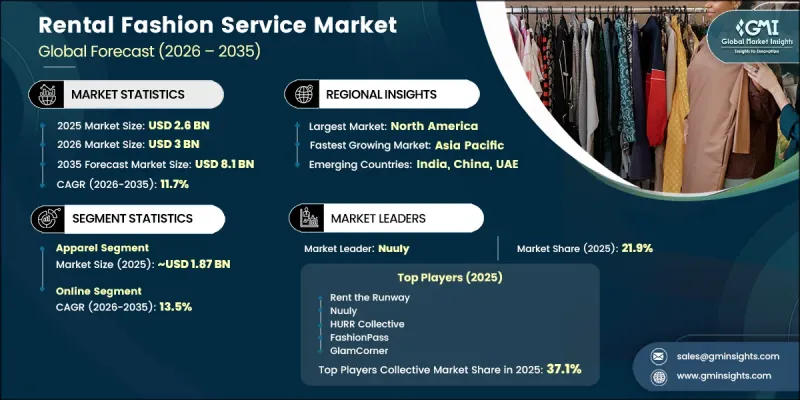
Market growth is driven by rising consumer interest in cost-effective access to premium fashion, increasing awareness of sustainable consumption practices, and the rapid expansion of digital rental platforms across major global regions. The industry is undergoing a notable transformation as consumers shift away from traditional ownership-based purchasing toward access-oriented fashion consumption. This transition enables users to enjoy greater wardrobe variety while reducing overall apparel expenditure and supporting sustainability objectives. Growing concerns regarding textile waste and the environmental impact of the fashion industry are further accelerating demand for rental services that extend garment life cycles and promote resource efficiency. Technological advancements in digital commerce, personalized recommendation engines, subscription management systems, and inventory optimization tools have improved customer experiences and strengthened platform scalability. In addition, advancements in logistics infrastructure and fulfillment networks are enabling rental fashion providers to expand operations more efficiently while reducing the capital requirements associated with geographic growth. These factors continue to support the long-term expansion of the Rental Fashion Service Market.
| Market Scope | |
|---|---|
| Start Year | 2025 |
| Forecast Year | 2026-2035 |
| Start Value | $2.6 Billion |
| Forecast Value | $8.1 Billion |
| CAGR | 11.7% |
The apparel segment accounted for USD 1.87 billion in 2025, representing 72% share. Its dominant position is supported by the wide variety of apparel categories available through rental platforms, serving diverse consumer preferences and usage occasions. The broad applicability of rental apparel across multiple fashion segments continues to drive strong demand, making it the largest revenue-generating category within the market. As consumers increasingly seek flexibility, affordability, and sustainability in fashion choices, the apparel segment is expected to maintain its leadership position throughout the forecast period.
The online segment held 62% share in 2025, driven by widespread adoption of mobile commerce, seamless subscription management capabilities, and advanced digital discovery tools that enhance customer engagement. Digital platforms are increasingly delivering highly personalized shopping experiences, improving customer retention and encouraging recurring subscription activity. The continued evolution of e-commerce technologies and digital user experiences is expected to further strengthen the online segment's market position over the coming years.
North America Rental Fashion Service Market held a 38.05% share, generating USD 985 million. The region benefits from high consumer awareness of sustainable fashion, strong adoption of subscription-based services, and widespread acceptance of digital commerce platforms. Continued innovation in rental business models, growing consumer demand for convenience, and increasing interest in circular economy initiatives are expected to support ongoing market expansion throughout the forecast period.
Major companies operating in the Global Rental Fashion Service Market include HURR Collective, Rent the Runway, FashionPass, Vivrelle, BY ROTATION, GlamCorner, Nuuly, Armoire, Rotaro, Flyrobe, MyWardrobe, Pickle, Wearr, and BNTO. Companies operating in the Rental Fashion Service Market are focusing on digital innovation, subscription model enhancement, and strategic partnerships to strengthen their competitive position. Investments in artificial intelligence, data analytics, and personalized recommendation technologies are helping providers improve customer engagement and optimize inventory utilization. Many companies are expanding product assortments and introducing flexible membership plans to attract a broader consumer base and increase recurring revenue. Strategic collaborations with fashion brands, retailers, and logistics providers are enabling market participants to improve service quality and expand geographic reach. Businesses are also investing in advanced fulfillment capabilities, garment care technologies, and sustainability initiatives to enhance operational efficiency and customer satisfaction.
Table of Contents
Chapter 1 Methodology & Scope
- 1.1 Research approach
- 1.2 Quality Commitments
- 1.2.1 GMI AI policy & data integrity commitment
- 1.2.1.1 Source consistency protocol
- 1.2.1 GMI AI policy & data integrity commitment
- 1.3 Research Trail & Confidence Scoring
- 1.3.1 Research Trail Components
- 1.3.2 Scoring Components
- 1.4 Data Collection
- 1.4.1 Partial list of primary sources
- 1.5 Data mining sources
- 1.5.1 Paid sources
- 1.5.1.1 Sources, by region
- 1.5.1 Paid sources
- 1.6 Base estimates and calculations
- 1.6.1 Base year calculation for any one approach
- 1.7 Forecast model
- 1.7.1 Quantified market impact analysis
- 1.7.1.1 Mathematical impact of growth parameters on forecast
- 1.7.1 Quantified market impact analysis
- 1.8 Research transparency addendum
- 1.8.1 Source attribution framework
- 1.8.2 Quality assurance metrics
- 1.8.2.1 Our commitment to trust
Chapter 2 Executive Summary
- 2.1 Industry 360° synopsis, 2022 - 2035
- 2.2 Key market trends
- 2.2.1 Region
- 2.2.2 Rental Model
- 2.2.3 Product Type
- 2.2.4 End-user
- 2.2.5 Distribution Channel
Chapter 3 Industry Insights
- 3.1 Industry ecosystem analysis
- 3.2 Supply chain analysis
- 3.2.1 inventory acquisition models (owned vs. Consigned vs. Branded partnerships)
- 3.2.2 Reverse logistics & returns management
- 3.2.3 Garment cleaning, inspection & reconditioning networks
- 3.2.4 Packaging & sustainability compliance
- 3.3 Industry impact forces
- 3.3.1 Market drivers
- 3.3.1.1 rising consumer preference for access-over-ownership among millennials & gen z
- 3.3.1.2 Growing sustainability consciousness & circular economy momentum
- 3.3.1.3 Cost-effective access to luxury & designer fashion
- 3.3.1.4 Digital platform proliferation & mobile-first consumer behavior
- 3.3.1.5 Social commerce & influencer-led rental discovery
- 3.3.2 Market restraints
- 3.3.2.1 High operational & logistics costs (cleaning, shipping, warehousing)
- 3.3.2.2 Consumer hygiene perceptions & stigma around pre-worn clothing
- 3.3.2.3 Inventory depreciation, quality degradation & lifecycle challenges
- 3.3.2.4 Environmental paradox of rental logistics (transportation emissions, cleaning chemicals)
- 3.3.3 Market opportunities
- 3.3.3.1 Expansion of luxury & designer segment rental
- 3.3.3.2 Untapped corporate & b2b fashion rental demand (brand activations, media, styling)
- 3.3.3.3 AI-powered personalization as a customer retention lever
- 3.3.3.4 Emerging market expansion Asia Pacific & Middle East
- 3.3.3.5 Integration of rental with retail & brand direct-to-consumer strategies
- 3.3.1 Market drivers
- 3.4 Growth potential analysis
- 3.5 Technology & innovation landscape
- 3.5.1 AI & machine learning in inventory management & personalization
- 3.5.2 RFID & IoT-enabled garment tracking
- 3.5.3 Virtual try-on & augmented reality integration
- 3.5.4 Blockchain for provenance & authenticity verification
- 3.6 Regulatory framework
- 3.6.1 Sharing economy & platform liability regulations by region
- 3.6.2 Consumer protection standards for rental transactions
- 3.6.3 Textile waste & circular economy policies (EU textile strategy, U.S. EPA guidelines)
- 3.6.4 Hygiene & safety standards for rented garments
- 3.7 Major market trends and disruptions
- 3.8 Future market trends
- 3.9 Pricing analysis (driven by primary research)
- 3.9.1 Historical price trend analysis (2019-2024) (driven by primary research)
- 3.9.2 Pricing strategy by player type (premium/value / cost-plus) (driven by primary research)
- 3.9.3 Subscription tier benchmarking across key platforms
- 3.9.4 Price sensitivity by end-user demographic & occasion type
- 3.10 Trade data analysis (driven by primary research)
- 3.10.1 Import/export volume & value trends for fashion goods in rental supply chains (driven by primary research)
- 3.10.2 Key trade corridors & tariff impact on cross-border inventory sourcing (driven by primary research)
- 3.11 Impact of AI & generative AI on the market
- 3.11.1 AI-driven disruption of existing rental business models (demand forecasting, dynamic pricing)
- 3.11.2 GENAI use cases & adoption roadmap by rental segment (virtual styling, chatbot support, content generation)
- 3.11.3 Risks, limitations & regulatory considerations of AI deployment in fashion rental
- 3.12 Investment & funding analysis
- 3.12.1 Venture capital & private equity activity (2019-2024)
- 3.12.2 Notable funding rounds & valuations
- 3.12.3 Mergers, acquisitions & strategic exits
- 3.12.4 Public market performance of key players
- 3.13 Porter's analysis
- 3.14 PESTEL analysis
Chapter 4 Competitive Landscape, 2025
- 4.1 Introduction
- 4.2 Company market share analysis
- 4.2.1 By Region
- 4.2.1.1 North America
- 4.2.1.2 Europe
- 4.2.1.3 Asia Pacific
- 4.2.1.4 Latin America
- 4.2.1.5 Middle East and Africa
- 4.2.1 By Region
- 4.3 Company matrix analysis
- 4.4 Competitive analysis of major market players
- 4.5 Competitive positioning matrix
- 4.6 Key developments
- 4.6.1 Mergers & acquisitions
- 4.6.2 Partnerships & collaborations
- 4.6.3 New product launches
- 4.6.4 Expansion plans
Chapter 5 Market Estimates and Forecast, By Rental Model, 2022 - 2035 (USD Billion)
- 5.1 Key Trends
- 5.2 Subscription-Based Rental
- 5.2.1 Monthly Plans
- 5.2.2 Quarterly Plans
- 5.2.3 Annual Plans
- 5.2.4 Unlimited Swap / Rotating Wardrobe Models
- 5.3 One-Time / Occasion-Based Rental
- 5.3.1 Wedding & Bridal Occasion Rental
- 5.3.2 Formal Event & Gala Rental
- 5.3.3 Corporate Event & Conference Rental
- 5.3.4 Festival & Seasonal Occasion Rental
- 5.4 Peer-To-Peer (P2P) Rental
- 5.4.1 Marketplace Platforms (Individual-To-Individual)
- 5.4.2 Community-Based & Influencer-Led P2P Models
- 5.5 Corporate / B2B Rental
- 5.5.1 Fashion Styling Houses & Media Production
- 5.5.2 Brand Activation & Marketing Event Rental
- 5.5.3 Hospitality & Luxury Hotel Amenity Programs
Chapter 6 Market Estimates and Forecast, By Product Category, 2022 - 2035 (USD Billion)
- 6.1 Key Trends
- 6.2 Apparel
- 6.2.1 Formalwear (Suits, Tuxedos, Evening Gowns)
- 6.2.2 Casualwear (Everyday Rotation, Workwear)
- 6.2.3 Ethnic & Traditional Wear
- 6.2.4 Activewear & Athleisure
- 6.2.5 Outerwear (Coats, Jackets)
- 6.2.6 Maternity Wear
- 6.2.7 Bridal & Wedding Wear
- 6.3 Accessories & Jewelry
- 6.3.1 Designer Handbags & Clutches
- 6.3.2 Fine Jewelry & Statement Pieces
- 6.3.3 Watches & Timepieces
- 6.3.4 Scarves, Belts & Small Accessories
- 6.4 Footwear
- 6.4.1 Designer Heels & Occasion Footwear
- 6.4.2 Boots & Statement Footwear
- 6.4.3 Sneakers & Casual Footwear
Chapter 7 Market Estimates and Forecast, By End User, 2022 - 2035 (USD Billion)
- 7.1 Key trends
- 7.2 Women
- 7.2.1 Occasion & Event Wear (Weddings, Galas, Parties)
- 7.2.2 Workwear & Professional Wardrobe Rotation
- 7.2.3 Luxury & Designer Access
- 7.3 Men
- 7.3.1 Formalwear & Suit Rental
- 7.3.2 Wedding & Event Attire
- 7.3.3 Casualwear Rotation
- 7.4 Children
- 7.4.1 Occasion & Festive Wear
- 7.4.2 School Event & Special Ceremony Attire
Chapter 8 Market Estimates and Forecast, By Distribution Channel, 2022 - 2035 (USD Billion)
- 8.1 Key trends
- 8.2 Online / E-Commerce
- 8.2.1 Brand-Owned Mobile Applications
- 8.2.2 Brand-Owned Websites & Digital Storefronts
- 8.2.3 Third-Party Marketplace Platforms
- 8.3 Offline / In-Store
- 8.3.1 Standalone Physical Rental Boutiques
- 8.3.2 Department Store & Multi-Brand Retail Partnerships
- 8.3.3 Pop-Up Rental Studios & Experience Stores
Chapter 9 Market Estimates & Forecast, By Region, 2022 - 2035, (USD Billion)
- 9.1 Key trends
- 9.2 North America
- 9.2.1 U.S.
- 9.2.2 Canada
- 9.3 Europe
- 9.3.1 Germany
- 9.3.2 U.K.
- 9.3.3 France
- 9.3.4 Italy
- 9.3.5 Spain
- 9.4 Asia Pacific
- 9.4.1 China
- 9.4.2 India
- 9.4.3 Japan
- 9.4.4 South Korea
- 9.4.5 Australia
- 9.5 Latin America
- 9.5.1 Brazil
- 9.5.2 Mexico
- 9.5.3 Argentina
- 9.6 MEA
- 9.6.1 UAE
- 9.6.2 Saudi Arabia
- 9.6.3 South Africa
Chapter 10 Company Profiles
- 10.1 Nuuly
- 10.2 Rent the Runway
- 10.3 BY ROTATION
- 10.4 FashionPass
- 10.5 GlamCorner
- 10.6 HURR Collective
- 10.7 Vivrelle
- 10.8 Flyrobe (Rent It Bae)
- 10.9 MyWardrobe HQ
- 10.10 Armoire
- 10.11 Wearr
- 10.12 Rotaro
- 10.13 BNTO
- 10.14 Pickle
- 10.15 The Volte
- 10.16 Hirestreet
- 10.17 Kleiderei
- 10.18 Front Row
- 10.19 Switch
- 10.20 Stage 3
- 10.21 MsParis
- 10.22 LENA the Fashion Library
- 10.23 ReLi Norge
- 10.24 Lizee

