PUBLISHER: Global Market Insights Inc. | PRODUCT CODE: 2083322

PUBLISHER: Global Market Insights Inc. | PRODUCT CODE: 2083322
Fire Tube Industrial Boiler Market Opportunity, Growth Drivers, Industry Trend Analysis, and Forecast 2026 - 2035
The Global Fire Tube Industrial Boiler Market was valued at USD 3.6 billion in 2025 and is estimated to grow at a CAGR of 5.7% to reach USD 5.9 billion by 2035.
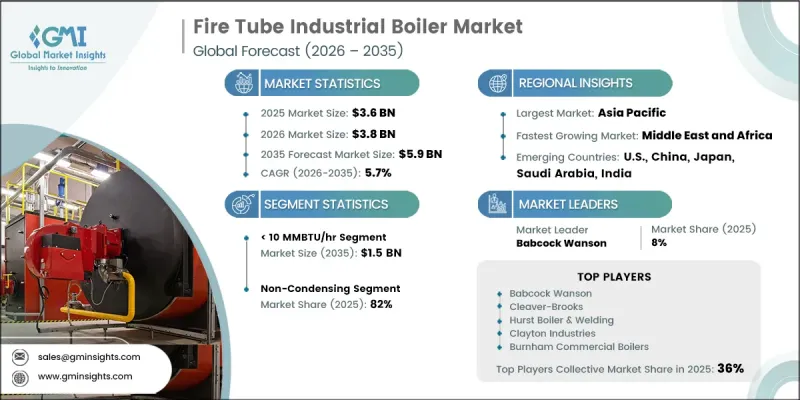
Market expansion is driven by rising activity in food processing industries, growing investments in industrial infrastructure, and supportive initiatives from governments and financial institutions aimed at establishing new manufacturing facilities. In addition, increasing regulatory pressure to reduce greenhouse gas emissions, combined with the replacement of outdated heating systems, is reinforcing demand for modern boiler solutions. Industrial growth across chemicals, manufacturing, and processing sectors is further strengthening adoption, as operators prioritize reliable steam generation and energy-efficient systems. Manufacturers are also investing in R&D to improve efficiency, reduce emissions, and align with sustainability requirements, which is reshaping product innovation across the industry.
| Market Scope | |
|---|---|
| Start Year | 2025 |
| Forecast Year | 2026-2035 |
| Start Value | $3.6 Billion |
| Forecast Value | $5.9 Billion |
| CAGR | 5.7% |
Fire tube boilers function by passing hot combustion gases through tubes that are surrounded by water in a sealed chamber. Heat from the gases transfers through the tube walls into the surrounding water, producing steam or hot water for industrial use. The exhaust gases are then released through a flue system that supports continuous combustion airflow. This design is widely used across industries due to its operational simplicity, durability, and suitability for medium-capacity steam generation. Ongoing industrial expansion, particularly in processing and manufacturing sectors, continues to support steady equipment demand. In parallel, producers are focusing on efficiency upgrades and environmentally compliant designs to meet evolving regulatory expectations.
The fire tube industrial boiler market segment below 10 MMBTU/hr is projected to reach USD 1.5 billion by 2035. Growth in this category is supported by the expansion of small-scale industries, improving economic conditions, and supportive government policies encouraging industrial development. Adoption is further strengthened by the integration of automation and IoT-based control systems, which enable real-time performance monitoring, predictive maintenance, and improved operational efficiency, ultimately reducing overall operating costs and increasing system reliability.
The non-condensing fire tube industrial boilers segment accounted for 82% share in 2025. These systems remain widely preferred due to their straightforward design, lower installation cost, and ease of maintenance compared to condensing alternatives. Continued emphasis on sustainable industrial practices and compliance with environmental standards is further supporting their adoption across multiple end-use sectors, sustaining their strong market position.
U.S. Fire Tube Industrial Boiler Market was valued at USD 470.8 million in 2025. Demand in the country is increasing due to the need for consistent and efficient steam generation across industrial operations, supported by the durability and energy performance of these systems. Regulatory efforts aimed at reducing greenhouse gas emissions are also encouraging the replacement of older heating technologies with more efficient boiler systems. Additionally, ongoing advancements in boiler engineering and rising demand for compact, high-performance equipment are contributing to broader market deployment.
Major players operating in the global fire tube industrial boiler industry include Cleaver-Brooks, Hurst Boiler & Welding, Fulton, Babcock Wanson, Johnston Boiler, Rentech Boilers, Cannon Bono, Superior Boiler, Burnham Commercial Boilers, EPCB Boiler, ICI Caldaie, Industrial Boilers America, MEL Group, Microtech Boilers, Nationwide Boiler Inc., Sellers Manufacturing, Thermodyne Engineering Systems, Clayton Industries, Hoval, and Victory Energy Operations. The companies operating in the fire tube industrial boiler market are focusing on strengthening their market position through continuous product innovation and efficiency improvements in thermal systems. Manufacturers are increasingly investing in R&D to develop low-emission and energy-efficient boiler technologies that comply with evolving environmental regulations. Strategic collaborations, long-term supply contracts, and expansion into emerging industrial markets are also key growth tactics. Firms are enhancing digital capabilities by integrating IoT-enabled monitoring systems and predictive maintenance solutions to improve operational reliability and reduce downtime. Additionally, players are expanding service networks and aftermarket support offerings to increase customer retention.
Table of Contents
Chapter 1 Methodology & Scope
- 1.1 Research approach
- 1.2 Quality commitments
- 1.2.1 GMI AI policy & data integrity commitment
- 1.2.1.1 Source consistency protocol
- 1.2.1 GMI AI policy & data integrity commitment
- 1.3 Research trail & confidence scoring
- 1.3.1 Research trail components
- 1.3.2 Scoring components
- 1.4 Data collection
- 1.4.1 Partial list of primary sources
- 1.5 Data mining sources
- 1.5.1 Paid sources
- 1.5.1.1 Sources, by region
- 1.5.1 Paid sources
- 1.6 Base estimates and calculations
- 1.6.1 Base year calculation for any one approach
- 1.7 Market estimates & forecasts parameters
- 1.8 Forecast model
- 1.8.1 Quantified market impact analysis
- 1.8.1.1 Mathematical impact of growth parameters on forecast
- 1.8.1 Quantified market impact analysis
- 1.9 Research transparency addendum
- 1.9.1 Source attribution framework
- 1.9.2 Quality assurance metrics
- 1.9.3 Our commitment to trust
- 1.10 Market definitions
Chapter 2 Executive Summary
- 2.1 Industry synopsis, 2022 - 2035
- 2.1.1 Business trends
- 2.1.2 Capacity trends
- 2.1.3 Technology trends
- 2.1.4 Fuel trends
- 2.1.5 Application trends
- 2.1.6 Regional trends
Chapter 3 Industry Insights
- 3.1 Industry ecosystem analysis
- 3.1.1 Raw material availability & sourcing analysis
- 3.1.2 Manufacturing capacity assessment
- 3.1.3 Supply chain resilience & risk factors
- 3.1.4 Distribution network analysis
- 3.2 Industry impact forces
- 3.2.1 Growth drivers
- 3.2.2 Industry pitfalls & challenges
- 3.3 Regulatory landscape
- 3.4 Growth potential analysis
- 3.5 Porter's analysis
- 3.5.1 Bargaining power of suppliers
- 3.5.2 Bargaining power of buyers
- 3.5.3 Threat of new entrants
- 3.5.4 Threat of substitutes
- 3.6 PESTEL analysis
- 3.6.1 Political factors
- 3.6.2 Economic factors
- 3.6.3 Social factors
- 3.6.4 Technological factors
- 3.6.5 Legal factors
- 3.6.6 Environmental factors
- 3.7 Cost structure analysis of fire tube industrial boiler
- 3.8 Emerging opportunities & trends
- 3.9 Digitalization & IoT integration
- 3.9.1 Growth in untapped markets & applications
- 3.10 Investment analysis & future prospects
- 3.11 Price trend analysis (USD/MMBTU/hr) (Driven by Primary Research)
- 3.11.1 By region (Driven by Primary Research)
- 3.11.2 By technology (Driven by Primary Research)
- 3.12 Trade data analysis (Driven by Primary Research)
- 3.12.1 Import/export value trends (Driven by Primary Research)
- 3.12.2 Key trade corridors & tariff impact (Driven by Primary Research)
- 3.13 Capacity & production landscape (Driven by Primary Research)
- 3.13.1 Capacity by region & key producer (Driven by Primary Research)
- 3.13.2 Capacity utilization rates & expansion pipelines (Driven by Primary Research)
- 3.14 Impact of AI & Generative AI on the market (Driven by Primary Research)
- 3.14.1 AI-Driven production optimization (Driven by Primary Research)
- 3.14.2 Predictive maintenance & fault detection (Driven by Primary Research)
Chapter 4 Competitive Landscape, 2026
- 4.1 Introduction
- 4.2 Company market share analysis, by region, 2025
- 4.2.1 North America
- 4.2.2 Europe
- 4.2.3 Asia Pacific
- 4.2.4 Middle East & Africa
- 4.2.5 Latin America
- 4.3 Competitive analysis of major market players
- 4.4 Competitive positioning matrix
- 4.5 Key developments
- 4.5.1 Mergers & acquisitions
- 4.5.2 Partnerships & collaborations
- 4.5.3 New product launches
- 4.5.4 Expansion plans & funding
- 4.6 Company tier benchmarking
- 4.6.1 Tier classification criteria & qualifying thresholds
- 4.6.2 Tier positioning matrix by revenue, geography & innovation
Chapter 5 Market Size and Forecast, By Capacity, 2022 - 2035 (USD Million, MMBTU/hr & Units)
- 5.1 Key trends
- 5.2 ≤ 10 MMBTU/hr
- 5.3 > 10 - 25 MMBTU/hr
- 5.4 > 25 - 50 MMBTU/hr
- 5.5 > 50 - 75 MMBTU/hr
- 5.6 > 75 MMBTU/hr
Chapter 6 Market Size and Forecast, By Technology, 2022 - 2035 (USD Million, MMBTU/hr & Units)
- 6.1 Key trends
- 6.2 Condensing
- 6.3 Non-condensing
Chapter 7 Market Size and Forecast, By Fuel, 2022 - 2035 (USD Million, MMBTU/hr & Units)
- 7.1 Key trends
- 7.2 Natural gas
- 7.3 Oil
- 7.4 Coal
- 7.5 Others
Chapter 8 Market Size and Forecast, By Application, 2022 - 2035 (USD Million, MMBTU/hr & Units)
- 8.1 Key trends
- 8.2 Food processing
- 8.3 Pulp & paper
- 8.4 Chemical
- 8.5 Refinery
- 8.6 Primary metal
- 8.7 Other manufacturing
Chapter 9 Market Size and Forecast, By Region, 2022 - 2035 (USD Million, MMBTU/hr & Units)
- 9.1 Key trends
- 9.2 North America
- 9.2.1 U.S.
- 9.2.2 Canada
- 9.2.3 Mexico
- 9.3 Europe
- 9.3.1 France
- 9.3.2 UK
- 9.3.3 Poland
- 9.3.4 Italy
- 9.3.5 Spain
- 9.3.6 Austria
- 9.3.7 Germany
- 9.3.8 Sweden
- 9.3.9 Russia
- 9.4 Asia Pacific
- 9.4.1 China
- 9.4.2 India
- 9.4.3 Philippines
- 9.4.4 Japan
- 9.4.5 South Korea
- 9.4.6 Australia
- 9.4.7 Indonesia
- 9.5 Middle East & Africa
- 9.5.1 Saudi Arabia
- 9.5.2 Iran
- 9.5.3 UAE
- 9.5.4 Nigeria
- 9.5.5 South Africa
- 9.6 Latin America
- 9.6.1 Argentina
- 9.6.2 Chile
- 9.6.3 Brazil
Chapter 10 Company Profiles
- 10.1 Babcock Wanson
- 10.2 Burnham Commercial Boilers
- 10.3 Cannon Bono
- 10.4 Clayton Industries
- 10.5 Cleaver-Brooks
- 10.6 EPCB Boiler
- 10.7 Fulton
- 10.8 Hoval
- 10.9 Hurst Boiler & Welding
- 10.10 ICI Caldaie
- 10.11 Industrial Boilers America
- 10.12 Johnston Boiler
- 10.13 MEL Group
- 10.14 Microtech Boilers
- 10.15 Nationwide Boiler Inc.
- 10.16 Rentech Boilers
- 10.17 Sellers Manufacturing
- 10.18 Superior Boiler
- 10.19 Thermodyne Engineering Systems
- 10.20 Victory Energy Operations

