PUBLISHER: Global Market Insights Inc. | PRODUCT CODE: 2083324

PUBLISHER: Global Market Insights Inc. | PRODUCT CODE: 2083324
Africa Distribution Lines Market Opportunity, Growth Drivers, Industry Trend Analysis, and Forecast 2026 - 2035
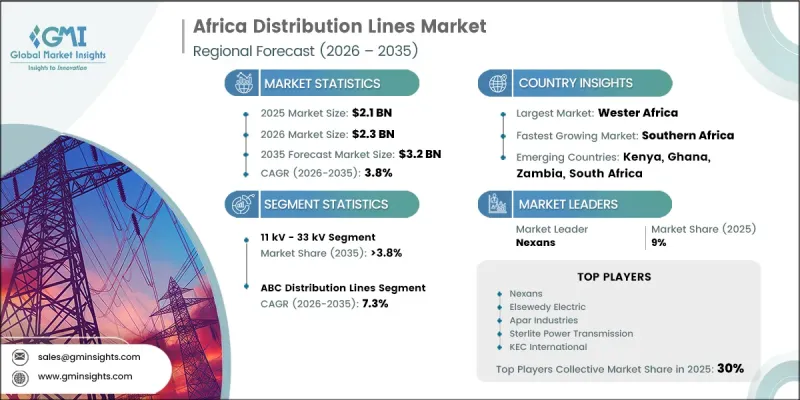
The Global Africa Distribution Lines Market was valued at USD 2.1 billion in 2025 and is estimated to grow at a CAGR of 3.8% to reach USD 3.2 billion by 2035.
This growth is supported by accelerating urbanization, renewable energy integration into national grids, and sustained efforts to improve electricity access in underserved communities. Governments across the region are prioritizing expansion of transmission and distribution infrastructure to reduce outages, enhance reliability, and support rising industrial and residential power consumption. The introduction of smart grid technologies is further improving operational efficiency, enabling real-time monitoring, load balancing, and reduced technical losses. Foreign direct investment, combined with public-sector funding, is also strengthening project pipelines for grid expansion. Across Africa, utilities are increasingly focusing on reducing both technical and commercial losses while improving grid resilience against load fluctuations and climate-related disruptions. Collectively, these factors are reinforcing long-term structural demand for distribution line infrastructure across diverse regional markets, positioning the industry for consistent, policy-supported growth over the forecast horizon.
| Market Scope | |
|---|---|
| Start Year | 2025 |
| Forecast Year | 2026-2035 |
| Start Value | $2.1 Billion |
| Forecast Value | $3.2 Billion |
| CAGR | 3.8% |
The 11 kV-33 kV distribution lines segment is projected to grow at a CAGR of 3.8% through 2035, supported by sustained investments in rural electrification and expanding access to electricity in remote and underserved areas. Utility providers and government agencies are increasingly deploying low- and medium-voltage infrastructure to strengthen last-mile connectivity and improve socio-economic development outcomes. This segment continues to benefit from its critical role in connecting residential, commercial, and small industrial consumers to broader national grids, thereby supporting balanced regional electrification efforts.
The ABC distribution lines segment is expected to grow at a CAGR of 7.3% through 2035, driven by rising demand for safer, more efficient, and lower-loss electricity distribution systems. Utilities across Africa are increasingly shifting toward modern conductor technologies to minimize technical losses, enhance safety in densely populated areas, and improve overall grid reliability. This transition is also supported by ongoing upgrades of aging infrastructure, where traditional open-wire systems are being progressively replaced with more advanced configurations that align with modern distribution standards.
Western Africa Distribution Lines Market is forecast to grow at a CAGR of 3.9% through 2035, supported by expanding electrification initiatives and continued investment in grid infrastructure development. The region is witnessing strong momentum in renewable energy integration, smart grid adoption, and system loss reduction strategies. These developments are improving electricity access and reliability while strengthening long-term distribution network performance across both urban and rural areas.
Major players operating in the Africa Distribution Lines Industry include Prysmian Group, Nexans, Sumitomo Electric Industries, Sterlite Power Transmission Ltd., KEC International, Elsewedy Electric, Apar Industries, Kalpataru Power Distribution Limited, Lamifil, Furukawa Electric Co., NKT A/S, Riyadh Cables, Encore Wire Corporation, Aberdare Cables, African Industries, Bahra Electric, CBI African Cables, East Africa Cables, Metal Fabricators of Zambia, and Midal Cables. Companies in the Africa distribution lines market are focusing on long-term grid modernization contracts, expanding partnerships with utilities and government agencies, and increasing participation in rural electrification programs. Many players are investing in advanced conductor technologies to reduce transmission losses and improve system efficiency. Strategic emphasis is also placed on localization of manufacturing and supply chains to reduce costs and improve delivery timelines. Firms are actively deploying smart grid-compatible solutions that enable real-time monitoring and predictive maintenance. Joint ventures and public-private partnerships are being used to secure large-scale infrastructure projects, while continuous R&D investments are aimed at enhancing conductor durability, thermal performance, and environmental resilience. Companies are also strengthening regional distribution networks to improve service coverage and competitiveness.
Table of Contents
Chapter 1 Methodology & Scope
- 1.1 Research approach
- 1.2 Quality commitments
- 1.2.1 GMI AI policy & data integrity commitment
- 1.2.1.1 Source consistency protocol
- 1.2.1 GMI AI policy & data integrity commitment
- 1.3 Research trail & confidence scoring
- 1.3.1 Research trail components
- 1.3.2 Scoring components
- 1.4 Data collection
- 1.4.1 Partial list of primary sources
- 1.5 Data mining sources
- 1.5.1 Paid sources
- 1.5.1.1 Sources, by region
- 1.5.1 Paid sources
- 1.6 Base estimates and calculations
- 1.6.1 Base year calculation for any one approach
- 1.7 Market estimates & forecasts parameters
- 1.8 Forecast model
- 1.8.1 Quantified market impact analysis
- 1.8.1.1 Mathematical impact of growth parameters on forecast
- 1.8.1 Quantified market impact analysis
- 1.9 Research transparency addendum
- 1.9.1 Source attribution framework
- 1.9.2 Quality assurance metrics
- 1.9.3 Our commitment to trust
- 1.10 Market definitions
Chapter 2 Executive Summary
- 2.1 Industry synopsis, 2022 - 2035
- 2.1.1 Business trends
- 2.1.2 Voltage trends
- 2.1.3 Product trends
- 2.1.4 Regional trends
Chapter 3 Industry Insights
- 3.1 Industry ecosystem analysis
- 3.1.1 Raw material availability & sourcing analysis
- 3.1.2 supply chain resilience & risk factors
- 3.1.3 Distribution Network analysis
- 3.2 Regulatory landscape
- 3.3 Industry impact forces
- 3.3.1 Growth drivers
- 3.3.2 Industry pitfalls & challenges
- 3.4 Growth potential analysis
- 3.5 Porter's Analysis
- 3.5.1 Bargaining power of suppliers
- 3.5.2 Bargaining power of buyers
- 3.5.3 Threat of new entrants
- 3.5.4 Threat of substitutes
- 3.6 PESTEL Analysis
- 3.6.1 Political factors
- 3.6.2 Economic factors
- 3.6.3 Social factors
- 3.6.4 Technological factors
- 3.6.5 Environmental factors
- 3.6.6 Legal factors
- 3.7 Emerging opportunities & trends
- 3.8 Digitalization & IoT integration
- 3.9 Investment analysis & future prospects
- 3.10 Price trend analysis, 2022 - 2035 (Driven by primary research)
- 3.10.1 By voltage (USD/ckm)
- 3.10.2 By region (USD/ckm)
- 3.11 Impact of AI & Generative AI on the market (Driven by primary research)
- 3.11.1 AI-driven production optimization
- 3.11.2 Predictive maintenance & fault detection
- 3.11.3 Risks, limitations & regulatory considerations for AI in distribution line operations
Chapter 4 Competitive Landscape, 2026
- 4.1 Introduction
- 4.2 Company market share analysis, 2025
- 4.2.1 By region
- 4.2.1.1 Western Africa
- 4.2.1.2 Eastern Africa
- 4.2.1.3 Southern Africa
- 4.2.2 Market concentration analysis
- 4.2.1 By region
- 4.3 Competitive analysis of major market players
- 4.4 Competitive positioning matrix
- 4.5 key developments
- 4.5.1 Merger & acquisition
- 4.5.2 Partnership & collaboration
- 4.5.3 New product launched
- 4.5.4 Expansion plans & funding
- 4.6 Company tier benchmarking
- 4.6.1 Tier classification criteria & qualifying thresholds
- 4.6.2 Tier positioning matrix by revenue, geography & innovation
Chapter 5 Market Size and Forecast, By Voltage, 2022 - 2035 (ckm, USD Million)
- 5.1 Key trends
- 5.2 < 11 kV
- 5.3 11-33 kV
- 5.4 > 33 kV - 66 kV
- 5.5 > 66 kV
Chapter 6 Market Size and Forecast, By Product, 2022 - 2035 (ckm, USD Million)
- 6.1 Key trends
- 6.2 Open wire
- 6.3 ABC
Chapter 7 Market Size and Forecast, By Region, 2022 - 2035 (ckm, USD Million)
- 7.1 Key trends
- 7.2 Western Africa
- 7.3 Eastern Africa
- 7.4 Southern Africa
Chapter 8 Company Profiles
- 8.1 Aberdare Cables
- 8.2 African Industries
- 8.3 Apar Industries
- 8.4 Bahra Electric
- 8.5 CBI African Cables
- 8.6 East Africa Cables
- 8.7 Elsewedy Electric
- 8.8 Encore Wire Corporation
- 8.9 Furukawa Electric Co.
- 8.10 Kalpataru Power Distribution Limited
- 8.11 KEC International
- 8.12 Lamifil
- 8.13 Metal Fabricators of Zambia
- 8.14 Midal Cables
- 8.15 Nexans
- 8.16 NKT A/S
- 8.17 Prysmian Group
- 8.18 Riyadh Cables
- 8.19 Sterlite Power Transmission Ltd.
- 8.20 Sumitomo Electric Industries

