PUBLISHER: Global Market Insights Inc. | PRODUCT CODE: 2083328

PUBLISHER: Global Market Insights Inc. | PRODUCT CODE: 2083328
Warm Cap Market Opportunity, Growth Drivers, Industry Trend Analysis, and Forecast 2026 - 2035
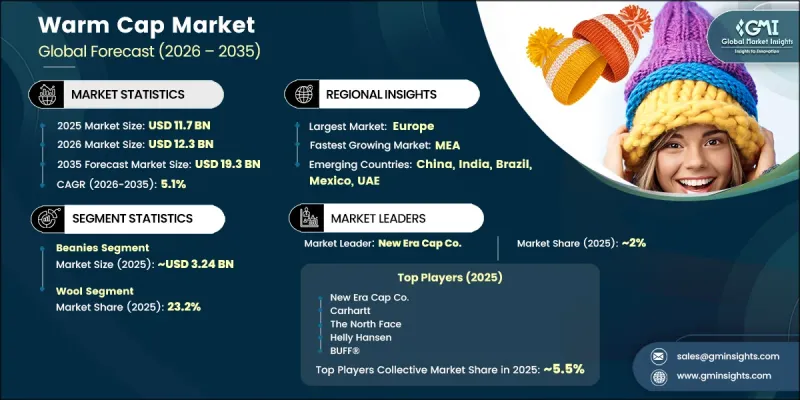
The Global Warm Cap Market was valued at USD 11.7 billion in 2025 and is estimated to grow at a CAGR of 5.1% to reach USD 19.3 billion by 2035.
The warm cap market is evolving steadily as demand increasingly reflects a blend of functional utility, fashion orientation, and seasonal lifestyle consumption. Rising consumer preference for versatile headwear that balances comfort, insulation, and style is reshaping product development strategies across global brands. The market is also benefiting from the expansion of e-commerce platforms, which has significantly improved product accessibility and brand reach across developed and emerging economies. At the same time, growing participation in outdoor recreational activities is widening the consumer base and strengthening demand across diverse demographic groups. Sustainability expectations are also becoming a defining factor, with brands increasingly shifting toward recycled and responsibly sourced materials to align with regulatory expectations and evolving consumer values. This transition is particularly evident in premium retail segments, where environmental compliance and ethical sourcing are becoming essential purchasing considerations. In addition, continuous innovation in fabric technology, design aesthetics, and performance-driven materials is enhancing product differentiation. Together, these factors are contributing to a more competitive and innovation-driven warm cap market landscape globally.
| Market Scope | |
|---|---|
| Start Year | 2025 |
| Forecast Year | 2026-2035 |
| Start Value | $11.7 Billion |
| Forecast Value | $19.3 Billion |
| CAGR | 5.1% |
The beanies segment generated USD 3.24 billion in 2025 and is projected to grow at a CAGR of 5.3% through 2035. This segment maintains a leading position due to its broad usability across casual wear, sports applications, and everyday fashion, making it suitable for year-round consumer demand. Its adaptability across different climates and styling preferences continues to support strong market penetration across global retail channels.
The wool material segment accounted for 23.2% share in 2025 and is expected to grow at a CAGR of 4.8% during 2026-2035. The material landscape is gradually shifting, with traditional natural fibers such as wool and cotton maintaining strong presence in premium and sustainability-focused segments. At the same time, synthetic materials are undergoing structural changes, with recycled variants gaining momentum due to increasing environmental awareness and regulatory pressure on textile sustainability.
North America Warm Cap Market accounted for 23.6% share, generating USD 2.7 billion in 2025. The region's growth is supported by strong consumer spending on seasonal apparel, high participation in outdoor activities, and well-established retail and e-commerce networks. Demand is also influenced by shifting fashion preferences and increasing adoption of performance-oriented winter wear across diverse consumer groups.
Major companies operating in the global warm cap market include The North Face, Nike (Headwear Division), Patagonia, Inc., Columbia Sportswear, Carhartt, Inc., New Era Cap Co., Helly Hansen, Fjallraven, Smartwool, BUFF(R), Outdoor Research, Yupoong Inc. (Flexfit), Kangol, Beechfield Brands, Barts B.V., Atlantis Headwear, CapGlobal (Nantong), Aung Crown, Aungwinter, Seetime Luxury, M.G.D Headwear, Rustek, JoinTop Headwear, Minnesota Knitting Mills, and Turtle Fur. Companies operating in the warm cap market are strengthening their competitive position through continuous product innovation, material diversification, and expansion of sustainable product lines. Market players are increasingly investing in recycled fibers, organic textiles, and eco-certified manufacturing processes to align with tightening environmental standards and shifting consumer expectations. Strong emphasis is being placed on digital retail expansion and direct-to-consumer channels to enhance brand visibility and improve market reach. Companies are also focusing on collaborations with fashion labels and outdoor performance brands to strengthen product differentiation and capture premium segments.
Table of Contents
Chapter 1 Methodology & Scope
- 1.1 Market scope and definition
- 1.2 Research design
- 1.2.1 Research approach
- 1.2.2 Data collection methods
- 1.3 Data mining sources
- 1.3.1 Global
- 1.3.2 Regional/Country
- 1.4 Base estimates and calculations
- 1.4.1 Base year calculation
- 1.4.2 Key trends for market estimation
- 1.5 Primary research and validation
- 1.5.1 Primary sources
- 1.6 Forecast model
- 1.7 Research assumptions and limitations
Chapter 2 Executive Summary
- 2.1 Industry 360° synopsis
- 2.2 Key market trends
- 2.2.1 Region
- 2.2.2 Product Type
- 2.2.3 Material
- 2.2.4 Usage
- 2.2.5 Price Range
- 2.2.6 End-user
- 2.2.7 Distribution channel
Chapter 3 Industry Insights
- 3.1 Industry ecosystem analysis
- 3.1.1 Supplier landscape
- 3.1.2 Profit margin
- 3.1.3 Value addition at each stage
- 3.1.4 Factor affecting the value chain
- 3.2 Industry impact forces
- 3.2.1 Growth drivers
- 3.2.1.1 Growing Participation in Outdoor Recreation, Winter Sports & Cold-Weather Tourism
- 3.2.1.2 Rising Athleisure & Functional Fashion Trends Driving Year-Round Demand
- 3.2.1.3 Increasing Demand for Sustainable & Eco-Friendly Warm Headwear
- 3.2.1.4 Expanding E-Commerce Channels & D2C Brand Proliferation
- 3.2.2 Industry pitfalls & challenges
- 3.2.2.1 High Seasonality of Demand & Inventory Risk for Retailers
- 3.2.2.2 Price Sensitivity in Developing Markets & Competition from Low-Cost Imports
- 3.2.3 Opportunities
- 3.2.3.1 Integration of Smart & Heated Thermal Technologies in Premium Warm Caps
- 3.2.3.2 Untapped Potential in Sustainable Materials (Organic Cotton, Recycled Wool, Bio-based Fibers)
- 3.2.3.3 Customization, Personalization & Limited-Edition Collaboration Strategies
- 3.2.1 Growth drivers
- 3.3 Growth potential analysis
- 3.4 Supply Chain Analysis
- 3.4.1 Key Sourcing Regions (China, Bangladesh, Vietnam, India)
- 3.4.2 Supply Chain Disruption Risks & Mitigation Strategies
- 3.4.3 Raw Material Availability & Cost Dynamics
- 3.5 Future market trends
- 3.6 Technology and innovation landscape
- 3.6.1 Current technological trends
- 3.6.2 Emerging technologies
- 3.7 Regulatory landscape
- 3.7.1 Textile & Apparel Regulatory Standards (REACH, OEKO-TEX, GOTS, ZDHC MRSL)
- 3.7.2 Import/Export Tariff Regulations & Trade Policies
- 3.7.3 Labeling & Consumer Safety Compliance
- 3.8 Trade data analysis (HS Code - 65050090)
- 3.8.1 Import/Export Volume & Value Trends (Driven by Primary Research)
- 3.8.2 Key Trade Corridors & Tariff Impact (Driven by Primary Research)
- 3.9 Impact of AI & generative AI on the market
- 3.9.1 AI-Driven Disruption of Existing Business Models
- 3.9.2 GenAI Use Cases & Adoption Roadmap by Segment
- 3.9.3 Risks, Limitations & Regulatory Considerations
- 3.10 Pricing Analysis
- 3.10.1 Historical Price Trend Analysis (Driven by Primary Research)
- 3.10.2 Pricing Strategy by Player Type (Premium / Value / Cost-plus) (Driven by Primary Research)
- 3.11 Porter's analysis
- 3.12 PESTEL analysis
- 3.13 Consumer Behavior Analysis
Chapter 4 Competitive Landscape, 2025
- 4.1 Introduction
- 4.2 Company market share analysis
- 4.3 Company matrix analysis
- 4.4 Competitive analysis of major market players
- 4.5 Competitive positioning matrix
- 4.6 Key developments
- 4.6.1 Mergers & acquisitions
- 4.6.2 Partnerships & collaborations
- 4.6.3 New product launches
- 4.6.4 Expansion plans
Chapter 5 Market Estimates & Forecast, By Product Type, 2022 - 2035, (USD Billion) (Million Units)
- 5.1 Key Trends
- 5.2 Beanies
- 5.2.1 Standard Cuffed Beanies
- 5.2.2 Pom-Pom Beanies
- 5.2.3 Slouchy/Oversized Beanies
- 5.3 Trapper Hats
- 5.3.1 Faux Fur Trapper Hats
- 5.3.2 Genuine Fur/Shearling Trapper Hats
- 5.4 Knit Caps
- 5.4.1 Cable-Knit Caps
- 5.4.2 Ribbed Knit Caps
- 5.5 Sport Caps
- 5.5.1 Running & Cycling Thermal Caps
- 5.5.2 Skiing & Snow Sport Caps
- 5.6 Fashion Caps
- 5.6.1 Branded/Designer Fashion Caps
- 5.6.2 Embellished & Novelty Caps
- 5.7 Others (Fleece Caps, Balaclavas, Thermal Liners)
Chapter 6 Market Estimates & Forecast, By Material, 2022 - 2035, (USD Billion) (Million Units)
- 6.1 Key Trends
- 6.2 Wool
- 6.2.1 Merino Wool
- 6.2.2 Standard/Virgin Wool
- 6.3 Cotton
- 6.3.1 Organic Cotton
- 6.3.2 Standard Cotton
- 6.4 Acrylic
- 6.5 Polyester
- 6.5.1 Recycled Polyester
- 6.5.2 Standard Polyester
- 6.6 Blended Fabrics
- 6.6.1 Wool-Acrylic Blends
- 6.6.2 Cotton-Polyester Blends
- 6.6.3 Other Blended Compositions
- 6.7 Others (Fleece, Cashmere, Technical Thermal Composites)
Chapter 7 Market Estimates & Forecast, By Usage, 2022 - 2035, (USD Billion) (Million Units)
- 7.1 Key Trends
- 7.2 Sports & Outdoor Activities
- 7.2.1 Skiing & Snowboarding
- 7.2.2 Running & Cycling (Cold-Weather)
- 7.2.3 Hiking & Trekking
- 7.3 Casual/Everyday Wear
- 7.4 Professional/Work Wear
- 7.4.1 Construction & Industrial Workers
- 7.4.2 Agricultural & Farming Workers
- 7.4.3 Military & Defense Personnel
- 7.5 Fashion
- 7.6 Others (Medical/Therapeutic Use)
Chapter 8 Market Estimates & Forecast, By Price Range, 2022 - 2035, (USD Billion) (Million Units)
- 8.1 Key Trends
- 8.2 Economy
- 8.3 Mid-Range
- 8.4 Premium
Chapter 9 Market Estimates & Forecast, By End-user, 2022 - 2035, (USD Billion) (Million Units)
- 9.1 Key Trends
- 9.2 Men
- 9.3 Women
- 9.4 Kids
Chapter 10 Market Estimates & Forecast, By Distribution Channel, 2022 - 2035, (USD Billion) (Million Units)
- 10.1 Key Trends
- 10.2 Online/E-Commerce
- 10.2.1 Brand Owned Websites & D2C Platforms
- 10.2.2 Third-Party Marketplaces (Amazon, Flipkart, JD.com, etc.)
- 10.2.3 Social Commerce (Instagram, TikTok Shop, Pinterest)
- 10.3 Offline Retail
- 10.3.1 Specialty Outdoor & Sports Retail Stores
- 10.3.2 Department Stores & Multi-Brand Apparel Outlets
- 10.3.3 Branded Mono-Brand Stores
- 10.3.4 Hypermarkets, Supermarkets & Mass Merchandisers
- 10.3.5 Others (Pop-up Stores, Airport Retail, Duty-Free)
Chapter 11 Market Estimates & Forecast, By Region, 2022 - 2035, (USD Billion) (Million Units)
- 11.1 Key Trends
- 11.2 North America
- 11.2.1 U.S.
- 11.2.2 Canada
- 11.3 Europe
- 11.3.1 Germany
- 11.3.2 France
- 11.3.3 UK
- 11.3.4 Italy
- 11.3.5 Spain
- 11.4 Asia Pacific
- 11.4.1 China
- 11.4.2 Japan
- 11.4.3 India
- 11.4.4 Australia
- 11.4.5 South Korea
- 11.5 Latin America
- 11.5.1 Brazil
- 11.5.2 Mexico
- 11.5.3 Argentina
- 11.6 MEA
- 11.6.1 Saudi Arabia
- 11.6.2 UAE
- 11.6.3 South Africa
Chapter 12 Company Profiles
- 12.1 Nike (Headwear Division)
- 12.2 The North Face
- 12.3 Columbia Sportswear
- 12.4 Carhartt, Inc.
- 12.5 Patagonia, Inc.
- 12.6 New Era Cap Co.
- 12.7 Barts B.V.
- 12.8 CapGlobal (Nantong)
- 12.9 Aung Crown
- 12.10 Aungwinter
- 12.11 Seetime Luxury
- 12.12 M.G.D Headwear
- 12.13 Rustek
- 12.14 JoinTop Headwear
- 12.15 Minnesota Knitting Mills
- 12.16 Smartwool
- 12.17 Outdoor Research
- 12.18 Helly Hansen
- 12.19 Fjallraven
- 12.20 BUFF®
- 12.21 Turtle Fur
- 12.22 Beechfield Brands
- 12.23 Atlantis Headwear
- 12.24 Yupoong Inc. (Flexfit)
- 12.25 Kangol

