PUBLISHER: Global Market Insights Inc. | PRODUCT CODE: 2083330

PUBLISHER: Global Market Insights Inc. | PRODUCT CODE: 2083330
Massive Open Online Courses (MOOCs) Market Opportunity, Growth Drivers, Industry Trend Analysis, and Forecast 2026 - 2035
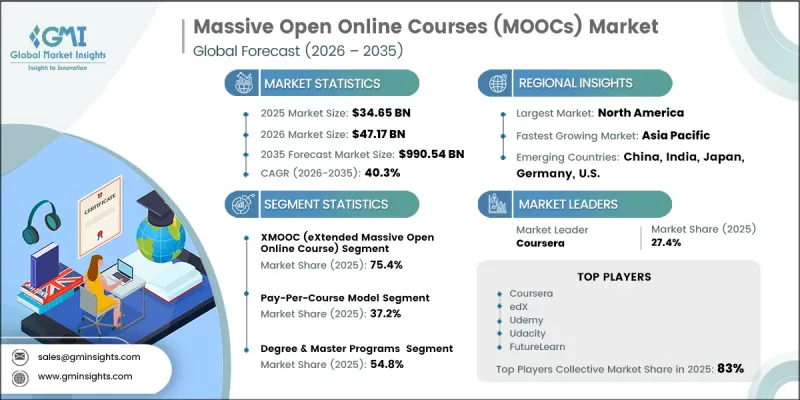
The Global Massive Open Online Courses Market was valued at USD 34.65 billion in 2025 and is estimated to grow at a CAGR of 40.3% to reach USD 990.54 billion by 2035.
The market's rapid growth is driven by the increasing demand for accessible, flexible, and cost-efficient learning solutions across academic, professional, and corporate environments. As digital transformation continues to reshape the education landscape, online learning platforms are becoming an essential tool for skill development, professional certification, workforce training, and higher education. The growing availability of internet connectivity and widespread adoption of digital technologies have significantly improved access to online educational resources worldwide. In addition, learners are increasingly seeking self-directed learning opportunities that allow them to balance education with personal and professional responsibilities. Organizations and educational institutions are also embracing scalable learning models to expand educational reach and improve training efficiency. Technological advancements within digital learning ecosystems, including enhanced user experiences, personalized learning pathways, and interactive course delivery methods, are further supporting market expansion. As the emphasis on lifelong learning and workforce readiness continues to grow, massive open online courses are becoming a critical component of global education and professional development strategies.
| Market Scope | |
|---|---|
| Start Year | 2025 |
| Forecast Year | 2026-2035 |
| Start Value | $34.65 Billion |
| Forecast Value | $990.54 Billion |
| CAGR | 40.3% |
The XMOOC (eXtended Massive Open Online Course) segment held a 75.4% share in 2025. The segment's strong position is supported by widespread adoption among educational institutions, enterprises, and professional learners seeking structured and instructor-guided learning experiences. These courses typically combine organized content delivery, assessments, and instructional support, making them highly suitable for certification programs, academic education, and workforce development initiatives. Growing demand for scalable and flexible digital education solutions continues to strengthen the segment's market leadership and long-term growth potential.
The pay-per-course model segment held a 37.2% share in 2025. The segment's leadership is attributed to the growing preference among learners for flexible payment structures that allow access to specific courses based on individual learning objectives and career advancement goals. This model enables users to acquire targeted knowledge and specialized skills without committing to long-term subscriptions or extensive financial obligations. Increasing demand for affordable, outcome-oriented digital learning solutions continues to support adoption across a broad range of online education platforms.
North America Massive Open Online Courses Market accounted for 32.5% share in 2025. The region maintains a leading position owing to strong demand for online education, professional certification programs, and workforce development initiatives among educational institutions, businesses, and individual learners. Market growth is supported by advanced digital infrastructure, high levels of technology adoption, and widespread acceptance of virtual learning environments. Expanding use of online education across corporate training, higher education, and professional development applications continues to drive demand for sophisticated learning platforms throughout the region.
Key companies operating in the global massive open online courses market include Udemy, Coursera, FutureLearn, OpenClassrooms, edX, Khan Academy, Alison, OpenLearning, Udacity, Canvas Network, France Universite Numerique, Swayam, EduOpen, FutureLearn Ltd., OpenEdu, ThaiMOOC, and Miriadax. Companies operating in the massive open online courses market are implementing a variety of strategic initiatives to strengthen their market presence and enhance competitive positioning. Investments in platform innovation remain a major focus, with providers continuously improving user experience, content delivery, and learning personalization capabilities. Strategic collaborations with educational institutions, industry organizations, and corporate employers are helping companies expand course offerings and improve the relevance of certification programs. Market participants are also focusing on developing industry-specific learning pathways, professional credentials, and workforce training solutions that address evolving labor market requirements. Geographic expansion, multilingual content development, and mobile-first learning experiences are supporting broader audience engagement.
Table of Contents
Chapter 1 Methodology and Scope
- 1.1 Market scope and definition
- 1.2 Research design
- 1.2.1 Research approach
- 1.2.2 Data collection methods
- 1.3 Data mining sources
- 1.3.1 Global
- 1.3.2 Regional/Country
- 1.4 Base estimates and calculations
- 1.4.1 Base year calculation
- 1.4.2 Key trends for market estimation
- 1.5 Primary research and validation
- 1.5.1 Primary sources
- 1.6 Forecast model
- 1.7 Research assumptions and limitations
Chapter 2 Executive Summary
- 2.1 Industry 360° synopsis, 2022 - 2035
- 2.2 Key market trends
- 2.2.1 Course Type trends
- 2.2.2 Course Category trends
- 2.2.3 Business Model trends
- 2.2.4 Subject Area trends
- 2.2.5 Service Provider Type trends
- 2.2.6 Delivery Mode trends
- 2.2.7 Language trends
- 2.2.8 End User trends
- 2.2.9 Regional trends
- 2.3 TAM Analysis, 2026-2035
- 2.4 CXO perspectives: Strategic imperatives
Chapter 3 Industry Insights
- 3.1 Industry ecosystem analysis
- 3.1.1 Supplier Landscape
- 3.1.2 Profit Margin
- 3.1.3 Cost structure
- 3.1.4 Value addition at each stage
- 3.1.5 Factor affecting the value chain
- 3.1.6 Disruptions
- 3.2 Industry impact forces
- 3.2.1 Growth drivers
- 3.2.1.1 Increasing demand for flexible and affordable online education
- 3.2.1.2 Growing emphasis on professional upskilling and reskilling
- 3.2.1.3 Rapid digitalization and rising internet penetration
- 3.2.1.4 Technological advancements in AI-driven learning platforms
- 3.2.1.5 Growing partnerships between universities and enterprises with MOOCs providers
- 3.2.2 Industry pitfalls and challenges
- 3.2.2.1 Low course completion and learner engagement rates
- 3.2.2.2 Limited recognition of online certifications in certain industries
- 3.2.3 Market opportunities
- 3.2.3.1 Rising online training
- 3.2.3.2 Expansion of MOOCs platforms in emerging economies
- 3.2.1 Growth drivers
- 3.3 Growth potential analysis
- 3.4 Regulatory landscape
- 3.4.1 North America
- 3.4.2 Europe
- 3.4.3 Asia Pacific
- 3.4.4 Latin America
- 3.4.5 Middle East & Africa
- 3.5 Porter's analysis
- 3.6 PESTEL analysis
- 3.7 Technology and Innovation landscape
- 3.7.1 Current technological trends
- 3.7.2 Emerging technologies
- 3.8 Patent and IP analysis
- 3.9 Pricing Analysis (Driven by Primary Research)
- 3.9.1 Historical Price Analysis (2022-2025)
- 3.9.2 Pricing Strategy by Player Type (Premium / Value / Cost-plus)
- 3.10 Trade Data Analysis (HS Code) (Based on Paid Database)
- 3.10.1 Import/Export Volume & Value Trends
- 3.10.2 Key Trade Corridors & Tariff Impact
- 3.11 Impact of AI & Generative AI on the Market (Driven by Primary Research)
- 3.11.1 AI-Driven Disruption of Existing Business Models
- 3.11.2 GenAI Use Cases & Adoption Roadmap by Segment
- 3.11.3 Risks, Limitations & Regulatory Considerations
- 3.12 Capacity & Production Landscape (Driven by Primary Research)
- 3.12.1 Installed Capacity by Region & Key Producer
- 3.12.2 Capacity Utilization Rates & Expansion Pipelines
Chapter 4 Competitive Landscape, 2025
- 4.1 Company market share analysis, 2025
- 4.1.1 By Region
- 4.1.1.1 North America
- 4.1.1.2 Europe
- 4.1.1.3 Asia-Pacific
- 4.1.1.4 Latin America
- 4.1.1.5 Middle East and Africa
- 4.1.2 Market Concentration Analysis
- 4.1.1 By Region
- 4.2 Competitive analysis of major market players
- 4.3 Competitive positioning matrix
- 4.4 Key developments
- 4.4.1 Mergers & acquisitions
- 4.4.2 Partnerships & collaborations
- 4.4.3 New product launches
- 4.4.4 Expansion plans and funding
- 4.5 Company tier benchmarking
- 4.5.1 Tier classification criteria & qualifying thresholds
- 4.6 Tier positioning matrix by revenue, geography & innovation
Chapter 5 Market Estimates and Forecast, By Course Type, 2022 - 2035 (USD Billion)
- 5.1 Key trends
- 5.2 XMOOC (eXtended Massive Open Online Course)
- 5.3 CMOOC (Connectivist Massive Open Online Course)
Chapter 6 Market Estimates and Forecast, By Course Category, 2022 - 2035 (USD Billion)
- 6.1 Key trends
- 6.2 Certificate & Professional Courses
- 6.3 Degree & Master Programs
Chapter 7 Market Estimates and Forecast, By Business Model, 2022 - 2035 (USD Billion)
- 7.1 Key trends
- 7.2 Freemium Model
- 7.3 Subscription-Based Model
- 7.4 Pay-Per-Course Model
- 7.5 Government/Non-Profit Funded
Chapter 8 Market Estimates and Forecast, By Subject Area, 2022 - 2035 (USD Billion)
- 8.1 Key trends
- 8.2 Business management
- 8.3 Computer science and programming
- 8.4 Science
- 8.5 Humanities
- 8.6 Health and medicine
- 8.7 Education and teaching
- 8.8 Engineering
- 8.9 Arts and design
- 8.10 Mathematics
- 8.11 Others
Chapter 9 Market Estimates and Forecast, By Service Provider Type, 2022 - 2035 (USD Billion)
- 9.1 Key trends
- 9.2 University-Affiliated Platforms
- 9.3 Private EdTech Companies
- 9.4 Nonprofit & Government-Supported Platforms
Chapter 10 Market Estimates and Forecast, By Delivery Mode, 2022 - 2035 (USD Billion)
- 10.1 Key trends
- 10.2 Self-paced
- 10.3 Instructor-led
Chapter 11 Market Estimates and Forecast, By Language, 2022 - 2035 (USD Billion)
- 11.1 Key trends
- 11.2 English
- 11.3 Spanish
- 11.4 Mandarin
- 11.5 Others
Chapter 12 Market Estimates and Forecast, By End User, 2022 - 2035 (USD Billion)
- 12.1 Key trends
- 12.2 Individual
- 12.2.1 High school students
- 12.2.2 Undergraduate students
- 12.2.3 Graduate students
- 12.2.4 Lifelong learners
- 12.3 Enterprise/Corporate
- 12.3.1 SMEs
- 12.3.2 Large Scale Enterprises
- 12.4 Educational Institutes
- 12.5 Others
Chapter 13 Market Estimates and Forecast, By Region, 2022 - 2035 (USD Billion)
- 13.1 Key trends
- 13.2 North America
- 13.2.1 U.S.
- 13.2.2 Canada
- 13.3 Europe
- 13.3.1 Germany
- 13.3.2 UK
- 13.3.3 France
- 13.3.4 Spain
- 13.3.5 Italy
- 13.4 Asia Pacific
- 13.4.1 China
- 13.4.2 India
- 13.4.3 Japan
- 13.4.4 Australia
- 13.4.5 South Korea
- 13.5 Latin America
- 13.5.1 Brazil
- 13.5.2 Mexico
- 13.5.3 Argentina
- 13.6 Middle East and Africa
- 13.6.1 South Africa
- 13.6.2 Saudi Arabia
- 13.6.3 UAE
Chapter 14 Company Profiles
- 14.1 Global Key Players
- 14.1.1 Coursera
- 14.1.2 edX
- 14.1.3 Udemy
- 14.1.4 Udacity
- 14.1.5 FutureLearn
- 14.2 Regional key players
- 14.2.1 North America
- 14.2.1.1 Canvas Network
- 14.2.1.2 Khan Academy
- 14.2.2 Asia Pacific
- 14.2.2.1 Swayam
- 14.2.2.2 OpenLearning
- 14.2.2.3 ThaiMOOC
- 14.2.2.4 Europe
- 14.2.2.5 France Universite Numerique
- 14.2.2.6 Miriadax
- 14.2.1 North America
- 14.3 Niche Players/Disruptors
- 14.3.1 Photonics Industries International, Inc.
- 14.3.2 Laser Quantum Ltd
- 14.3.3 Alison
- 14.3.4 EduOpen
- 14.3.5 OpenClassrooms
- 14.3.6 OpenEdu

