PUBLISHER: Global Market Insights Inc. | PRODUCT CODE: 2083340

PUBLISHER: Global Market Insights Inc. | PRODUCT CODE: 2083340
Wellness Services Market Opportunity, Growth Drivers, Industry Trend Analysis, and Forecast 2026 - 2035
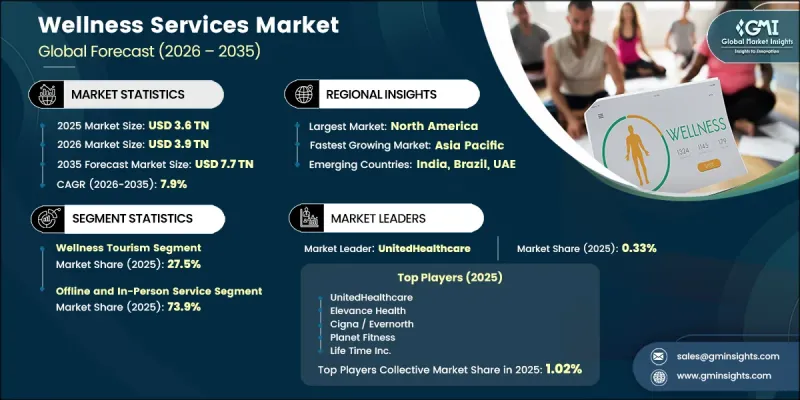
The Global Wellness Services Market was valued at USD 3.6 trillion in 2025 and is estimated to grow at a CAGR of 7.9% to reach USD 7.7 trillion by 2035.
Market growth is supported by the increasing emphasis on preventive healthcare, mental wellness, and lifestyle-oriented health management across both developed and emerging economies. The industry is experiencing a significant transformation as digital health solutions, employer-sponsored wellness initiatives, and growing consumer spending on health-focused experiences collectively create a broader and more diversified demand landscape. Wellness services now extend far beyond traditional fitness centers and spa offerings, encompassing areas such as nutritional counseling, mental wellness programs, wellness-oriented residential developments, and longevity-focused healthcare services. Rising prevalence of preventable chronic health conditions has intensified the focus on proactive health management, while evolving consumer perceptions have positioned wellness expenditures as long-term investments rather than discretionary spending. This structural shift is expected to contribute between 1.5% and 2% to the market's overall growth rate throughout the forecast period. In addition, organizations across major economies are increasing investments in employee wellness programs as workforce health continues to demonstrate measurable benefits in productivity, engagement, and employee retention. These factors are expected to sustain long-term expansion across the global wellness services landscape.
| Market Scope | |
|---|---|
| Start Year | 2025 |
| Forecast Year | 2026-2035 |
| Start Value | $3.6 Trillion |
| Forecast Value | $7.7 Trillion |
| CAGR | 7.9% |
The wellness services accounted for 27.5% share and is projected to grow at a CAGR of 7.5% through 2035. Strong demand for health-focused travel experiences among affluent consumers, combined with the continued development of wellness-oriented travel infrastructure across multiple regions, is supporting segment growth. The increasing preference for immersive wellness experiences that combine relaxation, preventive care, and lifestyle enhancement continues to drive spending within this category.
The offline and in-person service delivery segment held 73.9% share in 2025. The leadership of this segment is largely attributed to the experience-driven nature of key wellness offerings, including fitness programs, wellness retreats, traditional therapeutic services, and spa treatments. Consumers are increasingly integrating wellness activities into their daily routines through virtual platforms, resulting in a gradual shift toward more flexible service delivery formats. Despite this transition, physical wellness facilities continue to remain highly relevant by emphasizing premium experiences, personalized services, and comprehensive wellness environments.
North America Wellness Services Market accounted for 33.2% share in 2025 and is expected to register a CAGR of 7.6% through 2035, maintaining its position as the largest regional market. The United States continues to lead regional demand, supported by a highly developed corporate wellness ecosystem and strong consumer spending on health and well-being services. Employer-sponsored wellness initiatives, growing awareness of preventive healthcare, and widespread adoption of integrated wellness programs continue to support market expansion across the region. Increasing investments in physical, mental, and lifestyle wellness solutions are expected to further strengthen North America's leadership position throughout the forecast period.
Key companies operating in the global wellness services market include Wellhub, Equinox Group, Elevance Health, TELUS Health, Banyan Group, UnitedHealthcare, Planet Fitness, Lyra Health, Cigna/Evernorth, ComPsych, Noom Inc., Chiva-Som International, Life Time Inc., Restore Hyper Wellness, Amway Corp., Spring Health, Vitality Group (Discovery), Canyon Ranch, Six Senses, Clinique La Prairie, and Anytime Fitness. Companies operating in the wellness services market are focusing on a combination of expansion, innovation, and customer engagement strategies to strengthen their market position. Leading providers are investing heavily in digital wellness platforms, virtual care services, and personalized health solutions powered by data analytics and artificial intelligence. Strategic partnerships with employers, healthcare organizations, insurers, and technology providers are helping companies broaden their customer reach and enhance service offerings.
Table of Contents
Chapter 1 Methodology & Scope
- 1.1 Research approach
- 1.2 Quality Commitments
- 1.2.1 GMI AI policy & data integrity commitment
- 1.2.1.1 Source consistency protocol
- 1.2.1 GMI AI policy & data integrity commitment
- 1.3 Research Trail & Confidence Scoring
- 1.3.1 Research Trail Components
- 1.3.2 Scoring Components
- 1.4 Data Collection
- 1.4.1 Partial list of primary sources
- 1.5 Data mining sources
- 1.5.1 Paid sources
- 1.5.1.1 Sources, by region
- 1.5.1 Paid sources
- 1.6 Base estimates and calculations
- 1.6.1 Base year calculation for any one approach
- 1.7 Forecast model
- 1.7.1 Quantified market impact analysis
- 1.7.1.1 Mathematical impact of growth parameters on forecast
- 1.7.1 Quantified market impact analysis
- 1.8 Research transparency addendum
- 1.8.1 Source attribution framework
- 1.8.2 Quality assurance metrics
- 1.8.3 Our commitment to trust
Chapter 2 Executive Summary
- 2.1 Industry 360° synopsis, 2022 - 2035
- 2.2 Key market trends
- 2.2.1 Region
- 2.2.2 Service Type
- 2.2.3 Pricing Model
- 2.2.4 End Users
- 2.2.5 Delivery Channels
Chapter 3 Industry Insights
- 3.1 Industry ecosystem analysis
- 3.1.1 Supplier landscape
- 3.1.2 Profit margin
- 3.1.3 Value addition at each stage
- 3.1.4 Factor affecting the value chain
- 3.2 Industry impact forces
- 3.2.1 Growth drivers
- 3.2.1.1 Rising consumer health consciousness & shift toward preventive healthcare
- 3.2.1.2 Growing corporate wellness expenditure driven by employee productivity
- 3.2.1.3 Digital platform proliferation enabling scalable wellness service delivery
- 3.2.1.4 Aging global population increasing demand for longevity & restorative wellness
- 3.2.2 Industry pitfalls & challenges
- 3.2.2.1 High cost of premium wellness services limiting mass-market penetration
- 3.2.2.2 Absence of standardized regulatory frameworks across geographies
- 3.2.3 Opportunities
- 3.2.3.1 Personalized wellness powered by genomics, wearables & AI
- 3.2.3.2 Untapped demand in emerging markets
- 3.2.1 Growth drivers
- 3.3 Growth potential analysis
- 3.4 Regulatory framework
- 3.4.1 Standards & compliance requirements
- 3.4.2 Regional regulatory frameworks
- 3.4.3 Certification standards
- 3.5 Major market trends and disruptions
- 3.6 Technology/innovation landscape
- 3.6.1 Current trends
- 3.6.2 Emerging trends
- 3.7 Pricing Analysis (driven by primary research)
- 3.7.1 Historical price trend analysis (driven by primary research)
- 3.7.2 Pricing strategy by player type (premium / value / cost- plus) (driven by primary research)
- 3.8 Future market trends
- 3.9 Impact of AI & Generative AI on the Market
- 3.9.1 AI- driven disruption of existing business models
- 3.9.2 Gen-AI use cases & adoption roadmap by segment
- 3.9.3 Risks, limitations & regulatory considerations
- 3.10 Porter’s analysis
- 3.11 PESTEL analysis
- 3.12 Service delivery capacity & provider infrastructure (driven by primary research)
- 3.12.1 Provider network density & coverage by region (driven by primary research)
- 3.12.2 Capacity gaps & addressable demand mismatch (driven by primary research)
- 3.12.3 Infrastructure investment requirements for market entry
Chapter 4 Competitive Landscape, 2025
- 4.1 Introduction
- 4.2 Company market share analysis
- 4.2.1 By Region
- 4.2.1.1 North America
- 4.2.1.2 Europe
- 4.2.1.3 Asia Pacific
- 4.2.1.4 Middle East and Africa
- 4.2.1.5 Latin America
- 4.2.1 By Region
- 4.3 Company matrix analysis
- 4.4 Competitive analysis of major market players
- 4.5 Competitive positioning matrix
- 4.6 Key developments
- 4.6.1 Mergers & acquisitions
- 4.6.2 Partnerships & collaborations
- 4.6.3 New product launches
- 4.6.4 Expansion plans
Chapter 5 Market Estimates & Forecast, By Type, 2022-2035 (USD Trillion)
- 5.1 Key trends
- 5.2 Personal care & beauty
- 5.3 Nutrition & weight management
- 5.4 Physical activity & fitness
- 5.5 Wellness tourism
- 5.6 Preventive & personalized health
- 5.7 Traditional & complementary medicine
- 5.8 Wellness real estate
- 5.9 Mental wellness
- 5.10 Spa services
- 5.11 Springs & thermal therapy
- 5.12 Workplace wellness
Chapter 6 Market Estimates & Forecast, By Pricing Model, 2022-2035 (USD Trillion)
- 6.1 Key trends
- 6.2 Premium services
- 6.3 Affordable/budget services
- 6.4 Subscription-based services
- 6.5 Pay-per-use services
Chapter 7 Market Estimates & Forecast, By End-User, 2022-2035 (USD Trillion)
- 7.1 Key Trends
- 7.2 Individual Consumers
- 7.3 Corporate Clients
- 7.4 Medical & Healthcare Institutions
- 7.5 Hospitality & Wellness Resort Operators
- 7.6 Others
Chapter 8 Market Estimates & Forecast, By Delivery Channel, 2022-2035 (USD Trillion)
- 8.1 Key trends
- 8.2 Online / digital services
- 8.2.1 Wellness mobile applications
- 8.2.2 Virtual consultations & therapy sessions
- 8.2.3 AI-powered wellness coaching platforms
- 8.2.4 E-commerce platforms for wellness services & programs
- 8.3 Offline / in-person services
- 8.3.1 Brick-and-mortar wellness centers & spas
- 8.3.2 On-site corporate wellness programs
- 8.3.3 Traditional clinics for complementary medicine
- 8.3.4 Wellness-integrated hospitality venues
- 8.4 Hybrid delivery models
Chapter 9 Market Estimates & Forecast, By Region, 2022-2035 (USD Trillion)
- 9.1 Key trends
- 9.2 North America
- 9.2.1 U.S.
- 9.2.2 Canada
- 9.3 Europe
- 9.3.1 UK
- 9.3.2 Germany
- 9.3.3 France
- 9.3.4 Italy
- 9.3.5 Spain
- 9.4 Asia Pacific
- 9.4.1 China
- 9.4.2 India
- 9.4.3 Japan
- 9.4.4 South Korea
- 9.4.5 Australia
- 9.5 Latin America
- 9.5.1 Brazil
- 9.5.2 Mexico
- 9.5.3 Argentina
- 9.6 MEA
- 9.6.1 South Africa
- 9.6.2 Saudi Arabia
- 9.6.3 UAE
Chapter 10 Company Profiles
- 10.1 Global Companies
- 10.1.1 Amway Corp.
- 10.1.1.1 Business Overview
- 10.1.1.2 Financial Data
- 10.1.1.3 Product Landscape
- 10.1.1.4 Strategic Outlook
- 10.1.1.5 SWOT Analysis
- 10.1.2 Anytime Fitness
- 10.1.3 Banyan Group
- 10.1.4 ComPsych
- 10.1.5 Planet Fitness
- 10.1.6 Six Senses
- 10.1.7 TELUS Health
- 10.1.8 UnitedHealthcare
- 10.1.1 Amway Corp.
- 10.2 Regional Companies
- 10.2.1 Canyon Ranch
- 10.2.2 Chiva-Som International
- 10.2.3 Cigna / Evernorth
- 10.2.4 Elevance Health
- 10.2.5 Life Time Inc.
- 10.2.6 Vitality Group (Discovery)
- 10.3 Emerging Companies
- 10.3.1 Clinique La Prairie
- 10.3.2 Equinox Group
- 10.3.3 Lyra Health
- 10.3.4 Noom Inc.
- 10.3.5 Restore Hyper Wellness
- 10.3.6 Spring Health
- 10.3.7 Wellhub

