PUBLISHER: Global Market Insights Inc. | PRODUCT CODE: 2083356

PUBLISHER: Global Market Insights Inc. | PRODUCT CODE: 2083356
Enterprise Mobility Management Market Opportunity, Growth Drivers, Industry Trend Analysis, and Forecast 2026 - 2035
The Global Enterprise Mobility Management Market was valued at USD 15.7 billion in 2025 and is estimated to grow at a CAGR of 24.5% to reach USD 129.4 billion by 2035.
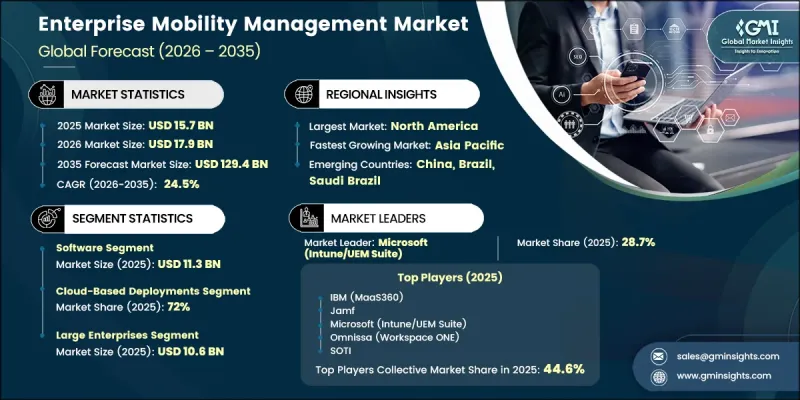
Expansion is driven by the normalization of hybrid and remote work environments, widespread adoption of cloud-native enterprise ecosystems, and increasing demand for unified policy enforcement across diverse device environments including employee-owned, corporate-issued, and industrial endpoints. A key structural transformation is the evolution of enterprise mobility management into a core security layer, where identity governance, endpoint compliance, application access control, and audit-ready security reporting are increasingly integrated into a single framework. The expansion of bring-your-own-device environments is also enlarging the managed endpoint ecosystem, requiring organizations to enforce governance policies without direct hardware ownership. At the same time, global privacy and data protection regulations are turning endpoint compliance into a mandatory operational requirement, compelling enterprises to maintain enforceable device-level controls that align with cross-border data governance obligations.
| Market Scope | |
|---|---|
| Start Year | 2025 |
| Forecast Year | 2026-2035 |
| Start Value | $15.7 Billion |
| Forecast Value | $129.4 Billion |
| CAGR | 24.5% |
The software segment generated USD 11.3 billion in 2025, accounting for 72.3% share, and is expected to reach USD 85.3 billion by 2035 at a CAGR of 23.4%. Demand is concentrated in unified endpoint management, mobile device management, mobile application management, endpoint analytics, mobile threat defense, compliance tracking, and policy enforcement platforms. Leading platforms such as Microsoft Intune and Omnissa Workspace ONE are defining enterprise-grade capability through centralized device management across multiple operating systems, combined with security integration and digital experience monitoring that enables IT teams to assess performance, compliance, and user experience within a unified interface.
The cloud-based deployment models segment reached USD 11.3 billion, representing 72% share in 2025, and is projected to grow to USD 99.3 billion by 2035. Cloud adoption continues to expand due to lower infrastructure overhead, simplified system maintenance, faster feature deployment cycles, and stronger integration with identity and access management ecosystems. Modern cloud EMM platforms operate through continuous update models rather than traditional upgrade cycles, improving scalability and responsiveness. Integration with identity protocols and enterprise authentication systems further enhances interoperability, while subscription-based pricing models support adoption across small and medium-sized enterprises that prefer operational expenditure over capital investment.
North America Enterprise Mobility Management Market accounted for USD 5.9 billion in 2025, representing 38% share, and is expected to reach USD 44.9 billion by 2035 at a CAGR of 23.4%. Regional growth is supported by large-scale enterprise mobility deployments, federal digital modernization programs, and extensive adoption across regulated industries requiring strict endpoint governance. Strong enterprise IT ecosystems and advanced security frameworks continue to reinforce regional leadership in mobility management adoption.
Major players operating in the global enterprise mobility management industry include Microsoft, Cisco Systems, IBM, BlackBerry, Ivanti Software, Citrix, Jamf, SOTI, and Omnissa (formerly VMware Workspace ONE). Companies in the enterprise mobility management market are strengthening their competitive position by integrating advanced security capabilities directly into endpoint management platforms, ensuring mobility tools function as part of broader enterprise cybersecurity architectures. Vendors are prioritizing cloud-native architectures that enable continuous updates, scalability, and seamless integration with identity and access management systems. Strategic emphasis is being placed on unified endpoint management platforms that consolidate device, application, and compliance controls into a single interface. Partnerships with cloud providers and identity platform vendors are enhancing interoperability and ecosystem stickiness. Firms are also investing in AI-driven analytics for threat detection, user behavior monitoring, and automated compliance reporting.
Table of Contents
Chapter 1 Methodology
- 1.1 Research approach
- 1.2 Quality Commitments
- 1.2.1 GMI AI policy & data integrity commitment
- 1.2.1.1 Source consistency protocol
- 1.2.1 GMI AI policy & data integrity commitment
- 1.3 Research Trail & Confidence Scoring
- 1.3.1 Research Trail Components
- 1.3.2 Scoring Components
- 1.4 Data Collection
- 1.4.1 Partial list of primary sources
- 1.5 Data mining sources
- 1.5.1 Paid sources
- 1.5.1.1 Sources, by region
- 1.5.1 Paid sources
- 1.6 Base estimates and calculations
- 1.6.1 Base year calculation
- 1.7 Forecast model
- 1.7.1 Quantified market impact analysis
- 1.7.1.1 Mathematical impact of growth parameters on forecast
- 1.7.1 Quantified market impact analysis
- 1.8 Research transparency addendum
- 1.8.1 Source attribution framework
- 1.8.2 Quality assurance metrics
- 1.8.3 Our commitment to trust
Chapter 2 Executive Summary
- 2.1 Industry 360° synopsis
- 2.2 Key market trends
- 2.2.1 Regional
- 2.2.2 Component
- 2.2.3 Deployment Mode
- 2.2.4 Enterprise Size
- 2.2.5 Ownership Model
- 2.2.6 End use
- 2.3 TAM analysis, 2026-2035
- 2.4 CXO perspectives: Strategic imperatives
Chapter 3 Industry Insights
- 3.1 Industry ecosystem analysis
- 3.1.1 Supplier landscape
- 3.1.2 Profit margin
- 3.1.3 Cost structure
- 3.1.4 Value addition at each stage
- 3.1.5 Factor affecting the value chain
- 3.1.6 Disruptions
- 3.2 Industry impact forces
- 3.2.1 Growth drivers
- 3.2.1.1 BYOD workforce expansion surge
- 3.2.1.2 Rising mobile cyber threats
- 3.2.1.3 Strict data privacy regulations
- 3.2.1.4 Rapid cloud migration adoption
- 3.2.2 Industry pitfalls and challenges
- 3.2.2.1 High implementation costs burden
- 3.2.2.2 Legacy integration complexity issues
- 3.2.3 Market opportunities
- 3.2.3.1 AI-driven security automation
- 3.2.3.2 Zero Trust adoption growth
- 3.2.3.3 SME cloud EMM expansion
- 3.2.3.4 EMM-UEM convergence acceleration
- 3.2.1 Growth drivers
- 3.3 Growth potential analysis
- 3.4 Technology and innovation landscape
- 3.4.1 Current technological trends
- 3.4.2 Emerging technologies
- 3.5 Regulatory landscape
- 3.5.1 North America
- 3.5.1.1 National Institute of Standards and Technology (NIST - United States)
- 3.5.1.2 Cybersecurity and Infrastructure Security Agency (CISA - United States)
- 3.5.2 Europe
- 3.5.2.1 European Union Agency for Cybersecurity (ENISA)
- 3.5.2.2 European Commission (GDPR and NIS2 framework)
- 3.5.3 Asia Pacific
- 3.5.3.1 Ministry of Electronics and Information Technology (MeitY - India)
- 3.5.3.2 Cyber Security Agency of Singapore (CSA - Singapore)
- 3.5.4 Latin America
- 3.5.4.1 National Data Protection Authority (ANPD - Brazil)
- 3.5.4.2 National Institute for Transparency, Access to Information and Personal Data Protection (INAI - Mexico)
- 3.5.5 Middle East & Africa
- 3.5.5.1 National Cybersecurity Authority (NCA - Saudi Arabia)
- 3.5.5.2 UAE Cyber Security Council
- 3.5.1 North America
- 3.6 Porter's analysis
- 3.7 PESTEL analysis
- 3.8 Patent analysis (Driven by Primary Research)
- 3.9 Cost breakdown analysis
- 3.10 Sustainability and environmental aspects
- 3.10.1 Sustainable practices
- 3.10.2 Waste reduction strategies
- 3.10.3 Energy efficiency in production
- 3.10.4 Eco-friendly initiatives
- 3.10.5 Carbon footprint considerations
- 3.11 Impact of AI & Generative AI on the Market
- 3.11.1 AI-driven disruption of existing business models
- 3.11.2 Gen AI use cases & adoption roadmap by segment
- 3.11.3 Risks, limitations & regulatory considerations
- 3.12 Forecast assumptions & scenario analysis (Driven by primary research)
- 3.12.1 Base Case key macro & industry variables driving CAGR
- 3.12.2 Optimistic Scenarios Favorable macro and industry tailwinds
- 3.12.3 Pessimistic Scenario Macroeconomic slowdown or industry headwinds
Chapter 4 Competitive Landscape, 2025
- 4.1 Introduction
- 4.2 Company market share analysis
- 4.2.1 North America
- 4.2.2 Europe
- 4.2.3 Asia Pacific
- 4.2.4 LATAM
- 4.2.5 MEA
- 4.3 Competitive analysis of major market players
- 4.4 Competitive positioning matrix
- 4.5 Key developments
- 4.5.1 Mergers & acquisitions
- 4.5.2 Partnerships & collaborations
- 4.5.3 New product launches
- 4.5.4 Expansion plans and funding
- 4.6 Company tier benchmarking
- 4.6.1 Tier classification criteria & qualifying thresholds
- 4.6.2 Tier positioning matrix by revenue, geography & innovation
Chapter 5 Market Estimates & Forecast, By Component, 2022 - 2035 ($Bn, Transactional Value)
- 5.1 Key trends
- 5.2 Software
- 5.2.1 Mobile device management (MDM)
- 5.2.2 Mobile application management (MAM)
- 5.2.3 Mobile content management (MCM)
- 5.2.4 Mobile identity & access management
- 5.2.5 Mobile expense management
- 5.3 Services
- 5.3.1 Professional services
- 5.3.1.1 Consulting
- 5.3.1.2 Deployment & integration
- 5.3.1.3 Support & maintenance
- 5.3.2 Managed services
- 5.3.1 Professional services
Chapter 6 Market Estimates & Forecast, By Deployment Mode, 2022 - 2035 ($Bn, Transactional Value)
- 6.1 Key trends
- 6.2 Cloud-based
- 6.3 On-premises
- 6.4 Hybrid
Chapter 7 Market Estimates & Forecast, By Enterprise Size, 2022 - 2035 ($Bn, Transactional Value)
- 7.1 Key trends
- 7.2 Large enterprises
- 7.3 Small & medium-sized enterprises (SMEs)
Chapter 8 Market Estimates & Forecast, By Ownership Model, 2022 - 2035 ($Bn, Transactional Value)
- 8.1 Key trends
- 8.2 Bring your own device (BYOD)
- 8.3 Corporate-owned, business-only (COBO)
- 8.4 Corporate-owned, personally enabled (COPE)
- 8.5 Choose your own device (CYOD)
Chapter 9 Market Estimates & Forecast, By End Use, 2022 - 2035 ($Bn, Transactional Value)
- 9.1 Key trends
- 9.2 BFSI
- 9.3 Healthcare & Life Sciences
- 9.4 IT & Telecom
- 9.5 Retail & E-Commerce
- 9.6 Manufacturing
- 9.7 Transportation & Logistics
- 9.8 Energy & Utilities
- 9.9 Education
- 9.10 Media & Entertainment
- 9.11 Government & Defense
- 9.12 Others
Chapter 10 Market Estimates & Forecast, By Region, 2022 - 2035 ($Bn, Transactional Value)
- 10.1 Key trends
- 10.2 North America
- 10.2.1 U.S.
- 10.2.2 Canada
- 10.3 Europe
- 10.3.1 Germany
- 10.3.2 UK
- 10.3.3 France
- 10.3.4 Italy
- 10.3.5 Spain
- 10.3.6 Sweden
- 10.3.7 Switzerland
- 10.3.8 Netherlands
- 10.4 Asia Pacific
- 10.4.1 China
- 10.4.2 India
- 10.4.3 Japan
- 10.4.4 South Korea
- 10.4.5 Australia
- 10.4.6 Singapore
- 10.4.7 Malaysia
- 10.4.8 Indonesia
- 10.4.9 Thailand
- 10.5 Latin America
- 10.5.1 Brazil
- 10.5.2 Mexico
- 10.5.3 Argentina
- 10.6 MEA
- 10.6.1 South Africa
- 10.6.2 Saudi Arabia
- 10.6.3 UAE
Chapter 11 Company Profiles
- 11.1 Global players
- 11.1.1 BlackBerry
- 11.1.2 Cisco Systems
- 11.1.3 Citrix
- 11.1.4 IBM
- 11.1.5 Ivanti Software
- 11.1.6 Jamf
- 11.1.7 Microsoft
- 11.1.8 Omnissa (formerly VMware Workspace ONE)
- 11.1.9 SOTI
- 11.2 Regional players
- 11.2.1 42Gears Mobility Systems
- 11.2.2 Alma
- 11.2.3 AppTec
- 11.2.4 Baramundi Software
- 11.2.5 Check Point Software Technologies
- 11.2.6 HCLSoftware (HCL Technologies)
- 11.2.7 ManageEngine (Zoho)
- 11.2.8 Matrix42 AG
- 11.2.9 Sophos
- 11.2.10 Tamara
- 11.3 Emerging players
- 11.3.1 Hexnode UEM (Mitsogo)
- 11.3.2 Iru (formerly Kandji)
- 11.3.3 Scalefusion (ProMobi Technologies)

