PUBLISHER: Mordor Intelligence | PRODUCT CODE: 2122164

PUBLISHER: Mordor Intelligence | PRODUCT CODE: 2122164
Enterprise Mobility Security - Market Share Analysis, Industry Trends & Statistics, Growth Forecasts (2026 - 2031)
According to Mordor Intelligence, enterprise mobility security market size in 2026 is estimated at USD 5.14 billion, growing from 2025 value of USD 4.59 billion with 2031 projections showing USD 9.02 billion, growing at 11.94% CAGR over 2026-2031.
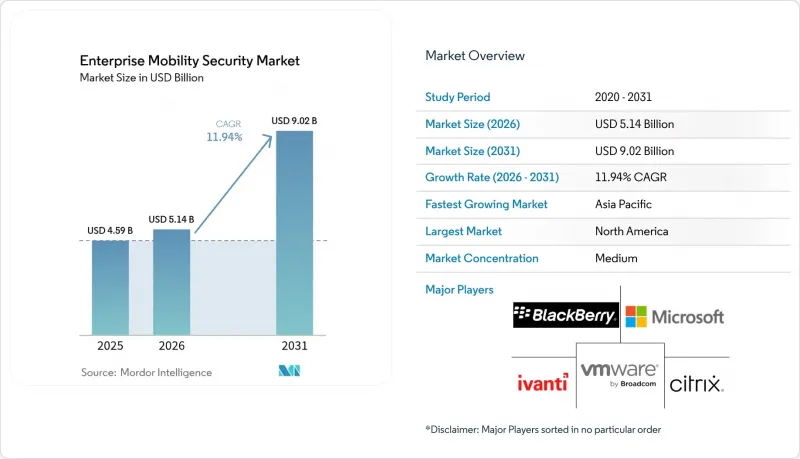
This report is Segmented by Device (Smartphones, Laptops, and More), Deployment Model (On-Premises, Cloud, and Hybrid), Security Type (Mobile Device Management, Mobile Threat Defense, and More), Organization Size (Small and Medium Enterprises, and Large Enterprises), End-User (BFSI, Healthcare, and More), and Geography. The Market Forecasts are Provided in Terms of Value (USD).
Global Enterprise Mobility Security Market Trends and Insights
BYOD and Remote-Work Proliferation
Permanent hybrid-work policies transform employee-owned smartphones into core corporate assets, yet fewer than 40% of organizations containerize personal and business data. Okta observed that 63% of authentication attempts to enterprise applications in January 2025 came from unmanaged mobile devices, up from 48% in 2023. Professional-services employees frequently toggle between consumer messaging and customer-relationship-management apps on the same handset, maximizing phishing exposure. Palo Alto Networks logged a 74% year-over-year rise in mobile phishing targeting remote staff during 1H 2024. Regulatory frameworks such as GDPR and HIPAA impose breach liability but offer scant prescriptive guidance for securing BYOD environments, compelling enterprises to stitch together vendor-specific controls.
Escalating Mobile Cyber-Threat Landscape
Ransomware, banking trojans, and vishing attacks now aim at specific verticals. Lookout identified 3.7 million distinct malware samples in 2024, a 58% increase over the prior year, and found that 22% of enterprise devices encountered at least one high-severity threat. Zimperium reported an 86% rise in voice-phishing events in the banking sector, frequently paired with SIM-swapping to intercept one-time passwords. Apple disclosed 14 exploited iOS zero-days in 2024, while Google patched 11 root-level Android flaws, demonstrating platform-agnostic risk. Generative-AI techniques make malicious messages context-aware, lifting click-through rates and compressing defenders' reaction windows.
Integration Complexity with Legacy IT Stacks
Organizations running on-premises Active Directory alongside cloud identity providers face multi-year migration paths. Cisco recorded that 54% of large enterprises see authentication failures when federating legacy directories with cloud-based unified endpoint management, necessitating latency-heavy middleware. VMware found 41% of Secure Access Service Edge pilots stall over hard-coded VPN dependencies. Mainframe-centric BFSI firms lack APIs for instant mobile policy updates, pushing synchronization lags to 24 hours and leaving exposure windows open.
Other drivers and restraints analyzed in the detailed report include:
- Cloud-First Adoption Among SMEs
- Tightening Compliance Mandates
- Budget Constraints for Mid-Sized Enterprises
For complete list of drivers and restraints, kindly check the Table Of Contents.
Segment Analysis
Wearables contributed a modest slice in 2025 but are forecast to expand at 14.54% annually through 2031, outpacing smartphones, laptops, and tablets. Samsung Knox for Wearables, launched April 2024, lets administrators encrypt and remotely wipe smartwatches used to access electronic health records, tackling HIPAA compliance needs. Honeywell's rugged scanners integrate with VMware Workspace ONE to enforce role-based access, curbing unauthorized shop-floor actions. Smartphones retained 47.65% of device revenue in 2025 owing to BYOD ubiquity, yet their growth curve is flattening as saturation nears in developed markets.
The shift to wearables enlarges the threat surface. Lookout found 14 exploitable flaws in popular fitness-tracker firmware during 2024. Draft U.S. FDA guidance on wearable medical-device cybersecurity will not fully apply until 2027, leaving a multi-year gap wherein innovation outruns regulation. Vendors are rushing firmware-over-the-air update mechanisms to close that gap.
Hybrid architectures are tracking a 13.98% CAGR as enterprises partition workloads between sovereign on-premises enclaves and scalable public clouds. The UAE's Data Protection Law bars cross-border citizen-data transfers without consent, forcing local unified endpoint management servers while still tapping global threat-intelligence feeds. Cloud deployments commanded 60.92% in 2025, buoyed by subscription-based Intune, Workspace ONE Cloud, and Ivanti Neurons. Edge computing is surfacing as a third pillar, enabling factories to enforce policies on rugged tablets with <80 ms latency using Cisco edge-native modules.
On-premises footprints will decline as talent pools shrink, yet they endure in air-gapped defense networks and mainframe-reliant financial institutions. Vendors now pitch migration toolkits that replicate legacy policies in cloud consoles to ease the transition.
Complete Report Scope:
- By Device
- Smartphones
- Laptops
- Tablets
- Wearables
- By Deployment Model
- On-Premises
- Cloud
- Hybrid
- By Security Type
- Mobile Device Management (MDM)
- Mobile Application Management (MAM)
- Mobile Threat Defense (MTD)
- Unified Endpoint Management (UEM)
- Identity and Access Management for Mobility
- By Organization Size
- Small and Medium Enterprises
- Large Enterprises
- By End-User
- Banking and Insurance
- Healthcare
- IT and Telecom
- Government
- Retail and eCommerce
- Manufacturing
- Other End-User
- By Geography
- North America
- United States
- Canada
- Mexico
- South America
- Brazil
- Argentina
- Rest of South America
- Europe
- United Kingdom
- Germany
- France
- Spain
- Italy
- Rest of Europe
- Asia Pacific
- China
- India
- Japan
- Australia
- South Korea
- Rest of Asia-Pacific
- Middle East and Africa
- Middle East
- Saudi Arabia
- United Arab Emirates
- Turkey
- Rest of Middle East
- Africa
- South Africa
- Kenya
- Rest of Africa
- Middle East
- North America
Geography Analysis
North America generated 37.70% of 2025 revenue, driven by strict HIPAA enforcement that prompted healthcare providers to adopt unified endpoint management. A U.S. federal directive required Mobile Threat Defense on all government devices by December 2024, unlocking a procurement wave for Lookout, Zimperium, and CrowdStrike. Canada's PIPEDA amendment extended breach-notification rules to mobile endpoints, while Mexico's fintech boom is spurring demand for banking-trojan detection. Growth is steadier than spectacular because the Enterprise Mobility Security market has reached deep deployment levels across Fortune 1000 firms.
The Asia Pacific is projected to have a 15.45% CAGR through 2031, as digital-banking initiatives in India and Indonesia bring millions of unbanked citizens online. Reserve Bank of India guidelines mandate device binding and multi-factor authentication for mobile transactions, driving unified endpoint rollouts at state-owned lenders. China's data-localization laws favor domestic vendors, such as Huawei, while Japan's extraterritorial privacy statutes oblige foreign SaaS providers to secure the data of Japanese citizens on mobile devices. Australia's Notifiable Data Breaches scheme reported that 19% of 2024 incidents involved mobile endpoints, reinforcing purchasing urgency.
Europe tightened oversight via the Network and Information Security Directive 2 in October 2024, obliging telecom operators and clouds to ingest real-time mobile telemetry. GDPR fine volume reached EUR 1.2 billion in 2024, 18% tied to inadequate mobile safeguards. Germany's BSI now requires Evaluation Assurance Level 4-certified unified endpoint management in critical infrastructure sectors. The United Kingdom's NCSC is steering agencies toward Zero-Trust mobile architectures that enforce continuous posture checks. Middle-East jurisdictions impose sovereign-cloud laws that necessitate local servers, while Saudi Arabia's Essential Cybersecurity Controls demand MTD across government devices by end-2025. South America's opportunity concentrates in Brazil and Argentina, though budget pressures cap widespread rollouts.
- BlackBerry Limited
- Ivanti Inc. (MobileIron)
- VMware Inc.
- Citrix Systems Inc.
- Microsoft Corporation
- Cisco Systems Inc.
- McAfee LLC
- Broadcom Inc. (Symantec Enterprise)
- SAP SE
- Oracle Corporation
- Honeywell International Inc.
- International Business Machines Corporation
- Check Point Software Technologies Ltd.
- Trend Micro Incorporated
- Sophos Group plc
- Dell Technologies Inc.
- Samsung Electronics Co. Ltd.
- Google LLC
- Lookout Inc.
- Zimperium Inc.
Additional Benefits:
- The market estimate (ME) sheet in Excel format
- 3 months of analyst support
TABLE OF CONTENTS
1 INTRODUCTION
- 1.1 Study Assumptions
- 1.2 Scope of the Study
2 RESEARCH METHODOLOGY
3 EXECUTIVE SUMMARY
4 MARKET LANDSCAPE
- 4.1 Market Overview
- 4.2 Market Drivers
- 4.2.1 BYOD and remote-work proliferation
- 4.2.2 Escalating mobile cyber-threat landscape
- 4.2.3 Cloud-first adoption among SMEs
- 4.2.4 Tightening compliance mandates (GDPR, HIPAA, PCI-DSS)
- 4.2.5 Zero-Trust architecture integration for mobile endpoints
- 4.2.6 Secure mobile DevOps pipeline demand in regulated verticals
- 4.3 Market Restraints
- 4.3.1 Integration complexity with legacy IT stacks
- 4.3.2 Budget constraints for mid-sized enterprises
- 4.3.3 Talent shortage of mobile-security specialists
- 4.3.4 Fragmented global regulatory requirements
- 4.4 Industry Value Chain Analysis
- 4.5 Regulatory Landscape
- 4.6 Technological Outlook
- 4.7 Impact of Macroeconomic Factors
- 4.8 Porter's Five Forces Analysis
- 4.8.1 Threat of New Entrants
- 4.8.2 Bargaining Power of Buyers
- 4.8.3 Bargaining Power of Suppliers
- 4.8.4 Threat of Substitute Products
- 4.8.5 Intensity of Competitive Rivalry
5 MARKET SIZE AND GROWTH FORECASTS (VALUE)
- 5.1 By Device
- 5.1.1 Smartphones
- 5.1.2 Laptops
- 5.1.3 Tablets
- 5.1.4 Wearables
- 5.2 By Deployment Model
- 5.2.1 On-Premises
- 5.2.2 Cloud
- 5.2.3 Hybrid
- 5.3 By Security Type
- 5.3.1 Mobile Device Management (MDM)
- 5.3.2 Mobile Application Management (MAM)
- 5.3.3 Mobile Threat Defense (MTD)
- 5.3.4 Unified Endpoint Management (UEM)
- 5.3.5 Identity and Access Management for Mobility
- 5.4 By Organization Size
- 5.4.1 Small and Medium Enterprises
- 5.4.2 Large Enterprises
- 5.5 By End-User
- 5.5.1 Banking and Insurance
- 5.5.2 Healthcare
- 5.5.3 IT and Telecom
- 5.5.4 Government
- 5.5.5 Retail and eCommerce
- 5.5.6 Manufacturing
- 5.5.7 Other End-User
- 5.6 By Geography
- 5.6.1 North America
- 5.6.1.1 United States
- 5.6.1.2 Canada
- 5.6.1.3 Mexico
- 5.6.2 South America
- 5.6.2.1 Brazil
- 5.6.2.2 Argentina
- 5.6.2.3 Rest of South America
- 5.6.3 Europe
- 5.6.3.1 United Kingdom
- 5.6.3.2 Germany
- 5.6.3.3 France
- 5.6.3.4 Spain
- 5.6.3.5 Italy
- 5.6.3.6 Rest of Europe
- 5.6.4 Asia Pacific
- 5.6.4.1 China
- 5.6.4.2 India
- 5.6.4.3 Japan
- 5.6.4.4 Australia
- 5.6.4.5 South Korea
- 5.6.4.6 Rest of Asia-Pacific
- 5.6.5 Middle East and Africa
- 5.6.5.1 Middle East
- 5.6.5.1.1 Saudi Arabia
- 5.6.5.1.2 United Arab Emirates
- 5.6.5.1.3 Turkey
- 5.6.5.1.4 Rest of Middle East
- 5.6.5.2 Africa
- 5.6.5.2.1 South Africa
- 5.6.5.2.2 Kenya
- 5.6.5.2.3 Rest of Africa
- 5.6.5.1 Middle East
- 5.6.1 North America
6 COMPETITIVE LANDSCAPE
- 6.1 Market Concentration
- 6.2 Strategic Moves
- 6.3 Market Share Analysis
- 6.4 Company Profiles (includes Global level Overview, Market level overview, Core Segments, Financials as available, Strategic Information, Market Rank/Share for key companies, Products and Services, and Recent Developments)
- 6.4.1 BlackBerry Limited
- 6.4.2 Ivanti Inc. (MobileIron)
- 6.4.3 VMware Inc.
- 6.4.4 Citrix Systems Inc.
- 6.4.5 Microsoft Corporation
- 6.4.6 Cisco Systems Inc.
- 6.4.7 McAfee LLC
- 6.4.8 Broadcom Inc. (Symantec Enterprise)
- 6.4.9 SAP SE
- 6.4.10 Oracle Corporation
- 6.4.11 Honeywell International Inc.
- 6.4.12 International Business Machines Corporation
- 6.4.13 Check Point Software Technologies Ltd.
- 6.4.14 Trend Micro Incorporated
- 6.4.15 Sophos Group plc
- 6.4.16 Dell Technologies Inc.
- 6.4.17 Samsung Electronics Co. Ltd.
- 6.4.18 Google LLC
- 6.4.19 Lookout Inc.
- 6.4.20 Zimperium Inc.
7 MARKET OPPORTUNITIES AND FUTURE OUTLOOK
- 7.1 White-space and Unmet-Need Assessment

