
PUBLISHER: Global Market Insights Inc. | PRODUCT CODE: 2083377

PUBLISHER: Global Market Insights Inc. | PRODUCT CODE: 2083377
French Door Market Opportunity, Growth Drivers, Industry Trend Analysis, and Forecast 2026 - 2035
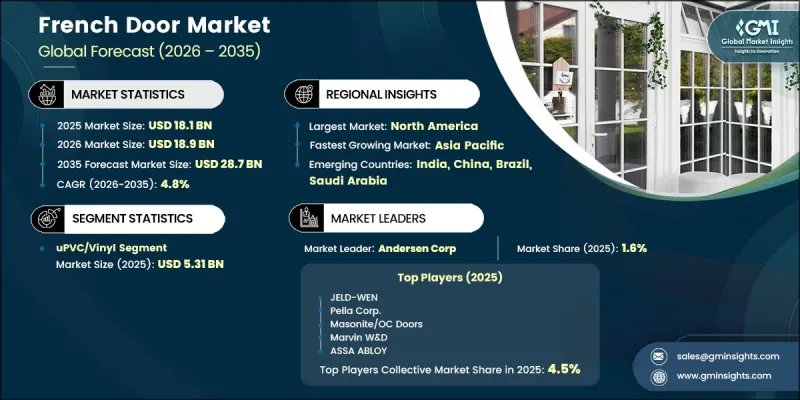
The Global French Door Market was valued at USD 18.1 billion in 2025 and is estimated to grow at a CAGR of 4.8% to reach USD 28.7 billion by 2035.
Growth in the French Door Market is shaped by rising residential renovation spending, stronger demand for visually connected living spaces, and increasingly strict building energy efficiency regulations across major global construction markets. Consumers are steadily prioritizing architectural solutions that combine design aesthetics with thermal insulation performance, supporting wider adoption of advanced fenestration systems. Materials such as thermally optimized aluminum, reinforced uPVC, and engineered fiberglass with wood-style finishes are gaining traction due to their balance of durability, insulation capability, and design flexibility. A key structural driver is the growing preference for seamless indoor-outdoor living concepts, where residential layouts are designed to remove visual and physical barriers between interior and exterior spaces. This shift is particularly strong in renovation-driven demand cycles, where homeowners invest in upgrading existing properties to improve comfort, energy efficiency, and lifestyle functionality. The market is also supported by consistent demand from premium and mid-tier housing segments, where aesthetic appeal and energy-efficient performance are increasingly viewed as standard requirements rather than optional features. Overall, the French Door Market continues to benefit from evolving architectural preferences and long-term improvements in residential construction quality standards.
| Market Scope | |
|---|---|
| Start Year | 2025 |
| Forecast Year | 2026-2035 |
| Start Value | $18.1 Billion |
| Forecast Value | $28.7 Billion |
| CAGR | 4.8% |
The uPVC/Vinyl segment held a 30% share, accounting for USD 5.31 billion in 2025. Its leadership position is attributed to strong thermal insulation performance, cost efficiency, and low maintenance requirements over long product lifecycles. This material category remains widely adopted in residential applications due to its ability to deliver consistent energy efficiency while maintaining affordability. Demand is further supported by its extensive use in replacement and renovation projects, where performance reliability and ease of installation are key decision factors.
The offline distribution channel continues to dominate the french door market, driven by strong consumer preference for in-person product evaluation prior to purchase. Buyers typically rely on physical assessment of design quality, material finish, customization options, and structural durability before making final decisions. In addition, advisory support, measurement services, and installation coordination offered through traditional retail networks play a critical role in driving conversions. Established distribution networks, including specialty outlets and building material supply channels, continue to serve as the primary sales pathway across most regional markets.
North America French Door Market generated USD 5.5 billion, accounting for 30.47% share in 2025. The region's mature construction landscape results in demand being primarily driven by renovation and replacement activities rather than new residential builds. This steady upgrade cycle supports consistent product adoption, particularly in energy-efficient and design-oriented home improvement projects. While growth remains moderate compared to emerging regions, the market continues to benefit from strong consumer spending on housing upgrades and sustained interest in architectural modernization.
Key companies operating in the Global French door market include Marvin Windows & Doors, Andersen Corporation, Pella Corporation, JELD-WEN, Inc., Masonite International Corporation (now OC Doors, an Owens Corning division), LIXIL Corporation, ASSA ABLOY AB, Hormann Group, Therma-Tru Doors, Milgard Windows & Doors, Internorm, Allegion plc, ProVia, APRO Door, and Vallisco. Companies in the French Door Market are actively focusing on product innovation, energy-efficient designs, and material advancements to strengthen their competitive positioning. Manufacturers are enhancing product portfolios with improved insulation technologies, durable composite materials, and customizable design options to meet evolving consumer preferences. Expansion of distribution networks and stronger partnerships with builders, contractors, and retail channels are supporting broader market penetration. Firms are also investing in manufacturing automation, digital product visualization tools, and advanced supply chain optimization to improve operational efficiency.
Table of Contents
Chapter 1 Methodology & Scope
- 1.1 Research approach
- 1.2 Quality Commitments
- 1.2.1 GMI AI policy & data integrity commitment
- 1.2.1.1 Source consistency protocol
- 1.2.1 GMI AI policy & data integrity commitment
- 1.3 Research Trail & Confidence Scoring
- 1.3.1 Research Trail Components
- 1.3.2 Scoring Components
- 1.4 Data Collection
- 1.4.1 Partial list of primary sources
- 1.5 Data mining sources
- 1.5.1 Paid sources
- 1.5.1.1 Sources, by region
- 1.5.1 Paid sources
- 1.6 Base estimates and calculations
- 1.6.1 Base year calculation for any one approach
- 1.7 Forecast model
- 1.7.1 Quantified market impact analysis
- 1.7.1.1 Mathematical impact of growth parameters on forecast
- 1.7.1 Quantified market impact analysis
- 1.8 Research transparency addendum
- 1.8.1 Source attribution framework
- 1.8.2 Quality assurance metrics
- 1.8.2.1 Our commitment to trust
Chapter 2 Executive Summary
- 2.1 Industry 360° synopsis, 2022 - 2035
- 2.2 Key market trends
- 2.2.1 Region
- 2.2.2 Material
- 2.2.3 Door configuration and type
- 2.2.4 Application
- 2.2.5 End-user
- 2.2.6 Distribution channel
Chapter 3 Industry Insights
- 3.1 Industry ecosystem analysis
- 3.2 Supply chain analysis
- 3.2.1 key raw material sourcing landscape
- 3.2.2 Supply chain risks & disruption assessment
- 3.2.3 Nearshoring & supplier diversification trends
- 3.3 Industry impact forces
- 3.3.1 Market drivers
- 3.3.1.1 Rising residential renovation & home improvement spending
- 3.3.1.2 Growing consumer preference for indoor-outdoor living & natural light integration
- 3.3.1.3 Tightening energy efficiency mandates & green building code requirements
- 3.3.1.4 Growth in luxury residential construction & premium architectural design
- 3.3.2 Market restraints
- 3.3.2.1 Raw material price volatility (aluminum, glass, hardwood, upvc)
- 3.3.2.2 High installation & customization costs limiting adoption in price-sensitive segments
- 3.3.3 Market opportunities
- 3.3.3.1 Smart home integration motorized operation, integrated sensors & smart locking
- 3.3.3.2 Rapid urbanization & new construction activity in asia pacific & middle east
- 3.3.3.3 Expansion of luxury hospitality sector driving premium commercial demand
- 3.3.3.4 e-commerce channel growth enabling direct-to-consumer standard-spec sales
- 3.3.1 Market drivers
- 3.4 Growth potential analysis
- 3.5 Technology & innovation landscape
- 3.5.1 Precision seeding technologies (GPS, variable rate technology, RTK)
- 3.5.2 IoT & sensor integration in modern seed drills
- 3.5.3 Pneumatic & hydraulic advances in broadcast seeder design
- 3.5.4 No-till & direct seeding technology evolution
- 3.5.5 Electric & hybrid propulsion emerging platforms
- 3.5.6 Drone / UAV-mounted aerial seeding systems
- 3.6 Regulatory framework
- 3.6.1 Energy Efficiency Standards & Building Codes (IECC, EU Energy Performance of Buildings Directive)
- 3.6.2 Fire Safety & Security Certifications (UL, CE Marking, BS 476)
- 3.6.3 Environmental & Sustainability Regulations (REACH, RoHS, Green Building Standards)
- 3.6.3.1 Trade Tariffs & Import/Export Regulations
- 3.7 Major market trends and disruptions
- 3.8 Future market trends
- 3.9 Pricing analysis (driven by primary research)
- 3.9.1 Historical Price Trend Analysis (Driven by Primary Research)
- 3.9.2 Pricing Strategy by Player Type (Premium / Value / Cost-plus) (Driven by Primary Research)
- 3.9.3 Price Benchmarking by Material Type (Wood vs. Aluminum vs. uPVC vs. Fiberglass)
- 3.10 Trade data analysis (driven by primary research)
- 3.10.1 Import/Export Volume & Value Trends by Material Type (Driven by Primary Research)
- 3.10.2 Key Trade Corridors & Tariff Impact (US-China, EU Intra-Trade, APAC) (Driven by Primary Research)
- 3.11 Impact of AI & generative AI on the market
- 3.11.1 AI-Driven Disruption of Existing Business Models (Configurators, Custom Design Automation)
- 3.11.2 GenAI Use Cases & Adoption Roadmap by Segment (Virtual Showrooms, Predictive Maintenance)
- 3.12 Capacity & production landscape (driven by primary research)
- 3.12.1 Manufacturing capacity installed by region & key producer (driven by primary research)
- 3.12.2 Capacity utilization rates & expansion pipelines (driven by primary research)
- 3.13 Investment & funding analysis
- 3.13.1 Capital Investment Trends in Manufacturing Capacity
- 3.13.2 M&A Activity & Strategic Acquisition Patterns
- 3.13.3 R&D Expenditure Benchmarks by Company Tier
- 3.14 Porter's analysis
- 3.15 PESTEL analysis
Chapter 4 Competitive Landscape, 2025
- 4.1 Introduction
- 4.2 Company market share analysis
- 4.2.1 By Region
- 4.2.1.1 North America
- 4.2.1.2 Europe
- 4.2.1.3 Asia Pacific
- 4.2.1.4 Latin America
- 4.2.1.5 Middle East and Africa
- 4.2.1 By Region
- 4.3 Company matrix analysis
- 4.4 Competitive analysis of major market players
- 4.5 Competitive positioning matrix
- 4.6 Key developments
- 4.6.1 Mergers & acquisitions
- 4.6.2 Partnerships & collaborations
- 4.6.3 New product launches
- 4.6.4 Expansion plans
Chapter 5 Market Estimates and Forecast, By Material, 2022 - 2035 (USD Billion) (Thousand Units)
- 5.1 Key trends
- 5.2 Wood
- 5.2.1 Solid Wood
- 5.2.2 Engineered Wood
- 5.2.3 Cladded/Clad Wood (Aluminum-Clad, Vinyl-Clad)
- 5.3 Aluminum
- 5.3.1 Standard Aluminum
- 5.3.2 Thermally Broken Aluminum
- 5.4 uPVC/Vinyl
- 5.4.1 Standard uPVC
- 5.4.2 Reinforced uPVC
- 5.5 Fiberglass
- 5.5.1 Smooth Fiberglass
- 5.5.2 Wood-Grain Fiberglass
- 5.6 Steel
- 5.7 Composite
Chapter 6 Market Estimates and Forecast, By Door Configuration & Type, 2022 - 2035 (USD Billion) (Thousand Units)
- 6.1 Key trends
- 6.2 Double Hinged French Doors
- 6.2.1 Two-Panel (Both Operable)
- 6.2.2 Two-Panel (One Fixed, One Operable)
- 6.2.3 Three-Panel Configurations
- 6.3 Single Hinged French Door
- 6.4 Sliding French Doors (French Patio Doors)
- 6.4.1 Two-Panel Sliding
- 6.4.2 Four-Panel Sliding
- 6.5 Bifold/Multi-Panel French Doors
- 6.5.1 Three-Panel Bifold
- 6.5.2 Four-Panel & Above Bifold
Chapter 7 Market Estimates and Forecast, By Application, 2022 - 2035 (USD Billion) (Thousand Units)
- 7.1 Key trends
- 7.2 Exterior Doors
- 7.2.1 Patio & Garden-Facing
- 7.2.2 Balcony & Terrace
- 7.2.3 Entry/Facade
- 7.3 Interior Doors
- 7.3.1 Room Dividers
- 7.3.2 Sunroom/Conservatory Separators
- 7.3.3 Living-to-Dining Transitions
Chapter 8 Market Estimates and Forecast, By End User, 2022 - 2035 (USD Billion) (Thousand Units)
- 8.1 Key trends
- 8.2 Residential
- 8.2.1 New Construction
- 8.2.2 Renovation & Replacement
- 8.3 Commercial
- 8.3.1 Hospitality (Hotels, Resorts, Restaurants)
- 8.3.2 Office Buildings
- 8.3.3 Retail & Mixed-Use Developments
- 8.3.4 Healthcare Facilities
Chapter 9 Market Estimates and Forecast, By Distribution Channel, 2022 - 2035 (USD Billion) (Thousand Units)
- 9.1 Key trends
- 9.2 Online
- 9.2.1 E-commerce
- 9.2.2 Company Website
- 9.3 Offline
- 9.3.1 Specialty Doors & Windows Retailers
- 9.3.2 Home Improvement & DIY Stores
- 9.3.3 Direct-to-Contractor / B2B
Chapter 10 Market Estimates & Forecast, By Region, 2022 - 2035, (USD Billion) (Thousand Units)
- 10.1 Key trends
- 10.2 North America
- 10.2.1 U.S.
- 10.2.2 Canada
- 10.3 Europe
- 10.3.1 Germany
- 10.3.2 U.K.
- 10.3.3 France
- 10.3.4 Italy
- 10.3.5 Spain
- 10.4 Asia Pacific
- 10.4.1 China
- 10.4.2 India
- 10.4.3 Japan
- 10.4.4 South Korea
- 10.4.5 Australia
- 10.5 Latin America
- 10.5.1 Brazil
- 10.5.2 Mexico
- 10.5.3 Argentina
- 10.6 MEA
- 10.6.1 UAE
- 10.6.2 Saudi Arabia
- 10.6.3 South Africa
Chapter 11 Company Profiles
- 11.1 Global Companies
- 11.1.1 JELD-WEN, Inc.
- 11.1.2 Andersen Corporation
- 11.1.3 Pella Corporation
- 11.1.4 Masonite International Corporation
- 11.1.5 Marvin Windows & Doors
- 11.1.6 ASSA ABLOY AB
- 11.2 Regional Companies
- 11.2.1 Hormann Group
- 11.2.2 Internorm
- 11.2.3 LIXIL Corporation
- 11.2.4 Therma-Tru Doors
- 11.2.5 Allegion plc
- 11.2.6 NorDan Group
- 11.2.7 OKNOPLAST Group
- 11.3 Emerging Companies
- 11.3.1 Milgard Windows & Doors
- 11.3.2 ProVia
- 11.3.3 Vallisco
- 11.3.4 APRO Door
- 11.3.5 Plastpro Inc.
- 11.3.6 Cascadia Windows & Doors
- 11.3.7 TruStile Doors
- 11.3.8 Woodgrain Inc.

