PUBLISHER: Global Market Insights Inc. | PRODUCT CODE: 2083392

PUBLISHER: Global Market Insights Inc. | PRODUCT CODE: 2083392
Food and Beverages Packaging Machine Market Opportunity, Growth Drivers, Industry Trend Analysis, and Forecast 2026 - 2035
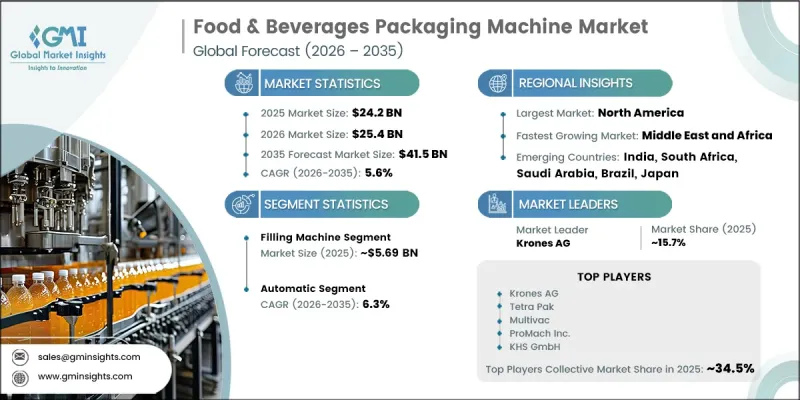
The Global Food & Beverages Packaging Machine Market was valued at USD 24.2 billion in 2025 and is estimated to grow at a CAGR of 5.6% to reach USD 41.5 billion by 2035.
The food & beverages packaging machine market is witnessing steady expansion driven by rising global consumption of packaged and processed food products, particularly in rapidly urbanizing regions. Increasing disposable incomes, changing dietary patterns, and the expansion of modern retail infrastructure are significantly boosting demand for efficient packaging systems. At the same time, stringent food safety and hygiene regulations across developed economies are compelling manufacturers to adopt advanced, automated packaging solutions that ensure product integrity, traceability, and compliance with strict quality standards. Rising labor costs are further accelerating the shift toward automation, encouraging food processors to invest in high-speed, multi-functional packaging equipment. Manufacturers are increasingly upgrading legacy production lines with advanced filling, sealing, labeling, and end-of-line systems to improve efficiency and output capacity. Regulatory frameworks such as food safety compliance standards in major markets are also driving continuous capital investment in hygienic and fully automated packaging infrastructure.
| Market Scope | |
|---|---|
| Start Year | 2025 |
| Forecast Year | 2026-2035 |
| Start Value | $24.2 Billion |
| Forecast Value | $41.5 Billion |
| CAGR | 5.6% |
The filling machine segment generated USD 5.69 billion in 2025 and is expected to grow at a CAGR of 4.8% through 2035. This segment remains a key contributor to the food & beverages packaging machine market due to its critical role in handling a wide range of liquid, powder, granule, paste, and viscous products. Liquid filling systems account for the highest production volumes, driven by strong demand from beverage and dairy processing industries. Filling technologies continue to evolve to support higher speed, improved accuracy, and enhanced hygiene standards, making them essential for large-scale food manufacturing operations.
The automatic segment accounted for 56.1% share in 2025 and is projected to grow at a CAGR of 6.3% during 2035. Its dominance is supported by increasing demand for high-efficiency production systems that reduce manual intervention while improving consistency and operational speed. Automation technologies are widely adopted across food processing facilities to enhance productivity, minimize errors, and maintain strict hygiene standards. In addition, robotic and semi-automated solutions are gaining traction, particularly in packaging applications that require flexibility, precision handling, and improved throughput performance across diverse product categories.
North America Food & Beverages Packaging Machine Market held 29.6% share in 2025, driven by its highly developed and technologically advanced food processing industry. The region continues to invest heavily in automation and modern packaging infrastructure to improve production efficiency and ensure compliance with stringent food safety and quality regulations. Strong regulatory frameworks emphasizing hygiene, traceability, and preventive safety measures are encouraging continuous upgrades in packaging systems across food and beverage manufacturing facilities. This sustained focus on automation and compliance continues to reinforce North America's strong position in the global market.
Major companies operating in the global food & beverages packaging machine market include Syntegon Technology GmbH, Ishida Co., Ltd., Omori Machinery Co., Ltd., Tetra Pak International S.A., Coesia Group, Gerhard Schubert GmbH, Multivac Group, Barry-Wehmiller Companies Inc., ULMA Packaging S. Coop., CAMA Group S.r.l., ProMach Inc., IMA Group S.p.A., KHS GmbH, Nichrome India Ltd., Rovema GmbH, Krones AG, TNA Solutions Pty Ltd., Fuji Machinery Co., Ltd., SACMI Group, Triangle Package Machinery Co., and Optima Packaging Group GmbH. Companies operating in the food & beverages packaging machine market are strengthening their competitive position by investing in advanced automation technologies, smart packaging systems, and high-speed production equipment that improve efficiency and operational accuracy. Many manufacturers are expanding research and development efforts to introduce innovative filling, sealing, and labeling solutions that meet evolving food safety and hygiene requirements. Strategic partnerships with food and beverage producers are helping companies expand market reach and strengthen customer relationships. Businesses are also focusing on modular machine designs, digital monitoring systems, and predictive maintenance capabilities to enhance productivity and reduce downtime.
Table of Contents
Chapter 1 Methodology & Scope
- 1.1 Market scope and definition
- 1.2 Research design
- 1.2.1 Research approach
- 1.2.2 Data collection methods
- 1.3 Data mining sources
- 1.3.1 Global
- 1.3.2 Regional/Country
- 1.4 Base estimates and calculations
- 1.4.1 Base year calculation
- 1.4.2 Key trends for market estimation
- 1.5 Primary research and validation
- 1.5.1 Primary sources
- 1.6 Forecast model
- 1.7 Research assumptions and limitations
Chapter 2 Executive Summary
- 2.1 Industry 360° synopsis
- 2.2 Key market trends
- 2.2.1 Region
- 2.2.2 Machine Type
- 2.2.3 Application
- 2.2.4 Automation Level
- 2.2.5 Packaging Type
- 2.2.6 Distribution channel
Chapter 3 Industry Insights
- 3.1 Industry ecosystem analysis
- 3.1.1 Supplier landscape
- 3.1.2 Profit margin
- 3.1.3 Value addition at each stage
- 3.1.4 Factor affecting the value chain
- 3.2 Industry impact forces
- 3.2.1 Growth drivers
- 3.2.1.1 Rising global demand for packaged & processed food products driven by urbanization & changing lifestyles
- 3.2.1.2 Stringent food safety & hygiene regulations compelling automation upgrades (FDA FSMA, EU Reg 852/2004)
- 3.2.1.3 Growth of e-commerce food & beverage channels requiring high-speed, flexible packaging lines
- 3.2.1.4 Labor cost pressures & workforce shortages accelerating shift to automated packaging systems
- 3.2.2 Industry pitfalls & challenges
- 3.2.2.1 High capital expenditure & long payback periods for advanced automated packaging machinery
- 3.2.2.2 Skilled labor shortage for programming, operation & maintenance of smart packaging systems
- 3.2.3 Opportunities
- 3.2.3.1 Sustainability-driven demand for machinery compatible with recyclable, bio-based & reduced-plastic formats
- 3.2.3.2 Packaging-machine-as-a-service (MAAS) & lease-based procurement models lowering adoption barriers for SMES
- 3.2.3.3 Rapid expansion of food processing industries in Asia Pacific, MEA creating greenfield demand
- 3.2.3.4 Smart & IoT-connected machinery with AI-driven predictive maintenance & OEE optimization
- 3.2.1 Growth drivers
- 3.3 Growth potential analysis
- 3.4 Future market trends
- 3.5 Technology and innovation landscape
- 3.5.1 Current technological trends
- 3.5.2 Emerging technologies
- 3.6 Regulatory landscape
- 3.6.1 U.S. FDA Food Safety Modernization Act (FSMA) Implications
- 3.6.2 EU Regulation 852/2004 & Packaging & Packaging Waste Directive
- 3.6.3 PMMI & Industry Association Standards
- 3.6.4 Extended Producer Responsibility (EPR) Policy Impact
- 3.7 Trade data analysis (HS Code - 8422.30)
- 3.7.1 Import/Export Volume & Value Trends by Machine Type (Driven by Primary Research)
- 3.7.2 Key Trade Corridors & Tariff Impact on Packaging Machinery (Driven by Primary Research)
- 3.8 Impact of AI & generative AI on the market
- 3.8.1 AI-driven Disruption of Existing Packaging Line Business Models
- 3.8.2 GenAI Use Cases & Adoption Roadmap by Segment (Predictive Maintenance, Quality Inspection, Throughput Optimization)
- 3.8.3 Risks, Limitations & Regulatory Considerations of AI in Packaging Machinery
- 3.9 Pricing Analysis
- 3.9.1 Historical Price Trend Analysis (Driven by Primary Research)
- 3.9.2 Pricing Strategy by Player Type (Premium / Value / Cost-plus) (Driven by Primary Research)
- 3.10 Porter's analysis
- 3.11 PESTEL analysis
- 3.12 Consumer Behavior Analysis
Chapter 4 Competitive Landscape, 2025
- 4.1 Introduction
- 4.2 Company market share analysis
- 4.3 Company matrix analysis
- 4.4 Competitive analysis of major market players
- 4.5 Competitive positioning matrix
- 4.6 Key developments
- 4.6.1 Mergers & acquisitions
- 4.6.2 Partnerships & collaborations
- 4.6.3 New product launches
- 4.6.4 Expansion plans
Chapter 5 Market Estimates & Forecast, By Machine Type, 2022 - 2035, (USD Billion) (Million Units)
- 5.1 Key Trends
- 5.2 Filling Machines
- 5.2.1 Liquid Filling Machines (Gravity, Piston, Volumetric, Flow Meter)
- 5.2.2 Powder & Granule Filling Machines (Auger, Net Weigh, Gross Weigh)
- 5.2.3 Paste & Viscous Product Filling Machines (Piston, Peristaltic, Rotary)
- 5.3 Sealing Machines
- 5.3.1 Heat Sealing Machines (Band Sealers, Impulse Sealers, Continuous Sealers)
- 5.3.2 Induction Sealing Machines
- 5.3.3 Vacuum Sealing Machines
- 5.4 Labeling Machines
- 5.4.1 Pressure-Sensitive Labeling Machines
- 5.4.2 Sleeve Labeling Machines (Heat Shrink, Roll-Fed)
- 5.4.3 Wrap-Around & Hot Glue Labeling Machines
- 5.4.4 Coding & Marking Systems (Inkjet, Laser, Thermal Transfer)
- 5.5 Wrapping Machines
- 5.5.1 Stretch Wrapping Machines
- 5.5.2 Shrink Wrapping Machines (Sleeve, Full-Body)
- 5.5.3 Flow Wrapping Machines (Horizontal & Vertical)
- 5.6 Form-Fill-Seal (FFS) Machines
- 5.6.1 Vertical Form-Fill-Seal (VFFS) Machines
- 5.6.2 Horizontal Form-Fill-Seal (HFFS) Machines
- 5.6.3 Thermoform-Fill-Seal (TFFS) Machines
- 5.7 Pouch Packaging Machines
- 5.7.1 Stand-Up Pouch Packaging Machines
- 5.7.2 Flat & Pillow Pouch Packaging Machines
- 5.7.3 Spouted & Fitment Pouch Packaging Machines
- 5.8 Others
- 5.8.1 Cartoning Machines (Horizontal & Vertical)
- 5.8.2 Case Packing & Tray Packing Machines
- 5.8.3 Palletizing & Depalletizing Machines (Conventional & Robotic)
- 5.8.4 Checkweighers, Vision Inspection & Metal Detection Systems
Chapter 6 Market Estimates & Forecast, By Application, 2022 - 2035, (USD Billion) (Million Units)
- 6.1 Key Trends
- 6.2 Beverages
- 6.2.1 Non-Alcoholic Beverages (Bottled Water, Carbonated Soft Drinks, Juices, Energy Drinks)
- 6.2.2 Alcoholic Beverages (Beer, Wine, Spirits)
- 6.2.3 Dairy Beverages (Milk, Flavored Milk, Plant-Based Drinks)
- 6.2.4 Hot Beverages (Ready-to-Drink Coffee & Tea)
- 6.3 Processed Food
- 6.3.1 Ready-to-Eat & Ready-to-Cook Meals
- 6.3.2 Frozen Foods
- 6.3.3 Snacks & Savory Products
- 6.3.4 Condiments, Sauces & Dressings
- 6.4 Bakery Products
- 6.4.1 Bread, Rolls & Buns
- 6.4.2 Pastries, Cakes & Pies
- 6.4.3 Cookies & Crackers
- 6.5 Confectionery
- 6.5.1 Chocolate & Chocolate-Based Products
- 6.5.2 Sugar Confectionery, Gums & Jellies
- 6.6 Meat, Poultry & Seafood
- 6.6.1 Fresh & Chilled Meat & Poultry
- 6.6.2 Frozen Meat, Poultry & Seafood
- 6.6.3 Processed, Cured & Deli Products
- 6.7 Dairy Products
- 6.7.1 Fluid Milk & Cream
- 6.7.2 Cheese & Butter
- 6.7.3 Yogurt & Fermented Dairy Products
- 6.8 Fruits & Vegetables
- 6.8.1 Fresh & Pre-Cut Produce (MAP Packaging)
- 6.8.2 Frozen Fruits & Vegetables
- 6.8.3 Dried & Dehydrated Produce
- 6.9 Others (Health Foods, Nutritional Supplements, Infant Formula, Pet Food)
Chapter 7 Market Estimates & Forecast, By Automation Level, 2022 - 2035, (USD Billion) (Million Units)
- 7.1 Key Trends
- 7.2 Automatic Packaging Machines
- 7.2.1 Fully Automatic Continuous Motion Systems
- 7.2.2 Fully Automatic Intermittent Motion Systems
- 7.2.3 Robotic & Collaborative Automation Systems
- 7.3 Semi-Automatic Packaging Machines
- 7.3.1 Operator-Assisted Filling & Sealing Systems
- 7.3.2 Semi-Automatic Labeling & Coding Systems
- 7.3.3 Semi-Automatic Case Packing & Bundling Systems
- 7.4 Manual Packaging Machines
- 7.4.1 Hand-Operated Filling & Sealing Equipment
- 7.4.2 Entry-Level Manual Wrapping & Labeling Solutions
Chapter 8 Market Estimates & Forecast, By Packaging Type, 2022 - 2035, (USD Billion) (Million Units)
- 8.1 Key Trends
- 8.2 Flexible Packaging
- 8.2.1 Pouches & Bags
- 8.2.2 Films, Wraps & Laminates
- 8.2.3 Sachets & Single-Serve Formats
- 8.3 Rigid Packaging
- 8.3.1 Bottles & Jars (PET, Glass, HDPE)
- 8.3.2 Cans & Metal Containers (Aluminum, Tin)
- 8.3.3 Cartons & Paperboard Boxes
- 8.4 Semi-Rigid Packaging
- 8.4.1 Thermoformed Trays & Clamshells
- 8.4.2 Blister Packs & Skin Packs
Chapter 9 Market Estimates & Forecast, By Distribution Channel, 2022 - 2035, (USD Billion) (Million Units)
- 9.1 Key Trends
- 9.2 Direct
- 9.3 Indirect
Chapter 10 Market Estimates & Forecast, By Region, 2022 - 2035, (USD Billion) (Million Units)
- 10.1 Key Trends
- 10.2 North America
- 10.2.1 U.S.
- 10.2.2 Canada
- 10.3 Europe
- 10.3.1 Germany
- 10.3.2 France
- 10.3.3 UK
- 10.3.4 Italy
- 10.3.5 Spain
- 10.4 Asia Pacific
- 10.4.1 China
- 10.4.2 Japan
- 10.4.3 India
- 10.4.4 Australia
- 10.4.5 South Korea
- 10.5 Latin America
- 10.5.1 Brazil
- 10.5.2 Mexico
- 10.5.3 Argentina
- 10.6 MEA
- 10.6.1 Saudi Arabia
- 10.6.2 UAE
- 10.6.3 South Africa
Chapter 11 Company Profiles
- 11.1 Tetra Pak International S.A.
- 11.2 Krones AG
- 11.3 Syntegon Technology GmbH
- 11.4 Multivac Group
- 11.5 IMA Group S.p.A.
- 11.6 Coesia Group
- 11.7 KHS GmbH
- 11.8 ULMA Packaging S. Coop.
- 11.9 Barry-Wehmiller Companies Inc.
- 11.10 ProMach Inc.
- 11.11 Ishida Co., Ltd.
- 11.12 TNA Solutions Pty Ltd.
- 11.13 Rovema GmbH
- 11.14 Gerhard Schubert GmbH
- 11.15 CAMA Group S.r.l.
- 11.16 Fuji Machinery Co., Ltd.
- 11.17 SACMI Group
- 11.18 Optima Packaging Group GmbH
- 11.19 Triangle Package Machinery Co.
- 11.20 Nichrome India Ltd.
- 11.21 Paxiom Group Inc.
- 11.22 Omori Machinery

