PUBLISHER: Global Market Insights Inc. | PRODUCT CODE: 2101549

PUBLISHER: Global Market Insights Inc. | PRODUCT CODE: 2101549
North America Micro-Climate Indoor Gardening Pods Market Opportunity, Growth Drivers, Industry Trend Analysis, and Forecast 2026 - 2035
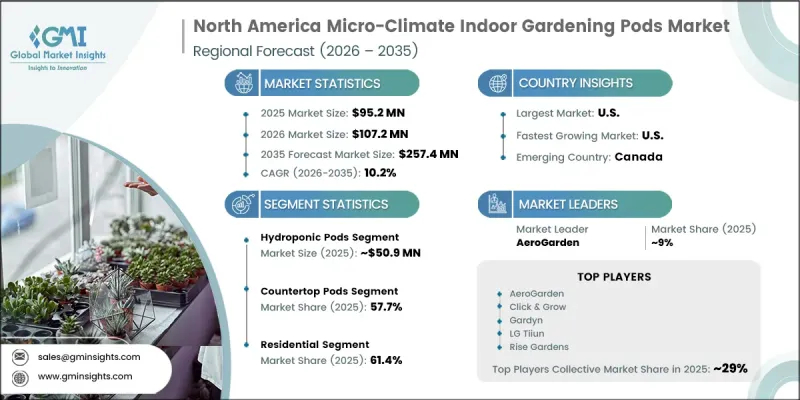
North America Micro-Climate Indoor Gardening Pods Market was valued at USD 95.2 million in 2025 and is estimated to grow at a CAGR of 10.2% to reach USD 257.4 million by 2035.
The market is gaining momentum as urban lifestyles continue to evolve across North America, with more consumers living in smaller residential spaces where conventional gardening options are limited. The growing preference for convenient access to fresh produce is encouraging households to adopt compact indoor gardening solutions that require minimal space and maintenance. Micro-climate indoor gardening pods are becoming increasingly attractive because they enable consumers to cultivate plants in controlled environments with improved efficiency. Continuous innovation in hydroponic and aeroponic cultivation methods is improving crop productivity, resource management, and overall user experience. The integration of smart technologies is further accelerating market adoption, as connected systems provide automated monitoring, remote control, and optimized growing conditions. Rising awareness about healthy eating habits and the demand for fresh, naturally grown produce are also contributing to increased consumer interest in indoor gardening solutions. These trends are collectively strengthening demand for advanced indoor cultivation systems across residential environments in North America.
| Market Scope | |
|---|---|
| Start Year | 2025 |
| Forecast Year | 2026-2035 |
| Start Value | $95.2 Million |
| Forecast Value | $257.4 Million |
| CAGR | 10.2% |
The hydroponic pods segment generated USD 50.9 million in 2025 and is expected to grow at a CAGR of 9.9% from 2026 to 2035. Hydroponic pods maintain a leading position in the North America micro-climate indoor gardening pods market due to their efficient cultivation process, accelerated plant development, and elimination of soil-based growing requirements. These systems rely on nutrient-enriched water circulation to provide controlled growing conditions, allowing users to achieve consistent plant production with greater precision. Their capability to support year-round cultivation of herbs and vegetables has increased their popularity among consumers and has positioned hydroponic technology as a key foundation for major indoor gardening brands.
The countertop pods segment accounted for 57.7% share in 2025. Demand for countertop pods continues to rise because of their compact design, easy installation, and suitability for limited residential spaces. These systems are specifically developed for consumers looking for simple indoor gardening solutions that can be integrated into everyday living areas. Their user-friendly operation makes them an accessible option for beginners entering the indoor gardening space. Growing interest in home meal preparation and the preference for readily available fresh ingredients are further supporting the adoption of countertop gardening pods.
U.S. Micro-Climate Indoor Gardening Pods Market reached USD 71.6 million in 2025. The country's market leadership is supported by strong consumer awareness, higher purchasing capacity, and widespread acceptance of smart home technologies. Increasing urban development, rising attention toward personal wellness, and growing interest in cultivating fresh produce at home are creating favorable conditions for market expansion. The United States continues to demonstrate strong demand for smart gardening solutions as consumers seek convenient and technology-enabled methods for producing fresh crops indoors.
The key players operating in the North America micro-climate indoor gardening pods market include: AeroGarden, Click & Grow, LG Tiiun, LetPot, iDOO, Veritable SAS, BSH / Bosch SmartGrow, Gardyn, Lettuce Grow, Urban Cultivator, edn / EDN Inc., Rise Gardens, VIVOSUN VGrow, Just Vertical, Plantaform, ingarden, Vegehome, Novagrow, Nutraponics, Luya, and Back to the Roots. Key strategies adopted by companies operating in the North America micro-climate indoor gardening pods market focus on product innovation, technology integration, and expanding consumer accessibility. Market participants are developing advanced systems with automated lighting, climate monitoring, and connected control features to improve user convenience and cultivation efficiency. Companies are also strengthening their positions through partnerships, direct-to-consumer sales channels, and improvements in product design to attract a wider customer base. Expanding product portfolios with different capacity options and customized solutions helps businesses address diverse consumer requirements. Strategic investments in research and development, sustainability-focused technologies, and smart home compatibility are enabling companies to enhance brand recognition and maintain competitive advantages in the growing indoor gardening sector.
Table of Contents
Chapter 1 Methodology and Scope
- 1.1 Market scope and definition
- 1.2 Research design
- 1.2.1 Research approach
- 1.2.2 Data collection methods
- 1.3 Data mining sources
- 1.3.1 Global
- 1.3.2 Regional/Country
- 1.4 Base estimates and calculations
- 1.4.1 Base year calculation
- 1.4.2 Key trends for market estimation
- 1.5 Primary research and validation
- 1.5.1 Primary sources
- 1.6 Forecast model
- 1.7 Research assumptions and limitations
Chapter 2 Executive Summary
- 2.1 Industry 360° synopsis
- 2.2 Key market trends
- 2.2.1 Country
- 2.2.2 Growth Technology
- 2.2.3 Form and Design
- 2.2.4 Plant Type
- 2.2.5 Price Range
- 2.2.6 End User
Chapter 3 Industry Insights
- 3.1 Industry ecosystem analysis
- 3.1.1 Raw material & component suppliers
- 3.1.2 Pod hardware manufacturers & OEMs
- 3.1.3 Seed pod & nutrient solution providers
- 3.1.4 Software & app platform developers
- 3.1.5 Distribution channels & retail partners
- 3.1.6 End users & aftermarket consumable ecosystem
- 3.1.7 Profit margin
- 3.1.8 Value addition at each stage
- 3.1.9 Factor affecting the value chain
- 3.2 Industry impact forces
- 3.2.1 Growth drivers
- 3.2.1.1 Rising urbanization and limited outdoor space
- 3.2.1.2 Growing demand for fresh, organic, and home-grown produce
- 3.2.1.3 Technological advancements
- 3.2.2 Pitfalls & Challenges
- 3.2.2.1 High initial cost and maintenance expenses
- 3.2.2.2 Limited crop variety and yield capacity
- 3.2.3 Opportunities
- 3.2.3.1 Expansion into smart home ecosystems
- 3.2.3.2 Commercial and institutional adoption
- 3.2.1 Growth drivers
- 3.3 Growth potential analysis
- 3.4 Technology and innovation landscape
- 3.4.1 Micro-climate control technologies
- 3.4.2 LED grow light spectrum engineering
- 3.4.3 Nutrient delivery system innovation
- 3.4.4 IoT integration & smart sensor architecture
- 3.4.5 App-controlled automation & remote monitoring capabilities
- 3.4.6 Seed pod capsule design & proprietary germination technologies
- 3.5 Regulatory framework
- 3.5.1 Food safety & produce labeling regulations for pod-grown crops
- 3.5.2 Organic & non-GMO certification landscape for indoor pod cultivation
- 3.5.3 Electrical safety & consumer product compliance standards
- 3.5.4 Water use & nutrient disposal regulations by region
- 3.5.5 Emerging regulations on closed-system aquaponic pod ecosystems
- 3.6 Pricing analysis (driven by primary research)
- 3.6.1 Historical price trend analysis by product category
- 3.6.2 Pricing strategy by player type (premium / value / cost-plus)
- 3.7 Supply chain analysis
- 3.7.1 Component sourcing geography & key supplier concentration risks
- 3.7.2 Semiconductor & sensor supply disruption impact on pod manufacturing
- 3.7.3 Seed pod consumable supply chain & agricultural input dependencies
- 3.7.4 Tariff impact on import/export of pod hardware components
- 3.8 Trade data analysis (driven by paid database) (HS code- 847989)
- 3.8.1 Import/export volume & value trends by product category
- 3.8.2 Key trade corridors & tariff impact
- 3.9 Impact of AI & generative AI on the market
- 3.9.1 AI-driven disruption of existing business models
- 3.9.2 GenAI use cases & adoption roadmap by segment
- 3.9.3 Risks, limitations & regulatory considerations
- 3.10 Distribution infrastructure & channel penetration landscape (driven by primary research)
- 3.10.1 Channel coverage by region & format (modern vs. traditional trade)
- 3.10.2 Last-mile infrastructure gaps & emerging channel shifts
Chapter 4 Competitive Landscape, 2025
- 4.1 Introduction
- 4.2 Company market share analysis
- 4.2.1 By country
- 4.2.1.1 U.S.
- 4.2.1.2 Canada
- 4.2.1 By country
- 4.3 Company matrix analysis
- 4.4 Competitive analysis of major market players
- 4.5 Competitive positioning matrix
- 4.6 Key developments
- 4.6.1 Mergers & acquisitions
- 4.6.2 Partnerships & collaborations
- 4.6.3 New product launches
- 4.6.4 Expansion plans
Chapter 5 Market Estimates and Forecast, By Growing Technology, 2022 – 2035 (USD Million) (Thousand Units)
- 5.1 Key trends
- 5.2 Hydroponic pods
- 5.2.1 Deep Water Culture (DWC) hydroponic pods
- 5.2.2 Nutrient Film Technique (NFT) hydroponic pods
- 5.2.3 Drip system hydroponic pods
- 5.3 Aeroponic pods
- 5.3.1 Low-pressure aeroponic pods
- 5.3.2 High-pressure aeroponic pods
- 5.4 Aquaponic pods
- 5.5 Soil-based smart pods
- 5.5.1 Peat & coco coir substrate smart pods
- 5.5.2 Nano-substrate & engineered growing media smart pods
Chapter 6 Market Estimates and Forecast, By Form and Design, 2022 – 2035 (USD Million) (Thousand Units)
- 6.1 Key trends
- 6.2 Countertop pods
- 6.2.1 Small countertop pods (≤6 pod sites)
- 6.2.2 Large countertop pods (>6 pod sites)
- 6.3 Floor-standing/standalone pods
- 6.3.1 Single-column floor-standing units
- 6.3.2 Multi-column floor-standing units
- 6.4 Wall-mounted pods
- 6.4.1 Fixed wall-mounted pods
- 6.4.2 Rail-system wall-mounted pods
- 6.5 Modular/stackable pod systems
- 6.5.1 Horizontal stackable pod arrays
- 6.5.2 Vertical modular pod towers
Chapter 7 Market Estimates and Forecast, By Plant Type, 2022 – 2035 (USD Million) (Thousand Units)
- 7.1 Key trends
- 7.2 Herbs & leafy greens
- 7.2.1 Culinary herbs
- 7.2.2 Microgreens & baby greens
- 7.2.3 Lettuce varieties
- 7.3 Vegetables
- 7.3.1 Fruiting vegetables
- 7.3.2 Root vegetables
- 7.4 Fruits
- 7.4.1 Strawberries
- 7.4.2 Dwarf citrus & other fruiting plants
- 7.5 Flowers & ornamentals
- 7.5.1 Edible flowers
- 7.5.2 Decorative/aromatic ornamentals
Chapter 8 Market Estimates and Forecast, By Price Range, 2022 – 2035 (USD Million) (Thousand Units)
- 8.1 Key trends
- 8.2 Low
- 8.3 Medium
- 8.4 High
Chapter 9 Market Estimates and Forecast, By End User, 2022 – 2035 (USD Million) (Thousand Units)
- 9.1 Key trends
- 9.2 Residential
- 9.2.1 Homeowners
- 9.2.2 Apartment dwellers & urban renters
- 9.3 Commercial food service
- 9.3.1 Restaurants & cafes
- 9.3.2 Hotels & hospitality venues
- 9.4 Educational institutions
- 9.4.1 K-12 schools (stem programs)
- 9.4.2 Universities & research institutions
- 9.5 Corporate/office spaces
Chapter 10 Market Estimates and Forecast, By Country, 2022 – 2035 (USD Million) (Thousand Units)
- 10.1 Key trends
- 10.2 North America
- 10.2.1 U.S.
- 10.2.2 Canada
Chapter 11 Company Profiles
- 11.1 Global Players
- 11.1.1 AeroGarden
- 11.1.2 Click & Grow
- 11.1.3 LG Tiiun
- 11.1.4 LetPot
- 11.1.5 iDOO
- 11.1.6 Veritable SAS
- 11.1.7 BSH / Bosch SmartGrow
- 11.1.8 Gardyn
- 11.1.9 Lettuce Grow
- 11.2 Regional Players
- 11.2.1 Urban Cultivator
- 11.2.2 ēdn / EDN Inc.
- 11.2.3 Rise Gardens (replaces SproutsIO)
- 11.2.4 VIVOSUN VGrow
- 11.2.5 Just Vertical
- 11.2.6 Plantaform
- 11.2.7 ingarden
- 11.3 Emerging Players
- 11.3.1 Vegehome
- 11.3.2 Novagrow
- 11.3.3 Nutraponics
- 11.3.4 Luya
- 11.3.5 Back to the Roots

