PUBLISHER: Global Market Insights Inc. | PRODUCT CODE: 2101693

PUBLISHER: Global Market Insights Inc. | PRODUCT CODE: 2101693
Europe Indoor Plant Market Opportunity, Growth Drivers, Industry Trend Analysis, and Forecast 2026 - 2035
Europe Indoor Plant Market was valued at USD 9.1 billion in 2025 and is estimated to grow at a CAGR of 5.2% to reach USD 15 billion by 2035.
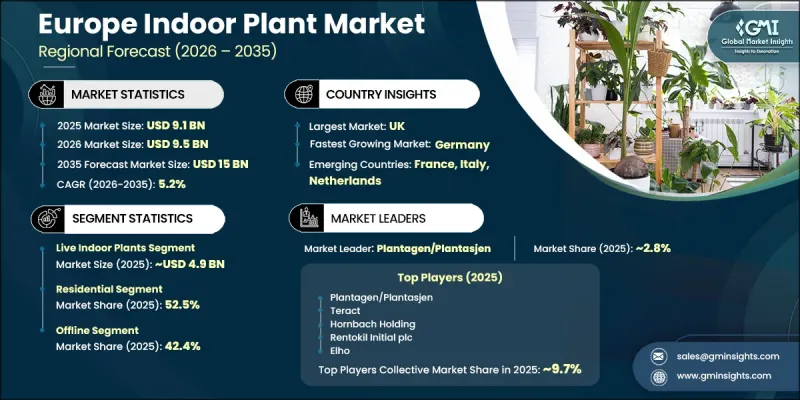
Europe indoor plant market benefits from an established consumer base that increasingly values indoor plants as an essential component of modern interior spaces, wellness-focused lifestyles, and aesthetically appealing workplaces. Businesses across the region continue incorporating indoor greenery into office layouts and commercial properties as part of broader workplace enhancement initiatives, contributing to sustained market growth. Consumer interest also remains strong, supported by increasing awareness of biophilic design principles, home decor trends, and healthier indoor living environments. Demand is particularly robust across major European economies where indoor gardening has become deeply embedded in household purchasing behavior. In addition, growing investments in decorative interior landscaping and professionally designed green installations continue to create new opportunities for suppliers. The expanding preference for premium indoor plants, decorative planters, and customized interior greenery solutions further supports long-term growth across the Europe indoor plant market throughout the forecast period.
| Market Scope | |
|---|---|
| Start Year | 2025 |
| Forecast Year | 2026-2035 |
| Start Value | $9.1 Billion |
| Forecast Value | $15 Billion |
| CAGR | 5.2% |
The live indoor plants segment generated USD 4.9 billion in 2025 and is expected to grow at a CAGR of 4.8% from 2026 to 2035. This segment continues to hold the largest share of the Europe indoor plant market because consumers consistently favor natural indoor greenery for residential and commercial spaces. Strong consumer demand, widespread availability of products, and sustained interest in decorative indoor plants have reinforced the segment's leadership position. Retailers continue to expand product selections across garden centers, supermarkets, and online platforms, while sustained consumer interest in indoor gardening, home decor, and wellness-oriented living supports long-term market expansion. Growing appreciation for natural aesthetics and easy-to-maintain indoor plants continues to strengthen demand across the region.
The residential application segment accounted for 52.5% share in 2025, making it the leading end-use category. Household demand remains the primary source of market revenue as indoor plant ownership continues to be widely embraced across European homes. Rising consumer focus on attractive living spaces, improved indoor environments, and nature-inspired home decor continues to encourage higher spending on indoor plants and complementary decorative accessories. Younger consumers also play an increasingly important role in supporting market growth by purchasing premium indoor plants and aesthetically appealing planters that align with evolving interior design preferences. Continued interest in home personalization and lifestyle-oriented decor products is expected to maintain strong demand across the residential segment throughout the forecast period.
Germany Indoor Plant Market captured USD 3 billion in 2025 and is anticipated to register a CAGR of 5.9% between 2026 and 2035. The country remains the largest regional market due to consistently high consumer spending on ornamental horticulture and long-standing demand for indoor greenery across residential and commercial settings. German consumers continue to demonstrate strong preference for premium-quality products, environmentally responsible solutions, and durable indoor gardening accessories, supporting stable demand across multiple product categories. Increasing consumer awareness of sustainability, product quality, and long-term value continues to reinforce Germany's leadership position within the Europe indoor plant market.
Major companies operating in the Europe indoor plant market include Elho, Scheurich, LECHUZA, Dummen Orange, Klasmann-Deilmann, Verdissimo, SemperGreenwall (Sempergreen), Beekenkamp Group, Anthura, KP Holland, Selecta One (Selecta Klemm), Double H Nurseries, Hills Plants, Click & Grow, TERACT/Jardiland/Gamm Vert, Hornbach Holding, Rentokil/Ambius, Mikskaar Miksgrow AS, Plant Plan, Plantagen/Plantasjen, CitySens, Auk, 4Nature System, PlantClub, and WeDoGreen. Companies operating in the Europe indoor plant market focus on expanding product portfolios, strengthening sustainability initiatives, and enhancing customer engagement to reinforce their market position. Manufacturers continue investing in innovative indoor plant varieties, premium planters, and environmentally responsible growing solutions that address changing consumer preferences. Many companies improve their competitive advantage by expanding retail partnerships, strengthening online sales platforms, and increasing distribution capabilities across key European markets. Product differentiation through premium quality, modern designs, and sustainable materials remains a major strategic priority. Businesses also emphasize research and development to improve cultivation techniques, product durability, and overall customer satisfaction.
Table of Contents
Chapter 1 Methodology and Scope
- 1.1 Market scope and definition
- 1.2 Research design
- 1.2.1 Research approach
- 1.2.2 Data collection methods
- 1.3 Data mining sources
- 1.3.1 Global
- 1.3.2 Regional/Country
- 1.4 Base estimates and calculations
- 1.4.1 Base year calculation
- 1.4.2 Key trends for market estimation
- 1.5 Primary research and validation
- 1.5.1 Primary sources
- 1.6 Forecast model
- 1.7 Research assumptions and limitations
Chapter 2 Executive Summary
- 2.1 Industry 360° synopsis
- 2.2 Key market trends
- 2.2.1 Business trends
- 2.2.2 Country
- 2.2.3 Product
- 2.2.4 End use application
- 2.2.5 Distribution channel
Chapter 3 Industry Insights
- 3.1 Industry ecosystem analysis
- 3.1.1 Raw material suppliers
- 3.1.2 Manufacturers
- 3.1.3 Distributors
- 3.1.4 Retailers / trade channels
- 3.1.5 End users
- 3.1.6 Service providers
- 3.1.7 Profit margin
- 3.1.8 Value addition at each stage
- 3.1.9 Factor affecting the value chain
- 3.1.10 B2C vs. B2B ecosystem differentiation
- 3.2 Industry impact forces
- 3.2.1 Growth drivers
- 3.2.1.1 Biophilic design movement in commercial interiors
- 3.2.1.2 Corporate wellness & quality of work life (QWL) mandates
- 3.2.1.3 Green building certifications driving indoor plant specification
- 3.2.2 Industry pitfalls & challenges
- 3.2.2.1 Consumer perception of maintenance burden
- 3.2.2.2 Price sensitivity in mass-market channels
- 3.2.3 Opportunities
- 3.2.3.1 Premium self-watering and smart planter innovation
- 3.2.3.2 Expansion of CSE and corporate gifting as a structured B2B distribution channel
- 3.2.1 Growth drivers
- 3.3 Growth Potential Analysis
- 3.4 Future market trends
- 3.5 Technology and innovation landscape
- 3.5.1 Current technological trends
- 3.5.2 Emerging technologies
- 3.6 Price trends (Driven by Primary Research)
- 3.6.1 Historical Price Trend Analysis
- 3.6.2 Pricing Strategy by Player Type - Premium / Value / Cost-Plus
- 3.7 Regulatory landscape
- 3.7.1 EU-wide regulatory framework
- 3.7.1.1 CE marking requirements for consumer products
- 3.7.1.2 EU Eco-Design directive - implications for planters and materials
- 3.7.1.3 REACH regulation - chemical compliance for planter materials
- 3.7.1.4 Packaging and waste regulations
- 3.7.2 France
- 3.7.2.1 QWL legislation and its impact on workplace greening procurement
- 3.7.2.2 CSE (Comite Social et Economique) - regulatory framework and budget scope
- 3.7.2.3 French eco-labeling standards (NF Environment, Origine France Garantie)
- 3.7.2.4 Retail market access requirements
- 3.7.3 Germany
- 3.7.3.1 GS Mark and product safety standards
- 3.7.3.2 German sustainability labeling (Blauer Engel) and relevance to planters
- 3.7.3.3 Green procurement rules for public sector and corporate buyers
- 3.7.3.4 Import and distribution compliance for non-EU manufactured products
- 3.7.4 United Kingdom
- 3.7.4.1 UKCA Marking requirements and divergence from EU CE
- 3.7.4.2 UK product safety and materials compliance
- 3.7.4.3 Post-Brexit import duties and tariff implications for EU-manufactured products
- 3.7.4.4 UK retail compliance and labeling standards
- 3.7.5 Nordic Countries
- 3.7.5.1 Nordic Swan Ecolabel - applicability and market advantage
- 3.7.5.2 Public sector green procurement standards (Sweden, Denmark, Norway, Finland)
- 3.7.5.3 VAT and customs considerations for market entry
- 3.7.5.4 Consumer protection and product standards by country
- 3.7.1 EU-wide regulatory framework
- 3.8 Supply chain analysis
- 3.8.1 Key raw material sources
- 3.8.2 European vs. Asian sourcing comparison
- 3.8.3 Manufacturing hub overview
- 3.8.4 Intra-EU production vs. Import dependency
- 3.8.5 Supply chain risks & dependencies
- 3.9 Porter's analysis
- 3.10 PESTEL analysis
- 3.11 Trade statistics (driven by paid database) (HS Code- 39269099)
- 3.11.1 Import / Export Volume & Value Trends
- 3.11.2 Key Trade Corridors & Tariff Impact
- 3.12 Impact of AI & Generative AI on the Market
- 3.12.1 AI-Driven Disruption of Existing Business Models
- 3.12.1.1 AI-enabled personalization in plant and planter e-commerce (product recommendation engines)
- 3.12.1.2 AI in B2B interior design specification (automated space planning with biophilic elements)
- 3.12.1.3 Smart inventory and supply chain optimization for plant product distributors
- 3.12.2 GenAI use cases & adoption roadmap by segment
- 3.12.3 Risks, limitations & regulatory considerations
- 3.12.1 AI-Driven Disruption of Existing Business Models
- 3.13 Distribution infrastructure & channel penetration landscape (driven by primary research)
- 3.13.1 Channel coverage by country & format - modern vs. Specialty vs. B2b
- 3.13.2 Last-mile infrastructure gaps & emerging channel shifts
Chapter 4 Competitive Landscape, 2025
- 4.1 Introduction
- 4.2 Company market share analysis
- 4.2.1 By Country
- 4.2.1.1 Germany
- 4.2.1.2 France
- 4.2.1.3 UK
- 4.2.1.4 Italy
- 4.2.1.5 Spain
- 4.2.1.6 Nordics
- 4.2.1 By Country
- 4.3 Company matrix analysis
- 4.4 Competitive analysis of major market players
- 4.5 Competitive positioning matrix
- 4.6 Strategy Mapping
- 4.7 Key developments
- 4.7.1 Mergers & acquisitions
- 4.7.2 Partnerships & collaborations
- 4.7.3 New product launches
- 4.7.4 Expansion plans
Chapter 5 Market Estimates & Forecast, By Product, 2022-2035 (USD Billion) (Million Units)
- 5.1 Key trends
- 5.2 Live indoor plants
- 5.3 Artificial & preserved indoor plants
- 5.4 Indoor planters & container systems
- 5.4.1 Self-watering & autonomous planter systems
- 5.4.2 Capillary / wick-based self-watering systems
- 5.4.3 Reservoir / bottom-fill self-watering systems
- 5.4.4 Smart / IoT-connected self-watering systems
- 5.4.5 Standard planters, pots & cache-pots
- 5.4.6 Modular green wall & vertical garden systems
- 5.4.6.1 Indoor modular wall panel systems (magnetic / rail-based)
- 5.4.6.2 Freestanding vertical garden systems
- 5.4.6.3 Ceiling / suspended & curtain rod plant systems
- 5.4.7 Smart connected planters
- 5.4.8 Desk & tabletop plant accessories
- 5.5 Indoor plant accessories & grow media
- 5.6 Indoor plant services (maintenance, leasing & installation)
Chapter 6 Market Estimates & Forecast, By End Use Application, 2022-2035 (USD Billion) (Million Units)
- 6.1 Key trends
- 6.2 Residential
- 6.2.1 Home decor & aesthetic plant solutions
- 6.2.2 Home wellness & biophilic living
- 6.2.3 Urban apartment & small-space greening
- 6.2.4 Others (gifting, etc.)
- 6.3 Commercial
- 6.3.1 Large enterprise / corporate headquarters
- 6.3.2 SME office environment
- 6.3.3 Co-working & flexible workspaces
- 6.4 Hospitality
- 6.4.1 Hotels & serviced residences
- 6.4.2 Restaurants, cafes & food service
- 6.4.3 Event venues & short-term rental properties
- 6.4.4 Retail & commercial spaces
- 6.5 Healthcare & wellness facilities
- 6.6 Educational institutions
- 6.7 Others (public sector buildings, etc.)
Chapter 7 Market Estimates & Forecast, By Distribution Channel, 2022-2035 (USD Billion) (Million Units)
- 7.1 Key trends
- 7.2 Online
- 7.2.1 E-Commerce
- 7.2.2 Company website
- 7.2.3 Social commerce
- 7.3 Garden centers & nurseries
- 7.3.1 Independent garden centers
- 7.3.2 Garden center chains
- 7.4 Home decor & interior retail
- 7.5 Diy & home improvement retail
- 7.6 Specialty plant boutiques & premium retail
- 7.7 B2B direct / corporate procurement
- 7.7.1 Facility management & workplace fitout procurement
- 7.7.2 Interior design & architecture specification channel
- 7.7.3 Corporate gifting platforms & B2B gift procurement
- 7.7.4 Works council / CSE & employee wellness program procurement
- 7.8 Hospitality direct procurement
Chapter 8 Market Estimates & Forecast, By Country, 2022-2035 (USD Billion) (Million Units)
- 8.1 Key trends
- 8.2 Europe
- 8.2.1 Germany
- 8.2.2 France
- 8.2.3 UK
- 8.2.4 Italy
- 8.2.5 Spain
- 8.2.6 Nordic countries
- 8.2.7 Rest of Europe
Chapter 9 Company Profiles
- 9.1 Global Players
- 9.1.1 Elho
- 9.1.2 Scheurich
- 9.1.3 LECHUZA
- 9.1.4 Dummen Orange
- 9.1.5 Klasmann-Deilmann
- 9.1.6 Verdissimo
- 9.1.7 SemperGreenwall (Sempergreen)
- 9.2 Regional players
- 9.2.1 Beekenkamp Group
- 9.2.2 Anthura
- 9.2.3 KP Holland
- 9.2.4 Selecta One (Selecta Klemm)
- 9.2.5 Double H Nurseries
- 9.2.6 Hills Plants
- 9.2.7 Click & Grow
- 9.2.8 TERACT/Jardiland/Gamm Vert
- 9.2.9 Hornbach Holding
- 9.2.10 Rentokil/Ambius
- 9.2.11 Mikskaar Miksgrow AS
- 9.2.12 Plant Plan
- 9.2.13 Plantagen/Plantasjen
- 9.3 Emerging players
- 9.3.1 CitySens
- 9.3.2 Auk
- 9.3.3 4Nature System
- 9.3.4 PlantClub
- 9.3.5 WeDoGreen

