PUBLISHER: Global Market Insights Inc. | PRODUCT CODE: 2101552

PUBLISHER: Global Market Insights Inc. | PRODUCT CODE: 2101552
North America Hand Tools Market Opportunity, Growth Drivers, Industry Trend Analysis, and Forecast 2026 - 2035
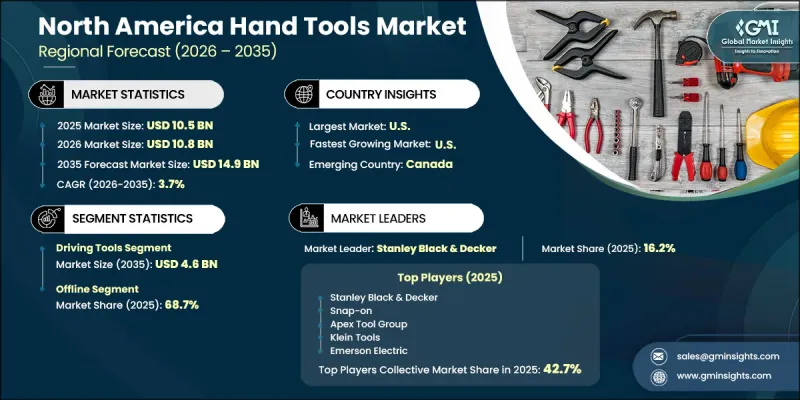
North America Hand Tools Market was valued at USD 10.5 billion in 2025 and is estimated to grow at a CAGR of 3.7% to reach USD 14.9 billion by 2035.
Ongoing expansion in construction and infrastructure development across North America continues to generate strong demand for hand tools among professional users as well as institutional buyers. Rising investments in residential, commercial, and public construction projects are supporting consistent demand for tools used in installation, cutting, fastening, and measurement applications. Continuous procurement through retail, wholesale, and direct distribution channels is further contributing to market growth. Increasing demand for skilled labor across multiple technical industries is also driving the adoption of professional-grade hand tools that deliver greater precision, durability, and workplace safety. At the same time, the growing popularity of home improvement and do-it-yourself projects is expanding the consumer base for high-quality hand tools. Easy access to educational content and repair guidance is encouraging more homeowners to undertake maintenance and renovation projects, creating additional opportunities for manufacturers and suppliers. These combined factors continue to support the long-term expansion of the North America hand tools market.
| Market Scope | |
|---|---|
| Start Year | 2025 |
| Forecast Year | 2026-2035 |
| Start Value | $10.5 Billion |
| Forecast Value | $14.9 Billion |
| CAGR | 3.7% |
The driving tools segment generated USD 3.3 billion in 2025 and is projected to reach USD 4.6 billion by 2035. The segment continues to account for a significant share of the North America hand tools market because these products are widely used across both professional and consumer applications. Consistent daily usage, frequent replacement cycles, and increasing participation in home improvement activities continue to support sustained demand for driving tools throughout the forecast period.
The offline distribution channels held 68.7% share in 2025. This channel continues to maintain its leading position because professional buyers often prefer to physically evaluate product quality, handling, durability, balance, and overall performance before making purchasing decisions. Long-standing relationships between distributors and commercial customers also contribute to continued growth through offline sales channels, particularly for large-volume procurement and institutional purchasing.
U.S. Hand Tools Market accounted for 87.3% share in 2025. Market growth is supported by continued investment in infrastructure, sustained residential and commercial construction activity, and a large consumer base actively engaged in home improvement projects. The country's strong manufacturing capabilities, well-established distribution network, and high level of brand recognition among leading hand tool manufacturers continue to reinforce customer loyalty while supporting stable product availability across professional and consumer markets.
Major companies operating in the North America hand tools market include Apex Tool Group, Channellock, Emerson Electric, Estwing, Gray Tools, Grupo URREA, Hilti, Ideal Industries, Klein Tools, Leatherman, Matco Tools, Robert Bosch, SK Hand Tool, Snap-on, Stanley Black & Decker, Techtronic Industries (TTI), Tekton, Truper, Warwood Tool, Wiha Tools, and Wright Tool. Companies operating in the North America hand tools market are strengthening their market position by expanding product portfolios with durable, ergonomic, and high-performance tools designed to meet evolving customer requirements. Manufacturers continue investing in research and development to improve product quality, material performance, and user safety while enhancing operational efficiency. Many companies are increasing manufacturing capacity, optimizing supply chain operations, and strengthening distribution networks to improve product availability across the region. Strategic partnerships with retailers, distributors, and professional organizations help expand market reach and reinforce customer relationships.
Table of Contents
Chapter 1 Methodology & Scope
- 1.1 Research approach
- 1.2 Quality Commitments
- 1.2.1 GMI AI policy & data integrity commitment
- 1.2.1.1 Source consistency protocol
- 1.2.1 GMI AI policy & data integrity commitment
- 1.3 Research Trail & Confidence Scoring
- 1.3.1 Research Trail Components
- 1.3.2 Scoring Components
- 1.4 Data Collection
- 1.4.1 Partial list of primary sources
- 1.5 Data mining sources
- 1.5.1 Paid sources
- 1.5.1.1 Sources, by region
- 1.5.1 Paid sources
- 1.6 Base estimates and calculations
- 1.6.1 Base year calculation for any one approach
- 1.7 Forecast model
- 1.7.1 Quantified market impact analysis
- 1.7.1.1 Mathematical impact of growth parameters on forecast
- 1.7.1 Quantified market impact analysis
- 1.8 Research transparency addendum
- 1.8.1 Source attribution framework
- 1.8.2 Quality assurance metrics
- 1.8.3 Our commitment to trust
Chapter 2 Executive Summary
- 2.1 Industry 360° synopsis, 2022 - 2035
- 2.2 Key market trends
- 2.2.1 By country
- 2.2.2 Product type
- 2.2.3 Technology type
- 2.2.4 Price
- 2.2.5 End use
- 2.2.6 Distribution channel
Chapter 3 Industry Insights
- 3.1 Industry ecosystem analysis
- 3.1.1 Supplier landscape
- 3.1.2 Profit margin
- 3.1.3 Value addition at each stage
- 3.1.4 Factor affecting the value chain
- 3.2 Industry impact forces
- 3.2.1 Growth drivers
- 3.2.1.1 Rapid urbanization & infrastructure development
- 3.2.1.2 Growing DIY culture & middle class expansion
- 3.2.1.3 Surging construction & manufacturing activity
- 3.2.2 Industry pitfalls & challenges
- 3.2.2.1 Fluctuating import tariffs & trade policy uncertainty
- 3.2.2.2 Supply chain disruptions & logistics constraints
- 3.2.3 Opportunities
- 3.2.3.1 Local manufacturing investment & capacity expansion
- 3.2.3.2 Private label development in retail chains
- 3.2.1 Growth drivers
- 3.3 Growth potential analysis
- 3.4 Regulatory framework
- 3.5 Major market trends and disruptions
- 3.6 Pricing Analysis (driven by primary research)
- 3.6.1 Historical price trend analysis (driven by primary research)
- 3.6.2 Pricing strategy by player type (premium / value / cost-plus) (driven by primary research)
- 3.7 Future market trends
- 3.8 Trade data analysis (driven by paid database) (HS Code 8201/ 8203/8204)
- 3.8.1 Import/export volume & value trends (driven by primary research)
- 3.8.2 Key trade corridors & tariff impact (driven by primary research)
- 3.9 Impact of AI & Generative AI on the Market
- 3.9.1 AI-driven disruption of existing business models
- 3.9.2 Gen-AI use cases & adoption roadmap by segment
- 3.9.3 Risks, limitations & regulatory considerations
- 3.10 Porter's analysis
- 3.11 PESTEL analysis
- 3.12 Capacity & production landscape (driven by primary research)
- 3.12.1 Installed capacity by region & key producer (driven by primary research)
- 3.12.2 Capacity utilization rates & expansion pipelines (driven by primary research)
- 3.13 Consumer behavior analysis
- 3.13.1 Purchasing patterns
- 3.13.2 Preference analysis
- 3.13.3 Regional variations in consumer behavior
- 3.13.4 Impact of e-commerce on buying decisions
Chapter 4 Competitive Landscape, 2025
- 4.1 Introduction
- 4.2 Company market share analysis
- 4.2.1 By Country
- 4.2.1.1 U.S.
- 4.2.1.2 Canada
- 4.2.1 By Country
- 4.3 Company matrix analysis
- 4.4 Competitive analysis of major market players
- 4.5 Competitive positioning matrix
- 4.6 Key developments
- 4.6.1 Mergers & acquisitions
- 4.6.2 Partnerships & collaborations
- 4.6.3 New product launches
- 4.6.4 Expansion plans
Chapter 5 Market Estimates & Forecast, By Product Type, 2022-2035 (USD Billion) (Million Units)
- 5.1 Key trends
- 5.2 Cutting tools
- 5.2.1 Hand saws
- 5.2.2 Saw blades
- 5.2.3 Knives
- 5.2.4 Blades
- 5.2.5 Shears
- 5.2.6 Scissors
- 5.2.7 Others (chisels, etc.)
- 5.3 Striking tools
- 5.3.1 Hammers
- 5.3.2 Mallets
- 5.3.3 Axes
- 5.3.4 Punches
- 5.3.5 Others (hatchets etc.)
- 5.4 Holding and gripping tools
- 5.4.1 Pliers
- 5.4.2 Vises
- 5.4.3 Clamps
- 5.4.4 Pullers and extractors
- 5.4.5 Others (tongs and tweezers, etc.)
- 5.5 Driving tools
- 5.5.1 Screwdrivers
- 5.5.2 Wrenches
- 5.5.3 Others (keys and hex tools, etc.)
- 5.6 Measuring and marking tools
- 5.6.1 Rulers
- 5.6.2 Calipers
- 5.6.3 Micrometers
- 5.6.4 Gauge blocks
- 5.6.5 Spirit levels
- 5.6.6 Others (scribes and awls, etc.)
- 5.7 Others (impact and demolition tools, etc.)
Chapter 6 Market Estimates & Forecast, By Technology Type, 2022-2035 (USD Billion) (Million Units)
- 6.1 Key trends
- 6.2 Non-powered hand tools
- 6.3 Power-driven hand tools
Chapter 7 Market Estimates & Forecast, By Price, 2022-2035 (USD Billion) (Million Units)
- 7.1 Key trends
- 7.2 Low (below $20)
- 7.3 Medium ($20-$100)
- 7.4 High (above $100)
Chapter 8 Market Estimates & Forecast, By End Use, 2022-2035 (USD Billion) (Million Units)
- 8.1 Key trends
- 8.2 DIY
- 8.3 Commercial
- 8.4 Industrial
- 8.4.1 Construction
- 8.4.2 Electronics
- 8.4.3 Automotive
- 8.4.4 Woodworking
- 8.4.5 Aerospace and defense
- 8.5 Others (marine and shipbuilding, etc.)
Chapter 9 Market Estimates & Forecast, By Distribution Channel, 2022 - 2035 (USD Billion) (Million Units)
- 9.1 Key trends
- 9.2 Online
- 9.2.1 E-commerce
- 9.2.2 Company websites
- 9.3 Offline
- 9.3.1 Supermarkets/hypermarket
- 9.3.2 Specialty retail stores
- 9.3.3 Others (independent retailer etc.)
Chapter 10 Market Estimates & Forecast, By Country, 2022 - 2035, (USD Billion) (Million Units)
- 10.1 Key trends
- 10.2 U.S.
- 10.3 Canada
Chapter 11 Company Profiles
- 11.1 Global Companies
- 11.1.1 Apex Tool Group
- 11.1.1.1 Business Overview
- 11.1.1.2 Financial Data
- 11.1.1.3 Product Landscape
- 11.1.1.4 Strategic Outlook
- 11.1.1.5 SWOT Analysis
- 11.1.2 Emerson Electric
- 11.1.3 Hilti
- 11.1.4 Robert Bosch
- 11.1.5 Snap-on
- 11.1.6 Stanley Black & Decker
- 11.1.7 Techtronic Industries (TTI)
- 11.1.1 Apex Tool Group
- 11.2 Regional Companies
- 11.2.1 Channellock
- 11.2.2 Gray Tools
- 11.2.3 Grupo URREA
- 11.2.4 Ideal Industries
- 11.2.5 Klein Tools
- 11.2.6 Leatherman
- 11.2.7 Truper
- 11.3 Emerging Companies
- 11.3.1 Estwing
- 11.3.2 Matco Tools
- 11.3.3 SK Hand Tool
- 11.3.4 Tekton
- 11.3.5 Warwood Tool
- 11.3.6 Wiha Tools
- 11.3.7 Wright Tool

