PUBLISHER: Global Market Insights Inc. | PRODUCT CODE: 2102004

PUBLISHER: Global Market Insights Inc. | PRODUCT CODE: 2102004
Combination Spanner Market Opportunity, Growth Drivers, Industry Trend Analysis, and Forecast 2026 - 2035
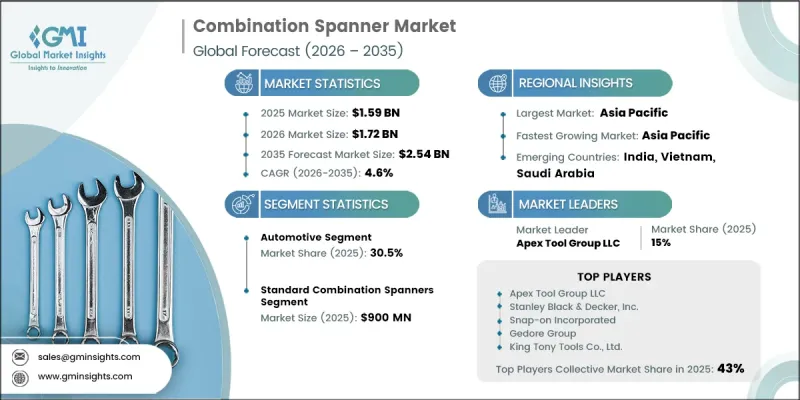
The Global Combination Spanner Market was valued at USD 1.59 billion in 2025 and is estimated to grow at a CAGR of 4.6% to reach USD 2.54 billion by 2035.
The combination spanner market includes multi-piece hand tool sets that combine an open-end wrench with a ring-end design, serving industrial, commercial, and consumer applications worldwide. Market growth is supported by rising demand from automotive manufacturing, equipment maintenance, construction activities, and expanding industrial operations across global economies. Increasing industrialization and manufacturing investments across developing regions continue to strengthen demand for professional-grade hand tools as businesses increasingly shift toward organized procurement channels and branded equipment. The recovery of construction projects, growing infrastructure investments, and rising maintenance requirements across manufacturing facilities are creating consistent opportunities for market expansion. Product innovation is further supporting industry growth as manufacturers introduce advanced designs that improve flexibility, efficiency, and user convenience for professional applications. In addition, the rapid expansion of digital procurement platforms is transforming purchasing behavior by improving product accessibility for industrial buyers, enabling businesses of all sizes to source high-quality combination spanner sets more efficiently while supporting the continued development of the global combination spanner market.
| Market Scope | |
|---|---|
| Start Year | 2025 |
| Forecast Year | 2026-2035 |
| Start Value | $1.59 Billion |
| Forecast Value | $2.54 Billion |
| CAGR | 4.6% |
The automotive segment accounted for 30.5% share in 2025. Demand from this segment is driven by both vehicle manufacturing operations and the automotive service industry, where combination spanner sets remain essential for assembly, maintenance, and repair applications. Continued growth in vehicle production, expanding maintenance requirements, and the increasing adoption of electric vehicles are supporting sustained demand for precision hand tools. The need for reliable tools capable of supporting accurate fastening and servicing operations continues to strengthen the automotive segment's leadership within the market.
The standard combination spanners segment generated USD 900 million in 2025, making them the leading product segment in the combination spanner market. Their widespread adoption is supported by their versatility across automotive manufacturing, construction, industrial maintenance, and general repair applications. Standard combination spanners continue to be preferred because they are compatible with established fastening requirements and provide the flexibility needed for a broad range of maintenance and assembly tasks. Their broad size availability and dependable performance make them a preferred choice for professional users and institutional buyers across multiple industries.
United States Combination Spanner Market held 87.6% share, generating USD 376 million in 2025. Market leadership is supported by a well-established automotive service industry, extensive industrial maintenance operations, and strong demand from professional technicians and commercial users. Continued investment in high-quality hand tools, supported by a mature repair and maintenance ecosystem, contributes to stable market growth. Ongoing replacement demand and increasing preference for premium branded tools are expected to sustain the country's leading position throughout the forecast period.
Major companies operating in the global combination spanner market include Apex Tool Group LLC, Snap-on Incorporated, Stanley Black & Decker Inc., Wera Werkzeuge GmbH, Gedore Group, Klein Tools Inc., King Tony Tools Co., Ltd., Jonnesway Enterprise Co., Ltd., TOPTUL (ROTAR International Co., Ltd.), Hazet-Werk Hermann Zerver GmbH & Co. KG, Teng Tools AB, KTC (Kyoto Tool Co., Ltd.), TONE Co., Ltd., Sunex Tools Inc., Wright Tool Company, Beta Utensili S.p.A. (Beta Tools), Unior d.d., Draper Tools Ltd., SK Professional Tools (SK Tools USA, LLC), Stahlwille Eduard Wille GmbH, and Proxxon GmbH. Companies operating in the combination spanner market are enhancing their competitive position through continuous product innovation, portfolio expansion, and investments in advanced manufacturing technologies. Industry participants are developing ergonomic, lightweight, and durable hand tools that improve user comfort, productivity, and long-term performance. Manufacturers are also strengthening their distribution networks by expanding digital sales channels and improving access to professional-grade tools across emerging markets. Strategic collaborations, acquisitions, and geographic expansion initiatives continue to support broader market penetration and customer acquisition.
Table of Contents
Chapter 1 Methodology
- 1.1 Research approach
- 1.2 Quality Commitments
- 1.2.1 GMI AI policy & data integrity commitment
- 1.2.1.1 Source consistency protocol
- 1.2.1 GMI AI policy & data integrity commitment
- 1.3 Research Trail & Confidence Scoring
- 1.3.1 Research Trail Components
- 1.3.2 Scoring Components
- 1.4 Data Collection
- 1.4.1 Partial list of primary sources
- 1.5 Data mining sources
- 1.5.1 Paid sources
- 1.5.1.1 Sources, by region
- 1.5.1 Paid sources
- 1.6 Base estimates and calculations
- 1.6.1 Base year calculation for any one approach
- 1.7 Forecast model
- 1.7.1 Quantified market impact analysis
- 1.7.1.1 Mathematical impact of growth parameters on forecast
- 1.7.1 Quantified market impact analysis
- 1.8 Research transparency addendum
- 1.8.1 Source attribution framework
- 1.8.2 Quality assurance metrics
- 1.8.3 Our commitment to trust
Chapter 2 Executive Summary
- 2.1 Industry snapshot
- 2.2 Business trends
- 2.3 Type trends
- 2.4 Material trends
- 2.5 Size trends
- 2.6 End use trends
- 2.7 Distribution channel trends
- 2.8 Regional trends
Chapter 3 Industry Insights
- 3.1 Industry ecosystem and value chain analysis
- 3.1.1 Factors affecting the value chain
- 3.1.2 Profit margin analysis
- 3.1.3 Disruptions & future outlook
- 3.1.4 Manufacturer landscape overview
- 3.1.5 Distributor landscape overview
- 3.2 Industry impact forces
- 3.2.1 Market Driver
- 3.2.2 Market challenges/pitfalls
- 3.2.3 Market opportunities
- 3.3 Growth potential analysis
- 3.4 Industry ecosystem analysis
- 3.5 Regulatory framework
- 3.5.1 Product safety & quality standards (ISO, DIN, ANSI/ASME)
- 3.5.2 Environmental & RoHS compliance
- 3.5.3 Import/export trade regulations & tariff policies
- 3.6 Pricing analysis (driven by primary research)
- 3.6.1 Historical price trend analysis (driven by primary research)
- 3.6.2 Pricing strategy by player type (premium / value / cost-plus) (driven by primary research)
- 3.7 Technology and innovation landscape
- 3.7.1 Material science advancements (chrome vanadium, titanium alloys)
- 3.7.2 Surface treatment & coating technologies
- 3.7.3 Ergonomic & smart design innovations
- 3.8 Porter's Analysis
- 3.9 PESTEL Analysis
- 3.10 Trade data analysis (driven by paid database) (HS Code: 82041110)
- 3.10.1 Import/export volume & value trends (driven by paid database)
- 3.10.2 Key trade corridors & tariff impact (driven by paid database)
- 3.11 Impact of AI and generative AI on the market
- 3.11.1 AI-driven disruption of existing business models (design, quality control, demand forecasting)
- 3.11.2 GenAI use cases & adoption roadmap by segment
- 3.11.3 Risks, limitations & regulatory considerations
- 3.12 Capacity & production landscape (driven by primary research)
- 3.12.1 Installed capacity by region & key producer (driven by primary research)
- 3.12.2 Capacity utilization rates & expansion pipelines (driven by primary research)
Chapter 4 Competitive Landscape, 2025
- 4.1 Introduction
- 4.2 Company market share analysis
- 4.2.1 North America
- 4.2.2 Europe
- 4.2.3 APAC
- 4.2.4 LATAM
- 4.2.5 MEA
- 4.3 Company matrix analysis
- 4.4 Competitive analysis of major market players
- 4.5 Competitive positioning matrix
- 4.6 Key developments
- 4.6.1 Mergers & acquisitions
- 4.6.2 Partnerships & collaborations
- 4.6.3 New product launches
- 4.6.4 Expansion plans
Chapter 5 Market Estimates and Forecast, By Type, 2022 - 2035 ($ Billion) (Thousand Units)
- 5.1 Key trends
- 5.2 Standard combination spanners
- 5.3 Ratchet combination spanners
- 5.4 Flex-head combination spanners
- 5.5 Offset/cranked combination spanners
- 5.6 Stubby combination spanners
- 5.7 Others
Chapter 6 Market Estimates and Forecast, By Material, 2022 - 2035 ($ Billion) (Thousand Units)
- 6.1 Key trends
- 6.2 Carbon steel
- 6.3 Chrome vanadium steel
- 6.4 Stainless steel
- 6.5 Others
Chapter 7 Market Estimates and Forecast, By Size, 2022 - 2035 ($ Billion) (Thousand Units)
- 7.1 Key trends
- 7.2 Small (up to 12 mm)
- 7.3 Medium (13 mm-22 mm)
- 7.4 Large (23 mm & above)
Chapter 8 Market Estimates and Forecast, By Application, 2022 - 2035 ($ Billion) (Thousand Units)
- 8.1 Key trends
- 8.2 Automotive
- 8.2.1 OEM vehicle assembly
- 8.2.2 Automotive aftermarket & service (MRO)
- 8.3 Construction & infrastructure
- 8.4 General manufacturing & industrial assembly
- 8.4.1 Heavy engineering & machinery maintenance
- 8.4.2 Light manufacturing & production line assembly
- 8.5 Home use/DIY
- 8.6 Aerospace & defense MRO
- 8.7 Marine MRO
- 8.8 Energy & utilities
- 8.8.1 Oil & gas
- 8.8.2 Renewable energy (wind, solar installation & maintenance)
- 8.9 Others
Chapter 9 Market Estimates and Forecast, By Distribution Channel, 2022 - 2035 ($ Billion) (Thousand Units)
- 9.1 Key trends
- 9.2 Online
- 9.3 Offline
Chapter 10 Market Estimates and Forecast, By Region, 2022 - 2035 ($ Billion) (Thousand Units)
- 10.1 Key trends
- 10.2 North America
- 10.2.1 US
- 10.2.2 Canada
- 10.3 Europe
- 10.3.1 Germany
- 10.3.2 UK
- 10.3.3 France
- 10.3.4 Italy
- 10.3.5 Spain
- 10.3.6 Netherlands
- 10.4 Asia Pacific
- 10.4.1 China
- 10.4.2 India
- 10.4.3 Japan
- 10.4.4 Australia
- 10.4.5 South Korea
- 10.5 Latin America
- 10.5.1 Brazil
- 10.5.2 Mexico
- 10.6 Middle East and Africa
- 10.6.1 South Africa
- 10.6.2 Saudi Arabia
- 10.6.3 UAE
Chapter 11 Company Profiles
- 11.1 TIER 1: Top Global Players
- 11.1.1 Snap-on Incorporated
- 11.1.2 Stanley Black & Decker Inc.
- 11.1.3 Wera Werkzeuge GmbH
- 11.1.4 Gedore Group
- 11.1.5 Klein Tools Inc.
- 11.1.6 King Tony Tools Co., Ltd.
- 11.1.7 Jonnesway Enterprise Co., Ltd.
- 11.1.8 TOPTUL (ROTAR International Co., Ltd.)
- 11.1.9 Apex Tool Group LLC.
- 11.2 TIER 2: Regional Players
- 11.2.1 Hazet-Werk Hermann Zerver GmbH & Co. KG
- 11.2.2 Teng Tools AB
- 11.2.3 KTC (Kyoto Tool Co., Ltd.)
- 11.2.4 TONE Co., Ltd.
- 11.2.5 Sunex Tools Inc.
- 11.2.6 Wright Tool Company
- 11.2.7 Beta Utensili S.p.A. (Beta Tools)
- 11.2.8 Unior d.d.
- 11.2.9 Draper Tools Ltd.
- 11.2.10 SK Professional Tools (SK Tools USA, LLC)
- 11.3 TIER 3: Niche & Specialist Players
- 11.3.1 Stahlwille Eduard Wille GmbH
- 11.3.2 Proxxon GmbH

