PUBLISHER: Global Market Insights Inc. | PRODUCT CODE: 2101554

PUBLISHER: Global Market Insights Inc. | PRODUCT CODE: 2101554
Biogas Engines Market Opportunity, Growth Drivers, Industry Trend Analysis, and Forecast 2026 - 2035
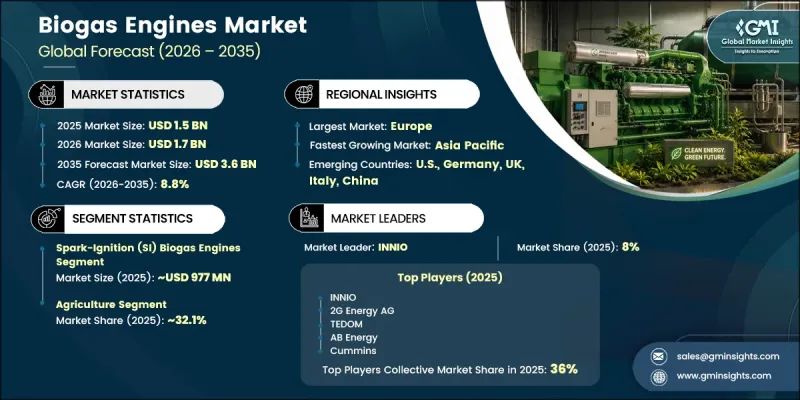
The Global Biogas Engines Market was valued at USD 1.5 billion in 2025 and is estimated to grow at a CAGR of 8.8% to reach USD 3.6 billion by 2035.
The growing emphasis on replacing fossil fuel-based distributed power generation with cleaner, feedstock-driven energy systems is strengthening the role of biogas-powered combined heat and power (CHP) solutions in both developed and emerging economies. Rising decarbonization targets, expanding investments in organic waste processing infrastructure, and continuous improvements in engine technologies are creating favorable conditions for market growth. Advancements in biomethane compatibility, digital monitoring capabilities, and lean-burn combustion systems are encouraging faster project deployment while improving operational efficiency. These technological developments continue to attract capital investments and support wider adoption of biogas engine systems. As renewable energy priorities continue to evolve, the market is benefiting from growing demand for efficient, low-emission power generation technologies that deliver reliable performance across a wide range of operating environments.
| Market Scope | |
|---|---|
| Start Year | 2025 |
| Forecast Year | 2026-2035 |
| Start Value | $1.5 Billion |
| Forecast Value | $3.6 Billion |
| CAGR | 8.8% |
The transition from conventional agricultural biogas toward upgraded biomethane has significantly influenced engine development across the biogas engines market. Biomethane refined to natural gas quality with methane concentrations of 95% or higher delivers greater combustion consistency while supporting grid integration opportunities. At the same time, these fuel characteristics require advanced engine platforms capable of operating efficiently at higher compression ratios while complying with increasingly stringent emission regulations governing nitrogen oxides and methane slip. As regulatory expectations continue to tighten, manufacturers are prioritizing enhanced combustion efficiency, fuel flexibility, and improved emissions performance to satisfy evolving customer and compliance requirements.
The spark-ignition (SI) biogas engines segment held 65.1% share, generating USD 977 million in 2025. SI engines rely on electrically generated ignition to initiate combustion and are specifically designed to maximize performance with methane-rich fuels. Their ability to deliver efficient and reliable operation under stable fuel conditions makes them the preferred solution for biomethane-powered CHP installations as well as biogas facilities utilizing consistent feedstock sources.
The agriculture segment generated USD 482 million, accounting for 32.1% share in 2025, and is forecast to grow at a CAGR of 8.6% through 2035. Agricultural operations continue to provide an abundant supply of organic feedstocks suitable for biogas production, creating long-term opportunities for engine deployment. Strong feedstock availability and ongoing investment in renewable energy infrastructure are supporting sustained demand for biogas engine systems throughout the agricultural sector while reinforcing its position as one of the market's largest end-use industries.
North America Biogas Engines Market accounted for 19.6% share in 2025. The regional market continues to benefit from a well-established biogas production network supported by substantial historical capital investments totaling approximately USD 39.8 billion. A significant installed base of biogas facilities has created consistent demand for engine maintenance, lifecycle services, equipment modernization, and replacement procurement. This growing installed infrastructure continues to strengthen long-term revenue opportunities for engine manufacturers and service providers operating throughout the region.
Companies operating in the global biogas engines market include INNIO, 2G Energy AG, TEDOM, AB Energy, Cummins Inc., MAN Energy Solutions, Caterpillar Inc., Kohler Power / Clarke Energy, Shandong Lvhuan Power Equipment, and Ettes Power (Wuxi Teneng Power & Machinery). Companies in the biogas engines market are strengthening their competitive positions by expanding aftermarket service capabilities, investing in digital monitoring platforms, and enhancing predictive maintenance solutions to improve equipment reliability and customer retention. Manufacturers are also prioritizing engine platforms with greater fuel flexibility, improved combustion efficiency, and lower emissions to comply with evolving environmental regulations. Product customization for diverse operating conditions and specialized applications continues to differentiate suppliers during competitive bidding processes. In addition, companies are expanding regional service networks, increasing lifecycle support offerings, and pursuing strategic mergers and acquisitions to broaden their installed equipment base and technical expertise.
Table of Contents
Chapter 1 Methodology & Scope
- 1.1 Research approach
- 1.2 Quality commitments
- 1.2.1 GMI AI policy & data integrity commitment
- 1.2.1.1 Source consistency protocol
- 1.2.1 GMI AI policy & data integrity commitment
- 1.3 Research trail & confidence scoring
- 1.3.1 Research trail components
- 1.3.2 Scoring components
- 1.4 Data collection
- 1.4.1 Partial list of primary sources
- 1.5 Data mining sources
- 1.5.1 Paid sources
- 1.5.1.1 Sources, by region
- 1.5.1 Paid sources
- 1.6 Base estimates and calculations
- 1.6.1 Base year calculation for any one approach
- 1.7 Market estimates & forecasts parameters
- 1.8 Forecast model
- 1.8.1 Quantified market impact analysis
- 1.8.1.1 Mathematical impact of growth parameters on forecast
- 1.8.1 Quantified market impact analysis
- 1.9 Research transparency addendum
- 1.9.1 Source attribution framework
- 1.9.2 Quality assurance metrics
- 1.9.3 Our commitment to trust
- 1.10 Market definitions
Chapter 2 Executive Summary
- 2.1 Industry synopsis, 2022 - 2035
- 2.1.1 Business trends
- 2.1.2 Product trends
- 2.1.3 Power trends
- 2.1.4 End use trends
- 2.1.5 Cooling system trends
- 2.1.6 Installation trends
- 2.1.7 Regional trends
Chapter 3 Industry Insights
- 3.1 Industry ecosystem analysis
- 3.1.1 Raw material availability & sourcing analysis
- 3.1.2 Manufacturing capacity assessment
- 3.1.3 Supply chain resilience & risk factors
- 3.1.4 Distribution network analysis
- 3.2 Industry impact forces
- 3.2.1 Growth drivers
- 3.2.2 Industry pitfalls & challenges
- 3.3 Regulatory landscape
- 3.4 Growth potential analysis
- 3.5 Porter's analysis
- 3.5.1 Bargaining power of suppliers
- 3.5.2 Bargaining power of buyers
- 3.5.3 Threat of new entrants
- 3.5.4 Threat of substitutes
- 3.6 PESTEL analysis
- 3.6.1 Political factors
- 3.6.2 Economic factors
- 3.6.3 Social factors
- 3.6.4 Technological factors
- 3.6.5 Legal factors
- 3.6.6 Environmental factors
- 3.7 Cost structure analysis of biogas engines
- 3.8 Emerging opportunities & trends
- 3.9 Digitalization & IoT integration
- 3.10 Growth in untapped markets & applications
- 3.11 Investment analysis & future prospects
- 3.12 Price trend analysis (USD/MW) (Driven by Primary Research)
- 3.12.1 By region (Driven by Primary Research)
- 3.12.2 By power (Driven by Primary Research)
- 3.13 Trade data analysis (Driven by Primary Research)
- 3.13.1 Import/export value trends (Driven by Primary Research)
- 3.13.2 Key trade corridors & tariff impact (Driven by Primary Research)
- 3.14 Impact of AI & Generative AI on the market (Driven by Primary Research)
- 3.14.1 AI-Driven production optimization (Driven by Primary Research)
- 3.14.2 Predictive maintenance & fault detection (Driven by Primary Research)
Chapter 4 Competitive Landscape, 2026
- 4.1 Introduction
- 4.2 Company market share analysis, by region, 2025
- 4.2.1 North America
- 4.2.2 Europe
- 4.2.3 Asia Pacific
- 4.2.4 Middle East & Africa
- 4.2.5 Latin America
- 4.3 Competitive analysis of major market players
- 4.4 Competitive positioning matrix
- 4.5 Key developments
- 4.5.1 Mergers & acquisitions
- 4.5.2 Partnerships & collaborations
- 4.5.3 New product launches
- 4.5.4 Expansion plans & funding
- 4.6 Company tier benchmarking
- 4.6.1 Tier classification criteria & qualifying thresholds
- 4.6.2 Tier positioning matrix by revenue, geography & innovation
Chapter 5 Market Size and Forecast, By Product, 2022 - 2035 (USD Million & MW)
- 5.1 Key trends
- 5.2 Spark-ignition (SI) biogas engines
- 5.3 Dual-fuel biogas engines
Chapter 6 Market Size and Forecast, By Power, 2022 - 2035 (USD Million & MW)
- 6.1 Key trends
- 6.2 ≤ 100 kW
- 6.3 > 100 kW - 500 kW
- 6.4 > 500 kW - 1 MW
- 6.5 > 1 MW
Chapter 7 Market Size and Forecast, By End Use, 2022 - 2035 (USD Million & MW)
- 7.1 Key trends
- 7.2 Agriculture
- 7.3 Wastewater treatment
- 7.4 Landfills
- 7.5 Industrial
- 7.6 Municipal waste
- 7.7 Others
Chapter 8 Market Size and Forecast, By Cooling System, 2022 - 2035 (USD Million & MW)
- 8.1 Key trends
- 8.2 Air-cooled
- 8.3 Water-cooled
Chapter 9 Market Size and Forecast, By Installation, 2022 - 2035 (USD Million & MW)
- 9.1 Key trends
- 9.2 New
- 9.3 Replacement
Chapter 10 Market Size and Forecast, By Region, 2022 - 2035 (USD Million & MW)
- 10.1 Key trends
- 10.2 North America
- 10.2.1 U.S.
- 10.2.2 Canada
- 10.3 Europe
- 10.3.1 Germany
- 10.3.2 UK
- 10.3.3 Austria
- 10.3.4 Italy
- 10.3.5 France
- 10.3.6 Sweden
- 10.3.7 Finland
- 10.3.8 Spain
- 10.3.9 Netherlands
- 10.3.10 Poland
- 10.3.11 Czech Republic
- 10.4 Asia Pacific
- 10.4.1 China
- 10.4.2 India
- 10.4.3 Japan
- 10.4.4 South Korea
- 10.4.5 Australia
- 10.4.6 Malaysia
- 10.4.7 Thailand
- 10.4.8 Philippines
- 10.5 Middle East & Africa
- 10.5.1 Saudi Arabia
- 10.5.2 South Africa
- 10.5.3 UAE
- 10.5.4 Kenya
- 10.6 Latin America
- 10.6.1 Brazil
- 10.6.2 Mexico
- 10.6.3 Argentina
Chapter 11 Company Profiles
- 11.1 2G Energy AG
- 11.2 AB Energy
- 11.3 Bergen Engines
- 11.4 Capstone Green Energy
- 11.5 Caterpillar
- 11.6 Clarke Energy
- 11.7 Cummins
- 11.8 Deutz AG
- 11.9 Doosan Enerbility
- 11.10 Everllence
- 11.11 Guascor Energy
- 11.12 INNIO
- 11.13 JFE Engineering
- 11.14 Kawasaki Heavy Industries
- 11.15 Liebherr
- 11.16 Mitsubishi Heavy Industries
- 11.17 Perkins Engines
- 11.18 Rolls Royce
- 11.19 TEDOM
- 11.20 Wartsila
- 11.21 Weichai Power
- 11.22 YANMAR HOLDINGS CO.

