PUBLISHER: Global Market Insights Inc. | PRODUCT CODE: 2101560

PUBLISHER: Global Market Insights Inc. | PRODUCT CODE: 2101560
Amphibious Excavators Market Opportunity, Growth Drivers, Industry Trend Analysis, and Forecast 2026 - 2035
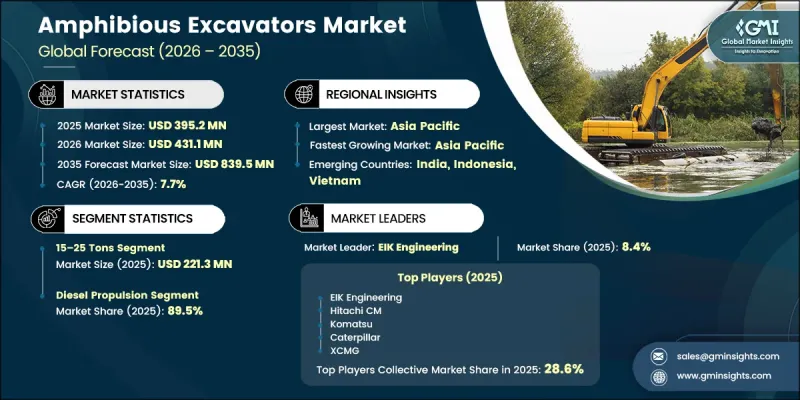
The Global Amphibious Excavators Market was valued at USD 395.2 million in 2025 and is estimated to grow at a CAGR of 7.7% to reach USD 839.5 million by 2035.
Market growth is supported by increasing investments in coastal infrastructure, waterway development, wetland restoration, and marine construction projects that require specialized equipment capable of operating in challenging aquatic and semi-aquatic environments. Expanding offshore infrastructure activities and growing public funding for environmental restoration programs continue to create long-term opportunities for amphibious excavator deployment across multiple regions. Government-backed initiatives focused on restoring wetlands, improving waterways, and strengthening climate resilience are contributing to a steady pipeline of projects requiring specialized excavation equipment. Although amphibious excavators are priced significantly higher than conventional tracked excavators because of their specialized engineering, corrosion-resistant construction, pontoon systems, and hydraulic configurations, demand continues to expand as contractors seek equipment designed for complex operating conditions. Higher equipment costs remain a challenge for smaller construction companies, particularly in cost-sensitive markets. However, increasing availability of rental and leasing services is helping reduce capital investment requirements, enabling contractors to access advanced equipment on a project basis while supporting broader adoption across infrastructure and environmental restoration projects.
| Market Scope | |
|---|---|
| Start Year | 2025 |
| Forecast Year | 2026-2035 |
| Start Value | $395.2 Million |
| Forecast Value | $839.5 million |
| CAGR | 7.7% |
The 15-25 tons operating weight segment represented USD 221.3 million, accounting for 56% share in 2025. This operating weight category continues to lead the market because it provides an effective balance of lifting capacity, digging performance, operational reach, and versatility required for a broad range of dredging, wetland restoration, and water infrastructure applications. Its ability to perform efficiently across diverse project environments continues to support strong market demand.
The diesel propulsion segment accounted for 89.5% share in 2025, generating USD 353.9 million. Diesel-powered equipment continues to dominate the market because it offers high energy density, extended operating range, dependable refueling capabilities, and broad maintenance support through established service networks. These advantages remain particularly important for projects conducted in remote locations where access to electrical charging infrastructure is limited, allowing operators to maintain continuous productivity during demanding work cycles.
Asia Pacific Amphibious Excavators Market generated USD 189 million in 2025 and is projected to reach USD 437 million by 2035, registering the highest regional CAGR of 8.6%. The region continues to lead the global market due to rising investments in water infrastructure, coastal development, dredging activities, and environmental restoration projects. Ongoing expansion of public infrastructure programs and increasing demand for specialized construction equipment continue to strengthen regional market growth while supporting wider adoption of amphibious excavators across multiple application areas.
Major companies operating in the global amphibious excavators market include EIK Engineering, Hitachi CM, Komatsu, Caterpillar, XCMG, Sinoway Industrial, and Ultratrex Machinery. Companies operating in the amphibious excavators market are strengthening their competitive position by investing in product innovation, improving equipment durability, and expanding specialized product portfolios for marine and wetland applications. Manufacturers continue to enhance machine performance through advanced hydraulic systems, corrosion-resistant components, and improved operational efficiency to meet evolving customer requirements. Strategic investments in manufacturing capacity, distribution networks, and after-sales service capabilities are helping companies strengthen customer relationships and expand regional market presence. Many organizations are also focusing on rental partnerships, flexible equipment leasing solutions, and customized project support services to improve accessibility for contractors.
Table of Contents
Chapter 1 Methodology & Scope
- 1.1 Research approach
- 1.2 Quality Commitments
- 1.2.1 GMI AI policy & data integrity commitment
- 1.2.1.1 Source consistency protocol
- 1.2.1 GMI AI policy & data integrity commitment
- 1.3 Research Trail & Confidence Scoring
- 1.3.1 Research Trail Components
- 1.3.2 Scoring Components
- 1.4 Data Collection
- 1.4.1 Partial list of primary sources
- 1.5 Data mining sources
- 1.5.1 Paid sources
- 1.5.1.1 Sources, by region
- 1.5.1 Paid sources
- 1.6 Base estimates and calculations
- 1.6.1 Base year calculation
- 1.7 Forecast model
- 1.7.1 Quantified market impact analysis
- 1.7.1.1 Mathematical impact of growth parameters on forecast
- 1.7.1 Quantified market impact analysis
- 1.8 Research transparency addendum
- 1.8.1 Source attribution framework
- 1.8.2 Quality assurance metrics
- 1.8.3 Our commitment to trust
Chapter 2 Executive Summary
- 2.1 Industry 360° synopsis
- 2.2 Key market trends
- 2.2.1 Operating Weight
- 2.2.2 Propulsion
- 2.2.3 Application
- 2.2.4 End-User
- 2.2.5 Region
- 2.3 TAM Analysis, 2026-2035
- 2.4 CXO perspectives: Strategic imperatives
Chapter 3 Industry Insights
- 3.1 Industry ecosystem analysis
- 3.1.1 Supplier landscape
- 3.1.2 Cost structure
- 3.1.3 Profit margin
- 3.1.4 Value addition at each stage
- 3.1.5 Vertical integration trends
- 3.1.6 Disruptors
- 3.2 Industry impact forces
- 3.2.1 Growth drivers
- 3.2.1.1 Expansion of flood control infrastructure
- 3.2.1.2 Growth in dredging and port development
- 3.2.1.3 Rising pipeline installation projects
- 3.2.1.4 Government investment in ecosystem restoration
- 3.2.2 Industry pitfalls & challenges
- 3.2.2.1 High equipment costs
- 3.2.2.2 Niche market demand
- 3.2.2.3 Limited skilled operators
- 3.2.3 Market opportunities
- 3.2.3.1 Expansion of coastal protection projects
- 3.2.3.2 Increasing inland waterway modernization
- 3.2.3.3 Growth in environmental remediation
- 3.2.3.4 Adoption of hybrid and electric amphibious excavators
- 3.2.1 Growth drivers
- 3.3 Growth potential analysis
- 3.4 Technology and Innovation landscape
- 3.4.1 Current technologies
- 3.4.2 Emerging technologies
- 3.5 Pricing Analysis (Driven by Primary Research)
- 3.5.1 Historical Price Trend Analysis
- 3.5.2 Pricing Strategy by Player Type (Premium / Value / Cost-plus)
- 3.6 Regulatory landscape
- 3.6.1 North America
- 3.6.1.1 OSHA Excavation & Heavy Equipment Safety Standards (US)
- 3.6.1.2 EPA Tier 4 Final Nonroad Diesel Engine Emission Standards (US)
- 3.6.1.3 USACE Dredging and Environmental Regulations (US)
- 3.6.1.4 CSA Construction Equipment Safety Standards (Canada)
- 3.6.2 Europe
- 3.6.2.1 EU Machinery Regulation (EU) 2023/1230
- 3.6.2.2 EU Stage V Non-Road Mobile Machinery (NRMM) Emission Standards
- 3.6.2.3 CE Marking for Construction Machinery
- 3.6.2.4 Water Framework Directive (2000/60/EC)
- 3.6.3 Asia-Pacific
- 3.6.3.1 China Stage IV Non-Road Mobile Machinery Emission Standards
- 3.6.3.2 GB Safety Standards for Earthmoving Machinery (China)
- 3.6.3.3 Japan Off-Road Vehicle Emission Regulations
- 3.6.3.4 CPCB IV Emission Norms for Construction Equipment (India)
- 3.6.3.5 Work Health and Safety (WHS) Regulations for Earthmoving Equipment (Australia)
- 3.6.4 Latin America
- 3.6.4.1 NR-12 Machinery and Equipment Safety Regulations (Brazil)
- 3.6.4.2 NOM-004-STPS Machinery Safety Standard (Mexico)
- 3.6.5 Middle East & Africa
- 3.6.5.1 UAE Environmental and Heavy Equipment Safety Regulations
- 3.6.5.2 Saudi Environmental Regulations for Construction Equipment
- 3.6.5.3 South Africa Occupational Health and Safety Act - Driven Machinery Regulations
- 3.6.1 North America
- 3.7 Porter's analysis
- 3.8 PESTEL analysis
- 3.9 Patent analysis (Driven by Primary Research)
- 3.10 Trade Data Analysis (Driven by paid database)
- 3.10.1 Import/export volume & value trends
- 3.10.2 Key trade corridors & tariff impact
- 3.11 Cost breakdown analysis
- 3.12 Impact of AI & generative AI on the market
- 3.12.1 AI Driven Disruption of Existing Business Models
- 3.12.2 GenAI Use Cases and Adoption Roadmap by Segment
- 3.12.3 Risks Limitations and Regulatory Considerations
- 3.13 Capacity & Production Landscape (Driven by Primary Research)
- 3.13.1 Installed Capacity by Region & Key Producer
- 3.13.2 Capacity Utilization Rates & Expansion Pipelines
- 3.14 Sustainability and environmental aspects
- 3.14.1 Sustainable practices
- 3.14.2 Waste reduction strategies
- 3.14.3 Energy efficiency in production
- 3.14.4 Eco-friendly Initiatives
- 3.14.5 Carbon footprint considerations
- 3.15 Forecast assumptions & scenario analysis (Driven by Primary Research)
- 3.15.1 Base Case key macro & industry variables driving CAGR
- 3.15.2 Optimistic Scenarios Favorable Macro and Industry Tailwinds
- 3.15.3 Pessimistic Scenario Macroeconomic slowdown or industry headwinds
Chapter 4 Competitive Landscape, 2025
- 4.1 Introduction
- 4.2 Company market share analysis
- 4.2.1 North America
- 4.2.2 Europe
- 4.2.3 Asia-Pacific
- 4.2.4 Latin America
- 4.2.5 Middle East & Africa
- 4.3 Competitive positioning matrix
- 4.4 Key developments
- 4.4.1 Mergers & acquisitions
- 4.4.2 Partnerships & collaborations
- 4.4.3 New product launches
- 4.4.4 Expansion plans and funding
- 4.5 Company tier benchmarking
- 4.5.1 Tier classification criteria & qualifying thresholds
- 4.5.2 Tier positioning matrix by revenue, geography & innovation
Chapter 5 Market Estimates & Forecast, By Operating Weight, 2022 - 2035 ($Mn, Units)
- 5.1 Key trends
- 5.2 Below 15 Tons
- 5.3 15-25 Tons
- 5.4 Above 25 Tons
Chapter 6 Market Estimates & Forecast, By Propulsion, 2022 - 2035 ($Mn, Units)
- 6.1 Key trends
- 6.2 Diesel
- 6.3 Hybrid/Electric
Chapter 7 Market Estimates & Forecast, By Application, 2022 - 2035 ($Mn, Units)
- 7.1 Key trends
- 7.2 Dredging
- 7.3 Wetland Construction & Restoration
- 7.4 Pipeline Installation
- 7.5 Environmental Remediation
- 7.6 Waterway Maintenance & Flood Control
- 7.7 Others
Chapter 8 Market Estimates & Forecast, By End-User, 2022 - 2035 ($Mn, Units)
- 8.1 Key trends
- 8.2 Construction
- 8.3 Government & Municipal Authorities
- 8.4 Oil & Gas
- 8.5 Mining
- 8.6 Environmental & Conservation Agencies
- 8.7 Others
Chapter 9 Market Estimates & Forecast, By Region, 2022 - 2035 ($Mn, Units)
- 9.1 North America
- 9.1.1 US
- 9.1.2 Canada
- 9.2 Europe
- 9.2.1 UK
- 9.2.2 Germany
- 9.2.3 France
- 9.2.4 Italy
- 9.2.5 Spain
- 9.2.6 Belgium
- 9.2.7 Netherlands
- 9.2.8 Sweden
- 9.2.9 Russia
- 9.3 Asia Pacific
- 9.3.1 China
- 9.3.2 India
- 9.3.3 Japan
- 9.3.4 Australia
- 9.3.5 Singapore
- 9.3.6 South Korea
- 9.3.7 Vietnam
- 9.3.8 Indonesia
- 9.3.9 Thailand
- 9.4 Latin America
- 9.4.1 Brazil
- 9.4.2 Mexico
- 9.4.3 Argentina
- 9.5 MEA
- 9.5.1 South Africa
- 9.5.2 Saudi Arabia
- 9.5.3 UAE
- 9.5.4 Turkey
Chapter 10 Company Profiles
- 10.1 Global Players
- 10.1.1 Caterpillar
- 10.1.2 Hitachi Construction Machinery
- 10.1.3 Hyundai Construction Equipment
- 10.1.4 Komatsu
- 10.1.5 Liebherr
- 10.1.6 SANY
- 10.1.7 Volvo Construction Equipment
- 10.1.8 XCMG
- 10.2 Regional Players
- 10.2.1 EIK Engineering
- 10.2.2 REMU
- 10.2.3 Sinoway Industrial
- 10.2.4 TSBC Engineering
- 10.2.5 Ultratrex Machinery
- 10.2.6 Waterking
- 10.2.7 Wetland Equipment
- 10.3 Emerging Players / Disruptors
- 10.3.1 Wilco Manufacturing
- 10.3.2 ESI Shanghai
- 10.3.3 Marsh Buggies
- 10.3.4 Wilson Marsh Equipment

