PUBLISHER: Global Market Insights Inc. | PRODUCT CODE: 2101563

PUBLISHER: Global Market Insights Inc. | PRODUCT CODE: 2101563
North America Precast Concrete Market Opportunity, Growth Drivers, Industry Trend Analysis, and Forecast 2026 - 2035
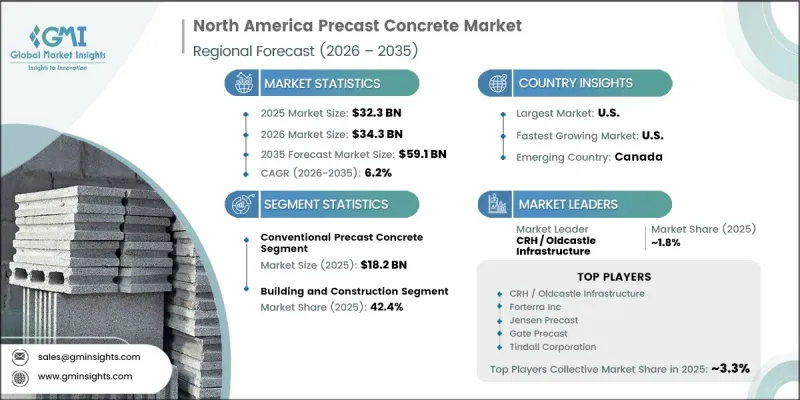
North America Precast Concrete Market was valued at USD 32.3 billion in 2025 and is estimated to grow at a CAGR of 6.2% to reach USD 59.1 billion by 2035.
The expansion reflects a structural evolution in construction practices across North America, where developers, contractors, and public sector bodies are increasingly shifting toward off-site manufacturing to shorten delivery schedules and reduce reliance on scarce on-site skilled labor. Infrastructure spending at the federal level, combined with schedule-driven project execution across private development, continues to reinforce demand momentum through the forecast period. Growth is also being reinforced by rising investment in data centers, industrial facilities, and multifamily residential construction, which is expanding the addressable demand base beyond traditional civil infrastructure applications. Precast adoption is increasingly favored due to its ability to support parallel construction workflows, where foundation work and component manufacturing occur simultaneously, reducing overall project timelines by 20% to 40% compared to cast-in-place methods. This efficiency advantage is especially critical in commercial real estate, hospitality, and residential development, where financing timelines and occupancy commitments strongly influence construction decisions.
| Market Scope | |
|---|---|
| Start Year | 2025 |
| Forecast Year | 2026-2035 |
| Start Value | $32.3 Billion |
| Forecast Value | $59.1 Billion |
| CAGR | 6.2% |
The conventional precast concrete segment generated USD 18.2 billion in 2025 and is projected to grow at a CAGR of 5.8% through 2035. This segment maintains strong market presence due to its widespread application across parking structures, transportation infrastructure, residential buildings, and civil engineering projects. Demand remains closely tied to ongoing construction volumes across the United States, where a well-established precast manufacturing base ensures consistent supply across major metropolitan regions and supports competitive pricing structures.
The building and construction application segment accounted for 42.4% share in 2025 and is projected to grow at a CAGR of 6.6% through 2035. Growth in this segment is driven by sustained activity in multifamily housing, commercial office developments, healthcare infrastructure, and data center construction. Precast concrete is increasingly selected due to its ability to deliver predictable construction schedules and controlled project costs, both of which are critical performance metrics for developers. Products such as double-tee floor systems and hollow-core slabs are widely used across parking facilities, mixed-use buildings, and residential towers, reinforcing their importance within high-volume manufacturing operations.
United States Precast Concrete Market represented USD 30.2 billion in 2025, accounting for a 93.5% share, and is projected to grow at a CAGR of 6.3% through 2035. Structural demand in the country is supported by large-scale infrastructure rehabilitation requirements, including a significant number of aging bridge structures requiring replacement or repair, which sustains long-term demand for precast bridge components. Manufacturing capacity is concentrated across regions including the Midwest, Southeast, Mid-Atlantic, and Texas, enabling efficient distribution to high-density construction corridors and reinforcing supply chain efficiency across the national market.
Major players operating in the North America Precast Concrete Market are Oldcastle Infrastructure (CRH plc), Forterra, Inc., Jensen Precast, Gate Precast Company, Tindall Corporation, Wells Concrete, Spancrete, Knife River Corporation, Fabcon Precast, Hannibal Industries, High Concrete Group, Northeast Precast, Nitterhouse Concrete Products, Concrete Pipe & Precast LLC, Leesburg Concrete Company. Companies operating in the North America precast concrete market are increasingly focusing on expanding production capacity and modernizing manufacturing facilities to support rising construction demand across infrastructure and building sectors. Strategic investments in automation and digital fabrication technologies are helping improve production efficiency, quality consistency, and cost optimization. Many players are strengthening regional supply chains by establishing or expanding plants closer to high-growth urban and infrastructure corridors, reducing logistics costs and delivery timelines. Partnerships with contractors and developers are becoming more common to secure long-term supply agreements for large-scale projects.
Table of Contents
Chapter 1 Research Methodology
- 1.1 Research approach
- 1.2 Quality Commitments
- 1.2.1 GMI AI policy & data integrity commitment
- 1.2.1.1 Source consistency protocol
- 1.2.1 GMI AI policy & data integrity commitment
- 1.3 Research Trail & Confidence Scoring
- 1.3.1 Research Trail Components
- 1.3.2 Scoring Components
- 1.4 Data Collection
- 1.4.1 Partial list of primary sources
- 1.5 Data mining sources
- 1.5.1 Paid sources
- 1.5.1.1 Sources, by region
- 1.5.1 Paid sources
- 1.6 Base estimates and calculations
- 1.6.1 Base year calculation
- 1.7 Forecast model
- 1.7.1 Quantified market impact analysis
- 1.7.1.1 Mathematical impact of growth parameters on forecast
- 1.7.1 Quantified market impact analysis
- 1.8 Research transparency addendum
- 1.8.1 Source attribution framework
- 1.8.2 Quality assurance metrics
- 1.8.3 Our commitment to trust
Chapter 2 Executive Summary
- 2.1 Industry 360° synopsis
- 2.2 Key market trends
- 2.2.1 Country
- 2.2.2 Product type
- 2.2.3 Material type
- 2.2.4 Application
Chapter 3 Industry Insights
- 3.1 Industry ecosystem analysis
- 3.1.1 Supplier landscape
- 3.1.2 Profit margin
- 3.1.3 Value addition at each stage
- 3.1.4 Factor affecting the value chain
- 3.2 Industry impact forces
- 3.2.1 Growth drivers
- 3.2.1.1 Rising demand for faster construction
- 3.2.1.2 Urbanization and smart city development
- 3.2.1.3 Adoption of automation, BIM (Building Information Modeling), and 3D modeling
- 3.2.1.4 Increased adoption in industrial & data center projects
- 3.2.2 Industry pitfalls & challenges
- 3.2.2.1 Design rigidity and customization limits
- 3.2.2.2 Skilled labor shortage in manufacturing
- 3.2.2.3 Price sensitivity & competition from alternatives
- 3.2.3 Opportunities
- 3.2.3.1 Low-carbon & green concrete innovation
- 3.2.3.2 Adoption of advanced materials (UHPC & HPC)
- 3.2.3.3 Digitalization & smart construction integration
- 3.2.1 Growth drivers
- 3.3 Growth potential analysis
- 3.4 Future market trends
- 3.5 Technology and innovation landscape
- 3.5.1 Current technological trends
- 3.5.2 Emerging technologies
- 3.6 Regulatory landscape
- 3.6.1 Standards and compliance requirements
- 3.6.2 Regional regulatory frameworks
- 3.6.3 Certification standards
- 3.7 Trade data analysis (HS Code 681091)
- 3.7.1 Import/export volume & value trends
- 3.7.2 Key trade corridors & tariff impact
- 3.8 Pricing analysis
- 3.8.1 Historical price trend analysis (driven by primary research)
- 3.8.2 Pricing strategy by player type (premium / value / mass market)
- 3.9 Impact of AI & generative AI on the market
- 3.9.1 AI-driven disruption of existing business models
- 3.9.2 GenAI use cases & adoption roadmap by segment
- 3.9.3 Risks, limitations & regulatory considerations
- 3.10 Porter's analysis
- 3.11 PESTEL analysis
Chapter 4 Competitive Landscape, 2025
- 4.1 Introduction
- 4.2 Company market share analysis
- 4.3 Company matrix analysis
- 4.4 Competitive analysis of major market players
- 4.5 Competitive positioning matrix
- 4.6 Key developments
- 4.6.1 Mergers & acquisitions
- 4.6.2 Partnerships & collaborations
- 4.6.3 New product launches
- 4.6.4 Expansion plans
Chapter 5 Market Estimates & Forecast, By Product Type, 2022 - 2035, (USD Billion) (Tons)
- 5.1 Key trends
- 5.2 Wall panels & facades
- 5.2.1 Architectural wall panels
- 5.2.2 Structural wall panels
- 5.3 Beams & columns
- 5.4 Floors & roofs
- 5.4.1 Double tee slabs
- 5.4.2 Hollow core slabs
- 5.4.3 Inverted tee beams
- 5.5 Staircases & landings
- 5.6 Bridge girders & elements
- 5.7 Pipes, manholes & drainage products
- 5.8 Piles & foundation elements
- 5.9 Others (retaining walls, barriers, utility vaults)
Chapter 6 Market Estimates & Forecast, By Material Type, 2022 - 2035, (USD Billion) (Tons)
- 6.1 Key trends
- 6.2 Conventional precast concrete
- 6.3 Prestressed precast concrete
- 6.4 Fiber-reinforced precast concrete
- 6.5 Ultra-high-performance concrete (UHPC)
Chapter 7 Market Estimates & Forecast, By Application, 2022 - 2035, (USD Billion) (Tons)
- 7.1 Key trends
- 7.2 Building & construction
- 7.2.1 Residential
- 7.2.1.1 Single-family housing
- 7.2.1.2 Multi-family & apartment buildings
- 7.2.2 Commercial
- 7.2.2.1 Office buildings & corporate campuses
- 7.2.2.2 Retail & mixed-use developments
- 7.2.2.3 Hospitality & entertainment venues
- 7.2.3 Industrial
- 7.2.3.1 Warehouses & logistics facilities
- 7.2.3.2 Manufacturing plants & facilities
- 7.2.1 Residential
- 7.3 Infrastructure
- 7.3.1 Bridges & overpasses
- 7.3.2 Roads & highways
- 7.3.3 Tunnels & underground structures
- 7.3.4 Railways & transit infrastructure
- 7.4 Water & wastewater
- 7.4.1 Water treatment facilities
- 7.4.2 Stormwater management systems
- 7.4.3 Sewage & wastewater infrastructure
- 7.5 Agricultural & rural infrastructure
- 7.6 Others
Chapter 8 Market Estimates & Forecast, By Country, 2022 - 2035, (USD Billion) (Tons)
- 8.1 Key trends
- 8.2 U.S.
- 8.3 Canada
Chapter 9 Company Profiles
- 9.1 Global Leaders
- 9.1.1 Oldcastle Infrastructure (CRH plc)
- 9.1.2 Forterra, Inc.
- 9.1.3 Jensen Precast
- 9.1.4 Gate Precast Company
- 9.1.5 Tindall Corporation
- 9.2 Regional Champions
- 9.2.1 Wells Concrete
- 9.2.2 Spancrete
- 9.2.3 Knife River Corporation
- 9.2.4 Hannibal Industries
- 9.2.5 Fabcon Precast
- 9.3 Emerging Players
- 9.3.1 Northeast Precast
- 9.3.2 High Concrete Group
- 9.3.3 Nitterhouse Concrete Products
- 9.3.4 Concrete Pipe & Precast LLC
- 9.3.5 Leesburg Concrete Company

