PUBLISHER: Global Market Insights Inc. | PRODUCT CODE: 2101581

PUBLISHER: Global Market Insights Inc. | PRODUCT CODE: 2101581
Cosmetics and Beauty Market Opportunity, Growth Drivers, Industry Trend Analysis, and Forecast 2026 - 2035
The Global Cosmetics and Beauty Market was valued at USD 1 trillion in 2025 and is estimated to grow at a CAGR of 4.1% to reach USD 1.5 trillion by 2035.
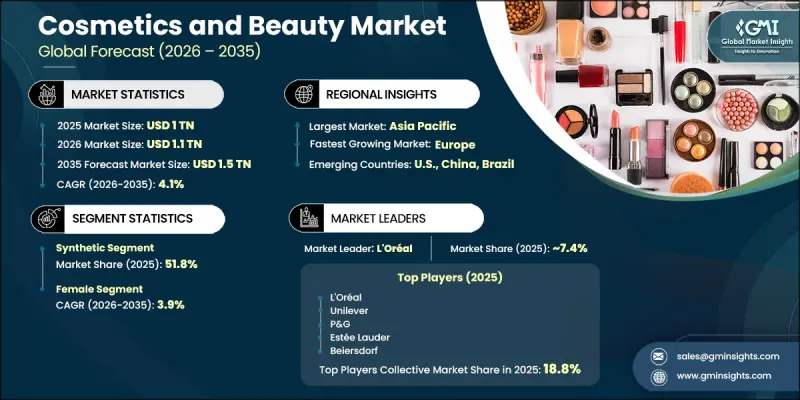
The cosmetics and beauty market continues to expand as consumers place greater emphasis on ingredient transparency, personal wellness, and premium self-care products. Growing awareness of product composition, safety, and sustainability is encouraging manufacturers to develop formulations that align with evolving consumer expectations while strengthening brand credibility. The rapid expansion of digital commerce, combined with changing purchasing behavior, is enabling brands to reach broader consumer groups and improve product accessibility across multiple distribution channels. At the same time, the market is expanding beyond its traditional consumer base as demand rises across additional demographic segments, creating new opportunities for product diversification and innovation. Increasing scrutiny of marketing claims and product labeling is also encouraging companies to strengthen regulatory compliance and improve transparency regarding ingredient sourcing and environmental positioning. Businesses that fail to support product claims with appropriate verification face growing reputational and regulatory risks. Meanwhile, fluctuations in energy prices, geopolitical uncertainties, and variations in agricultural output continue to influence raw material availability and production costs, creating periodic pricing pressure across manufacturing operations while reinforcing the need for efficient supply chain management throughout the cosmetics and beauty market.
| Market Scope | |
|---|---|
| Start Year | 2025 |
| Forecast Year | 2026-2035 |
| Start Value | $1 Trillion |
| Forecast Value | $1.5 Trillion |
| CAGR | 4.1% |
The synthetic segment accounted for 51.8% share in 2025, representing USD 528.8 billion, and is expected to grow at a CAGR of 3.8% during 2026-2035. The segment continues to maintain its leading position because synthetic ingredients offer consistent formulation performance, manufacturing efficiency, reliable product stability, and cost-effective large-scale production. These characteristics make synthetic materials an essential component in the development of high-volume personal care and beauty products, enabling manufacturers to maintain quality standards while supporting broad commercial availability across global markets.
The male consumers segment 22.5% share in 2025, accounting for USD 229.7 billion, and is projected to grow at a CAGR of 4.4% through 2035. Increasing acceptance of men's grooming, skincare, and beauty routines continues to reshape consumer demand across global markets. Growing interest in personal care, expanding product availability, and greater brand focus on male-oriented solutions are encouraging higher spending within this consumer segment. Companies are also introducing a wider range of products tailored to men's preferences, supporting continued market expansion and strengthening growth opportunities across this rapidly evolving customer base.
North America Cosmetics and Beauty Market accounted for 29.3% share in 2025, generating USD 299.1 billion. The United States remains the largest national market in the region, supported by high consumer spending on beauty and personal care products, a mature retail environment, and strong demand across multiple product categories. Broad retail availability, continued product innovation, and the widespread adoption of both physical and digital shopping channels continue to reinforce the region's leading position within the global cosmetics and beauty market.
Major companies operating in the global cosmetics and beauty market include The Estee Lauder Companies (ELC), L'Oreal S.A., Beiersdorf AG, Unilever PLC, and P&G Beauty. Companies operating in the cosmetics and beauty market are strengthening their competitive position by investing in product innovation, expanding clean and premium product portfolios, and developing formulations that address evolving consumer preferences for safety, transparency, and sustainability. Manufacturers continue to allocate significant resources to research and development to improve product performance and introduce differentiated offerings across multiple consumer segments. Businesses are also expanding digital commerce capabilities, strengthening omnichannel distribution networks, and enhancing direct-to-consumer engagement to improve customer reach. Strategic partnerships, portfolio diversification, sustainable sourcing initiatives, advanced manufacturing technologies, and efficient supply chain management remain central to long-term growth strategies.
Table of Contents
Chapter 1 Methodology and Scope
- 1.1 Market scope and definition
- 1.2 Research design
- 1.2.1 Research approach
- 1.2.2 Data collection methods
- 1.3 Data mining sources
- 1.3.1 Global
- 1.3.2 Regional/Country
- 1.4 Base estimates and calculations
- 1.4.1 Base year calculation
- 1.4.2 Key trends for market estimation
- 1.5 Primary research and validation
- 1.5.1 Primary sources
- 1.6 Forecast model
- 1.7 Research assumptions and limitations
Chapter 2 Executive Summary
- 2.1 Industry 360° synopsis
- 2.2 Key market trends
- 2.2.1 Regional
- 2.2.2 Product type
- 2.2.3 Ingredient type
- 2.2.4 Price range
- 2.2.5 Consumer group
- 2.2.6 Distribution channel
Chapter 3 Industry Insights
- 3.1 Industry ecosystem analysis
- 3.1.1 Raw material suppliers & botanical sourcing
- 3.1.2 Ingredient processors & extract manufacturers
- 3.1.3 Profit margin
- 3.1.4 Value addition at each stage
- 3.1.5 Factor affecting the value chain
- 3.2 Industry impact forces
- 3.2.1 Growth drivers
- 3.2.1.1 Rising demand for natural, organic & clean beauty products
- 3.2.1.2 K-Beauty global expansion & cultural influence
- 3.2.1.3 Premiumization & trading-up in skincare & hair care
- 3.2.2 Industry pitfalls & challenges
- 3.2.2.1 Greenwashing risks & growing consumer skepticism
- 3.2.2.2 Raw material price volatility & supply chain disruptions
- 3.2.3 Opportunities
- 3.2.3.1 Market expansion
- 3.2.3.2 Increasing trends of clean beauty in regions
- 3.2.1 Growth drivers
- 3.3 Growth potential analysis
- 3.4 Future market trends
- 3.5 Technology and innovation landscape
- 3.5.1 Cold pressing & steam distillation technologies
- 3.5.2 Fermentation & biotechnology in natural actives
- 3.5.3 Nanotechnology & encapsulation for enhanced delivery
- 3.5.4 Green chemistry & sustainable formulation methods
- 3.6 Price trends (driven by primary research)
- 3.6.1 Historical price trend analysis
- 3.6.2 Pricing strategy by player type (premium / value / cost-plus)
- 3.6.3 Natural & Organic vs. Conventional - Price Premium Analysis by Geography & Channel
- 3.6.4 Pricing Models - DTC vs. Wholesale vs. Mass Retail
- 3.7 Regulatory landscape
- 3.7.1 EU Cosmetic Regulation (EC No 1223/2009)
- 3.7.2 North America
- 3.7.2.1 United States - FDA Cosmetics Regulations & MoCRA 2022 Requirements
- 3.7.2.2 Canada - Health Canada Cosmetics Regulations & Natural Health Products Framework
- 3.7.3 Europe - EU Cosmetics Regulation (EC 1223/2009) & Green Claims Directive
- 3.7.4 Asia Pacific
- 3.7.4.1 China - NMPA Cosmetics Import Registration & Cross-Border E-Commerce Rules
- 3.7.4.2 SEA - Country-Level Regulatory Snapshot (Vietnam, Indonesia, Thailand, Philippines)
- 3.7.5 Latin America - Central America Regulatory Requirements
- 3.7.6 Organic & Natural Certification Standards
- 3.7.7 Emerging Regulatory Trends
- 3.8 Market entry analysis
- 3.9 Supply chain analysis
- 3.9.1 Global raw material origin map
- 3.9.2 Central America as a botanical ingredient sourcing hub
- 3.9.3 Manufacturing & processing hubs by region
- 3.9.4 Distribution network structure & logistics infrastructure
- 3.9.5 Supply chain risks & dependencies
- 3.10 Trade statistics (driven by paid database) (HS code - 3304)
- 3.10.1 Import/Export volume & value trends by product category
- 3.10.2 Key trade corridors & tariff impact
- 3.10.3 U.S. trade corridors
- 3.10.4 China & SEA cross-border trade flows & tariff implications
- 3.11 Impact of AI & generative AI on the Market
- 3.11.1 AI-driven disruption of existing business models
- 3.11.2 GenAI use cases & adoption roadmap by product segment
- 3.11.3 Risks, limitations & regulatory considerations for AI in beauty
- 3.12 Distribution infrastructure & channel penetration landscape (driven by primary research)
- 3.12.1 Channel coverage by region & format (modern vs. traditional trade)
- 3.12.2 Last-mile infrastructure gaps & emerging channel shifts (social commerce, quick commerce)
- 3.12.3 Mass retail channel accessibility for new entrants
- 3.13 Porter's analysis
- 3.14 PESTEL analysis
- 3.15 Consumer behavior analysis
- 3.15.1 Purchasing patterns
- 3.15.2 Preference analysis
- 3.15.3 Regional variations in consumer behavior
- 3.15.4 Impact of e-commerce on buying decisions
Chapter 4 Competitive Landscape, 2025
- 4.1 Introduction
- 4.2 Company market share analysis
- 4.2.1 By region
- 4.2.1.1 North America
- 4.2.1.2 Europe
- 4.2.1.3 Asia Pacific
- 4.2.1.4 Latin America
- 4.2.1.5 Middle East and Africa
- 4.2.1 By region
- 4.3 Company matrix analysis
- 4.4 Competitive analysis of major market players
- 4.5 Competitive positioning matrix
- 4.6 Key developments
- 4.6.1 Mergers & acquisitions
- 4.6.2 Partnerships & collaborations
- 4.6.3 New product launches
- 4.6.4 Expansion plans
Chapter 5 Market Estimates and Forecast, By Product Type, 2022 - 2035 (USD Billion) (Million Units)
- 5.1 Key trends
- 5.2 Skincare
- 5.2.1 Face care
- 5.2.1.1 Moisturizers
- 5.2.1.2 Serums
- 5.2.1.3 Cleansers
- 5.2.1.4 Toners
- 5.2.1.5 Treatment masks
- 5.2.2 Eye care
- 5.2.2.1 Eye creams
- 5.2.2.2 Under-eye treatments
- 5.2.3 Anti-aging & dermocosmetics
- 5.2.1 Face care
- 5.3 Hair care
- 5.3.1 Shampoo & conditioners
- 5.3.2 Hair treatments & masks
- 5.3.3 Styling & finishing products
- 5.4 Color cosmetics & makeup
- 5.4.1 Facial cosmetics
- 5.4.2 Eye cosmetics
- 5.4.3 Lip cosmetics
- 5.4.4 Nail cosmetics
- 5.5 Body care & personal hygiene
- 5.5.1 Body lotions, creams & moisturizers
- 5.5.2 Bath & shower products
- 5.5.2.1 Gels
- 5.5.2.2 Soaps
- 5.5.2.3 Scrubs
- 5.5.3 Deodorants & antiperspirants
- 5.5.4 Feminine hygiene products
- 5.6 Fragrances & perfumes
- 5.6.1 Premium / prestige fragrances
- 5.6.2 Mass fragrances, body mists & splashes
- 5.7 Sun care
- 5.7.1 Face sun care
- 5.7.1.1 SPF moisturizers
- 5.7.1.2 Facial sunscreens
- 5.7.2 Body sun care
- 5.7.1 Face sun care
- 5.8 Oral care
- 5.8.1 Toothpaste & teeth whitening products
- 5.8.2 Mouthwash & other oral hygiene
- 5.9 Men's grooming
- 5.9.1 Shaving & pre/post-shave products
- 5.9.2 Men's skincare
- 5.9.3 Men's hair care & styling
- 5.10 Baby & kids personal care
- 5.10.1 Baby skincare & body care
- 5.10.2 Baby hair care & bath products
- 5.11 Professional beauty services
- 5.11.1 Spa & wellness services
- 5.11.2 Hair salons
- 5.11.3 Nail salons
- 5.11.4 Beauty clinics & aesthetic treatments
- 5.11.5 Makeup & styling services
Chapter 6 Market Estimates and Forecast, By Ingredient Type, 2022 - 2035 (USD Billion) (Million Units)
- 6.1 Key trends
- 6.2 Natural
- 6.3 Semi-natural
- 6.4 Synthetic
Chapter 7 Market Estimates and Forecast, By Price Range, 2022 - 2035 (USD Billion) (Million Units)
- 7.1 Key trends
- 7.2 Low
- 7.3 Medium
- 7.4 High
- 7.5 Luxury
Chapter 8 Market Estimates and Forecast, By Consumer Group, 2022 - 2035 (USD Billion) (Million Units)
- 8.1 Key trends
- 8.2 Male
- 8.3 Female
- 8.4 Kids
Chapter 9 Market Estimates and Forecast, By Distribution Channel, 2022 - 2035 (USD Billion) (Million Units)
- 9.1 Key trends
- 9.2 Online
- 9.2.1 E-commerce
- 9.2.2 Social commerce
- 9.2.3 Company websites
- 9.3 Offline
- 9.3.1 Specialty stores
- 9.3.2 Mega retail stores
- 9.3.3 Pharmacies & drugstores
- 9.3.4 Professional & salon channels
- 9.3.5 Others (convenience stores, travel retail, direct sales)
Chapter 10 Market Estimates and Forecast, By Region, 2022 - 2035 (USD Billion) (Million Units)
- 10.1 Key trends
- 10.2 North America
- 10.2.1 U.S.
- 10.2.2 Canada
- 10.3 Europe
- 10.3.1 Germany
- 10.3.2 UK
- 10.3.3 France
- 10.3.4 Italy
- 10.3.5 Spain
- 10.4 Asia Pacific
- 10.4.1 China
- 10.4.2 Japan
- 10.4.3 India
- 10.4.4 Australia
- 10.4.5 South Korea
- 10.5 Latin America
- 10.5.1 Brazil
- 10.5.2 Mexico
- 10.5.3 Argentina
- 10.6 Middle East and Africa
- 10.6.1 South Africa
- 10.6.2 Saudi Arabia
- 10.6.3 UAE
Chapter 11 Company Profiles
- 11.1 Global players
- 11.1.1 L'Oreal S.A.
- 11.1.2 Unilever plc
- 11.1.3 Procter & Gamble
- 11.1.4 Estee Lauder Companies
- 11.1.5 Beiersdorf AG
- 11.1.6 Shiseido Company
- 11.1.7 LVMH (Perfumes & Cosmetics)
- 11.1.8 Coty Inc.
- 11.1.9 Puig Brands S.A.
- 11.1.10 Kenvue Inc.
- 11.2 Regional Players
- 11.2.1 Amorepacific Corporation
- 11.2.2 Kao Corporation
- 11.2.3 Natura Cosmeticos S.A.
- 11.2.4 Grupo Boticario (O Boticario)
- 11.2.5 Shanghai Jahwa United
- 11.2.6 Mandom Corporation
- 11.2.7 Clarins Group
- 11.2.8 e.l.f. Beauty, Inc.
- 11.3 Emerging brands
- 11.3.1 Yatsen Global (Perfect Diary)
- 11.3.2 Proya Cosmetics Co.
- 11.3.3 Kiko Milano S.p.A.

