PUBLISHER: Global Market Insights Inc. | PRODUCT CODE: 2101609

PUBLISHER: Global Market Insights Inc. | PRODUCT CODE: 2101609
Satellite Power Systems Market Opportunity, Growth Drivers, Industry Trend Analysis, and Forecast 2026 - 2035
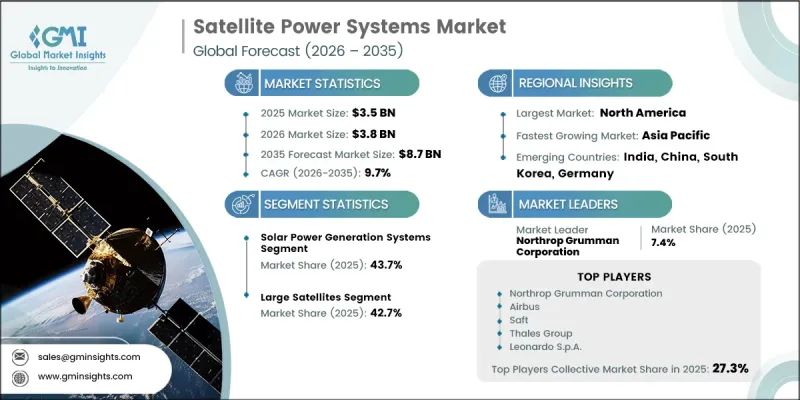
The Global Satellite Power Systems Market was valued at USD 3.5 billion in 2025 and is estimated to grow at a CAGR of 9.7% to reach USD 8.7 billion by 2035.
Market growth is driven by the industry's shift from limited satellite production toward continuous, high-volume manufacturing programs that require dependable onboard power generation, energy storage, and power management technologies. This transformation is creating sustained demand for advanced power subsystems capable of supporting increasingly sophisticated satellite missions. Rising power requirements for communication, navigation, Earth observation, and other high-performance payloads are encouraging manufacturers to develop lighter, more efficient power solutions without compromising operational reliability. At the same time, ongoing innovation in solar cell technology, battery performance, and power distribution architecture is improving system efficiency while reducing overall launch weight. Continuous improvements in power density, conversion efficiency, and integrated subsystem performance are strengthening the long-term outlook for the satellite power systems market as satellite operators seek reliable, lightweight, and high-output energy solutions for next-generation spacecraft operating across diverse mission profiles.
| Market Scope | |
|---|---|
| Start Year | 2025 |
| Forecast Year | 2026-2035 |
| Start Value | $3.5 Billion |
| Forecast Value | $8.7 Billion |
| CAGR | 9.7% |
Advancements in power generation technology continue to reshape the satellite power systems market by improving energy efficiency while lowering the mass required for onboard power production. High-efficiency multi-junction solar cell technologies now deliver cell-level AM0 efficiencies of approximately 32% to 33%, while achieving specific power levels exceeding 3,000 W/kg at the cell scale. These performance improvements enable satellite manufacturers to either reduce solar array size or increase available power for onboard payloads without significantly increasing launch mass, supporting more capable and cost-efficient spacecraft designs.
The solar power generation systems segment held 43.7% share in 2025 and is projected to grow at a CAGR of 9.3% throughout 2035. The segment maintains its leadership because photovoltaic technology remains the primary source of electrical power for satellites operating in Earth orbit. Continued advancements in solar energy conversion efficiency, durability, and lightweight array designs are further reinforcing the adoption of solar-based power systems across satellites of varying sizes and mission requirements.
The large satellites weighing more than 1,000 kg accounted for 42.7% share in 2025, making them the largest satellite class within the industry. Their leading position is primarily attributed to the substantially higher value of onboard power systems installed in each spacecraft. Larger satellite platforms require high-capacity solar arrays, advanced battery assemblies, and sophisticated power management equipment capable of supporting demanding mission profiles over extended operational lifecycles, resulting in significantly higher power subsystem expenditures per satellite.
North America Satellite Power Systems Market captured 44.5% share in 2025 and is forecast to grow at a CAGR of 9.3% during 2026-2035. Regional growth is supported by the strong presence of commercial satellite developers, government procurement organizations, and a highly developed manufacturing ecosystem specializing in satellite power technologies. Ongoing institutional investments in space programs continue to provide a stable demand environment for manufacturers supplying power generation, energy storage, and power management solutions across the satellite value chain.
The competitive landscape of the global satellite power systems market includes Airbus, Leonardo S.p.A., Northrop Grumman Corporation, Mitsubishi Electric Corporation, Thales Group, OHB SE, Beyond Gravity, Intuitive Machines, Moog Inc., Terma A/S, Rocket Lab USA / SolAero Technologies, AZUR SPACE Solar Power GmbH, Spectrolab Inc., Sierra Space, Redwire Space, EaglePicher Technologies, Saft, GS Yuasa Lithium Power, EnerSys / ABSL Space Products, Sharp Energy Solutions Corporation (SESJ), Shanghai Institute of Space Power-Sources (SISP), NanoAvionics, EnduroSat, AAC Clyde Space, and ISISpace (Innovative Solutions In Space). Companies operating in the satellite power systems market are strengthening their market positions through continuous investment in advanced solar technologies, high-performance battery systems, and intelligent power management solutions that improve spacecraft efficiency and operational reliability. Manufacturers are focusing on lightweight system designs, higher power density, and improved energy conversion capabilities to meet evolving satellite performance requirements. Strategic collaborations with satellite manufacturers, long-term supply agreements, and expanded production capabilities are supporting stronger customer relationships while increasing order visibility.
Table of Contents
Chapter 1 Methodology & Scope
- 1.1 Research approach
- 1.2 Quality commitments
- 1.2.1 GMI AI policy & data integrity commitment
- 1.2.1.1 Source consistency protocol
- 1.2.1 GMI AI policy & data integrity commitment
- 1.3 Research trail & confidence scoring
- 1.3.1 Research trail components
- 1.3.2 Scoring components
- 1.4 Data collection
- 1.4.1 Partial list of primary sources
- 1.5 Data mining sources
- 1.5.1 Paid sources
- 1.5.1.1 Sources, by region
- 1.5.1 Paid sources
- 1.6 Base estimates and calculations
- 1.6.1 Base year calculation for any one approach
- 1.7 Market estimates & forecasts parameters
- 1.8 Forecast model
- 1.8.1 Quantified market impact analysis
- 1.8.1.1 Mathematical impact of growth parameters on forecast
- 1.8.1 Quantified market impact analysis
- 1.9 Research transparency addendum
- 1.9.1 Source attribution framework
- 1.9.2 Quality assurance metrics
- 1.9.3 Our commitment to trust
- 1.10 Market definitions
Chapter 2 Executive Summary
- 2.1 Industry synopsis, 2022 - 2035
- 2.1.1 Component type trends
- 2.1.2 Satellite Class trends
- 2.1.3 Application trends
- 2.1.4 Orbit type trends
- 2.1.5 End user trends
- 2.1.6 Regional trends
Chapter 3 Industry Insights
- 3.1 Industry ecosystem analysis
- 3.2 Industry impact forces
- 3.2.1 Growth drivers
- 3.2.1.1 Rapid growth in commercial satellite launches and mega-constellation deployments
- 3.2.1.2 Expanding Earth observation, communication, navigation, and defense satellite programs
- 3.2.1.3 Continuous advancements in space-grade solar cells, batteries, and power management electronics
- 3.2.1.4 Rising government investments in space exploration and national space programs
- 3.2.2 Industry pitfalls and challenges
- 3.2.2.1 High qualification requirements for radiation-hardened, space-grade power components
- 3.2.2.2 Limited availability of specialized space-qualified electronic components
- 3.2.3 Market opportunities
- 3.2.3.1 Advancement of high-efficiency satellite power technologies
- 3.2.3.2 Expansion of small satellites and leo constellations
- 3.2.1 Growth drivers
- 3.3 Growth potential analysis
- 3.4 Regulatory landscape (Driven by primary research)
- 3.4.1 North America
- 3.4.2 Europe
- 3.4.3 Asia Pacific
- 3.4.4 Latin America
- 3.4.5 MEA
- 3.5 Technology landscape
- 3.5.1 Current technological trends
- 3.5.2 Emerging technologies
- 3.6 Pricing trend analysis (Driven by primary research)
- 3.7 Future market trends
- 3.8 Patent analysis
- 3.9 Porter's analysis
- 3.10 PESTEL analysis
- 3.11 Impact of AI and Generative AI on the market (Driven by primary research)
- 3.12 Value chain analysis (Driven by primary research)
- 3.13 Investment & funding analysis (Driven by primary research)
- 3.14 Consumer insights (Driven by primary research)
Chapter 4 Competitive Landscape, 2025
- 4.1 Introduction
- 4.2 Company market share analysis, by region, 2025
- 4.2.1 North America
- 4.2.2 Europe
- 4.2.3 Asia Pacific
- 4.2.4 Middle East & Africa
- 4.2.5 Latin America
- 4.3 Key developments
- 4.3.1 Key partnerships & collaborations
- 4.3.2 Major M&A activities
- 4.3.3 Product innovations & launches
- 4.3.4 Market expansion strategies
- 4.4 Competitive positioning matrix
Chapter 5 Market Size and Forecast, By Component Type, 2022 - 2035 (USD Million)
- 5.1 Key trends
- 5.2 Solar power generation systems
- 5.2.1 Photovoltaic cells
- 5.2.2 Solar panels & arrays
- 5.3 Energy Storage Systems
- 5.3.1 Lithium-ion (Li-Ion) batteries
- 5.3.2 Nickel-hydrogen (NiH₂) batteries
- 5.3.3 Solid-state batteries
- 5.3.4 Supercapacitors & hybrid storage
- 5.3.5 Battery management electronics
- 5.3.6 Others
- 5.4 Power management & distribution (PMAD) systems
- 5.4.1 Power conditioning units (PCUs)
- 5.4.2 DC-DC converters & voltage regulators
- 5.4.3 Electrical power controllers (EPCs)
- 5.4.4 Power distribution units (PDUs) & switchgear
Chapter 6 Market Size and Forecast, By Satellite Class , 2022 - 2035 (USD Million)
- 6.1 Key trends
- 6.2 Small satellites (≤ 100 kg)
- 6.3 Medium satellites (100–1,000 kg)
- 6.4 Large satellites (>1,000 kg)
Chapter 7 Market Size and Forecast, By Application, 2022 - 2035 (USD Million)
- 7.1 Key trends
- 7.2 Communication satellites
- 7.3 Earth observation satellites
- 7.4 Navigation satellites
- 7.5 Military & defense satellites
- 7.6 Scientific & research satellites
- 7.7 Space stations & human spaceflight systems
- 7.8 Others
Chapter 8 Market Size and Forecast, By Orbit Type, 2022 - 2035 (USD Million)
- 8.1 Key trends
- 8.2 Low earth orbit (LEO)
- 8.3 Medium earth orbit (MEO)
- 8.4 Geostationary orbit (GEO)
- 8.5 Deep space / highly elliptical orbit (HEO)
Chapter 9 Market Size and Forecast, By End User, 2022 - 2035 (USD Million)
- 9.1 Key Trends
- 9.2 Commercial satellite operators
- 9.3 Government & civil space agencies
- 9.4 Defense & military organizations
Chapter 10 Market Size and Forecast, By Region, 2022 - 2035 (USD Million)
- 10.1 Key trends
- 10.2 North America
- 10.2.1 U.S.
- 10.2.2 Canada
- 10.3 Europe
- 10.3.1 Germany
- 10.3.2 France
- 10.3.3 UK
- 10.3.4 Spain
- 10.3.5 Italy
- 10.4 Asia Pacific
- 10.4.1 China
- 10.4.2 Japan
- 10.4.3 South Korea
- 10.4.4 India
- 10.4.5 Australia
- 10.5 Middle East & Africa
- 10.5.1 Saudi Arabia
- 10.5.2 UAE
- 10.5.3 South Africa
- 10.6 Latin America
- 10.6.1 Brazil
- 10.6.2 Argentina
- 10.6.3 Mexico
Chapter 11 Company Profiles
- 11.1 Airbus
- 11.2 Northrop Grumman Corporation
- 11.3 Thales Group
- 11.4 Leonardo S.p.A.
- 11.5 Mitsubishi Electric Corporation
- 11.6 OHB SE
- 11.7 Intuitive Machines
- 11.8 Beyond Gravity
- 11.9 Terma A/S
- 11.10 Moog Inc.
- 11.11 AZUR SPACE Solar Power GmbH
- 11.12 Spectrolab Inc.
- 11.13 Rocket Lab USA / SolAero Technologies
- 11.14 Sierra Space
- 11.15 Redwire Space
- 11.16 Saft
- 11.17 EaglePicher Technologies
- 11.18 EnerSys / ABSL Space Products
- 11.19 GS Yuasa Lithium Power
- 11.20 Sharp Energy Solutions Corporation (SESJ)
- 11.21 Shanghai Institute of Space Power-Sources (SISP)
- 11.22 NanoAvionics
- 11.23 AAC Clyde Space
- 11.24 EnduroSat
- 11.25 ISISpace (Innovative Solutions In Space)

