PUBLISHER: Global Market Insights Inc. | PRODUCT CODE: 2101614

PUBLISHER: Global Market Insights Inc. | PRODUCT CODE: 2101614
Next Generation Customer Loyalty Market Opportunity, Growth Drivers, Industry Trend Analysis, and Forecast 2026 - 2035
The Global Next Generation Customer Loyalty Market was valued at USD 12.4 billion in 2025 and is estimated to grow at a CAGR of 12.6% to reach USD 39.1 billion by 2035.
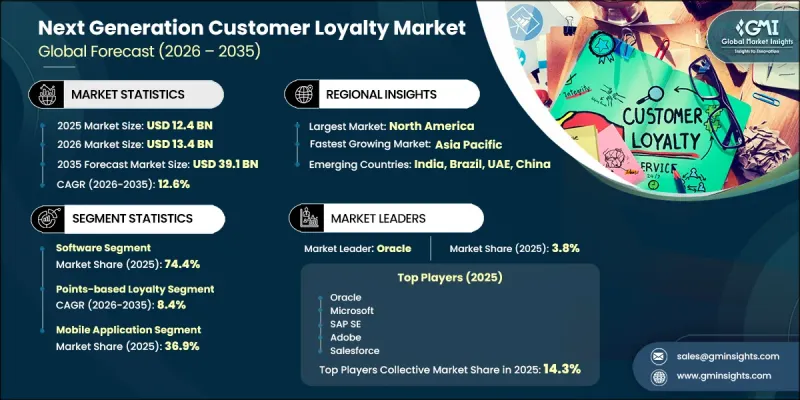
The next generation customer loyalty market is experiencing strong growth as organizations across multiple industries increasingly invest in intelligent customer engagement platforms that strengthen long-term consumer relationships and improve retention. Artificial intelligence has become a defining technology within modern loyalty solutions by enabling highly personalized customer experiences based on behavioral insights, purchasing activity, engagement patterns, and preference data. Advancements in cloud-native infrastructure, real-time analytics, and intelligent data processing have significantly improved the speed and accuracy of loyalty decision-making, allowing businesses to deliver personalized rewards almost instantly. At the same time, organizations are moving beyond traditional transaction-based reward programs and adopting engagement models focused on delivering more meaningful customer experiences. This evolution reflects a broader shift toward customer-centric loyalty strategies designed to improve emotional engagement, increase brand affinity, and maximize lifetime customer value. Continuous innovation in digital engagement technologies is expected to support sustained expansion of the next generation customer loyalty market throughout the forecast period.
| Market Scope | |
|---|---|
| Start Year | 2025 |
| Forecast Year | 2026-2035 |
| Start Value | $12.4 Billion |
| Forecast Value | $39.1 Billion |
| CAGR | 12.6% |
Artificial intelligence-powered personalization continues to redefine the next generation customer loyalty market by enabling businesses to deliver highly customized rewards, promotions, and engagement strategies based on real-time customer intelligence. The availability of advanced data infrastructure and intelligent analytics has substantially reduced response times between customer interactions and loyalty actions, allowing organizations to create more dynamic and responsive loyalty programs. As enterprises seek stronger customer relationships, greater emphasis is being placed on personalized engagement strategies that generate higher participation, stronger customer satisfaction, and improved revenue performance compared with conventional loyalty models.
The software segment accounted for 74.4% share in 2025 and is anticipated to grow at a CAGR of 13.5% between 2026 and 2035. The segment includes loyalty management software, personalization platforms, analytics solutions, reward management applications, and integration technologies that connect loyalty programs with broader enterprise ecosystems. Growing adoption of cloud-based software delivery models is accelerating market expansion as organizations continue replacing legacy systems with scalable, flexible, and data-driven loyalty platforms capable of supporting evolving customer engagement strategies.
The mobile application segment captured 36.9% share in 2025, making it the leading customer engagement channel. Mobile platforms have become the preferred interface for loyalty program participation by delivering personalized offers, real-time notifications, secure authentication, digital payment capabilities, and location-aware customer experiences within a single application. As businesses increasingly embrace mobile-first engagement strategies, mobile applications continue to serve as the primary platform for delivering seamless and continuous loyalty experiences that strengthen customer interaction across multiple industries.
China Next Generation Customer Loyalty Market accounted for 40% share, generating USD 1.3 billion in 2025. The country continues to represent one of the region's largest and fastest-growing markets, supported by the widespread integration of digital commerce and customer loyalty solutions. Loyalty engagement has become increasingly embedded within everyday digital purchasing activities, creating highly convenient customer experiences that encourage continuous interaction. This close integration between digital transactions and loyalty ecosystems has transformed customer loyalty into an essential component of the broader digital commerce landscape while supporting sustained market expansion across the region.
Leading participants in the global next generation customer loyalty market include Salesforce, Adobe, Oracle, SAP SE, Microsoft, Antavo, and Capillary Technologies. Companies operating in the next generation customer loyalty market are strengthening their competitive positions by investing in artificial intelligence, advanced analytics, and cloud-based loyalty platforms that deliver highly personalized customer experiences. Businesses continue expanding platform capabilities through improved automation, real-time decision-making, and deeper integration with enterprise applications to provide seamless omnichannel engagement. Product innovation remains a key priority as vendors introduce flexible loyalty solutions that support changing customer expectations and evolving business models. Companies are also pursuing strategic partnerships, expanding global operations, and enhancing research and development efforts to strengthen technology capabilities and broaden their customer base.
Table of Contents
Chapter 1 Research Methodology
- 1.1 Research approach
- 1.2 Quality Commitments
- 1.2.1 GMI AI policy & data integrity commitment
- 1.2.1.1 Source consistency protocol
- 1.2.1 GMI AI policy & data integrity commitment
- 1.3 Research Trail & Confidence Scoring
- 1.3.1 Research Trail Components
- 1.3.2 Scoring Components
- 1.4 Data Collection
- 1.4.1 Partial list of primary sources
- 1.5 Data mining sources
- 1.5.1 Paid sources
- 1.5.1.1 Sources, by region
- 1.5.1 Paid sources
- 1.6 Base estimates and calculations
- 1.6.1 Base year calculation for any one approach
- 1.7 Forecast model
- 1.7.1 Quantified Market impact analysis
- 1.7.1.1 Mathematical impact of growth parameters on forecast
- 1.7.1 Quantified Market impact analysis
- 1.8 Research transparency addendum
- 1.8.1 Source attribution framework
- 1.8.2 Quality assurance metrics
- 1.8.3 Our commitment to trust
Chapter 2 Executive Summary
- 2.1 Industry 360° synopsis, 2022 - 2035
- 2.2 Key Market trends
- 2.2.1 Regional
- 2.2.2 Solution
- 2.2.3 Program Type
- 2.2.4 Engagement Channel
- 2.2.5 End Use
- 2.3 TAM Analysis, 2026-2035
- 2.4 CXO perspectives: Strategic imperatives
Chapter 3 Industry Insights
- 3.1 Industry ecosystem analysis
- 3.1.1 Supplier landscape
- 3.1.2 Profit margin analysis
- 3.1.3 Cost structure
- 3.1.4 Value addition at each stage
- 3.1.5 Factor affecting the value chain
- 3.1.6 Disruptions
- 3.2 Industry impact forces
- 3.2.1 Growth drivers
- 3.2.1.1 Rising Demand for AI-Driven Hyper-Personalization in Loyalty Programs
- 3.2.1.2 Rapid Proliferation of Mobile-First & Omnichannel Engagement Models
- 3.2.1.3 Shift from Transactional to Experiential & Emotional Loyalty
- 3.2.1.4 Growing First-Party & Zero-Party Data Strategies Amid Cookie Deprecation
- 3.2.2 Industry pitfalls and challenges
- 3.2.2.1 Legacy POS & IT Fragmentation Delaying Real-Time Loyalty Execution
- 3.2.2.2 Stringent Data Privacy & Consent Compliance Burdens (GDPR, CCPA)
- 3.2.3 Market opportunities
- 3.2.3.1 Digital Wallet-Native Loyalty Passes Enabling App-Free Enrollment
- 3.2.3.2 Coalition & Partner Loyalty Ecosystems Expanding Member Reach
- 3.2.3.3 Tokenized & Blockchain-Based Loyalty as Web3 Differentiation
- 3.2.3.4 SME Market Democratization via Modular SaaS Loyalty Platforms
- 3.2.1 Growth drivers
- 3.3 Technology and innovation landscape
- 3.3.1 Current technological trends
- 3.3.2 Emerging technologies
- 3.4 Growth potential analysis
- 3.5 Pricing Analysis (Driven by primary research)
- 3.5.1 Historical Price Trend Analysis
- 3.5.2 Pricing Strategy by Player Type
- 3.6 Regulatory landscape
- 3.6.1 North America
- 3.6.1.1 U.S. Federal Trade Commission (FTC)
- 3.6.1.2 Consumer Financial Protection Bureau (CFPB)
- 3.6.1.3 National Institute of Standards and Technology (NIST)
- 3.6.2 Europe
- 3.6.2.1 European Data Protection Board (EDPB)
- 3.6.2.2 European Commission
- 3.6.2.3 Federal Network Agency (BNetzA)
- 3.6.2.4 French Data Protection Authority (CNIL)
- 3.6.3 Asia Pacific
- 3.6.3.1 Ministry of Industry and Information Technology (MIIT)
- 3.6.3.2 Ministry of Ecology and Environment (MEE)
- 3.6.3.3 Ministry of Economy, Trade and Industry (METI)
- 3.6.4 Latin America
- 3.6.4.1 National Institute of Metrology, Quality and Technology (INMETRO)
- 3.6.4.2 National Traffic Department (DENATRAN)
- 3.6.4.3 Secretariat of Infrastructure, Communications and Transport (SICT)
- 3.6.5 Middle East & Africa
- 3.6.5.1 Ministry of Energy and Infrastructure
- 3.6.5.2 Emirates Authority for Standardization and Metrology (ESMA)
- 3.6.5.3 Saudi Standards, Metrology and Quality Organization (SASO)
- 3.6.1 North America
- 3.7 Porter's analysis
- 3.8 PESTEL analysis
- 3.9 Patent analysis (Driven by primary research)
- 3.9.1 Patent Filing Trends by Technology Domain
- 3.9.2 Top Patent Holders & White Space Analysis
- 3.10 Cost breakdown analysis
- 3.11 Impact of AI and Generative AI on the Market
- 3.11.1 AI Driven Disruption of Existing Business Models
- 3.11.2 GenAI Use Cases and Adoption Roadmap by Segment
- 3.11.3 Risks Limitations and Regulatory Considerations
- 3.12 Sustainability and environmental aspects
- 3.12.1 Sustainable practices
- 3.12.2 Waste reduction strategies
- 3.12.3 Energy efficiency in production
- 3.12.4 Eco-friendly Initiatives
- 3.12.5 Carbon footprint considerations
- 3.13 Forecast assumptions & scenario analysis (Driven by Primary Research)
- 3.13.1 Base Case- Key Macro & Industry Variables Driving CAGR
- 3.13.2 Optimistic Scenarios- Favorable macro and industry tailwinds
- 3.13.3 Pessimistic Scenario - Macroeconomic slowdown or industry headwinds
Chapter 4 Competitive Landscape, 2025
- 4.1 Introduction
- 4.2 Company Market share analysis
- 4.2.1 North America
- 4.2.2 Europe
- 4.2.3 Asia Pacific
- 4.2.4 LATAM
- 4.2.5 MEA
- 4.3 Competitive analysis of major market players
- 4.4 Competitive positioning matrix
- 4.5 Key developments
- 4.5.1 Mergers & acquisitions
- 4.5.2 Partnerships & collaborations
- 4.5.3 New Product Launches
- 4.5.4 Expansion Plans and funding
- 4.6 Company tier benchmarking
- 4.6.1 Tier classification criteria & qualifying thresholds
- 4.6.2 Tier positioning matrix by revenue, geography & innovation
Chapter 5 Market Estimates & Forecast, By Solution, 2022 - 2035 (USD Mn)
- 5.1 Key trends
- 5.2 Software
- 5.2.1 Loyalty Platform & Engine
- 5.2.2 Analytics & Data Intelligence
- 5.2.3 Campaign & Offer Management
- 5.2.4 Customer Data Platform (CDP) Integration Layer
- 5.3 Services
- 5.3.1 Professional Services
- 5.3.2 Managed Services
Chapter 6 Market Estimates & Forecast, By Program Type, 2022 - 2035 (USD Mn)
- 6.1 Key trends
- 6.2 Points-Based Loyalty
- 6.3 Tier-Based / VIP Loyalty
- 6.4 Subscription-Based Loyalty
- 6.5 Coalition / Partner Loyalty
- 6.6 Gamified / Experiential Loyalty
- 6.7 Tokenized / Blockchain-Based Loyalty
- 6.8 Others
Chapter 7 Market Estimates & Forecast, By Engagement Channel, 2022 - 2035 (USD Mn)
- 7.1 Key trends
- 7.2 Mobile Application
- 7.3 Web & E-mail
- 7.4 Point-of-Sale (POS)
- 7.5 Social / Messaging
- 7.6 Others
Chapter 8 Market Estimates & Forecast, By End Use, 2022 - 2035 (USD Mn)
- 8.1 Key trends
- 8.2 Retail & E-Commerce
- 8.3 BFSI
- 8.4 Travel & Hospitality
- 8.5 Telecommunications
- 8.6 Healthcare
- 8.7 Media & Entertainment
- 8.8 FMCG
- 8.9 Others
Chapter 9 Market Estimates & Forecast, By Region, 2022 - 2035 (USD Mn)
- 9.1 Key trends
- 9.2 North America
- 9.2.1 US
- 9.2.2 Canada
- 9.3 Europe
- 9.3.1 Germany
- 9.3.2 UK
- 9.3.3 France
- 9.3.4 Italy
- 9.3.5 Spain
- 9.3.6 Russia
- 9.3.7 Norway
- 9.3.8 Netherlands
- 9.3.9 Sweden
- 9.4 Asia Pacific
- 9.4.1 China
- 9.4.2 India
- 9.4.3 Japan
- 9.4.4 Australia
- 9.4.5 South Korea
- 9.4.6 Singapore
- 9.4.7 Thailand
- 9.4.8 Indonesia
- 9.4.9 Vietnam
- 9.5 Latin America
- 9.5.1 Brazil
- 9.5.2 Mexico
- 9.5.3 Argentina
- 9.6 MEA
- 9.6.1 South Africa
- 9.6.2 Saudi Arabia
- 9.6.3 UAE
- 9.6.4 Turkey
Chapter 10 Company Profiles
- 10.1 Global Players
- 10.1.1 Salesforce
- 10.1.2 Oracle
- 10.1.3 SAP
- 10.1.4 Adobe
- 10.1.5 Microsoft
- 10.1.6 Epsilon
- 10.1.7 Merkle
- 10.1.8 Zeta Global
- 10.1.9 Blackhawk Network
- 10.2 Regional Players
- 10.2.1 Capillary Technologies
- 10.2.2 Antavo
- 10.2.3 Kobie Marketing
- 10.2.4 Eagle Eye Solutions
- 10.2.5 Yotpo
- 10.2.6 Annex Cloud
- 10.2.7 LoyaltyLion
- 10.2.8 Talon.One
- 10.2.9 Voucherify
- 10.2.10 Optimove
- 10.2.11 TrueLoyal

