PUBLISHER: Mordor Intelligence | PRODUCT CODE: 2062434

PUBLISHER: Mordor Intelligence | PRODUCT CODE: 2062434
Next-Generation Customer Loyalty - Market Share Analysis, Industry Trends & Statistics, Growth Forecasts (2026 - 2031)
According to Mordor Intelligence, the next-Generation customer loyalty market size is expected to grow from USD 12.32 billion in 2025 to USD 13.84 billion in 2026 and is forecast to reach USD 24.80 billion by 2031 at 12.37% CAGR over 2026-2031.
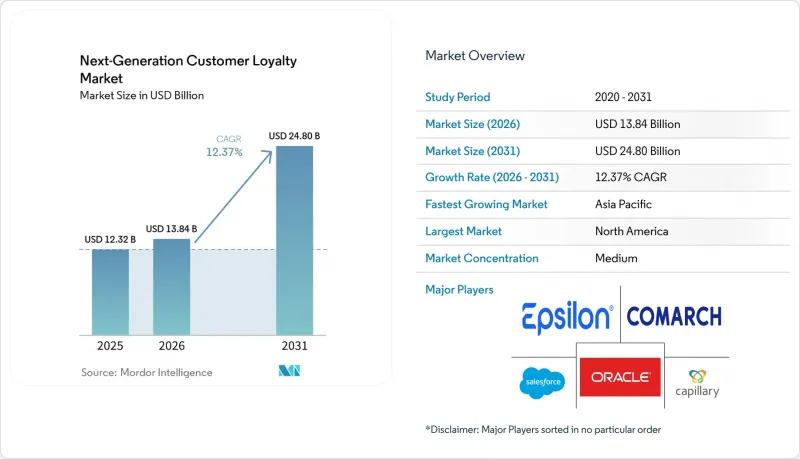
This report is Segmented by Organization Size (Large Enterprises, Small & Medium Enterprises (SMEs)), End User (Retail & E-Commerce, BFSI, Travel and Hospitality, Telecommunications, Healthcare, and More), by Engagement Channel (Mobile Application, Web & E-Mail, and More), and Geography (North America, South America, and More). The Market Forecasts are Provided in Terms of Value (USD).
Global Next-Generation Customer Loyalty Market Trends and Insights
Cookieless Shift Drives First-Party Loyalty Infrastructure
Browser-level tracking restrictions and privacy-led changes are accelerating the pivot to consented, first-party data that loyalty programs are structurally positioned to capture and activate across channels. The next-generation customer loyalty market is shifting from rented audience visibility to owned identity graphs built from transactional histories, declared preferences, and verified engagement signals, under clear consent flows. As brands consolidate customer identity within loyalty-led ecosystems, activation quality improves, enabling precise offer decisioning tied to measurable outcomes rather than inferred browsing intent. The same shift is elevating loyalty from a promotional lever to core data infrastructure, integrating profile, event, and journey data with real-time omnichannel orchestration. This structural reorientation is central to the next-generation customer loyalty market because it reduces dependency on third-party signals and builds defensibility through consent-based value exchange at scale.
AI-Powered Real-Time Offer Decisioning Scales Personalization
AI-first orchestration is moving loyalty from periodic campaigns to continuous, signal-driven decisions that adapt content, offers, and tiers in real time across channels. Platforms are embedding agentic capabilities that analyze loyalty signals, flag at-risk members, and propose targeted retention tactics that accelerate time to impact while reducing manual effort. Retail operators and multi-location brands are layering decisioning with insights, strategy, and activation tooling so teams can query performance in natural language, assemble offers, and test outcomes quickly. This approach supports the next-generation customer loyalty market by unifying identity, propensity, and budget logic to deliver one-to-one experiences with closed-loop attribution across web, app, and store. As decisioning becomes composable and API-first, brands can scale personalization without monolithic upgrades while maintaining governance across consumer touchpoints.
Stringent Data Privacy Compliance Burdens Constrain Experimentation
Regulatory requirements across jurisdictions are tightening consent standards and limiting data reuse, increasing operational overhead for loyalty teams and requiring robust consent management and auditability at scale. Brands are adapting program design to ensure data minimization and clear disclosures, while engineering linkages between loyalty identities and customer data platforms to ensure consistent rights management across channels. The next generation customer loyalty market responds with privacy-by-design architectures that segregate sensitive attributes and log member choices for transparent reporting and enforcement readiness. Operators that align value exchange with transparent privacy controls see stronger trust and participation, especially when programs make redemption easy and explain how data powers relevant benefits. This environment prioritizes disciplined governance and documentation without sacrificing agility, so teams are emphasizing platform capabilities that unify preference, identity, and consent at the core.
Other drivers and restraints analyzed in the detailed report include:
- Digital Wallet Passes Create App-Free, Always-On Engagement
- Coalition Partnerships Extend Reach and Dilute Acquisition Costs
- Legacy POS and IT Fragmentation Delays Real-Time Personalization
For complete list of drivers and restraints, kindly check the Table Of Contents.
Segment Analysis
Large enterprises held a 33.74% share of the next-generation customer loyalty market in 2025, reflecting their ability to fund enterprise-wide platforms, unify identity, and scale AI-led personalization across channels. Banks are broadening eligibility and tiered benefits to drive primacy across checking, credit, lending, and investments, as seen in the launch of BofA Rewards that extends enrollment to any client with an active checking account and introduces benefits calibrated by tier. This institutional model leverages embedded finance, identity protection, and lifestyle offers to deepen engagement through everyday needs that extend beyond single-product incentives. Enterprise operators are also adding channel breadth with wallet passes and agentic decisioning to orchestrate timely, personalized incentives at scale. As these capabilities converge, the next-generation customer loyalty market is reinforcing loyalty as part of financial planning, cross-sell strategy, and operating model discipline rather than treating it as a pure marketing expense.
SMEs, supported by cloud-native platforms and modular pricing, are expanding rapidly as barriers to real-time loyalty experience design continue to fall. The next-generation customer loyalty industry is delivering SME-ready integrations that connect storefronts, point of sale, and messaging into cohesive workflows, shortening time to value for smaller teams with limited engineering capacity. Wallet-native capabilities let SMEs deliver enrollment, balances, and offers without a full app build, while agentic tools reduce manual campaign work through on-platform guidance. As these SMEs scale, they are also adopting receipt-upload features to bridge online and in-store proof of purchase, enabling SKU-level validation without complex POS changes. Over time, this democratization supports competitive diversity inside the next-generation customer loyalty market, with a long tail of brands able to fund relevant benefits and governed personalization.
Geography Analysis
North America held 37.35% of the next-generation customer loyalty market share in 2025, supported by high digital adoption, omni-channel maturity, and an expanding set of AI-first loyalty orchestration tools. Platforms in 2026 are launching embedded agents that analyze signals, surface risks, and recommend retention actions to improve the speed and precision of personalization. New bank programs broaden eligibility and unify benefits across cards, deposits, savings, and lending, strengthening customer primacy and underscoring loyalty's role in financial relationship depth. PNC's national rollout approach shows how relationship metrics trigger automatic tiering and service differentiation that scales across markets. North American operators are also leaning into wallet-native channels to deliver app-free enrollment and redemption with policy-governed notifications that reach members reliably at scale. Coalitions and linked programs are expanding in Canada, where industry associations highlight the advantages of cross-brand value exchange for frequency and spend consolidation.
Asia-Pacific is projected to be the fastest-growing region, with a 11.64% CAGR through 2031, reflecting mobile-first adoption and a strong foundation for super-app and wallet-linked loyalty. Financial services and travel alliances are connecting banks and hospitality to enable dual earning and redemption that fits frequent travel corridors across major cities. As bank partners expand program relevance into everyday spend, hospitality networks gain more top-of-funnel opportunities while card issuers deepen engagement through lifestyle rewards. Wallet passes and lightweight validation methods are well-suited to urban density and store network complexity, enabling consistent recognition and faster redemption without requiring app installs. This foundation supports the next-generation customer loyalty market as APAC brands balance growth with compliance and expand cross-merchant engagement models.
Europe pairs advanced analytics capabilities with high-standard consent governance, rewarding transparent value exchange and stronger member participation. Retail programs are partnering with AI-first orchestration tools to deepen personalization for tens of millions of households and to accelerate experimentation with content and offers at scale. Wallet-native technology continues to enhance the in-store experience by reducing friction and enabling rapid enrollment and balance updates. Still, it requires attention to platform limits and image guidelines to protect performance during peak usage. In the Middle East and Africa, new hospitality partnerships with leading banks enable point conversion and broaden redemption options that resonate with regional travel and retail patterns. As these regions expand digital payments and unify identity across channels, the next-generation customer loyalty market builds a diversified base for omnichannel programs that are flexible, compliant, and scalable.
- Salesforce
- Adobe
- Oracle
- SAP Emarsys
- Comarch
- Epsilon
- Kobie
- Bond Brand Loyalty
- Antavo
- Annex Cloud
- Capillary Technologies
- Marigold (Cheetah Digital)
- PAR Technology
- Paytronix
- Braze
- Airship
- LoyaltyLion
- Yotpo
- Smile.io
- Zinrelo
- Thanx
- Collinson
Additional Benefits:
- The market estimate (ME) sheet in Excel format
- 3 months of analyst support
TABLE OF CONTENTS
1 Introduction
- 1.1 Study Assumptions & Market Definition
- 1.2 Scope of the Study
2 Research Methodology
3 Executive Summary
4 Market Landscape
- 4.1 Market Overview
- 4.2 Market Drivers
- 4.2.1 Cookieless shift boosts first-party loyalty
- 4.2.2 Real-time AI offer decisioning adoption
- 4.2.3 Wallet passes replacing plastic cards
- 4.2.4 Coalition partnerships rapidly expand reach
- 4.2.5 Gamified zero-party data capture accelerates
- 4.2.6 Receipt data enables SKU-level rewards
- 4.3 Market Restraints
- 4.3.1 Stringent data privacy compliance burdens
- 4.3.2 Legacy POS and IT fragmentation
- 4.3.3 Loyalty liability accounting pressures intensify
- 4.3.4 Wallet platform policy volatility risks
- 4.4 Value / Supply-Chain Analysis
- 4.5 Regulatory Landscape
- 4.6 Technological Outlook
- 4.6.1 Identity resolution and graph quality
- 4.6.2 Data clean rooms for loyalty
- 4.7 Porter's Five Forces Analysis
- 4.7.1 Supplier Power
- 4.7.2 Buyer Power
- 4.7.3 Threat of New Entrants
- 4.7.4 Threat of Substitutes
- 4.7.5 Competitive Rivalry
- 4.8 Customer Behavior and Gamification Analysis
- 4.9 Ecosystem and Partnership Models
5 Market Size & Growth Forecasts
- 5.1 By Organisation Size
- 5.1.1 Large Enterprises
- 5.1.2 Small & Medium Enterprises (SMEs)
- 5.2 By End-user Industry
- 5.2.1 Retail & E-commerce
- 5.2.2 BFSI
- 5.2.3 Travel & Hospitality
- 5.2.4 Telecommunications
- 5.2.5 Healthcare
- 5.2.6 Media & Entertainment
- 5.2.7 Energy & Utilities
- 5.2.8 FMCG & CPG
- 5.3 By Engagement Channel
- 5.3.1 Mobile Application
- 5.3.2 Web & E-mail
- 5.3.3 Point-of-Sale (POS)
- 5.3.4 Social / Messaging
- 5.4 By Geography
- 5.4.1 North America
- 5.4.1.1 United States
- 5.4.1.2 Canada
- 5.4.1.3 Mexico
- 5.4.2 South America
- 5.4.2.1 Brazil
- 5.4.2.2 Argentina
- 5.4.2.3 Chile
- 5.4.2.4 Peru
- 5.4.2.5 Rest of South America
- 5.4.3 Europe
- 5.4.3.1 United Kingdom
- 5.4.3.2 Germany
- 5.4.3.3 France
- 5.4.3.4 Italy
- 5.4.3.5 Spain
- 5.4.3.6 BENELUX (Belgium, Netherlands, Luxembourg)
- 5.4.3.7 NORDICS (Denmark, Finland, Iceland, Norway, Sweden)
- 5.4.3.8 Rest of Europe
- 5.4.4 Asia-Pacific
- 5.4.4.1 China
- 5.4.4.2 India
- 5.4.4.3 Japan
- 5.4.4.4 South Korea
- 5.4.4.5 Australia
- 5.4.4.6 South-East Asia (Singapore, Malaysia, Thailand, Indonesia, Vietnam, Philippines)
- 5.4.4.7 Rest of Asia-Pacific
- 5.4.5 Middle East & Africa
- 5.4.5.1 United Arab Emirates
- 5.4.5.2 Saudi Arabia
- 5.4.5.3 South Africa
- 5.4.5.4 Nigeria
- 5.4.5.5 Rest of Middle East & Africa
- 5.4.1 North America
6 Competitive Landscape
- 6.1 Market Concentration
- 6.2 Strategic Moves
- 6.3 Market Share Analysis
- 6.4 Company Profiles (includes Global level Overview, Market level overview, Core Segments, Financials as available, Strategic Information, Market Rank/Share for key companies, Products & Services, and Recent Developments)
- 6.4.1 Salesforce
- 6.4.2 Adobe
- 6.4.3 Oracle
- 6.4.4 SAP Emarsys
- 6.4.5 Comarch
- 6.4.6 Epsilon
- 6.4.7 Kobie
- 6.4.8 Bond Brand Loyalty
- 6.4.9 Antavo
- 6.4.10 Annex Cloud
- 6.4.11 Capillary Technologies
- 6.4.12 Marigold (Cheetah Digital)
- 6.4.13 PAR Technology
- 6.4.14 Paytronix
- 6.4.15 Braze
- 6.4.16 Airship
- 6.4.17 LoyaltyLion
- 6.4.18 Yotpo
- 6.4.19 Smile.io
- 6.4.20 Zinrelo
- 6.4.21 Thanx
- 6.4.22 Collinson
7 Market Opportunities & Future Outlook
- 7.1 White-space & unmet-need assessment

