PUBLISHER: Global Market Insights Inc. | PRODUCT CODE: 2101636

PUBLISHER: Global Market Insights Inc. | PRODUCT CODE: 2101636
5G in Defense Market Opportunity, Growth Drivers, Industry Trend Analysis, and Forecast 2026 - 2035
The Global 5G in Defense Market was valued at USD 1.8 billion in 2025 and is estimated to grow at a CAGR of 16.2% to reach USD 8.4 billion in 2035.
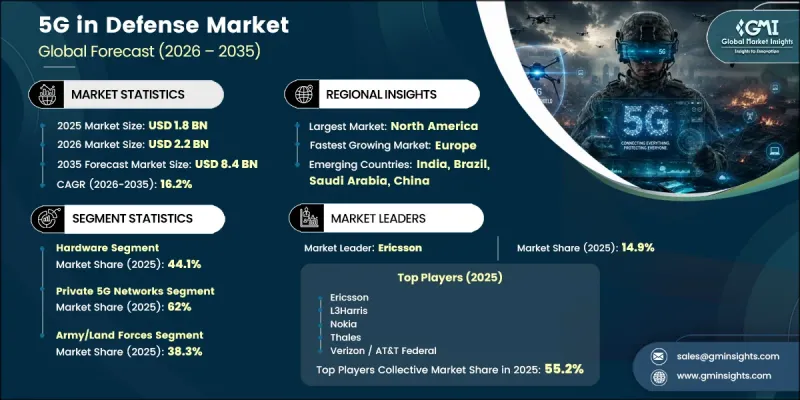
The 5G in defense market is experiencing rapid growth as military organizations worldwide accelerate the adoption of advanced communication networks to support digital transformation initiatives. Increasing demand for secure, high-speed, and reliable connectivity is encouraging defense agencies to integrate next-generation wireless technologies into modern military operations. The market growth is supported by rising investments in autonomous systems, advanced surveillance capabilities, and connected defense platforms that require enhanced communication infrastructure. Military forces are increasingly focusing on network-based operational strategies that improve information sharing, coordination, and real-time decision-making across multiple domains. Growing geopolitical challenges and evolving security requirements are also encouraging governments to modernize communication systems and strengthen defense readiness. The transition toward advanced wireless networks is creating opportunities for private communication systems, secure connectivity solutions, and specialized defense-grade infrastructure. As defense organizations continue to prioritize digital battlefield capabilities, 5G technology is becoming an important component of future military communication frameworks. Increasing investments in secure spectrum management, resilient networks, and advanced connectivity solutions are expected to support sustained market expansion throughout the forecast period.
| Market Scope | |
|---|---|
| Start Year | 2025 |
| Forecast Year | 2026-2035 |
| Start Value | $1.8 Billion |
| Forecast Value | $8.4 Billion |
| CAGR | 16.2% |
The growth of the 5G in defense market is strongly influenced by increasing defense modernization investments across major regions. Military organizations are allocating greater resources toward advanced communication infrastructure to support connected operations, digital battlefield transformation, and improved operational efficiency. Rising security concerns, geopolitical tensions, and the need for enhanced surveillance and rapid-response capabilities are encouraging nations to strengthen their communication networks. The adoption of interoperable defense systems is further increasing demand for secure private networks, flexible connectivity solutions, and advanced network management technologies. These developments are supporting the wider deployment of 5G infrastructure across defense environments while improving communication reliability and operational effectiveness.
The hardware segment accounted for 44.1% share in 2025, owing to the significant infrastructure requirements associated with military-grade 5G deployment. This segment includes specialized communication equipment designed to meet demanding defense operational requirements. Growing investments in secure communication infrastructure, advanced wireless equipment, and resilient network components are supporting segment growth. Hardware solutions remain essential for enabling reliable connectivity across various defense applications, providing the foundation required for fixed and mobile military communication environments.
The private 5G networks segment held 62% share in 2025. This leadership position is attributed to increasing adoption of dedicated communication networks that provide enhanced security, reliability, and control compared with shared communication systems. Private 5G networks enable defense organizations to maintain secure connectivity while supporting complex operational requirements and high-performance communication needs. Growing demand for protected data transmission, improved network management, and advanced military communication capabilities continues to drive adoption of private 5G infrastructure across defense applications.
North America 5G in Defense Market held 46% share in 2025. Regional leadership is supported by strong defense modernization initiatives, increasing investments in advanced communication technologies, and rising focus on secure military connectivity solutions. The region continues to experience significant demand for next-generation defense networks as military organizations prioritize digital transformation and advanced operational capabilities. Continued investment in secure communication infrastructure, technological innovation, and defense-focused wireless solutions is expected to support further market expansion across North America.
Prominent companies operating in the global 5G in defense market include Ericsson, Nokia Networks, Lockheed Martin, L3Harris Technologies, Raytheon Technologies (RTX), Thales Group, Leonardo S.p.A., Hughes Network Systems, Mavenir, Verizon Federal, Samsung Networks, Booz Allen Hamilton, AT&T Inc. (Public Sector / FirstNet), General Dynamics (GDIT), and NEC Corporation. Companies operating in the 5G in defense market are strengthening their competitive position through technology innovation, strategic partnerships, and expansion of advanced communication solutions. Market participants are investing in secure network technologies, defense-grade hardware, and software platforms designed to support evolving military connectivity requirements. Companies are also focusing on research and development activities to improve network reliability, cybersecurity, and operational flexibility. Strategic collaborations with defense organizations, government agencies, and technology providers are helping businesses accelerate deployment capabilities and expand market reach.
Table of Contents
Chapter 1 Methodology and Scope
- 1.1 Market scope and definition
- 1.2 Research design
- 1.2.1 Research approach
- 1.2.2 Data collection methods
- 1.3 Data mining sources
- 1.3.1 Global
- 1.3.2 Regional/Country
- 1.4 Base estimates and calculations
- 1.4.1 Base year calculation
- 1.4.2 Key trends for market estimation
- 1.5 Primary research and validation
- 1.5.1 Primary sources
- 1.6 Forecast model
- 1.7 Research assumptions and limitations
Chapter 2 Executive Summary
- 2.1 Industry 360° synopsis, 2022 - 2035
- 2.2 Key market trends
- 2.2.1 Component trends
- 2.2.2 Network Deployment trends
- 2.2.3 End-user trends
- 2.2.4 Regional trends
- 2.3 TAM Analysis, 2026-2035
- 2.4 CXO perspectives: Strategic imperatives
Chapter 3 Industry Insights
- 3.1 Industry ecosystem analysis
- 3.1.1 Supplier Landscape
- 3.1.2 Profit Margin
- 3.1.3 Cost structure
- 3.1.4 Value addition at each stage
- 3.1.5 Factor affecting the value chain
- 3.1.6 Disruptions
- 3.2 Industry impact forces
- 3.2.1 Growth drivers
- 3.2.1.1 Rising Global Defense Modernization Budgets
- 3.2.1.2 Growing Demand for Real-Time Intelligence, Surveillance, and Reconnaissance (ISR)
- 3.2.1.3 Escalating Geopolitical Tensions and Border Security Concerns
- 3.2.1.4 Increasing Deployment of Autonomous and Unmanned Systems
- 3.2.1.5 Shift Toward Network-Centric and Multi-Domain Warfare Strategies
- 3.2.2 Industry pitfalls and challenges
- 3.2.2.1 Cybersecurity Vulnerabilities in Virtualized Networks
- 3.2.2.2 Dependence on Vendor Ecosystem and Supply Chain Security Risks
- 3.2.3 Market opportunities
- 3.2.3.1 Emergence of 6G Research and Next-Generation Spectrum Technologies
- 3.2.3.2 Expansion of Private 5G Networks in Remote and Austere Environments
- 3.2.1 Growth drivers
- 3.3 Growth potential analysis
- 3.4 Pricing Analysis (Driven by Primary Research)
- 3.4.1 Historical Price Trend Analysis
- 3.4.2 Pricing Strategy by Player Type (Premium / Value / Cost-plus)
- 3.5 Regulatory landscape
- 3.5.1 North America
- 3.5.2 Europe
- 3.5.3 Asia Pacific
- 3.5.4 Latin America
- 3.5.5 Middle East & Africa
- 3.6 Porter's analysis
- 3.7 PESTEL analysis
- 3.8 Trade Data Analysis (Based on Paid Database)
- 3.8.1 Import/Export Volume & Value Trends
- 3.8.2 Key Trade Corridors & Tariff Impact
- 3.9 Impact of AI & Generative AI on the Market (Driven by Primary Research)
- 3.9.1 AI-Driven Disruption of Existing Business Models
- 3.9.2 GenAI Use Cases & Adoption Roadmap by Segment
- 3.10 Capacity & Production Landscape (Driven by Primary Research)
- 3.10.1 Production Capacity by Key Producer
- 3.11 Capacity Utilization Rates & Expansion Pipelines
Chapter 4 Competitive Landscape, 2025
- 4.1 Introduction
- 4.2 Company market share analysis, 2025
- 4.2.1 By Region
- 4.2.1.1 North America
- 4.2.1.2 Europe
- 4.2.1.3 Asia-Pacific
- 4.2.1.4 Latin America
- 4.2.1.5 Middle East and Africa
- 4.2.2 Market Concentration Analysis
- 4.2.1 By Region
- 4.3 Competitive analysis of major market players
- 4.4 Competitive positioning matrix
- 4.5 Key developments
- 4.5.1 Mergers & acquisitions
- 4.5.2 Partnerships & collaborations
- 4.5.3 New product launches
- 4.5.4 Expansion plans and funding
- 4.6 Company tier benchmarking
- 4.6.1 Tier classification criteria & qualifying thresholds
- 4.6.2 Tier positioning matrix by revenue, geography & innovation
Chapter 5 Market Estimates and Forecast, By Component, 2022 - 2035 (USD Million)
- 5.1 Key trends
- 5.2 Hardware
- 5.3 Software
- 5.4 Services
Chapter 6 Market Estimates and Forecast, By Network Deployment, 2022 - 2035 (USD Million)
- 6.1 Key trends
- 6.2 Private 5G Networks
- 6.3 Tactical / Deployable 5G Networks
Chapter 7 Market Estimates and Forecast, By End-User, 2022 - 2035 (USD Million)
- 7.1 Key trends
- 7.2 Army / Land Forces
- 7.3 Navy / Maritime Forces
- 7.4 Air Force / Aerospace Forces
- 7.5 Defense Agencies & Central Commands
Chapter 8 Market Estimates and Forecast, By Region, 2022 - 2035 (USD Million)
- 8.1 Key trends
- 8.2 North America
- 8.2.1 U.S.
- 8.2.2 Canada
- 8.3 Europe
- 8.3.1 Germany
- 8.3.2 UK
- 8.3.3 France
- 8.3.4 Spain
- 8.3.5 Italy
- 8.4 Asia Pacific
- 8.4.1 China
- 8.4.2 India
- 8.4.3 Japan
- 8.4.4 Australia
- 8.4.5 South Korea
- 8.5 Latin America
- 8.5.1 Brazil
- 8.5.2 Mexico
- 8.5.3 Argentina
- 8.6 Middle East and Africa
- 8.6.1 South Africa
- 8.6.2 Saudi Arabia
- 8.6.3 UAE
Chapter 9 Company Profiles
- 9.1 Global Key Players
- 9.1.1 Ericsson
- 9.1.2 Nokia Networks
- 9.1.3 Lockheed Martin
- 9.1.4 L3Harris Technologies
- 9.1.5 Raytheon Technologies (RTX)
- 9.1.6 Thales Group
- 9.1.7 NEC Corporation
- 9.1.8 Samsung Networks
- 9.2 Regional Key Players
- 9.2.1 North America
- 9.2.1.1 Hughes Network Systems
- 9.2.1.2 Mavenir
- 9.2.1.3 Verizon Federal
- 9.2.1.4 AT&T Inc. (Public Sector / FirstNet)
- 9.2.1.5 General Dynamics (GDIT)
- 9.2.2 Europe
- 9.2.2.1 Leonardo S.p.A.
- 9.2.1 North America
- 9.3 Niche Players/Disruptors
- 9.3.1 Booz Allen Hamilton

