PUBLISHER: Global Market Insights Inc. | PRODUCT CODE: 2101650

PUBLISHER: Global Market Insights Inc. | PRODUCT CODE: 2101650
Motorcycle Helmet Market Opportunity, Growth Drivers, Industry Trend Analysis, and Forecast 2026 - 2035
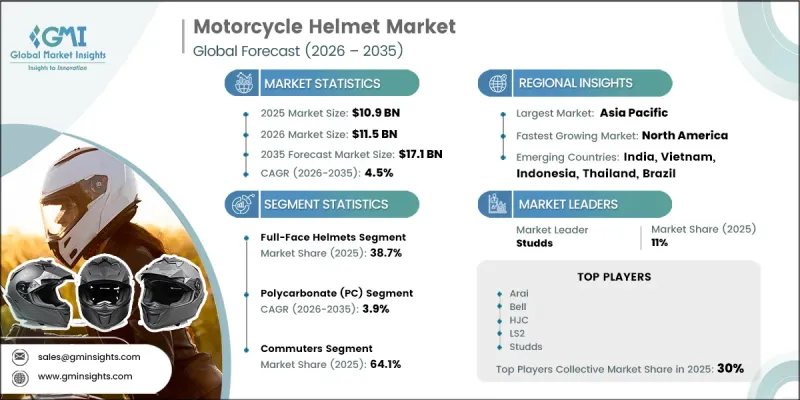
The Global Motorcycle Helmet Market was valued at USD 10.9 billion in 2025 and is estimated to grow at a CAGR of 4.5% to reach USD 17.1 billion by 2035.
Growth in the motorcycle helmet industry is supported by consistent replacement demand, regulatory requirements for certified protective equipment, and rising purchases from first-time motorcycle owners. The market continues to benefit from expanding motorcycle ownership, particularly in developing economies where two-wheel transportation remains a practical mobility solution. At the same time, mature markets are contributing higher revenue per unit as consumers increasingly prefer technologically advanced and premium helmet products. The overall growth pattern reflects the combination of rising sales volumes in developing regions and greater product value in established markets. Increasing urbanization, growing reliance on motorcycles for daily transportation, and the cost advantages of two-wheel mobility continue to encourage helmet purchases worldwide. Expanding motorcycle registrations and evolving safety standards are also supporting long-term demand, while ongoing product innovation and improved consumer awareness regarding rider protection continue to strengthen growth prospects across the global motorcycle helmet market.
| Market Scope | |
|---|---|
| Start Year | 2025 |
| Forecast Year | 2026-2035 |
| Start Value | $10.9 Billion |
| Forecast Value | $17.1 Billion |
| CAGR | 4.5% |
The full-face helmet segment accounted for 38.7% share in 2025 and is anticipated to register a CAGR of 5.2% during 2026-2035. The segment continues to lead the market because it offers extensive protection by covering multiple areas of the rider's head and face, making it a preferred choice among safety-focused consumers. Strong demand for enhanced rider protection and increasing compliance with safety regulations continue to support the adoption of full-face helmets across a wide range of motorcycle users. The segment also benefits from regulatory requirements that encourage the use of helmets offering higher protection standards.
The polycarbonate (PC) segment held 54% share in 2025 and is projected to grow at a CAGR of 3.9% through 2035. Its market leadership is supported by a favorable balance of manufacturing efficiency, cost-effectiveness, and reliable impact resistance that enables compliance with recognized safety standards. These characteristics make polycarbonate one of the most widely used shell materials for producing entry-level and mid-range motorcycle helmets while supporting large-scale manufacturing and broad consumer accessibility.
Asia Pacific Motorcycle Helmet Market held 45.1% share in 2025 and is forecast to grow at a CAGR of 4.9% during 2026-2035. Regional market leadership is supported by the large population of motorcycle users and the continued growth of two-wheel transportation across several developing economies. Rising motorcycle ownership, expanding urban populations, and increasing awareness of rider safety continue to generate consistent demand for certified motorcycle helmets, reinforcing the region's dominant position in the global market.
Major companies operating in the global motorcycle helmet market include Studds, Arai, HJC, LS2, Bell, Nolangroup, Shoei, Caberg, Schuberth, and Shark. Companies operating in the motorcycle helmet market are strengthening their market position by investing in product innovation, expanding premium product portfolios, and improving manufacturing capabilities. Many manufacturers continue to focus on lightweight materials, enhanced impact protection, improved ventilation systems, and advanced comfort features to meet evolving consumer preferences. Businesses are also increasing investments in research and development to enhance product performance while complying with changing safety regulations. Expanding distribution networks, strengthening online and offline sales channels, and improving brand visibility remain important strategies for reaching broader customer segments.
Table of Contents
Chapter 1 Methodology & Scope
- 1.1 Research approach
- 1.2 Quality Commitments
- 1.2.1 GMI AI policy & data integrity commitment
- 1.2.1.1 Source consistency protocol
- 1.2.1 GMI AI policy & data integrity commitment
- 1.3 Research Trail & Confidence Scoring
- 1.3.1 Research Trail Components
- 1.3.2 Scoring Components
- 1.4 Data Collection
- 1.4.1 Partial list of primary sources
- 1.5 Data mining sources
- 1.5.1 Paid sources
- 1.5.1.1 Sources, by region
- 1.5.1 Paid sources
- 1.6 Base estimates and calculations
- 1.6.1 Base year calculation
- 1.7 Forecast
- 1.7.1 Quantified market impact analysis
- 1.7.1.1 Mathematical impact of growth parameters on forecast
- 1.7.1 Quantified market impact analysis
- 1.8 Research transparency addendum
- 1.8.1 Source attribution framework
- 1.8.2 Quality assurance metrics
- 1.8.3 Our commitment to trust
Chapter 2 Executive Summary
- 2.1 Industry 360° synopsis
- 2.2 Key market trends
- 2.2.1 Regional
- 2.2.2 Helmet
- 2.2.3 Shell Material
- 2.2.4 Price Range
- 2.2.5 End Use
- 2.2.6 Motorcycle
- 2.2.7 Distribution Channel
- 2.3 TAM Analysis, 2026-2035
- 2.4 CXO perspectives: Strategic imperatives
Chapter 3 Industry Insights
- 3.1 Industry ecosystem analysis
- 3.1.1 Supplier landscape
- 3.1.1.1 Raw material suppliers
- 3.1.1.2 Component suppliers
- 3.1.1.3 Manufacturers
- 3.1.1.4 Service providers
- 3.1.1.5 Distribution channel
- 3.1.1.6 End Use
- 3.1.2 Cost structure
- 3.1.3 Profit margin
- 3.1.4 Value addition at each stage
- 3.1.5 Vertical integration trends
- 3.1.6 Disruptors
- 3.1.1 Supplier landscape
- 3.2 Industry impact forces
- 3.2.1 Growth drivers
- 3.2.1.1 Rising global motorcycle and two-wheeler ownership
- 3.2.1.2 Stringent helmet safety regulations
- 3.2.1.3 Growing rider safety awareness
- 3.2.1.4 Increasing adoption of smart helmets
- 3.2.2 Market Restraints
- 3.2.2.1 High cost of premium helmets
- 3.2.2.2 Availability of counterfeit helmets
- 3.2.3 Market Opportunities
- 3.2.3.1 Expansion of e-commerce sales
- 3.2.3.2 Growing two-wheeler markets in emerging economies
- 3.2.3.3 Rising adventure riding and motorsports
- 3.2.3.4 Sustainable helmet manufacturing
- 3.2.1 Growth drivers
- 3.3 Growth potential analysis
- 3.4 Technology and Innovation landscape
- 3.4.1 Current technologies
- 3.4.2 Emerging technologies
- 3.5 Pricing Analysis (Driven by Primary Research)
- 3.5.1 Historical Price Trend Analysis
- 3.5.2 Pricing Strategy by Player Type (Premium / Value / Cost-plus)
- 3.6 Regulatory guideline
- 3.6.1 North America
- 3.6.1.1 National Highway Traffic Safety Administration (NHTSA)
- 3.6.1.2 U.S. Department of Transportation (DOT) FMVSS No. 218 Helmet Standard
- 3.6.1.3 Snell Memorial Foundation Certification
- 3.6.1.4 Occupational Safety and Health Administration (OSHA)
- 3.6.1.5 Canadian Motor Vehicle Safety Standards (CMVSS)
- 3.6.2 Europe
- 3.6.2.1 UNECE Regulation No. 22 (ECE 22.06)
- 3.6.2.2 CE Marking (Personal Protective Equipment Regulation)
- 3.6.2.3 REACH (Registration, Evaluation, Authorisation and Restriction of Chemicals)
- 3.6.2.4 General Product Safety Regulation (GPSR)
- 3.6.2.5 National Type Approval Requirements
- 3.6.3 Asia Pacific
- 3.6.3.1 China Compulsory Certification (CCC)
- 3.6.3.2 Indian Central Motor Vehicles Rules (CMVR)
- 3.6.3.3 Bureau of Indian Standards (BIS) – IS 4151
- 3.6.3.4 Japanese Industrial Standards (JIS)
- 3.6.3.5 Australian/New Zealand Standard (AS/NZS 1698)
- 3.6.4 Latin America
- 3.6.4.1 Brazilian National Institute of Metrology (INMETRO)
- 3.6.4.2 Brazilian National Traffic Council (CONTRAN)
- 3.6.4.3 Mexican Official Standard (NOM)
- 3.6.4.4 Regional Import and Product Certification Requirements
- 3.6.5 MEA
- 3.6.5.1 GCC Standardization Organization (GSO)
- 3.6.5.2 Saudi Standards, Metrology and Quality Organization (SASO)
- 3.6.5.3 Emirates Authority for Standardization and Metrology (ESMA)
- 3.6.5.4 South African National Regulator for Compulsory Specifications (NRCS)
- 3.6.1 North America
- 3.7 Trade data analysis (Driven by Paid Research)
- 3.7.1 Import/export volume & value trends
- 3.7.2 Key trade corridors & tariff impact
- 3.8 Impact of AI & generative AI on the market
- 3.8.1 AI-driven disruption of existing business models
- 3.8.2 GenAI use cases & adoption roadmap by segment
- 3.8.3 Risks, limitations & regulatory considerations
- 3.9 Capacity & production landscape (Driven by Primary Research)
- 3.9.1 Installed capacity by region & key producer
- 3.9.2 Capacity utilization rates & expansion pipelines
- 3.10 Cost breakdown analysis
- 3.11 Patent analysis (Driven by Primary Research)
- 3.12 Porter’s analysis
- 3.13 PESTEL analysis
- 3.14 Consumer Buying Behavior
- 3.15 Smart Helmet Ecosystem
- 3.16 Certification & Testing Landscape
- 3.17 Sustainability and environmental aspects
- 3.17.1 Sustainable practices
- 3.17.2 Waste reduction strategies
- 3.17.3 Energy efficiency in production
- 3.17.4 Eco-friendly Initiatives
- 3.17.5 Carbon footprint considerations
- 3.18 Forecast assumptions & scenario analysis (Driven by Primary Research)
- 3.18.1 Base Case — key macro & industry variables driving CAGR
- 3.18.2 Optimistic Scenarios — Favorable macro and industry tailwinds
- 3.18.3 Pessimistic Scenario — Macroeconomic slowdown or industry headwinds
Chapter 4 Competitive Landscape, 2025
- 4.1 Introduction
- 4.2 Company market share analysis
- 4.2.1 North America
- 4.2.2 Europe
- 4.2.3 Asia-Pacific
- 4.2.4 Latin America
- 4.2.5 Middle East & Africa
- 4.3 Competitive positioning matrix
- 4.4 Key developments
- 4.4.1 Mergers & acquisitions
- 4.4.2 Partnerships & collaborations
- 4.4.3 New product launches
- 4.4.4 Expansion plans and funding
- 4.5 Company tier benchmarking
- 4.5.1 Tier classification criteria & qualifying thresholds
- 4.5.2 Tier positioning matrix by revenue, geography & innovation
Chapter 5 Market Estimates & Forecast, By Helmet, 2022 - 2035 ($Mn, Units)
- 5.1 Key trends
- 5.2 Full Face Helmets
- 5.3 Open Face (3/4) Helmets
- 5.4 Half Helmets
- 5.5 Modular/Flip-Up Helmets
- 5.6 Off-Road/Motocross Helmets
- 5.7 Dual-Sport/Adventure Helmets
Chapter 6 Market Estimates & Forecast, By Shell Material, 2022 - 2035 ($Mn, Units)
- 6.1 Key trends
- 6.2 Polycarbonate (PC)
- 6.3 Fiberglass Composite
- 6.4 Carbon Fiber
- 6.5 Advanced Composite (Multi-Material)
Chapter 7 Market Estimates & Forecast, By Price Range, 2022 - 2035 ($Mn, Units)
- 7.1 Key trends
- 7.2 Economy (Below USD 150)
- 7.3 Mid-Range (USD 150–USD 500)
- 7.4 Premium (USD 500–USD 1,000)
- 7.5 Ultra-Premium (Above USD 1,000)
Chapter 8 Market Estimates & Forecast, By End Use, 2022 - 2035 ($Mn, Units)
- 8.1 Key trends
- 8.2 Commuters
- 8.3 Professional/Racing Riders
- 8.4 Touring/Adventure Riders
Chapter 9 Market Estimates & Forecast, By Motorcycle, 2022 - 2035 ($Mn, Units)
- 9.1 Key Trends
- 9.2 Cruiser motorcycles
- 9.3 Sport motorcycles
- 9.4 Touring motorcycles
- 9.5 Standard/naked motorcycles
- 9.6 Adventure/dual-sport motorcycles
- 9.7 Off-road/dirt motorcycles
Chapter 10 Market Estimates & Forecast, By Distribution Channel, 2022 - 2035 ($Mn, Units)
- 10.1 Key Trends
- 10.2 Offline
- 10.2.1 Specialty Stores
- 10.2.2 Multi-Brand Retail Stores
- 10.2.3 Hypermarkets & Supermarkets
- 10.2.4 OEM Dealerships
- 10.3 Online
- 10.3.1 E-commerce Platforms
- 10.3.2 Brand Websites
Chapter 11 Market Estimates & Forecast, By Region, 2022 - 2035 ($Mn, Units)
- 11.1 Key Trends
- 11.2 North America
- 11.2.1 US
- 11.2.2 Canada
- 11.3 Europe
- 11.3.1 UK
- 11.3.2 Germany
- 11.3.3 France
- 11.3.4 Italy
- 11.3.5 Spain
- 11.3.6 Russia
- 11.3.7 Nordics
- 11.4 Asia Pacific
- 11.4.1 China
- 11.4.2 India
- 11.4.3 Japan
- 11.4.4 South Korea
- 11.4.5 Southeast Asia
- 11.4.5.1 Indonesia
- 11.4.5.2 Malaysia
- 11.4.5.3 Singapore
- 11.4.5.4 Thailand
- 11.4.5.5 Vietnam
- 11.4.6 ANZ
- 11.5 Latin America
- 11.5.1 Brazil
- 11.5.2 Mexico
- 11.5.3 Argentina
- 11.6 MEA
- 11.6.1 South Africa
- 11.6.2 Saudi Arabia
- 11.6.3 UAE
Chapter 12 Company Profiles
- 12.1 Global Players
- 12.1.1 Arai
- 12.1.2 Bell
- 12.1.3 Caberg
- 12.1.4 LS2
- 12.1.5 Nolan
- 12.1.6 Schuberth
- 12.1.7 Shark
- 12.1.8 Shoei
- 12.1.9 ScorpionEXO
- 12.2 Regional Players
- 12.2.1 Airoh
- 12.2.2 MT Helmets
- 12.2.3 Nexx
- 12.2.4 NZI
- 12.2.5 OGK Kabuto
- 12.2.6 Premier
- 12.2.7 SMK
- 12.2.8 Steelbird
- 12.2.9 STUDDS
- 12.2.10 Vega
- 12.2.11 ZEUS

