PUBLISHER: Mordor Intelligence | PRODUCT CODE: 2113594

PUBLISHER: Mordor Intelligence | PRODUCT CODE: 2113594
Premium Motorcycle Helmets - Market Share Analysis, Industry Trends & Statistics, Growth Forecasts (2026 - 2031)
According to Mordor Intelligence, the premium motorcycle helmets market size is expected to grow from USD 0.97 billion in 2025 to USD 1.02 billion in 2026 and is forecast to reach USD 1.33 billion by 2031 at a 5.45% CAGR over 2026-2031.
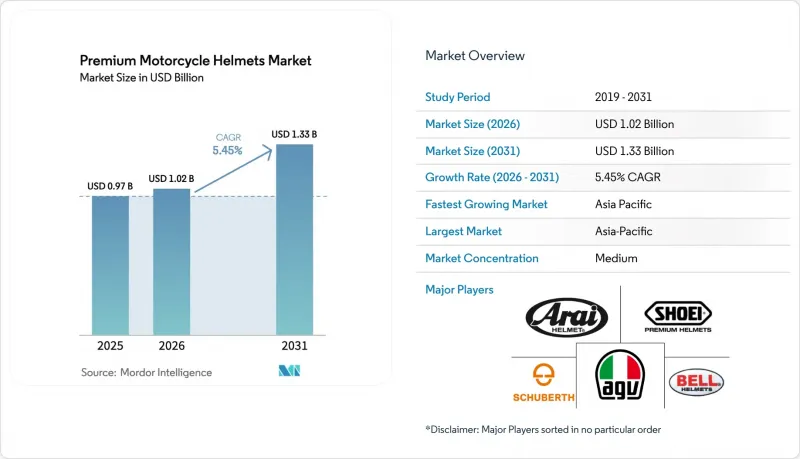
This report is Segmented by Type (Full-Face, Modular, and More), Material (Polycarbonate, Fiberglass, Carbon Fiber, and More), Application (Street Riding and More), Distribution Channel (Offline and Online), End-User (Commuters and Racers), and Geography (North America, South America, and More). Market Forecasts are Provided in Terms of Value (USD) and Volume (Units).
Global Premium Motorcycle Helmets Market Trends and Insights
Stringent Global Safety Regulations
New test matrices under ECE 22.06 require oblique-impact trials at higher velocities and double the number of strike points, rendering legacy molds obsolete and forcing multi-region labs to front-load R&D. Circuit racing homologation (FRHPhe-02), effective January 2026, caps rotational acceleration, compelling brands to design separate shells for track and street. India's tropical-climate ventilation rules further regionalize geometry, while Snell M2025R aligns helmet metrics with concussion thresholds used in professional football. The cumulative requirements raise certification outlays but create durable entry barriers that favor incumbents.
Technological Integration (Bluetooth, HUD)
Bluetooth intercoms and heads-up displays have migrated from bulky aftermarket kits to fully embedded modules that add under 50 grams. A 2025 production run of Schuberth's C5 integrates Cardo's SC-EDGE unit within the shell, cutting wind noise by 4 dB and removing exposed brackets that previously deterred premium buyers. Component commoditization has compressed the connectivity premiums, allowing mass-market brands to standardize basic communication while ultra-premium labels maintain analog positioning. Early adopters create halo demand, but widespread uptake will hinge on warranty assurances that electronics will not compromise impact integrity.
High Retail Prices in Emerging Markets
In many lower-income regions, authentic ECE-compliant helmets retail at USD 80-150, while non-certified look-alikes can be had for under USD 15. Tax structures such as a 28% goods-and-services levy on high-capacity bike accessories widen the affordability gap. Domestic makers are scaling mid-price ranges to reconcile safety and cost, but currency depreciation and import tariffs continue to skew buying toward polycarbonate shells.
Other drivers and restraints analyzed in the detailed report include:
- Rising Disposable Incomes & Superbike Uptake
- Shift Toward Lightweight Carbon-Fiber Composites
- Counterfeit Premium-Look Helmets
For complete list of drivers and restraints, kindly check the Table Of Contents.
Segment Analysis
In 2025, full-face models captured 46.98% of sales, solidifying their dominance in the premium motorcycle helmet market, especially for sport-touring and track uses. Yet, as off-road tourism and overlanding gain traction, adventure and dual-sport helmet designs are set to surge at a 7.83% CAGR. New models for 2025 feature peak visors, goggle compatibility, and removable chin bars, striking a balance between enhanced ventilation and freeway aerodynamics. While touring riders gravitate towards modular flip-ups for their convenience, many are opting for lighter carbon-fiber alternatives, driven by the added weight of traditional hinges.
Regional preferences add layers of complexity to product offerings. North America leans heavily towards full-face sport shells, Europe finds a middle ground with both modular and full-face options, and a significant portion of Asia-Pacific continues to prefer open-face helmets for commuting. To navigate this complexity, brands are innovating by creating versatile shells that cater to both street and track standards. Take Shark's Aeron, for instance: it's compliant with both ECE 22.06 and FIM 8859-2015 standards. This means dealers can stock a single SKU that seamlessly serves both racing enthusiasts and daily commuters, streamlining inventory management and enhancing perceived value.
Fiberglass dominated the premium motorcycle helmet market, accounting for 34.72% of 2025 revenue. However, carbon-fiber units are projected to grow at a 5.98% CAGR through 2031. Owing to advancements like automated fiber placement and hybrid lay-ups, manufacturers are producing shells under 1,200 grams that still meet stringent dual ECE and FIM impact tests. HJC's 2024 F100 carbon, priced below EUR 700 (USD 760), is strategically positioned to undercut rival flagship models while maintaining healthy margins due to reduced labor content. While thermoplastic and ABS shells dominate entry-level price points, consumers in India and Indonesia are making a notable shift to composites, facilitated by financing plans that spread payments over twelve months.
Material selection is evolving beyond mere safety considerations, becoming a pivotal tool for brand positioning. Premium brands, for instance, emphasize hand-finished carbon weaves to justify price tags exceeding USD 800. In contrast, mid-tier brands are ingeniously blending glass and carbon, allowing them to penetrate lower price brackets without compromising on perceived performance. Liner technology is also witnessing advancements: crumple-zone polymers, which absorb approximately 30% more oblique impact energy, come at an incremental cost of USD 150. This price point, however, limits their use to adventure helmets, where buyers are willing to invest more for enhanced multi-impact resilience.
Complete Report Scope:
- By Type
- Full-Face Helmets
- Modular Helmets
- Open-Face Helmets
- Half Helmets
- By Material
- Polycarbonate
- Fiberglass
- Carbon Fiber
- Kevlar
- Plastics / ABS
- By Application
- Street Riding
- Off-Road Riding
- Track Racing
- By Distribution Channel
- Offline (Retail Stores)
- Online (E-commerce)
- By End-User
- Commuters
- Racers
- By Geography
- North America
- United States
- Canada
- Rest of North America
- South America
- Brazil
- Argentina
- Rest of South America
- Europe
- United Kingdom
- Germany
- Spain
- Italy
- France
- Russia
- Rest of Europe
- Asia-Pacific
- India
- China
- Japan
- South Korea
- Rest of Asia-Pacific
- Middle East and Africa
- United Arab Emirates
- Saudi Arabia
- Turkey
- Egypt
- South Africa
- Rest of Middle-East and Africa
- North America
Geography Analysis
In 2025, the Asia-Pacific region accounted for 38.81% of the market's value and is projected to grow at a CAGR of 6.49%. As salaries rise in India and Indonesia, there's a noticeable shift from scooters to motorcycles exceeding 150 cc. This shift has led to an increased demand for helmets that comply with both DOT and ECE standards. While China holds the title of the world's largest motorcycle producer, the attachment rate of premium helmets lags behind the global average. This discrepancy is largely due to inconsistent enforcement of helmet laws in rural areas. Events like Indonesia's IMHAX draw significant crowds, yet sales predominantly fall below the USD 150 mark. This highlights a price sensitivity challenge that premium brands might address through financing options or local assembly.
North America is projected to grow at a CAGR of 3.02% until 2031. The growth is largely driven by Liberty Media's strategic moves with MotoGP and the increasing attendance at MotoAmerica events. These factors have cultivated a track-day culture with a heightened demand for dual-certified helmets. Despite a global downturn in unit sales, Shoei's North American revenue surged by 34.7% in fiscal 2024, underscoring the market's appreciation for perceived craftsmanship. Furthermore, Canada's 2024 endorsement of the ECE 22.06 standard, in addition to DOT, has expanded brand options and lowered compliance costs for European manufacturers.
Europe is anticipated to witness a growth rate of 3.49% CAGR. The adoption of the ECE 22.06 standard is leveling the playing field, especially in rotational-impact testing, bridging the performance divide between premium and mid-tier brands. Leading Japanese manufacturers have adeptly navigated currency fluctuations, countering volume declines with price hikes, a testament to the strength of brand loyalty. As environmental policies gain traction, they are poised to influence purchasing decisions. This is especially true as extended-producer-responsibility regulations emphasize helmet recyclability. Currently, existing take-back initiatives manage only a small fraction of the millions of discarded units each year.
- Shoei Co., Ltd
- Arai Helmet Ltd.
- Schuberth GmbH
- HJC Helmets
- Shark Helmets
- Bell Helmets
- Nolan Group
- Airoh Helmets
- LS2 Helmets
- MT Helmets
- Suomy Motorsport SRL
- Kabuto Helmets
- Scorpion Sports, Inc. (Scorpion EXO)
- Ruroc Ltd.
- MT Helmets
- Sena Technologies
- Forcite
- Alpinestars
Additional Benefits:
- The market estimate (ME) sheet in Excel format
- 3 months of analyst support
TABLE OF CONTENTS
1 Introduction
- 1.1 Study Assumptions & Market Definition
- 1.2 Scope of the Study
2 Research Methodology
3 Executive Summary
4 Market Landscape
- 4.1 Market Overview
- 4.2 Market Drivers
- 4.2.1 Stringent Global Safety Regulations
- 4.2.2 Technological Integration (Bluetooth, HUD, etc.)
- 4.2.3 Rising Disposable Incomes & Superbike Adoption
- 4.2.4 Shift Toward Lightweight Carbon-Fiber Composites
- 4.2.5 Insurance-Linked Telematics Discounts
- 4.2.6 Near-Shoring of Premium-Helmet Manufacturing
- 4.3 Market Restraints
- 4.3.1 High Retail Prices in Emerging Markets
- 4.3.2 Counterfeit Premium-Look Helmets
- 4.3.3 Electronics Obsolescence & E-Waste Risk
- 4.3.4 Carbon-Fiber Supply-Chain Volatility
- 4.4 Value / Supply-Chain Analysis
- 4.5 Regulatory Landscape
- 4.6 Technological Outlook
- 4.7 Porter's Five Forces
- 4.7.1 Threat of New Entrants
- 4.7.2 Bargaining Power of Buyers
- 4.7.3 Bargaining Power of Suppliers
- 4.7.4 Threat of Substitutes
- 4.7.5 Competitive Rivalry
5 Market Size & Growth Forecasts (Value and Volume)
- 5.1 By Type
- 5.1.1 Full-Face Helmets
- 5.1.2 Modular Helmets
- 5.1.3 Open-Face Helmets
- 5.1.4 Half Helmets
- 5.2 By Material
- 5.2.1 Polycarbonate
- 5.2.2 Fiberglass
- 5.2.3 Carbon Fiber
- 5.2.4 Kevlar
- 5.2.5 Plastics / ABS
- 5.3 By Application
- 5.3.1 Street Riding
- 5.3.2 Off-Road Riding
- 5.3.3 Track Racing
- 5.4 By Distribution Channel
- 5.4.1 Offline (Retail Stores)
- 5.4.2 Online (E-commerce)
- 5.5 By End-User
- 5.5.1 Commuters
- 5.5.2 Racers
- 5.6 By Geography
- 5.6.1 North America
- 5.6.1.1 United States
- 5.6.1.2 Canada
- 5.6.1.3 Rest of North America
- 5.6.2 South America
- 5.6.2.1 Brazil
- 5.6.2.2 Argentina
- 5.6.2.3 Rest of South America
- 5.6.3 Europe
- 5.6.3.1 United Kingdom
- 5.6.3.2 Germany
- 5.6.3.3 Spain
- 5.6.3.4 Italy
- 5.6.3.5 France
- 5.6.3.6 Russia
- 5.6.3.7 Rest of Europe
- 5.6.4 Asia-Pacific
- 5.6.4.1 India
- 5.6.4.2 China
- 5.6.4.3 Japan
- 5.6.4.4 South Korea
- 5.6.4.5 Rest of Asia-Pacific
- 5.6.5 Middle East and Africa
- 5.6.5.1 United Arab Emirates
- 5.6.5.2 Saudi Arabia
- 5.6.5.3 Turkey
- 5.6.5.4 Egypt
- 5.6.5.5 South Africa
- 5.6.5.6 Rest of Middle-East and Africa
- 5.6.1 North America
6 Competitive Landscape
- 6.1 Market Concentration
- 6.2 Strategic Moves
- 6.3 Market Share Analysis
- 6.4 Company Profiles (Includes Global Level Overview, Market Level Overview, Core Segments, Financials as Available, Strategic Information, Market Rank/Share for Key Companies, Products and Services, SWOT Analysis, and Recent Developments)
- 6.4.1 Shoei Co., Ltd
- 6.4.2 Arai Helmet Ltd.
- 6.4.3 Schuberth GmbH
- 6.4.4 HJC Helmets
- 6.4.5 Shark Helmets
- 6.4.6 Bell Helmets
- 6.4.7 Nolan Group
- 6.4.8 Airoh Helmets
- 6.4.9 LS2 Helmets
- 6.4.10 MT Helmets
- 6.4.11 Suomy Motorsport SRL
- 6.4.12 Kabuto Helmets
- 6.4.13 Scorpion Sports, Inc. (Scorpion EXO)
- 6.4.14 Ruroc Ltd.
- 6.4.15 MT Helmets
- 6.4.16 Sena Technologies
- 6.4.17 Forcite
- 6.4.18 Alpinestars
7 Market Opportunities and Future Outlook
- 7.1 White-Space and Unmet-Need Assessment

