PUBLISHER: Global Market Insights Inc. | PRODUCT CODE: 2101651

PUBLISHER: Global Market Insights Inc. | PRODUCT CODE: 2101651
North America Comic Book Market Opportunity, Growth Drivers, Industry Trend Analysis, and Forecast 2026 - 2035
North America Comic Book Market was valued at USD 2.44 billion in 2025 and is estimated to grow at a CAGR of 8.9% to reach USD 5.75 billion by 2035.
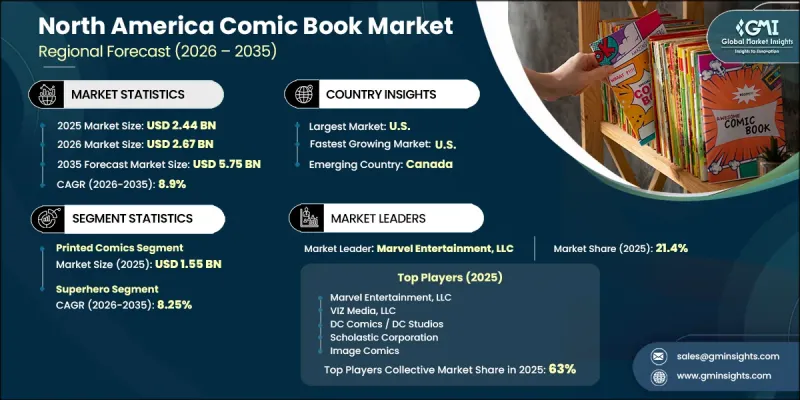
The market continues to gain momentum as consumer interest remains strong across both printed and digital comic book formats. Growing engagement with graphic storytelling, expanding digital accessibility, and increasing demand from collectors are collectively supporting long-term market expansion. The industry is benefiting from stronger connections across the broader entertainment landscape, where branded intellectual properties continue to encourage higher readership and recurring consumer engagement. This relationship has strengthened the overall market by attracting new readers while encouraging existing audiences to explore additional titles and formats. Publishers are increasingly aligning content availability with broader entertainment initiatives to improve audience conversion and maximize long-term reader retention. At the same time, digital reading platforms and subscription-based services have simplified access to extensive comic book libraries, reducing entry barriers for new consumers while encouraging repeat usage among existing readers. These evolving consumption habits continue to reshape purchasing behavior, allowing the North America comic book market to grow through a balanced combination of digital innovation, collector demand, and consistent interest in physical publications.
| Market Scope | |
|---|---|
| Start Year | 2025 |
| Forecast Year | 2026-2035 |
| Start Value | $2.44 Billion |
| Forecast Value | $5.75 Billion |
| CAGR | 8.9% |
The printed comics segment held 63.4% share in 2025, reaching USD 1.55 billion. Although digital reading continues to expand, printed comic books maintain a strong position because of sustained demand from specialty retail channels and collectors seeking premium physical editions. Continued consumer appreciation for collectible publications and limited-edition releases supports long-term demand, allowing printed formats to remain an important contributor to overall market revenue.
The superhero category captured 15.4% share in 2025, generating USD 380 million, and is projected to register a CAGR of 8.25% through 2035. The segment continues to lead the market through the enduring popularity of established intellectual properties and ongoing consumer engagement across multiple entertainment formats. Strong brand recognition, recurring content development, and continuous audience interest contribute to the sustained expansion of this genre throughout the forecast period.
United States Comic Book Market accounted for 93.1% share in 2025, representing USD 2.28 billion. The country continues to serve as the region's primary hub for comic book publishing, supported by an extensive specialty retail network and a large consumer base across both print and digital formats. A well-developed distribution infrastructure, together with an active collector community and strong retail presence, continues to reinforce the country's leadership while supporting ongoing demand throughout the market.
Major companies operating in the North America comic book market include Marvel Entertainment LLC, DC Comics/DC Studios, Scholastic Corporation, VIZ Media LLC, Dark Horse Comics, Image Comics, IDW Publishing, Webtoon Entertainment, Yen Press, BOOM! Studios, Archie Comics Publications, Fantagraphics Books, Drawn & Quarterly, Oni Press, Vault Comics, Mad Cave Studios, Ablaze Publishing, Tapas Media, Magnetic Press, Ahoy Comics, and Z2 Comics. Companies participating in the North America comic book market continue to strengthen their competitive position by expanding content portfolios across both print and digital formats while improving consumer accessibility through subscription-based reading platforms. Publishers are emphasizing long-term audience engagement by increasing digital catalog availability, enhancing publication quality, and introducing premium collectible editions that appeal to dedicated buyers. Strategic collaboration with distribution partners, retail channels, and digital platforms helps companies broaden market reach and improve product visibility. Many participants are also investing in stronger intellectual property management to maximize the commercial value of established franchises while supporting new content development.
Table of Contents
Chapter 1 Research Methodology
- 1.1 Research approach
- 1.2 Quality Commitments
- 1.2.1 GMI AI policy & data integrity commitment
- 1.2.1.1 Source consistency protocol
- 1.2.1 GMI AI policy & data integrity commitment
- 1.3 Research Trail & Confidence Scoring
- 1.3.1 Research Trail Components
- 1.3.2 Scoring Components
- 1.4 Data Collection
- 1.4.1 Partial list of primary sources
- 1.5 Data mining sources
- 1.5.1 Paid sources
- 1.5.1.1 Sources, by region
- 1.5.1 Paid sources
- 1.6 Base estimates and calculations
- 1.6.1 Base year calculation for any one approach
- 1.7 Forecast model
- 1.7.1 Quantified market impact analysis
- 1.7.1.1 Mathematical impact of growth parameters on forecast
- 1.7.1 Quantified market impact analysis
- 1.8 Research transparency addendum
- 1.8.1 Source attribution framework
- 1.8.2 Quality assurance metrics
- 1.8.3 Our commitment to trust
Chapter 2 Executive Summary
- 2.1 Industry 360° synopsis, 2022 - 2035
- 2.2 Key market trends
- 2.2.1 Country
- 2.2.2 Format type
- 2.2.3 Genre
- 2.2.4 End-user
- 2.2.5 Distribution channel
Chapter 3 Industry Insights
- 3.1 Industry ecosystem analysis
- 3.1.1 Factor affecting the value chain
- 3.1.2 Profit margin analysis
- 3.1.3 Disruptions
- 3.1.4 Future outlook
- 3.1.5 Manufacturers
- 3.1.6 Distributors
- 3.2 Supplier landscape
- 3.3 Key news & initiatives
- 3.4 Technology & Innovation Landscape
- 3.5 Regulatory landscape
- 3.6 Impact on forces
- 3.6.1 Growth drivers
- 3.6.1.1 Growing superhero franchises increase comic book readership globally
- 3.6.1.2 Rising digital platform adoption improves comic accessibility worldwide
- 3.6.1.3 Expanding collector communities support premium comic book purchases
- 3.6.2 Industry pitfalls & challenges
- 3.6.2.1 Piracy issues negatively affect legitimate comic industry revenues
- 3.6.2.2 High printing costs pressure comic publisher profit margins
- 3.6.3 Opportunities
- 3.6.3.1 Digital comic subscriptions create recurring revenue opportunities globally
- 3.6.3.2 AI-assisted translations improve international comic accessibility significantly
- 3.6.1 Growth drivers
- 3.7 Porter's analysis
- 3.8 PESTEL analysis
- 3.9 Pricing analysis (driven by primary research)
- 3.9.1 Historical price trend analysis (single issues, TPBs, digital singles) (driven by primary research)
- 3.9.2 Pricing strategy by player type (premium / value / cost-plus) (driven by primary research)
- 3.9.3 Subscription model pricing vs. a-la-carte digital pricing comparison
- 3.9.4 Collectible & variant edition pricing premiums
- 3.10 Trade data analysis (driven by paid database)
- 3.10.1 Import/export volume & value trends (print comics by region) (driven by paid database)
- 3.10.2 Key trade corridors & tariff impact (Japan USA manga, USA Europe superhero) (driven by paid database)
- 3.11 Impact of AI & generative AI on the market
- 3.11.1 AI-driven disruption of existing business models (AI-generated art, script generation, colorization)
- 3.11.2 GenAI use cases & adoption roadmap by segment (indie vs. major publishers vs. webtoon platforms)
- 3.11.3 Risks, limitations & regulatory considerations (creator rights, copyright, platform policy)
- 3.12 Distribution infrastructure & channel penetration landscape (driven by primary research)
- 3.12.1 Channel coverage by region & format (modern vs. traditional trade - LCS, bookstore, online, digital platform) (driven by primary research)
- 3.12.2 Last-mile infrastructure gaps & emerging channel shifts (crowdfunding, creator-direct, subscription box models) (driven by primary research)
Chapter 4 Competitive Landscape, 2025
- 4.1 Introduction
- 4.2 Company market share analysis
- 4.3 Competitive positioning matrix
- 4.4 Strategic outlook matrix
- 4.5 Competitive analysis of major market players
- 4.6 Key developments
- 4.6.1 Mergers & acquisitions
- 4.6.2 Partnerships & collaborations
- 4.6.3 New product launches
- 4.6.4 Expansion plans
Chapter 5 Market Estimates & Forecast, By Format Type, 2022-2035 (USD Billion) (Million Units)
- 5.1 Key trends
- 5.2 Printed comics
- 5.3 Digital comics
Chapter 6 Market Estimates & Forecast, By Genre, 2022-2035 (USD Billion) (Million Units)
- 6.1 Key trends
- 6.2 Superhero
- 6.3 Manga
- 6.4 Science-fiction
- 6.5 Fantasy & adventure
- 6.6 Non-fiction / educational
- 6.7 Others
Chapter 7 Market Estimates & Forecast, By End-User, 2022-2035 (USD Billion) (Million Units)
- 7.1 Key trends
- 7.2 Children (below 13 years)
- 7.3 Teens & young adults (13-25 years)
- 7.4 Adults (26+ years)
Chapter 8 Market Estimates & Forecast, By Distribution Channel, 2022-2035 (USD Billion) (Million Units)
- 8.1 Key trends
- 8.2 Specialty comic book stores
- 8.3 Bookstores & mass merchants
- 8.4 Online retail
- 8.5 Digital subscription & platform sales
- 8.6 Crowdfunding platforms
- 8.7 Others
Chapter 9 Market Estimates & Forecast, By Region, 2022 - 2035, (USD Billion) (Million Units)
- 9.1 Key trends
- 9.2 U.S.
- 9.3 Canada
Chapter 10 Company Profiles
- 10.1 Global players
- 10.1.1 Marvel Entertainment, LLC
- 10.1.2 DC Comics / DC Studios
- 10.1.3 Scholastic Corporation
- 10.1.4 VIZ Media, LLC
- 10.1.5 Dark Horse Comics
- 10.1.6 Image Comics
- 10.1.7 IDW Publishing
- 10.2 Regional players
- 10.2.1 Webtoon Entertainment
- 10.2.2 Yen Press
- 10.2.3 BOOM! Studios
- 10.2.4 Archie Comics
- 10.2.5 Fantagraphics Books
- 10.2.6 Drawn & Quarterly
- 10.2.7 Oni Press
- 10.3 Emerging players
- 10.3.1 Vault Comics
- 10.3.2 Mad Cave Studios
- 10.3.3 Ablaze Publishing
- 10.3.4 Tapas Media
- 10.3.5 Magnetic Press
- 10.3.6 Ahoy Comics
- 10.3.7 Z2 Comics

