PUBLISHER: Global Market Insights Inc. | PRODUCT CODE: 2101656

PUBLISHER: Global Market Insights Inc. | PRODUCT CODE: 2101656
Anti-Tank Guided Missile Market Opportunity, Growth Drivers, Industry Trend Analysis, and Forecast 2026 - 2035
The Global Anti-Tank Guided Missile Market was valued at USD 8.9 billion in 2025 and is estimated to grow at a CAGR of 4.8% to reach USD 14.7 billion by 2035.
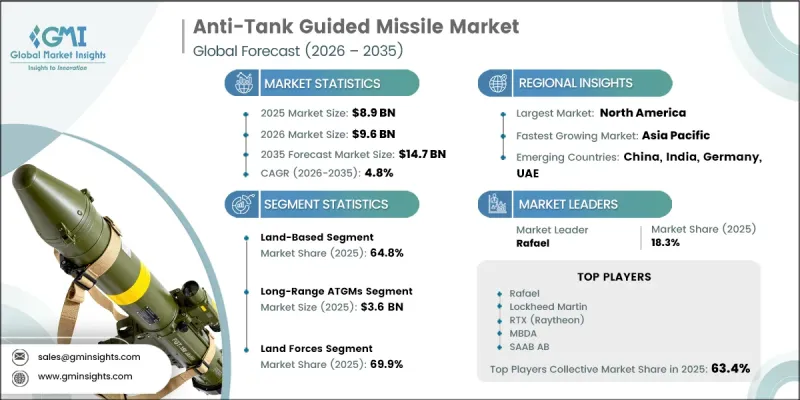
Growth in the anti-tank guided missile industry is driven by rising geopolitical uncertainty, increasing border security concerns, expanding defense budgets, and ongoing military modernization initiatives across multiple countries. Defense organizations continue to invest in advanced anti-armor weapon systems capable of improving battlefield effectiveness and strengthening operational readiness. Continuous technological progress in precision-guided missile systems is also supporting market expansion by improving targeting accuracy, operational efficiency, and mission effectiveness. Increasing emphasis on advanced guidance technologies and next-generation missile capabilities is further encouraging procurement across defense forces worldwide. In addition, governments are placing greater focus on strengthening domestic defense manufacturing capabilities and reducing dependence on external suppliers, creating new opportunities for indigenous missile development programs. Growing demand for modern land combat capabilities, combined with sustained investments in defense infrastructure and advanced weapon technologies, is expected to support the long-term expansion of the global anti-tank guided missile market throughout the forecast period.
| Market Scope | |
|---|---|
| Start Year | 2025 |
| Forecast Year | 2026-2035 |
| Start Value | $8.9 Billion |
| Forecast Value | $14.7 Billion |
| CAGR | 4.8% |
The anti-tank guided missile market continues to benefit from rising security challenges, increasing military preparedness, and stronger investments in modern ground combat systems. Demand for advanced anti-armor solutions is expanding as defense organizations prioritize greater operational precision, improved battlefield performance, and enhanced effectiveness against evolving armored threats. Ongoing advancements in guidance technologies, seeker systems, infrared sensing capabilities, and extended engagement ranges are strengthening the performance of precision-guided missile systems while reducing operational complexity during high-risk military missions.
The land-based segment accounted for 64.8% share in 2025, making it the leading deployment category. Growth within this segment is supported by continued procurement of anti-tank guided missile systems for ground combat operations involving armored vehicles and fortified targets. Rising investments in military modernization, increasing deployment of portable and vehicle-integrated missile platforms, and growing demand for advanced guidance capabilities continue to reinforce the segment's dominant market position. Expanding requirements for enhanced land warfare capabilities are also contributing to sustained demand throughout the forecast period.
The extended/NLOS segment is projected to register a CAGR of 14.3% during 2026-2035. Market growth is being supported by increasing demand for lightweight anti-tank weapon systems designed to improve operational flexibility across a broad range of military applications. Continued advancements in missile miniaturization, guidance technologies, system portability, weight reduction, and maneuverability are strengthening product adoption. At the same time, rising defense modernization efforts are encouraging greater procurement of portable anti-tank missile systems, supporting continued expansion of this segment during the forecast period.
North America Anti-Tank Guided Missile Market accounted for 29.9% share in 2025. Regional market growth continues to be supported by rising defense expenditures, sustained investments in military modernization, and increasing demand for advanced guided weapon systems. Ongoing efforts to strengthen land combat capabilities, improve troop survivability, and enhance operational readiness continue to drive procurement of modern long-range anti-tank missile systems. Continued investment in advanced defense technologies is expected to reinforce North America's position within the global anti-tank guided missile industry.
Major companies operating in the global anti-tank guided missile market include Bharat Dynamics Limited (BDL), Diehl Defence, EDGE Group / HALCON, Elbit Systems, Hanwha Aerospace, Israel Aerospace Industries (IAI), L&T MBDA Missile Systems India, LIG Defense Aerospace (formerly LIG Nex1), Lockheed Martin Corporation, MBDA, Norinco, Rafael Advanced Defense Systems, ROKETSAN, RTX (Raytheon), and Saab AB. Companies operating in the anti-tank guided missile market are strengthening their competitive position by investing in advanced missile technologies, expanding research and development capabilities, and enhancing precision-guided weapon performance. Manufacturers continue to prioritize improvements in guidance systems, targeting accuracy, operational range, and overall system reliability to address evolving defense requirements. Strategic partnerships, government defense contracts, and collaboration with military organizations remain important approaches for expanding market presence and securing long-term procurement opportunities. Companies are also increasing investments in domestic manufacturing capabilities, production efficiency, and next-generation missile platforms to strengthen supply chain resilience.
Table of Contents
Chapter 1 Methodology and Scope
- 1.1 Market scope and definition
- 1.2 Research design
- 1.2.1 Research approach
- 1.2.2 Data collection methods
- 1.3 Data mining sources
- 1.3.1 Global
- 1.3.2 Regional/Country
- 1.4 Base estimates and calculations
- 1.4.1 Base year calculation
- 1.4.2 Key trends for market estimation
- 1.5 Primary research and validation
- 1.5.1 Primary sources
- 1.6 Forecast model
- 1.7 Research assumptions and limitations
Chapter 2 Executive Summary
- 2.1 Industry 360° synopsis, 2022 - 2035
- 2.2 Key market trends
- 2.2.1 Launch platform trends
- 2.2.2 Guidance technology trends
- 2.2.3 Range classification trends
- 2.2.4 End-user trends
- 2.2.5 Regional trends
- 2.3 TAM Analysis, 2026-2035
- 2.4 CXO perspectives: Strategic imperatives
Chapter 3 Industry Insights
- 3.1 Industry ecosystem analysis
- 3.1.1 Supplier Landscape
- 3.1.2 Profit Margin
- 3.1.3 Cost structure
- 3.1.4 Value addition at each stage
- 3.1.5 Factor affecting the value chain
- 3.1.6 Disruptions
- 3.2 Industry impact forces
- 3.2.1 Growth drivers
- 3.2.1.1 Rising geopolitical tensions and regional conflicts
- 3.2.1.2 Increasing defense spending and military modernization programs
- 3.2.1.3 Advancements in precision-guided missile technologies
- 3.2.1.4 Growing deployment of advanced armored vehicles
- 3.2.1.5 Expansion of indigenous missile development and defense self-reliance initiatives
- 3.2.2 Industry pitfalls and challenges
- 3.2.2.1 High development and procurement costs of advanced ATGM systems
- 3.2.2.2 Countermeasures and evolving armored vehicle protection systems
- 3.2.3 Market opportunities
- 3.2.3.1 Integration of AI-enabled guidance and next-generation seeker technologies
- 3.2.3.2 Growing indigenous missile development and export opportunities
- 3.2.1 Growth drivers
- 3.3 Growth potential analysis
- 3.4 Regulatory landscape
- 3.4.1 North America
- 3.4.2 Europe
- 3.4.3 Asia Pacific
- 3.4.4 Latin America
- 3.4.5 Middle East & Africa
- 3.5 Porter's analysis
- 3.6 PESTEL analysis
- 3.7 Technology and Innovation landscape
- 3.7.1 Current technological trends
- 3.7.2 Emerging technologies
- 3.8 Price trends
- 3.8.1 By region
- 3.8.2 By product
- 3.9 Pricing Strategies
- 3.10 Emerging Business Models
- 3.11 Compliance Requirements
- 3.12 Patent and IP analysis
Chapter 4 Competitive Landscape, 2025
- 4.1 Introduction
- 4.2 Company market share analysis
- 4.2.1 By region
- 4.2.1.1 North America
- 4.2.1.2 Europe
- 4.2.1.3 Asia Pacific
- 4.2.1.4 Latin America
- 4.2.1.5 Middle East & Africa
- 4.2.2 Market concentration analysis
- 4.2.1 By region
- 4.3 Competitive benchmarking of key players
- 4.3.1 Financial performance comparison
- 4.3.1.1 Revenue
- 4.3.1.2 Profit margin
- 4.3.1.3 R&D
- 4.3.2 Product portfolio comparison
- 4.3.2.1 Product range breadth
- 4.3.2.2 Technology
- 4.3.2.3 Innovation
- 4.3.3 Geographic presence comparison
- 4.3.3.1 Global footprint analysis
- 4.3.3.2 Service network coverage
- 4.3.3.3 Market penetration by region
- 4.3.4 Competitive positioning matrix
- 4.3.4.1 Leaders
- 4.3.4.2 Challengers
- 4.3.4.3 Followers
- 4.3.4.4 Niche players
- 4.3.5 Strategic outlook matrix
- 4.3.1 Financial performance comparison
- 4.4 Key developments
- 4.4.1 Mergers and acquisitions
- 4.4.2 Partnerships and collaborations
- 4.4.3 Technological advancements
- 4.4.4 Expansion and investment strategies
- 4.4.5 Digital transformation initiatives
- 4.5 Emerging/ startup competitors landscape
Chapter 5 Market Estimates and Forecast, By Launch Platform, 2022 - 2035 (USD Million)
- 5.1 Key trends
- 5.2 Land-based
- 5.3 Air-launched ATGMs
- 5.4 Naval ATGM systems
Chapter 6 Market Estimates and Forecast, By Guidance Technology, 2022 - 2035 (USD Million)
- 6.1 Key trends
- 6.2 MCLOS
- 6.3 SACLOS
- 6.4 Laser beam riding / Semi-active laser homing
- 6.5 EO/TV guided
- 6.6 IIR fire-and-forget
- 6.7 Dual-mode / Multi-mode seekers
Chapter 7 Market Estimates and Forecast, By Range Classification, 2022 - 2035 (USD Million)
- 7.1 Key trends
- 7.2 Short-range ATGMs
- 7.3 Medium-range ATGMs
- 7.4 Long-range ATGMs
- 7.5 Extended/NLOS
Chapter 8 Market Estimates and Forecast, By End-User, 2022 - 2035 (USD Million)
- 8.1 Key trends
- 8.2 Land forces
- 8.3 Air forces
- 8.4 Naval forces
Chapter 9 Market Estimates and Forecast, By Region, 2022 - 2035 (USD Million)
- 9.1 Key trends
- 9.2 North America
- 9.2.1 U.S.
- 9.2.2 Canada
- 9.3 Europe
- 9.3.1 Germany
- 9.3.2 UK
- 9.3.3 France
- 9.3.4 Italy
- 9.3.5 Russia
- 9.4 Asia Pacific
- 9.4.1 China
- 9.4.2 India
- 9.4.3 Japan
- 9.4.4 Australia
- 9.4.5 South Korea
- 9.5 Latin America
- 9.5.1 Brazil
- 9.5.2 Mexico
- 9.5.3 Argentina
- 9.6 Middle East and Africa
- 9.6.1 Egypt
- 9.6.2 Saudi Arabia
- 9.6.3 UAE
Chapter 10 Company Profiles
- 10.1 Global Key Players
- 10.1.1 Rafael
- 10.1.2 Lockheed Martin
- 10.1.3 RTX (Raytheon)
- 10.1.4 MBDA
- 10.1.5 SAAB AB
- 10.2 Regional key players
- 10.2.1 Asia Pacific
- 10.2.1.1 Bharat Dynamics Limited (BDL)
- 10.2.1.2 Hanwha Aerospace
- 10.2.1.3 LIG Defense Aerospace
- 10.2.1.4 Norinco
- 10.2.2 Europe
- 10.2.2.1 Diehl Defence
- 10.2.1 Asia Pacific
- 10.3 Niche Players/Disruptors
- 10.3.1 EDGE Group
- 10.3.2 Elbit Systems
- 10.3.3 Israel Aerospace Industries
- 10.3.4 ROKETSAN
- 10.3.5 L&T MBDA Missile Systems India

