PUBLISHER: Global Market Insights Inc. | PRODUCT CODE: 2101659

PUBLISHER: Global Market Insights Inc. | PRODUCT CODE: 2101659
Private Credit Market Opportunity, Growth Drivers, Industry Trend Analysis, and Forecast 2026 - 2035
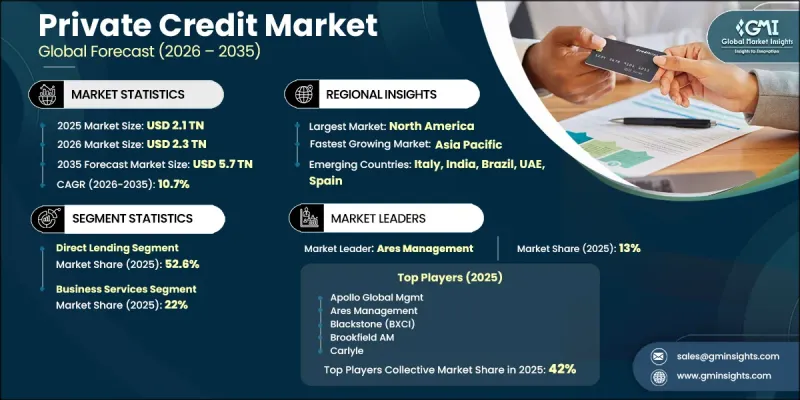
The Global Private Credit Market was valued at USD 2.1 trillion in 2025 and is estimated to grow at a CAGR of 10.7% to reach USD 5.7 trillion by 2035.
Growth in the private credit market continues to be supported by sustained capital deployment across direct lending, mezzanine financing, distressed debt, venture debt, and the rapidly growing asset-based finance segment. A long-term shift in the lending landscape has encouraged borrowers to increasingly seek financing from non-bank credit providers as traditional financial institutions continue to operate under stricter capital requirements. This structural transition has strengthened the role of private credit as an important source of funding for middle-market businesses and sponsor-backed transactions. At the same time, institutional investors are expanding allocations to alternative investments to enhance portfolio diversification, capture illiquidity premiums, and benefit from floating-rate income opportunities that have become more attractive than many traditional fixed-income assets. Ongoing regulatory developments continue to reshape commercial lending by increasing capital requirements for higher-risk lending activities, reducing the economic attractiveness of certain loan categories for banks.
| Market Scope | |
|---|---|
| Start Year | 2025 |
| Forecast Year | 2026-2035 |
| Start Value | $2.1 Trillion |
| Forecast Value | $5.7 Trillion |
| CAGR | 10.7% |
The direct lending segment accounted for 52.6% share in 2025 and is anticipated to grow at a 9.2% CAGR through 2035. The segment continues to represent the largest investment strategy within the institutional private credit industry due to its strong alignment with refinancing activity and acquisition financing requirements. Its leading position is supported by financing structures that provide borrowers with simplified execution, efficient pricing, and greater transaction certainty while offering investors access to senior secured lending opportunities across the middle-market segment. These advantages continue to strengthen the role of direct lending as the primary capital deployment strategy within the global private credit market.
The business services and industrials & manufacturing held 22% share in 2025. Continued financing activity across these industries is supported by business models that generate recurring revenue, maintain healthy cash flow profiles, and demonstrate relatively stable operating performance. Their financing requirements continue to create attractive lending opportunities for private credit providers seeking consistent risk-adjusted returns while expanding portfolio diversification across multiple sectors.
North America Private Credit Market accounted for 62.2% share in 2025. The region continues to benefit from a mature alternative investment ecosystem, a well-developed sponsor-backed financing environment, and strong institutional investor participation. Ongoing demand for flexible financing solutions and continued growth in private capital deployment are expected to reinforce the region's leadership throughout the forecast period.
Major companies operating in the global private credit market include Apollo Global Mgmt, Ares Management, Blackstone (BXCI), Brookfield AM, Brookfield Asset Management, Carlyle Group, HPS Investment Partners, KKR & Co., Oaktree Capital, and TPG Angelo Gordon. Companies participating in the private credit market are strengthening their competitive position by expanding fundraising capabilities, broadening investment portfolios, and increasing deployment across diversified credit strategies. Many firms are prioritizing long-term institutional partnerships to secure stable capital commitments while enhancing portfolio resilience through disciplined risk management and rigorous underwriting practices. Market participants are also expanding their geographic presence, increasing sector diversification, and developing customized financing solutions to address evolving borrower requirements. Investments in technology, portfolio analytics, and operational efficiency continue to improve investment decision-making and asset monitoring capabilities.
Table of Contents
Chapter 1 Methodology & Scope
- 1.1 Research approach
- 1.2 Quality Commitments
- 1.2.1 GMI AI policy & data integrity commitment
- 1.2.1.1 Source consistency protocol
- 1.2.1 GMI AI policy & data integrity commitment
- 1.3 Research Trail & Confidence Scoring
- 1.3.1 Research Trail Components
- 1.3.2 Scoring Components
- 1.4 Data Collection
- 1.4.1 Partial list of primary sources
- 1.5 Data mining sources
- 1.5.1 Paid sources
- 1.5.1.1 Sources, by region
- 1.5.1 Paid sources
- 1.6 Base estimates and calculations
- 1.6.1 Base year calculation
- 1.7 Forecast
- 1.7.1 Quantified market impact analysis
- 1.7.1.1 Mathematical impact of growth parameters on forecast
- 1.7.1 Quantified market impact analysis
- 1.8 Research transparency addendum
- 1.8.1 Source attribution framework
- 1.8.2 Quality assurance metrics
- 1.8.3 Our commitment to trust
Chapter 2 Executive Summary
- 2.1 Industry 360° synopsis
- 2.2 Key market trends
- 2.2.1 Regional
- 2.2.2 Credit Strategy
- 2.2.3 Borrower Size
- 2.2.4 Investor
- 2.2.5 Interest Rate
- 2.2.6 End Use
- 2.3 TAM Analysis, 2026-2035
- 2.4 CXO perspectives: Strategic imperatives
Chapter 3 Industry Insights
- 3.1 Industry ecosystem analysis
- 3.1.1 Supplier landscape
- 3.1.1.1 LP Investor Tier
- 3.1.1.2 Fund Manager
- 3.1.1.3 Borrower Tier
- 3.1.1.4 Service provider
- 3.1.2 Cost structure
- 3.1.3 Profit margin
- 3.1.4 Value addition at each stage
- 3.1.5 Vertical integration trends
- 3.1.6 Disruptors
- 3.1.1 Supplier landscape
- 3.2 Industry impact forces
- 3.2.1 Growth drivers
- 3.2.1.1 Bank lending retrenchment due to stricter capital regulations
- 3.2.1.2 Rising institutional investor allocations to alternative assets
- 3.2.1.3 Growth in sponsor-backed middle-market financing
- 3.2.1.4 Expansion of asset-based finance and specialty lending
- 3.2.2 Market Restraints
- 3.2.2.1 Rising borrower defaults and credit losses
- 3.2.2.2 Intensifying competition compressing lending spreads
- 3.2.3 Market Opportunities
- 3.2.3.1 Rapid expansion of asset-based finance strategies
- 3.2.3.2 Increasing participation of insurance capital
- 3.2.3.3 Growth of evergreen and semi-liquid private credit funds
- 3.2.3.4 Technology-driven credit underwriting and portfolio analytics
- 3.2.1 Growth drivers
- 3.3 Growth potential analysis
- 3.4 Pricing Analysis (Driven by Primary Research)
- 3.4.1 Historical Price Trend Analysis
- 3.4.2 Pricing Strategy by Player Type (Premium / Value / Cost-plus)
- 3.5 Regulatory landscape
- 3.5.1 North America
- 3.5.1.1 U.S. Securities Act of 1933 & SEC Rule 144A
- 3.5.1.2 Office of the Superintendent of Financial Institutions (OSFI) Guideline B-20
- 3.5.2 Europe
- 3.5.2.1 EU Prospectus Regulation & MiFID II
- 3.5.2.2 German Investment Code (Kapitalanlagegesetzbuch – KAGB)
- 3.5.3 Asia-Pacific
- 3.5.3.1 China Interbank Bond Market (CIBM) Regulations
- 3.5.3.2 Reserve Bank of India (RBI) Scale Based Regulation (SBR) Framework for NBFCs
- 3.5.4 Latin America
- 3.5.4.1 Brazil CVM Public Securities Offering Framework (CVM Resolution 160)
- 3.5.5 Middle East & Africa
- 3.5.5.1 Saudi Capital Market Authority (CMA) Debt Instruments Rules
- 3.5.5.2 Dubai International Financial Centre (DIFC) Private Credit Fund Regime
- 3.5.1 North America
- 3.6 Technology and Innovation Landscape
- 3.6.1 Current technologies
- 3.6.2 Emerging technologies
- 3.7 Porter’s analysis
- 3.8 PESTEL analysis
- 3.9 Patent analysis (Driven by Primary Research)
- 3.10 Impact of AI & generative AI on the market
- 3.10.1 AI-Driven Disruption of Existing Business Models
- 3.10.2 Automated design optimization
- 3.10.3 Supply chain AI for demand forecasting
- 3.10.4 GenAI use cases & adoption roadmap by segment
- 3.10.5 Risks, Limitations & Regulatory Considerations
- 3.11 Sustainability and environmental aspects
- 3.11.1 Sustainable practices
- 3.11.2 Waste reduction strategies
- 3.11.3 Energy efficiency in production
- 3.11.4 Eco-friendly Initiatives
- 3.11.5 Carbon footprint considerations
- 3.12 Forecast assumptions & scenario analysis (Driven by Primary Research)
- 3.12.1 Base Case - key macro & industry variables driving CAGR
- 3.12.2 Optimistic Scenarios - Favorable Macro and Industry Tailwinds
- 3.12.3 Pessimistic Scenario - Macroeconomic slowdown or industry headwinds
Chapter 4 Competitive Landscape, 2025
- 4.1 Introduction
- 4.2 Company market share analysis
- 4.2.1 North America
- 4.2.2 Europe
- 4.2.3 Asia-Pacific
- 4.2.4 Latin America
- 4.2.5 Middle East & Africa
- 4.3 Competitive positioning matrix
- 4.4 Key developments
- 4.4.1 Mergers & acquisitions
- 4.4.2 Partnerships & collaborations
- 4.4.3 New product launches
- 4.4.4 Expansion plans and funding
- 4.5 Company tier benchmarking
- 4.5.1 Tier classification criteria & qualifying thresholds
- 4.5.2 Tier positioning matrix by revenue, geography & innovation
Chapter 5 Market Estimates & Forecast, By Credit Strategy, 2022 - 2035 ($Tn)
- 5.1 Key trends
- 5.2 Direct Lending
- 5.2.1 Senior Secured First Lien
- 5.2.2 Unitranche
- 5.2.3 Second Lien
- 5.2.4 Stretch Senior
- 5.3 Asset-Based Finance
- 5.3.1 Real Estate Debt
- 5.3.2 Infrastructure Debt
- 5.3.3 Equipment Finance
- 5.3.4 Receivables Finance
- 5.3.5 Consumer Finance
- 5.4 Mezzanine Finance
- 5.4.1 Mezzanine Debt
- 5.4.2 Preferred Equity
- 5.4.3 PIK Notes
- 5.5 Distressed Debt
- 5.5.1 Distressed Loans
- 5.5.2 Distressed Bonds
- 5.5.3 Rescue Financing
- 5.5.4 DIP Financing
- 5.6 Special Situations & Opportunistic Credit
- 5.6.1 Bridge Financing
- 5.6.2 Acquisition Financing
- 5.6.3 Structured Capital
- 5.6.4 Liability Management
- 5.7 Venture Debt
- 5.7.1 Early-Stage Venture Debt
- 5.7.2 Growth Venture Debt
- 5.8 Others
Chapter 6 Market Estimates & Forecast, By Borrower Size, 2022 - 2035 ($Tn)
- 6.1 Key trends
- 6.2 Small Enterprises
- 6.3 Middle Enterprises
- 6.4 Large Corporates
Chapter 7 Market Estimates & Forecast, By Investor, 2022 - 2035 ($Tn)
- 7.1 Key trends
- 7.2 Pension Funds
- 7.3 Insurance Companies
- 7.4 Sovereign Wealth Funds
- 7.5 Endowments & Foundations
- 7.6 Family Offices
- 7.7 Asset Managers
- 7.8 Retail Investors
- 7.9 Others
Chapter 8 Market Estimates & Forecast, By Interest Rate, 2022 - 2035 ($Tn)
- 8.1 Key trends
- 8.2 Floating Rate
- 8.3 Fixed Rate
- 8.4 Hybrid Rate
Chapter 9 Market Estimates & Forecast, By End Use, 2022 - 2035 ($Tn)
- 9.1 Key trends
- 9.2 Business Services
- 9.3 Industrials & Manufacturing
- 9.4 Healthcare & Life Sciences
- 9.5 Technology & Software
- 9.6 Consumer & Retail
- 9.7 Infrastructure
- 9.8 Transportation & Logistics
- 9.9 Others
Chapter 10 Market Estimates & Forecast, By Region, 2022 - 2035 ($Tn)
- 10.1 Key trends
- 10.2 North America
- 10.2.1 US
- 10.2.2 Canada
- 10.3 Europe
- 10.3.1 UK
- 10.3.2 Germany
- 10.3.3 France
- 10.3.4 Italy
- 10.3.5 Spain
- 10.3.6 Belgium
- 10.3.7 Netherlands
- 10.3.8 Sweden
- 10.3.9 Russia
- 10.4 Asia Pacific
- 10.4.1 China
- 10.4.2 India
- 10.4.3 Japan
- 10.4.4 Australia
- 10.4.5 Singapore
- 10.4.6 South Korea
- 10.4.7 Thailand
- 10.5 Latin America
- 10.5.1 Brazil
- 10.5.2 Mexico
- 10.5.3 Argentina
- 10.6 Middle East and Africa
- 10.6.1 UAE
- 10.6.2 Saudi Arabia
- 10.6.3 South Africa
- 10.6.4 Turkey
Chapter 11 Company Profiles
- 11.1 Global players
- 11.1.1 Apollo Global Management
- 11.1.2 Ares Management
- 11.1.3 Blackstone Credit & Insurance (BXCI)
- 11.1.4 Blue Owl Capital
- 11.1.5 Brookfield Asset Management
- 11.1.6 HPS Investment Partners
- 11.1.7 KKR
- 11.1.8 Oaktree Capital Management
- 11.1.9 The Carlyle
- 11.1.10 TPG Angelo Gordon
- 11.2 Regional players
- 11.2.1 Antares Capital
- 11.2.2 Benefit Street Partners
- 11.2.3 Churchill Asset Management
- 11.2.4 Golub Capital
- 11.2.5 Intermediate Capital
- 11.2.6 Pemberton Asset Management
- 11.2.7 Tikehau Capital
- 11.3 Emerging players
- 11.3.1 Crescent Capital
- 11.3.2 Hayfin Capital Management
- 11.3.3 Monroe Capital

