PUBLISHER: Global Market Insights Inc. | PRODUCT CODE: 2101662

PUBLISHER: Global Market Insights Inc. | PRODUCT CODE: 2101662
Molten Salt Reactor Market Opportunity, Growth Drivers, Industry Trend Analysis, and Forecast 2026 - 2035
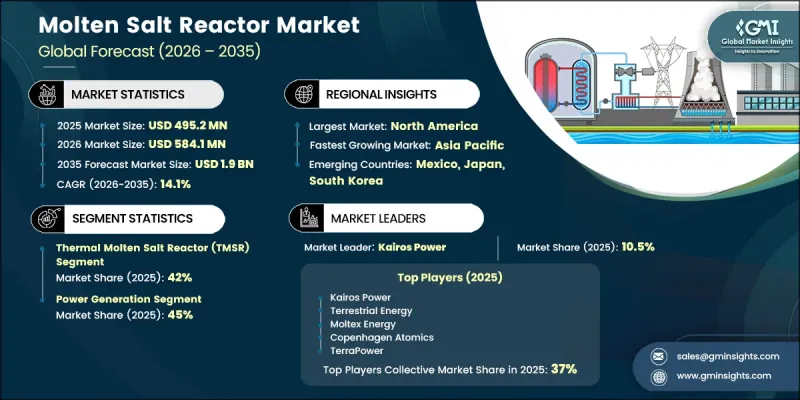
The Global Molten Salt Reactor (MSR) Market was valued at USD 495.2 million in 2025 and is estimated to grow at a CAGR of 14.1% to reach USD 1.9 billion by 2035.
The molten salt reactor (MSR) market is gaining significant momentum as governments and industry stakeholders increase investments in advanced nuclear technologies capable of delivering safe, efficient, and low-carbon energy generation. Growing commercialization of fluoride- and chloride-based reactor designs, combined with supportive policy frameworks across North America, Europe, and Asia Pacific, is accelerating market development. The industry is gradually transitioning beyond conventional light-water reactor technologies as molten salt reactors offer advantages including higher thermal efficiency, enhanced passive safety features, and the ability to supply high-temperature heat for industrial applications. These capabilities position MSRs as an attractive solution for meeting future electricity demand while supporting industrial decarbonization. Favorable government funding programs and policy initiatives aimed at advancing next-generation nuclear technologies are also improving investment confidence and encouraging long-term project development. Rising demand for reliable low-carbon electricity and high-temperature industrial energy continues to strengthen the business case for molten salt reactors, reinforcing growth prospects for the global molten salt reactor (MSR) market throughout the forecast period.
| Market Scope | |
|---|---|
| Start Year | 2025 |
| Forecast Year | 2026-2035 |
| Start Value | $495.2 Million |
| Forecast Value | $1.9 Billion |
| CAGR | 14.1% |
The thermal molten salt reactor segment accounted for 42% share in 2025 and is projected to grow at a CAGR of 16.8% through 2035, representing the fastest-growing reactor type. Thermal molten salt reactors continue to attract the greatest commercial interest because of their efficient operating characteristics, favorable safety profile, and suitability for high-temperature energy applications. Their technological maturity and ongoing development activities continue to support wider adoption as commercialization progresses across global markets.
The power generation segment represented 45% share in 2025 and is expected to register a CAGR of 20.2% through 2035, making it one of the fastest-growing application categories. Demand is increasing as energy providers seek dependable low-carbon baseload generation capable of supporting rising electricity consumption. Molten salt reactor technology is increasingly recognized as a promising option for delivering continuous power generation while supporting long-term energy transition strategies and expanding electricity requirements.
North America Molten Salt Reactor (MSR) Market accounted for 50.5% share in 2025 and is projected to grow at a CAGR of 16.1% through 2035. The region continues to lead market development through substantial public and private investment in advanced nuclear technologies, favorable regulatory progress, and strong institutional support for reactor innovation. Ongoing development activities, combined with increasing funding for advanced reactor commercialization, continue to reinforce North America's leadership position within the global market.
Major companies operating in the global molten salt reactor (MSR) market include TerraPower, Kairos Power, Terrestrial Energy, ThorCon International, Moltex Energy, China National Nuclear Corporation, Orano, Southern Company, Copenhagen Atomics, Flibe Energy, Alpha Tech Research Corp, Elysium Industries, Saltfoss Energy, Natura Resources, Naarea, Stellaria, Thorium Tech Solution (TTS), Thorizon, Transatomic Power, and Valar Atomics. Companies operating in the molten salt reactor (MSR) market are strengthening their competitive position through continuous investment in advanced reactor research, technology development, and commercialization initiatives. Industry participants are expanding strategic partnerships with government agencies, research organizations, utilities, and industrial energy users to accelerate project deployment and regulatory approvals. Companies are focusing on improving reactor efficiency, safety systems, fuel utilization, and modular construction methods to reduce project costs and shorten development timelines. Investments in demonstration projects, manufacturing capabilities, and advanced engineering expertise are supporting technology validation and market readiness.
Table of Contents
Chapter 1 Methodology & Scope
- 1.1 Research design
- 1.2 Quality commitment
- 1.2.1 GMI AI policy & data integrity commitment
- 1.2.1.1 Source consistency protocol
- 1.2.1 GMI AI policy & data integrity commitment
- 1.3 Research Trail & Confidence Scoring
- 1.3.1 Research Trail Components
- 1.3.2 Scoring Components
- 1.4 Data Collection
- 1.4.1 Partial list of primary sources
- 1.5 Data mining sources
- 1.5.1 Paid sources
- 1.5.1.1 Sources, by region
- 1.5.1 Paid sources
- 1.6 Base estimates and calculations
- 1.6.1 Base year calculation for any one approach
- 1.7 Forecast model
- 1.8 Research transparency addendum
- 1.8.1 Source attribution framework
- 1.8.2 Quality assurance metrics
- 1.8.3 Our commitment to trust
- 1.9 Market definitions
Chapter 2 Executive Summary
- 2.1 Industry synopsis, 2022 - 2035
- 2.2 Business trends
- 2.3 Reactor type trends
- 2.4 Application trends
- 2.5 Fuel trends
- 2.6 End use trends
- 2.7 Regional trends
Chapter 3 Industry Insights
- 3.1 Industry ecosystem
- 3.1.1 Raw material availability & sourcing analysis
- 3.1.2 Manufacturing capacity assessment
- 3.1.3 Supply chain resilience & risk factors
- 3.1.4 Distribution network analysis
- 3.2 Regulatory landscape
- 3.2.1 North America
- 3.2.2 Europe
- 3.2.3 Asia Pacific
- 3.2.4 Middle East & Africa
- 3.2.5 Latin America
- 3.3 Industry impact forces
- 3.3.1 Growth drivers
- 3.3.2 Industry pitfalls & challenges
- 3.4 Growth potential analysis
- 3.5 Porter's analysis
- 3.5.1 Bargaining power of suppliers
- 3.5.2 Bargaining power of buyers
- 3.5.3 Threat of new entrants
- 3.5.4 Threat of substitutes
- 3.6 PESTEL analysis
- 3.6.1 Political factors
- 3.6.2 Economic factors
- 3.6.3 Social factors
- 3.6.4 Technological factors
- 3.6.5 Legal factors
- 3.6.6 Environmental factors
- 3.7 Cost structure analysis of molten salt reactor
- 3.8 Impact of AI & generative AI on the market
- 3.8.1 Predictive maintenance & fault detection
- 3.8.2 Grid optimization & load forecasting
- 3.8.3 Digital twin simulation & testing
- 3.8.4 Risks, limitations & regulatory considerations
- 3.9 Emerging opportunities & trends
- 3.9.1 Digitalization & IoT integration
- 3.9.2 Emerging market penetration
- 3.10 Overall investment scenario and future outlook
Chapter 4 Competitive landscape, 2026
- 4.1 Introduction
- 4.2 Company market share analysis, by region, 2025
- 4.2.1 North America
- 4.2.2 Europe
- 4.2.3 Asia Pacific
- 4.2.4 Rest of world
- 4.3 Competitive analysis of major market players
- 4.4 Competitive positioning matrix
- 4.5 Key developments
- 4.5.1 Mergers & acquisitions
- 4.5.2 Partnerships & collaborations
- 4.5.3 New product launches
- 4.5.4 Expansion plans & funding
- 4.6 Company tier benchmarking
- 4.6.1 Tier classification criteria & qualifying thresholds
- 4.6.2 Tier positioning matrix by revenue, geography & innovation
Chapter 5 Market Size and Forecast, By Reactor type, 2022 - 2035 (USD Billion)
- 5.1 Key trends
- 5.2 Thermal molten salt reactor (TMSR)
- 5.3 Fast molten salt reactor (FMSR)
- 5.4 Molten salt breeder reactor (MSBR)
- 5.5 Others
Chapter 6 Market Size and Forecast, By Application, 2022 - 2035 (USD Billion)
- 6.1 Key trends
- 6.2 Power generation
- 6.3 Industrial process heat
- 6.4 Hydrogen production
- 6.5 Desalination
- 6.6 Research & development
- 6.7 Marine & naval propulsion
- 6.8 Others
Chapter 7 Market Size and Forecast, By Fuel, 2022 - 2035 (USD Billion)
- 7.1 Key trends
- 7.2 Thorium-based
- 7.3 Uranium-based
- 7.4 Plutonium / mixed oxide (MOX)
Chapter 8 Market Size and Forecast, By End use, 2022 - 2035 (USD Billion)
- 8.1 Key trends
- 8.2 Utilities & independent power producers (IPPs)
- 8.3 Government & defense
- 8.4 Industrial operators
- 8.5 Research institutes & universities
- 8.6 Others
Chapter 9 Market Size and Forecast, By Region, 2022 - 2035 (USD Billion)
- 9.1 Key trends
- 9.2 North America
- 9.2.1 U.S.
- 9.2.2 Canada
- 9.2.3 Mexico
- 9.3 Europe
- 9.3.1 UK
- 9.3.2 France
- 9.3.3 Germany
- 9.4 Asia Pacific
- 9.4.1 China
- 9.4.2 India
- 9.4.3 Japan
- 9.4.4 South Korea
- 9.5 Rest of world
Chapter 10 Company Profiles
- 10.1 Alpha Tech Research Corp
- 10.2 China National Nuclear Corporation
- 10.3 Copenhagen Atomics
- 10.4 Elysium Industries
- 10.5 Flibe Energy
- 10.6 Kairos Power
- 10.7 Moltex Energy
- 10.8 Naarea
- 10.9 Natura Resources
- 10.10 Orano
- 10.11 Saltfoss Energy
- 10.12 Southern Company
- 10.13 Stellaria
- 10.14 TerraPower
- 10.15 Terrestrial Energy
- 10.16 ThorCon International
- 10.17 Thorium Tech Solution (TTS)
- 10.18 Thorizon
- 10.19 Transatomic Power
- 10.20 Valar Atomics

