PUBLISHER: Global Market Insights Inc. | PRODUCT CODE: 2101671

PUBLISHER: Global Market Insights Inc. | PRODUCT CODE: 2101671
North America Electric Farm Tractor Market Opportunity, Growth Drivers, Industry Trend Analysis, and Forecast 2026 - 2035
North America Electric Farm Tractor Market was valued at USD 93.6 million in 2025 and is estimated to grow at a CAGR of 22.4% to reach USD 788.1 million by 2035.
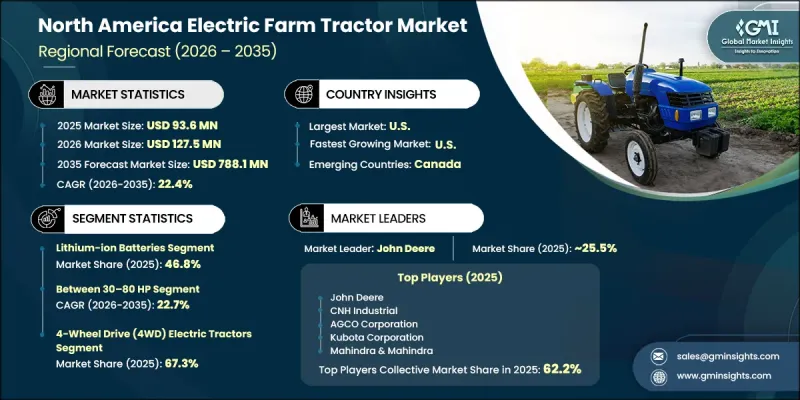
The regional market is experiencing a fundamental shift in agricultural machinery adoption patterns, supported by stricter emissions regulations, rising diesel fuel expenses, expanding government incentive frameworks, and increasing OEM investment in electrified and hybrid agricultural machinery. North America benefits from a well-developed agricultural ecosystem, strong distribution and service networks, and policy-driven sustainability initiatives, all of which are reinforcing the transition toward electric farm tractors. Regulatory tightening on non-road diesel equipment emissions is a key structural driver, as compliance requirements under current Tier 4 Final norms and anticipated future regulatory updates are increasing the cost burden of diesel-based systems. As a result, electric alternatives are becoming more economically competitive across long-term operational cycles. Additional regulatory alignment efforts across multiple U.S. states with stricter emissions frameworks are further accelerating procurement shifts toward electric agricultural equipment, strengthening the region's long-term electrification trajectory.
| Market Scope | |
|---|---|
| Start Year | 2025 |
| Forecast Year | 2026-2035 |
| Start Value | $93.6 Million |
| Forecast Value | $788.1 Million |
| CAGR | 22.4% |
The lithium-ion battery technology segment held a 46.8% share in 2025 and is expected to grow at a CAGR of 22.8% through 2035. This dominance is supported by high energy density, extended operational life, and improved cost efficiency compared to older energy storage technologies. Lithium-ion systems provide an optimal combination of weight efficiency, charging performance, and energy output, making them highly suitable for agricultural workloads where consistent power delivery and operational endurance are essential.
The 30-80 HP power output category accounted for 48.8% share and is projected to grow at a CAGR of 22.7% through 2035. This segment is widely used across core farming activities such as crop cultivation, livestock operations, orchard management, and general utility applications, making it the most adaptable and broadly adopted power range in the region. Strong availability of commercial models from multiple OEMs, combined with improving battery integration and charging ecosystem development, continues to reinforce its dominance in the market.
United States Electric Farm Tractor Market held a 75.3% share in 2025 and is projected to grow at a CAGR of 22.5% through 2035. The country's leadership is supported by its extensive agricultural base, which includes a wide mix of crop production, livestock farming, dairy operations, and specialty agriculture. Financial support mechanisms such as federal clean energy incentives, agricultural sustainability funding programs, and state-level electrification initiatives are contributing to faster adoption of electric tractors. The U.S. also benefits from a highly developed manufacturing ecosystem, advanced agricultural R&D capabilities, and an extensive dealer and service infrastructure that collectively reinforce its dominant market position.
Key companies operating in the North America electric farm tractor market include AGCO Corporation (Fendt), CNH Industrial (New Holland / Case IH), John Deere, Kubota Corporation, Mahindra & Mahindra (Tractor Division), Monarch Tractor, and Solectrac. Companies operating in the North America electric farm tractor market are focusing on strengthening their market position through investments in electrification-focused product development and expansion of battery-powered tractor portfolios across multiple horsepower categories. Manufacturers are prioritizing improvements in battery efficiency, charging speed, and operational endurance to align electric tractors with conventional diesel performance standards. Strategic partnerships with battery suppliers, technology providers, and agricultural equipment dealers are used to accelerate commercialization and distribution reach. Companies are also expanding pilot programs and field demonstrations to improve farmer adoption rates and build real-world performance confidence.
Table of Contents
Chapter 1 Methodology and Scope
- 1.1 Market scope and definition
- 1.2 Research design
- 1.2.1 Research approach
- 1.2.2 Data collection methods
- 1.3 Data mining sources
- 1.3.1 Global
- 1.3.2 Regional/Country
- 1.4 Base estimates and calculations
- 1.4.1 Base year calculation
- 1.4.2 Key trends for market estimation
- 1.5 Primary research and validation
- 1.5.1 Primary sources
- 1.6 Forecast model
- 1.7 Research assumptions and limitations
Chapter 2 Executive Summary
- 2.1 Industry 360° synopsis
- 2.2 Key market trends
- 2.2.1 Country
- 2.2.2 Power Output
- 2.2.3 Battery type
- 2.2.4 Drive type
- 2.2.5 Farm size
- 2.2.6 Application
Chapter 3 Industry Insights
- 3.1 Industry ecosystem analysis
- 3.1.1 Component manufacturing
- 3.1.2 Tractor assembly & OEM integration
- 3.1.3 Distribution channels
- 3.1.4 After-sales service & maintenance network coverage
- 3.1.5 Profit margin analysis by value chain stage
- 3.1.6 Value addition at each stage
- 3.2 Industry impact forces
- 3.2.1 Growth drivers
- 3.2.1.1 Stringent EPA emission standards & clean air regulations driving fleet electrification
- 3.2.1.2 Volatile diesel fuel prices increasing TCO advantage of electric tractors
- 3.2.1.3 Federal & state-level incentives
- 3.2.2 Market challenges
- 3.2.2.1 High upfront purchase cost vs. diesel equivalents
- 3.2.2.2 Inadequate rural charging infrastructure across Midwest & Prairie farming regions
- 3.2.3 Opportunities
- 3.2.3.1 Expansion into small & medium-scale farming segments in the U.S. & Canada
- 3.2.3.2 Integration of electric tractors with precision agriculture & AgriTech platforms
- 3.2.1 Growth drivers
- 3.3 Growth potential analysis
- 3.4 Regulatory landscape
- 3.4.1 Federal regulatory framework - EPA off-road emission standards & clean equipment mandates
- 3.4.2 USDA clean agriculture incentive programs & farm electrification support
- 3.4.3 Inflation Reduction Act (IRA) - clean energy & agricultural equipment provisions
- 3.4.4 U.S. state-level regulations - California CARB off-road equipment rules & other states
- 3.4.5 Canada - federal & provincial clean agriculture & emissions reduction policies
- 3.4.6 Import/export tariff landscape for electric tractors - U.S., Canada & Mexico
- 3.4.7 Carbon credit & climate finance opportunities for farm fleet electrification in North America
- 3.5 Major market trends and disruptions
- 3.6 Technological and innovation landscape
- 3.6.1 Technology maturity roadmap
- 3.6.2 Battery technology advancements & North America supply chain implications
- 3.6.3 Motor & drivetrain efficiency trends
- 3.6.4 Off-grid & solar charging technology development for remote farming operations
- 3.6.5 Precision agriculture integration with electric tractor platforms
- 3.6.6 Hydrogen fuel cell tractors as competing technology
- 3.7 Pricing analysis, 2025
- 3.7.1 Historical price trend analysis
- 3.7.2 Pricing strategy by player type (premium / value / cost-plus)
- 3.8 Future market trends
- 3.9 Porter's analysis
- 3.10 PESTEL analysis
- 3.11 Supply chain analysis
- 3.11.1 Battery raw material supply
- 3.11.2 Semiconductor and electronics component dependencies
- 3.11.3 Supply chain vulnerabilities and mitigation strategies
- 3.12 Trade Data Analysis (Driven by paid database) (HS code- 8701)
- 3.12.1 Import/export volume & value trends
- 3.12.2 Key trade corridors & tariff impact
- 3.13 Impact of AI & Generative AI on the Market
- 3.13.1 AI-Driven disruption of traditional agricultural machinery business models
- 3.13.2 GenAI use cases & adoption roadmap
- 3.13.3 Risks, limitations & regulatory considerations for ai-integrated agricultural equipment
- 3.14 Capacity & production landscape (driven by primary research)
- 3.14.1 Installed manufacturing capacity by region & key producer
- 3.14.2 Capacity utilization rates & expansion pipelines
Chapter 4 Competitive Landscape, 2025
- 4.1 Introduction
- 4.2 Company market share analysis
- 4.2.1 By country
- 4.2.1.1 U.S.
- 4.2.1.2 Canada
- 4.2.1 By country
- 4.3 Company matrix analysis
- 4.4 Competitive analysis of major market players
- 4.5 Competitive positioning matrix
- 4.6 Key developments
- 4.6.1 Mergers & acquisitions
- 4.6.2 Partnerships & collaborations
- 4.6.3 New product launches
- 4.6.4 Expansion plans
Chapter 5 Market Estimates and Forecast, By Power Output, 2022 - 2035 (USD Million) (Units)
- 5.1 Key trends
- 5.2 Below 30 HP
- 5.3 Between 30-80 HP
- 5.4 Above 80 HP
Chapter 6 Market Estimates and Forecast, By Battery Type, 2022 - 2035 (USD Million) (Units)
- 6.1 Key trends
- 6.2 Lithium-ion batteries
- 6.3 Lead-acid batteries
- 6.4 Solid-state battery
- 6.5 Others (sodium-ion, flow battery)
Chapter 7 Market Estimates and Forecast, By Drive Type, 2022 - 2035 (USD Million) (Units)
- 7.1 Key trends
- 7.2 2-Wheel Drive (2WD) electric tractors
- 7.3 4-Wheel Drive (4WD) electric tractors
Chapter 8 Market Estimates and Forecast, By Farm Size, 2022 - 2035 (USD Million) (Units)
- 8.1 Key trends
- 8.2 Small-scale farms - below 5 hectares
- 8.3 Medium-scale farms - 5-50 hectares
- 8.4 Large-scale farms - above 50 hectares
Chapter 9 Market Estimates and Forecast, By Application, 2022 - 2035 (USD Million) (Units)
- 9.1 Key trends
- 9.2 Farming and tillage
- 9.3 Haulage & transportation
- 9.4 Harvesting support operations
- 9.5 Others (spraying, irrigation support, orchard operations, etc.)
Chapter 10 Market Estimates and Forecast, By Country, 2022 - 2035 (USD Million) (Units)
- 10.1 Key trends
- 10.2 North America
- 10.2.1 U.S.
- 10.2.2 Canada
Chapter 11 Company Profiles
- 11.1 Global Players
- 11.1.1 John Deere
- 11.1.2 AGCO Corporation / Fendt
- 11.1.3 CNH Industrial (New Holland / Case IH)
- 11.1.4 Kubota Corporation
- 11.1.5 Yanmar Holdings Co. Ltd.
- 11.1.6 CLAAS Group
- 11.1.7 LS Mtron (LS Tractor)
- 11.2 Regional Players
- 11.2.1 Mahindra & Mahindra (Tractor Division)
- 11.2.2 Caterpillar Inc.
- 11.2.3 Bobcat (Doosan Bobcat)
- 11.2.4 SDF Group (Same Deutz-Fahr)
- 11.2.5 Weichai LOVOL (Foton Lovol International)
- 11.2.6 Escorts Kubota Limited
- 11.2.7 TAFE Limited
- 11.2.8 Sonalika / International Tractors Ltd.
- 11.2.9 FarmX / Amos Power
- 11.2.10 Tilmor
- 11.3 Emerging players
- 11.3.1 Ztractor
- 11.3.2 Werkr Tractors
- 11.3.3 Electric Tractor Corporation (ETC)
- 11.3.4 Autonomous Tractor Corporation (ATC)

