PUBLISHER: Global Market Insights Inc. | PRODUCT CODE: 2101868

PUBLISHER: Global Market Insights Inc. | PRODUCT CODE: 2101868
Banking as a Service Market Opportunity, Growth Drivers, Industry Trend Analysis, and Forecast 2026 - 2035
The Global Banking as a Service Market was valued at USD 24.8 billion in 2025 and is estimated to grow at a CAGR of 17.8% to reach USD 126.6 billion by 2035.
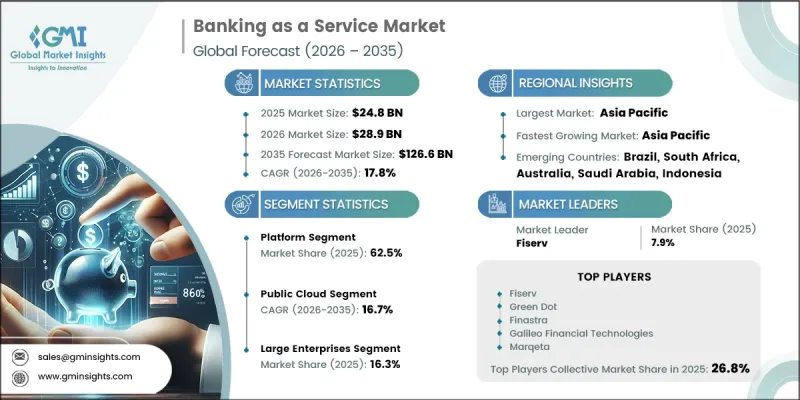
The banking as a service market is expanding rapidly as financial institutions and technology providers continue to accelerate digital transformation initiatives and broaden access to embedded financial services. Rising demand for digital banking experiences, faster deployment of financial products, and the integration of banking capabilities into non-financial platforms are creating strong momentum for market growth. Continuous expansion of the fintech ecosystem, increasing adoption of API-driven financial infrastructure, and the evolution of open banking initiatives are encouraging businesses to embed financial services into their digital platforms. Organizations are increasingly seeking scalable banking infrastructure that enables faster innovation while reducing operational complexity and development costs. The growing preference for cloud-based financial ecosystems, combined with rising investments in digital payment solutions and modern banking technologies, is further strengthening industry expansion. As enterprises focus on delivering seamless customer experiences through integrated financial services, Banking as a Service (BaaS) platforms are becoming a critical component of next-generation digital ecosystems, supporting sustained market growth throughout the forecast period.
| Market Scope | |
|---|---|
| Start Year | 2025 |
| Forecast Year | 2026-2035 |
| Start Value | $24.8 Billion |
| Forecast Value | $126.6 Billion |
| CAGR | 17.8% |
Banking as a Service (BaaS) enables licensed financial institutions to provide core banking capabilities, including payments, deposits, lending, and account management, through technology platforms that can be accessed by third-party organizations. This model allows businesses to introduce financial products without establishing their own regulated banking infrastructure, significantly reducing development timelines and operational complexity. The growing adoption of embedded finance across multiple industries continues to strengthen demand for BaaS platforms, as organizations increasingly integrate financial capabilities directly into their customer experiences to improve convenience, engagement, and service accessibility.
The platform segment accounted for 62.5% share in 2025 and is projected to grow at a CAGR of 17% from 2026 to 2035. Platform solutions maintain a leading market position because they provide scalable infrastructure that enables organizations to efficiently develop, deploy, and manage digital financial services. These platforms simplify access to essential banking capabilities through standardized application programming interfaces (APIs), allowing financial service providers and technology companies to accelerate product launches while improving operational efficiency and regulatory compliance.
The public cloud segment captured 75.5% share in 2025 and is expected to grow at a CAGR of 16.7% during 2026-2035. Public cloud infrastructure continues to gain widespread adoption due to its scalability, flexibility, and cost advantages. Financial institutions and technology providers increasingly rely on cloud-based environments to accelerate deployment, optimize infrastructure investments, and support the rapid expansion of API-enabled banking solutions. The continued evolution of digital financial services and cloud-native banking platforms is expected to reinforce strong demand for public cloud deployment models.
China Banking as a Service Market held 32.5% share, generating USD 1.8 billion in 2025. Asia Pacific remains the fastest-growing regional market, supported by a rapidly expanding digital economy, increasing financial inclusion initiatives, favorable regulatory developments, and widespread adoption of digital payment technologies. The region continues to witness significant investment in financial technology infrastructure, enabling financial institutions and technology providers to deliver scalable banking services while supporting growing demand for embedded financial solutions across diverse industries.
Major companies operating in the global banking as a service market include Mambu, Solaris, ClearBank, Plaid, Galileo Financial Technologies, Railsr, Green Dot, Marqeta, Finastra, and Fiserv. Companies operating in the banking as a service market are strengthening their competitive position by expanding API capabilities, enhancing cloud-native platforms, and developing scalable digital banking infrastructure. Market participants are investing heavily in technology innovation to improve platform performance, security, and regulatory compliance while supporting faster deployment of embedded financial services. Strategic collaborations with financial institutions, fintech companies, and enterprise technology providers continue to broaden service offerings and expand customer reach. Businesses are also strengthening their international presence through geographic expansion, platform localization, and ecosystem partnerships.
Table of Contents
Chapter 1 Research Methodology
- 1.1 Research approach
- 1.2 Quality Commitments
- 1.2.1 GMI AI policy & data integrity commitment
- 1.2.1.1 Source consistency protocol
- 1.2.1 GMI AI policy & data integrity commitment
- 1.3 Research Trail & Confidence Scoring
- 1.3.1 Research Trail Components
- 1.3.2 Scoring Components
- 1.4 Data Collection
- 1.4.1 Partial list of primary sources
- 1.5 Data mining sources
- 1.5.1 Paid sources
- 1.5.1.1 Sources, by region
- 1.5.1 Paid sources
- 1.6 Base estimates and calculations
- 1.6.1 Base year calculation for any one approach
- 1.7 Forecast model
- 1.7.1 Quantified Market impact analysis
- 1.7.1.1 Mathematical impact of growth parameters on forecast
- 1.7.1 Quantified Market impact analysis
- 1.8 Research transparency addendum
- 1.8.1 Source attribution framework
- 1.8.2 Quality assurance metrics
- 1.8.3 Our commitment to trust
Chapter 2 Executive Summary
- 2.1 Industry 360° synopsis, 2022 - 2035
- 2.2 Key Market trends
- 2.2.1 Regional
- 2.2.2 Component
- 2.2.3 Deployment
- 2.2.4 Organization size
- 2.2.5 End Use
- 2.3 TAM Analysis, 2026-2035
- 2.4 CXO perspectives: Strategic imperatives
Chapter 3 Industry Insights
- 3.1 Industry ecosystem analysis
- 3.1.1 Supplier landscape
- 3.1.2 Profit margin analysis
- 3.1.3 Cost structure
- 3.1.4 Value addition at each stage
- 3.1.5 Factor affecting the value chain
- 3.1.6 Disruptions
- 3.2 Industry impact forces
- 3.2.1 Growth drivers
- 3.2.1.1 Accelerating Demand for Embedded Finance Across Non-Financial Sectors
- 3.2.1.2 Open Banking Regulations Mandating API-Driven Financial Infrastructure
- 3.2.1.3 Rising Fintech Startup Ecosystem Requiring Plug-and-Play Banking Infrastructure
- 3.2.1.4 Cost Efficiency & Speed-to-Market Advantages over Traditional Banking Setup
- 3.2.2 Industry pitfalls and challenges
- 3.2.2.1 Heightened Regulatory Scrutiny & Enforcement Actions on Sponsor Banks
- 3.2.2.2 Cybersecurity & Data Privacy Risks in Multi-Party BaaS Architectures
- 3.2.3 Market opportunities
- 3.2.3.1 Expansion of Embedded Finance Across Non-Banking Industries
- 3.2.3.2 Growth in Real-Time Payments and Digital Wallet Adoption
- 3.2.3.3 Increasing Demand for API-First Cloud Banking Infrastructure
- 3.2.3.4 Rising Partnerships Between Banks, Fintechs, and Technology Providers
- 3.2.1 Growth drivers
- 3.3 Technology and innovation landscape
- 3.3.1 Current technological trends
- 3.3.1.1 API-First Banking Platforms
- 3.3.1.2 Cloud-Native Core Banking Systems
- 3.3.1.3 Real-Time Payment Processing Systems
- 3.3.1.4 Digital Identity and e-KYC Solutions
- 3.3.2 Emerging technologies
- 3.3.2.1 Artificial Intelligence and Machine Learning in Banking
- 3.3.2.2 Blockchain and Distributed Ledger Technology (DLT)
- 3.3.2.3 Open Banking 2.0 with Advanced Data Sharing APIs
- 3.3.2.4 Embedded Finance Automation Platforms
- 3.3.1 Current technological trends
- 3.4 Growth potential analysis
- 3.5 Pricing Analysis (Driven by primary research)
- 3.5.1 Historical Price Trend Analysis
- 3.5.2 Pricing Strategy by Player Type
- 3.6 Regulatory landscape
- 3.6.1 North America
- 3.6.1.1 Federal Reserve System
- 3.6.1.2 Office of the Comptroller of the Currency
- 3.6.1.3 Federal Deposit Insurance Corporation
- 3.6.1.4 Consumer Financial Protection Bureau
- 3.6.2 Europe
- 3.6.2.1 European Central Bank
- 3.6.2.2 European Banking Authority
- 3.6.2.3 Financial Conduct Authority
- 3.6.3 Asia Pacific
- 3.6.3.1 Reserve Bank of India
- 3.6.3.2 Monetary Authority of Singapore
- 3.6.3.3 People's Bank of China
- 3.6.3.4 Australian Prudential Regulation Authority
- 3.6.4 Latin America
- 3.6.4.1 Central Bank of Brazil
- 3.6.4.2 National Banking and Securities Commission
- 3.6.4.3 Superintendencia Financiera de Colombia
- 3.6.5 Middle East & Africa
- 3.6.5.1 Central Bank of the UAE
- 3.6.5.2 Saudi Central Bank
- 3.6.5.3 South African Reserve Bank
- 3.6.1 North America
- 3.7 Porter's analysis
- 3.8 PESTEL analysis
- 3.9 Patent analysis (Driven by primary research)
- 3.10 Cost breakdown analysis
- 3.11 Impact of AI and Generative AI on the Market
- 3.11.1 AI Driven Disruption of Existing Business Models
- 3.11.2 GenAI Use Cases and Adoption Roadmap by Segment
- 3.11.3 Risks Limitations and Regulatory Considerations
- 3.12 Sustainability and environmental aspects
- 3.12.1 Sustainable practices
- 3.12.2 Waste reduction strategies
- 3.12.3 Energy efficiency in production
- 3.12.4 Eco-friendly Initiatives
- 3.12.5 Carbon footprint considerations
- 3.13 Forecast assumptions & scenario analysis (Driven by Primary Research)
- 3.13.1 Base Case- Key Macro & Industry Variables Driving CAGR
- 3.13.2 Optimistic Scenarios- Favorable macro and industry tailwinds
- 3.13.3 Pessimistic Scenario - Macroeconomic slowdown or industry headwinds
Chapter 4 Competitive Landscape, 2025
- 4.1 Introduction
- 4.2 Company Market share analysis
- 4.2.1 North America
- 4.2.2 Europe
- 4.2.3 Asia Pacific
- 4.2.4 LATAM
- 4.2.5 MEA
- 4.3 Competitive analysis of major market players
- 4.4 Competitive positioning matrix
- 4.5 Key developments
- 4.5.1 Mergers & acquisitions
- 4.5.2 Partnerships & collaborations
- 4.5.3 New Product Launches
- 4.5.4 Expansion Plans and funding
- 4.6 Company tier benchmarking
- 4.6.1 Tier classification criteria & qualifying thresholds
- 4.6.2 Tier positioning matrix by revenue, geography & innovation
Chapter 5 Market Estimates & Forecast, By Component, 2022 - 2035 (USD Mn)
- 5.1 Key trends
- 5.2 Platform
- 5.2.1 Microservices Platform
- 5.2.2 Container Management Platform
- 5.2.3 API Management Platform
- 5.2.4 Service Mesh Platform
- 5.2.5 Integration Platform
- 5.3 Service
- 5.3.1 Consulting Services
- 5.3.2 Implementation & Integration Services
- 5.3.3 Training & Support Services
- 5.3.4 Managed Services
Chapter 6 Market Estimates & Forecast, By Deployment, 2022 - 2035 (USD Mn)
- 6.1 Key trends
- 6.2 Public Cloud
- 6.3 Private Cloud
- 6.4 Hybrid Cloud
Chapter 7 Market Estimates & Forecast, By Organization size, 2022 - 2035 (USD Mn)
- 7.1 Key trends
- 7.2 Large Enterprises
- 7.3 Small & Medium Enterprises (SMEs)
Chapter 8 Market Estimates & Forecast, By End Use, 2022 - 2035 (USD Mn)
- 8.1 Key trends
- 8.2 Fintech & NBFC
- 8.3 E-Commerce & Marketplace
- 8.4 Retail & Consumer Brands
- 8.5 Mobility & Gig Economy
- 8.6 Travel & Transportation
- 8.7 Healthcare
- 8.8 Others
Chapter 9 Market Estimates & Forecast, By Region, 2022 - 2035 (USD Mn)
- 9.1 Key trends
- 9.2 North America
- 9.2.1 US
- 9.2.2 Canada
- 9.3 Europe
- 9.3.1 Germany
- 9.3.2 UK
- 9.3.3 France
- 9.3.4 Italy
- 9.3.5 Spain
- 9.3.6 Russia
- 9.3.7 Norway
- 9.3.8 Netherlands
- 9.3.9 Sweden
- 9.4 Asia Pacific
- 9.4.1 China
- 9.4.2 India
- 9.4.3 Japan
- 9.4.4 Australia
- 9.4.5 South Korea
- 9.4.6 Singapore
- 9.4.7 Thailand
- 9.4.8 Indonesia
- 9.4.9 Vietnam
- 9.5 Latin America
- 9.5.1 Brazil
- 9.5.2 Mexico
- 9.5.3 Argentina
- 9.6 MEA
- 9.6.1 South Africa
- 9.6.2 Saudi Arabia
- 9.6.3 UAE
- 9.6.4 Turkey
Chapter 10 Company Profiles
- 10.1 Global Players
- 10.1.1 Galileo Financial Technologies
- 10.1.2 Marqeta
- 10.1.3 Solaris
- 10.1.4 Stripe
- 10.1.5 Treasury Prime
- 10.1.6 Green Dot
- 10.1.7 Cross River bank
- 10.1.8 ClearBank
- 10.1.9 OpenPayd
- 10.1.10 Synctera
- 10.2 Regional Players
- 10.2.1 Banco Bilbao Vizcaya Argentaria
- 10.2.2 MatchMove Pay
- 10.2.3 Starling Bank
- 10.2.4 Treezor
- 10.2.5 Swan
- 10.2.6 Intergiro
- 10.2.7 Vodeno
- 10.3 Emerging Players
- 10.3.1 Railsr
- 10.3.2 Sila
- 10.3.3 NatWest Boxed

