PUBLISHER: Mordor Intelligence | PRODUCT CODE: 2116620

PUBLISHER: Mordor Intelligence | PRODUCT CODE: 2116620
Germany Banking As A Service - Market Share Analysis, Industry Trends & Statistics, Growth Forecasts (2026 - 2031)
According to Mordor Intelligence, the Germany banking as a service market size is projected to be USD 535.07 billion in 2025, USD 580.93 billion in 2026, and reach USD 876.18 billion by 2031, growing at a CAGR of 8.57% from 2026 to 2031.
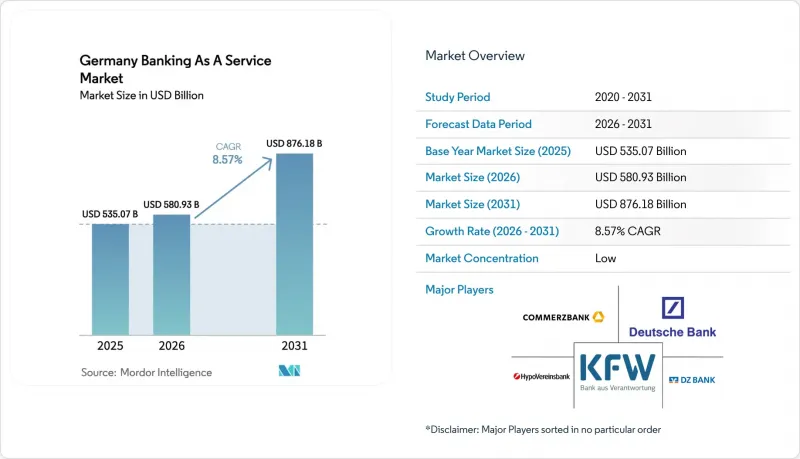
This report is Segmented by Product Type (Payment Gateway, Bank Account/Core Banking, Lending and Credit Services, and More), Enterprise Size (Large Enterprises, Small & Medium Enterprises), End User (Banks, Fintech Corporations, Other End Users), and Component (Platform/Infrastructure, Services). The Market Forecasts are Provided in Terms of Value (USD).
Germany Banking As A Service Market Trends and Insights
Rising Demand for Digital Banking Services
FinTech service usage in Germany reached an adoption level of 75%, surpassing the European average of 64%, while legacy banks retain deposit primacy and FinTechs dominate transactional interfaces, which together create fertile ground for modular BaaS integrations that improve time to market and unit economics. The EU Instant Payments Regulation requires all payment service providers to offer euro credit transfers settling within 10 seconds on a 24/7 basis from October 9, 2025, which compels BaaS platforms to implement real-time liquidity, verification of payee, and continuous risk monitoring. The new regime also enables payment and e-money institutions to compete more directly in instant settlement, narrowing the historic advantage held by banks on clearing and reconciliation windows. Online banking usage in the EU reached 72% of internet users in 2024, up from 56% in 2014, creating a stable behavioral base for end-to-end digital services that BaaS providers can modularize and scale. The German Banking as a Service market internalizes these adoption curves as companies re-platform payments and accounts to meet real-time commitments and higher UX standards.
Expansion of FinTechs and Embedded Finance Models
Germany counts 3.6 million SMEs, representing 99% of all enterprises, which widens the addressable base for embedded payments, invoicing, and working capital delivered through partner platforms that do not seek banking licenses. Only 35% of businesses completed digitalization projects in recent years, indicating untapped demand for BaaS-enabled solutions that compress onboarding and lower integration barriers for resource-constrained firms. Aggregate digitalization expenditure by German SMEs reached EUR 31.9 billion in 2023 and grew 54% versus 2019, which aligns with higher investment in APIs, data, and cloud architectures that often bundle embedded finance modules. Two-thirds of FinTech revenue in Germany stems from B2B business models, reinforcing the shift from direct to consumer plays toward infrastructure and enablement services. The Germany Banking as a Service market is the operating layer behind this shift, enabling software providers, marketplaces, and merchants to embed compliant financial workflows without full-stack rebuilds.
Stringent Regulatory Environment, Including BaFin Supervision and PSD2 Compliance
BaFin shortened the formal authorization timeline to six months from a complete application, yet applicants must still present a viable business model, a minimum initial capital of at least EUR 5 million for deposit and lending institutions, and fit and proper management, which raises entry thresholds for new providers. MiCAR applies fully since December 30, 2024, requiring crypto-asset service providers to demonstrate robust governance, IT resilience aligned with DORA, and investor protection standards, resulting in parallel authorizations for BaaS platforms that add digital asset modules. Supervisors face tight statutory deadlines for MiCAR applications, and incomplete or inconsistent submissions must be rejected, which elevates legal and technical preparation costs. BaFin's focus on operational resilience, including concentration risks and cross-border interdependencies across service providers, expands mapping and monitoring requirements for BaaS operators with multi-client footprints. The Instant Payments Regulation requires verification of payee services at no extra charge from October 9, 2025, so platforms must absorb implementation costs into their operating models.
Other drivers and restraints analyzed in the detailed report include:
- Open Banking Momentum Under PSD2
- Growing Adoption of Cloud-Based Infrastructure
- Heightened Data Protection and Privacy Requirements Under GDPR
For complete list of drivers and restraints, kindly check the Table Of Contents.
Segment Analysis
Payment gateways held a 31.56% share in 2025 within the product-type segmentation, while embedded finance software is projected to expand at a 12.34% CAGR through 2031, signaling a sustained mix shift as merchants and SaaS platforms fold payments and credit into user journeys. Payment processing faces margin compression as instant settlement becomes a baseline requirement, which lifts the appeal of higher value modules across lending, insurance, and wealth features that can be orchestrated through APIs. Bank account and core banking solutions continue as the foundational ledger and compliance layer for account issuance and reporting, although their growth is tempered by strong competition and strict prudential expectations around capital and governance. The German Banking as a Service market benefits from the scale of card and account transactions, which allows providers to upsell analytics, reconciliation, and fraud modules on top of base rails.
Comparing digitalization momentum among German businesses with the 2026-2031 outlook suggests stronger embedded finance adoption as liability frameworks mature and API standards harmonize, making integration more predictable for enterprise teams. Distribution channels broaden as EPI's Wero rollout places a bank-owned wallet into consumer flows, which can be white labeled or integrated with merchant experiences over time. Euro area card transactions reached 44.3 billion in H2 2024, up 11.3% year on year, reinforcing the scale case for modular card issuance and tokenized credentials. MiCAR's full applicability increases demand for compliant custody and token transaction monitoring within gateway and wallet stacks, extending the functional scope of product categories in the German Banking as a Service market.
Large enterprises held a 60.07% share in 2025 due to larger budgets and bespoke integration capacity, while SMEs are projected to grow at a 10.95% CAGR through 2031, reflecting both falling integration costs and a sharper need for automated onboarding that compresses time to cash. The German Banking as a Service market size allocated to SME targeted solutions is set to expand as credit constraints and real-time payment mandates steer businesses toward pre-integrated payment, invoicing, and working capital APIs. Germany's 3.6 million SMEs represent 99% of enterprises, yet only 35% report recent digitalization completion, which implies sizeable white space for turnkey BaaS suites that are lighter to adopt.
Large enterprises emphasize treasury, cross-border flows, and corporate card programs, with early pilots for blockchain-based settlement complementing traditional rails. SMEs value single API coverage of payment acceptance, invoicing, and cash cycle financing, lowering the burden on thin IT teams while raising integration velocity. Investor attention in 2025 favored infrastructure and enablement categories over consumer brands, consistent with Germany attracting USD 1.0 billion in FinTech investment across 149 deals and ranking third in Europe. As adoption leaves the early adopter cohort, the Germany Banking as a Service industry will likely standardize integration and compliance pathways to lower SME switching costs while fulfilling BaFin's resilience expectations.
Complete Report Scope:
- By Product Type
- Payment Gateway
- Bank Account/Core Banking
- Lending and Credit Services
- Embedded Finance Software
- Other Product Types
- By Enterprise Size
- Large Enterprises
- Small & Medium Enterprises (SMEs)
- By End User
- Banks
- FinTech Corporations
- Other End Users
- By Component
- Platform / Infrastructure
- Services (Compliance, KYC, Fraud, etc.)
List of Companies Covered in this Report:
- Deutsche Bank
- Commerzbank
- KfW Bankgruppe
- DZ Bank
- HypoVereinsbank
- Solaris SE
- Mambu
- Bankable
- Figo
- Crosscard
- Deposit Solutions
- Banking Circle
- AAZZUR
- finleap connect
- BW-Bank
- Marqeta
- Railsr
- 10x Banking
- ClearBank
- Treasury Prime
Additional Benefits:
- The market estimate (ME) sheet in Excel format
- 3 months of analyst support
TABLE OF CONTENTS
1 Introduction
- 1.1 Study Assumptions & Market Definition
- 1.2 Scope of the Study
2 Research Methodology
3 Executive Summary
4 Market Landscape
- 4.1 Market Overview
- 4.2 Market Drivers
- 4.2.1 Rising demand for digital banking services as consumers and enterprises shift toward fully online, seamless financial solutions
- 4.2.2 Expansion of FinTechs and embedded finance models, enabling non-bank platforms (e-commerce, marketplaces, SaaS) to offer integrated financial services
- 4.2.3 Open banking momentum under PSD2, encouraging API-driven innovation and collaboration between traditional banks and FinTech players
- 4.2.4 Growing adoption of cloud-based infrastructure, delivering scalability, flexibility, and cost advantages-especially for SMEs
- 4.2.5 Advanced digital infrastructure and strong technology adoption in Germany, supporting rapid BaaS ecosystem development
- 4.2.6 Increasing emphasis on personalized and enhanced customer experiences, driving demand for modular, data-driven banking services
- 4.3 Market Restraints
- 4.3.1 Stringent regulatory environment, including BaFin supervision and PSD2 compliance, increasing entry barriers and operational costs
- 4.3.2 Heightened data protection and privacy requirements under GDPR, necessitating continuous investment in cybersecurity and compliance
- 4.3.3 System integration challenges, particularly when embedding BaaS solutions into legacy IT architectures
- 4.3.4 Intense competitive landscape, with pressure from established banks and well-funded FinTech players limiting market share expansion
- 4.4 Value / Supply-Chain Analysis
- 4.5 Regulatory Landscape
- 4.6 Technological Outlook
- 4.7 Porter's Five Forces
- 4.7.1 Bargaining Power of Buyers
- 4.7.2 Bargaining Power of Suppliers
- 4.7.3 Threat of New Entrants
- 4.7.4 Threat of Substitutes
- 4.7.5 Intensity of Competitive Rivalry
5 Market Size & Growth Forecasts (Value)
- 5.1 By Product Type
- 5.1.1 Payment Gateway
- 5.1.2 Bank Account/Core Banking
- 5.1.3 Lending and Credit Services
- 5.1.4 Embedded Finance Software
- 5.1.5 Other Product Types
- 5.2 By Enterprise Size
- 5.2.1 Large Enterprises
- 5.2.2 Small & Medium Enterprises (SMEs)
- 5.3 By End User
- 5.3.1 Banks
- 5.3.2 FinTech Corporations
- 5.3.3 Other End Users
- 5.4 By Component
- 5.4.1 Platform / Infrastructure
- 5.4.2 Services (Compliance, KYC, Fraud, etc.)
6 Competitive Landscape
- 6.1 Market Concentration
- 6.2 Strategic Moves
- 6.3 Market Share Analysis
- 6.4 Company Profiles (includes Global Level Overview, Market Level Overview, Core Segments, Financials as available, Strategic Information, Market Rank/Share for Key Companies, Products & Services, and Recent Developments)
- 6.4.1 Deutsche Bank
- 6.4.2 Commerzbank
- 6.4.3 KfW Bankgruppe
- 6.4.4 DZ Bank
- 6.4.5 HypoVereinsbank
- 6.4.6 Solaris SE
- 6.4.7 Mambu
- 6.4.8 Bankable
- 6.4.9 Figo
- 6.4.10 Crosscard
- 6.4.11 Deposit Solutions
- 6.4.12 Banking Circle
- 6.4.13 AAZZUR
- 6.4.14 finleap connect
- 6.4.15 BW-Bank
- 6.4.16 Marqeta
- 6.4.17 Railsr
- 6.4.18 10x Banking
- 6.4.19 ClearBank
- 6.4.20 Treasury Prime
7 Market Opportunities & Future Outlook
- 7.1 White-Space & Unmet-Need Assessment

