PUBLISHER: Global Market Insights Inc. | PRODUCT CODE: 2101890

PUBLISHER: Global Market Insights Inc. | PRODUCT CODE: 2101890
Disposable Plates Market Opportunity, Growth Drivers, Industry Trend Analysis, and Forecast 2026 - 2035
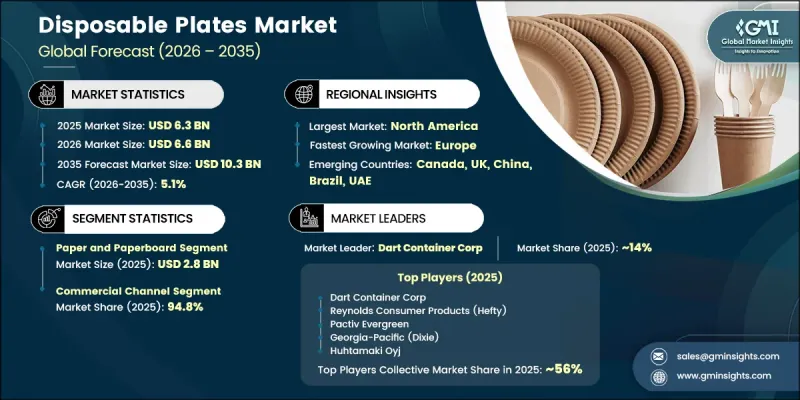
The Global Disposable Plates Market was valued at USD 6.3 billion in 2025 and is estimated to grow at a CAGR of 5.1% to reach USD 10.3 billion by 2035.
The growth of the disposable plates market is supported by increasing environmental consciousness among consumers and the rising preference for sustainable alternatives to conventional tableware products. As awareness regarding waste reduction and responsible consumption continues to increase, consumers are showing greater interest in disposable plates manufactured from biodegradable, compostable, and recycled materials. This shift is encouraging manufacturers to invest in innovative material solutions that offer improved functionality while reducing environmental impact. The growing emphasis on sustainable practices across foodservice, hospitality, and retail sectors is further accelerating the adoption of environmentally friendly disposable plates. Businesses are increasingly incorporating sustainable tableware options into their operations to meet changing customer expectations and align with evolving environmental goals. In addition, regulatory initiatives aimed at reducing single-use plastic consumption are creating favorable conditions for the expansion of alternative disposable plate solutions. The combination of rising sustainability awareness, increased demand from foodservice applications, and continuous advancements in eco-friendly manufacturing technologies is expected to strengthen market growth over the forecast period.
| Market Scope | |
|---|---|
| Start Year | 2025 |
| Forecast Year | 2026-2035 |
| Start Value | $6.3 Billion |
| Forecast Value | $10.3 Billion |
| CAGR | 5.1% |
Paper and paperboard segment generated USD 2.8 billion in 2025 growing at a CAGR of 5.4% through 2035. The segment's strong performance is driven by increasing compliance with sustainability regulations, rising institutional demand for environmentally responsible products, and the cost advantages achieved through advancements in fiber-based manufacturing over the last decade. Growth in this category is further supported by the wider availability of FSC- and PEFC-certified pulp sources, which strengthens the affordability and sustainability profile of paper and paperboard plate solutions across retail and institutional purchasing channels.
Based on end-use, the market is divided into residential and commercial sectors. Commercial applications held a 94.8% share in 2025, with food service providers and beverage centers adopting disposable plates extensively. These establishments are increasingly choosing palm leaf plates to align with sustainability goals. Palm leaf plates are durable, visually appealing, and capable of holding a wide range of foods without bending or cracking. This trend also helps businesses enhance their brand image by appealing to environmentally conscious customers.
U.S. Disposable Plates Market held a 75.74% share in 2025. The U.S. market is fueled by heightened environmental awareness and consumer preferences for eco-friendly products. The rise in on-the-go lifestyles is also a significant factor contributing to the increasing demand for disposable plates, particularly for takeout meals and beverages. The convenience of single-use products, including disposable plates and cups, helps cater to busy consumers seeking practical and sustainable dining solutions.
Companies such as Dart Container Corporation, Huhtamaki Oyj, Pactiv Evergreen Inc., Berry Global Group Inc., Sabert Corporation, Reynolds Consumer Products, Duni Group, Detpak (Detmold Group), Eco-Products Inc., World Centric, Leafware, GreenGood USA, Bionatic GmbH & Co. KG, Biopac India Corporation Ltd., and Georgia-Pacific LLC (Dixie brand) are strengthening their market presence through sustainability-focused product launches, brand development, regional expansion, and investments in advanced manufacturing processes. Companies operating in the disposable plates market are focusing on strategic product development, sustainability initiatives, and market expansion efforts to strengthen their competitive position. Key players are investing in the development of biodegradable, compostable, and recycled-material-based disposable plate solutions to meet growing demand for environmentally responsible products. Manufacturers are also expanding their production capabilities, improving supply chain networks, and strengthening distribution channels to increase market reach across foodservice, retail, and institutional segments.
Table of Contents
Chapter 1 Methodology & Scope
- 1.1 Market scope and definition
- 1.2 Research design
- 1.2.1 Research approach
- 1.2.2 Data collection methods
- 1.3 Data mining sources
- 1.3.1 Global
- 1.3.2 Regional/Country
- 1.4 Base estimates and calculations
- 1.4.1 Base year calculation
- 1.4.2 Key trends for market estimation
- 1.5 Primary research and validation
- 1.5.1 Primary sources
- 1.6 Forecast model
- 1.7 Research assumptions and limitations
Chapter 2 Executive Summary
- 2.1 Industry 360° synopsis
- 2.2 Key market trends
- 2.2.1 Regional
- 2.2.2 Material type
- 2.2.3 Design
- 2.2.4 Size
- 2.2.5 Functionality/feature
- 2.2.6 Price
- 2.2.7 Application
- 2.2.8 Distribution channel
Chapter 3 Industry Insights
- 3.1 Industry ecosystem analysis
- 3.1.1 Supplier landscape
- 3.1.2 Profit margin
- 3.1.3 Value addition at each stage
- 3.1.4 Factor affecting the value chain
- 3.2 Industry impact forces
- 3.2.1 Growth drivers
- 3.2.1.1 Rising demand from QSR & organized foodservice sector
- 3.2.1.2 Growth in events, catering & hospitality industry
- 3.2.1.3 Increasing urbanization & convenience-oriented consumer lifestyles
- 3.2.1.4 Hygiene consciousness sustaining single-use product demand
- 3.2.2 Industry pitfalls & challenges
- 3.2.2.1 Rapid adoption of biodegradable & compostable material alternatives
- 3.2.2.2 Premiumization in events, hospitality & catering segments
- 3.2.2.3 E-commerce & direct-to-consumer channel expansion
- 3.2.2.4 Untapped growth in emerging markets
- 3.2.3 Opportunities
- 3.2.3.1 Cost premium of sustainable alternatives vs. conventional plastics
- 3.2.3.2 PFAS phase-out & material reformulation complexity
- 3.2.3.3 Fragmented & evolving regulatory landscape across geographies
- 3.2.1 Growth drivers
- 3.3 Growth potential analysis
- 3.4 Future market trends
- 3.5 Technology and innovation landscape
- 3.5.1 Current technological trends
- 3.5.2 Emerging technologies
- 3.6 Regulatory landscape
- 3.6.1 Standards and compliance requirements
- 3.6.2 Regional regulatory frameworks
- 3.6.3 Certification standards
- 3.7 Trade data analysis (HS Code 3924.10)
- 3.7.1 Import/export volume & value trends
- 3.7.2 Key trade corridors & tariff impact
- 3.8 Pricing analysis
- 3.8.1 Historical price trend analysis (driven by primary research)
- 3.8.2 Pricing strategy by player type (premium / value / mass market)
- 3.9 Impact of AI & generative AI on the market
- 3.9.1 AI-driven disruption of existing business models
- 3.9.2 GenAI use cases & adoption roadmap by segment
- 3.9.3 Risks, limitations & regulatory considerations
- 3.10 Porter's analysis
- 3.11 PESTEL analysis
Chapter 4 Competitive Landscape, 2025
- 4.1 Introduction
- 4.2 Company market share analysis
- 4.2.1 By Region
- 4.2.1.1 North America
- 4.2.1.2 Europe
- 4.2.1.3 Asia Pacific
- 4.2.1.4 Latin America
- 4.2.1.5 Middle East & Africa
- 4.2.1 By Region
- 4.3 Company matrix analysis
- 4.4 Competitive analysis of major market players
- 4.5 Competitive positioning matrix
- 4.6 Key developments
- 4.6.1 Mergers & acquisitions
- 4.6.2 Partnerships & collaborations
- 4.6.3 New product launches
- 4.6.4 Expansion plans
Chapter 5 Market Estimates & Forecast, By Material Type, 2022 - 2035, (USD Billion) (Million Units)
- 5.1 Key trends
- 5.2 Plastic
- 5.3 Paper/Paperboard
- 5.4 Biodegradable/Eco-Friendly
- 5.5 Aluminum/Foil
- 5.6 Others
Chapter 6 Market Estimates & Forecast, By Design, 2022 - 2035, (USD Billion) (Million Units)
- 6.1 Key trends
- 6.2 Plain/standard
- 6.3 Compartmental
- 6.4 Decorative/printed
Chapter 7 Market Estimates & Forecast, By Size, 2022 - 2035, (USD Billion) (Million Units)
- 7.1 Key trends
- 7.2 Small (Up to 6 Inches)
- 7.3 Medium (7-9 Inches)
- 7.4 Large (10-12 Inches)
Chapter 8 Market Estimates & Forecast, By Functionality/Feature, 2022 - 2035, (USD Billion) (Million Units)
- 8.1 Key trends
- 8.2 Standard use
- 8.3 Microwave-safe
- 8.4 Oven/heat-resistant
- 8.5 Grease/leak-resistant
- 8.6 Heavy-duty/reinforced
Chapter 9 Market Estimates & Forecast, By Price, 2022 - 2035, (USD Billion) (Million Units)
- 9.1 Key trends
- 9.2 Low
- 9.3 Medium
- 9.4 High
Chapter 10 Market Estimates & Forecast, By Application, 2022 - 2035, (USD Billion) (Million Units)
- 10.1 Key trends
- 10.2 Residential
- 10.3 Commercial
- 10.3.1 Food & beverage
- 10.3.2 Hotels and cafes
- 10.3.3 Hospitality and events
- 10.3.4 Others (quick-service restaurants etc.)
Chapter 11 Market Estimates & Forecast, By Distribution Channel, 2022 - 2035, (USD Billion) (Million Units)
- 11.1 Key trends
- 11.2 Online
- 11.2.1 Company websites
- 11.2.2 E-commerce
- 11.3 Offline
- 11.3.1 B2B
- 11.3.2 Supermarkets & hypermarkets
- 11.3.3 Convenience & specialty stores
Chapter 12 Market Estimates & Forecast, By Region, 2022 - 2035, (USD Billion) (Million Units)
- 12.1 Key trends
- 12.2 North America
- 12.2.1 U.S.
- 12.2.2 Canada
- 12.3 Europe
- 12.3.1 Germany
- 12.3.2 UK
- 12.3.3 France
- 12.3.4 Italy
- 12.3.5 Spain
- 12.4 Asia Pacific
- 12.4.1 China
- 12.4.2 India
- 12.4.3 Japan
- 12.4.4 South Korea
- 12.4.5 Australia
- 12.4.6 Indonesia
- 12.4.7 Malaysia
- 12.5 Latin America
- 12.5.1 Brazil
- 12.5.2 Mexico
- 12.5.3 Argentina
- 12.6 MEA
- 12.6.1 Saudi Arabia
- 12.6.2 UAE
- 12.6.3 South Africa
Chapter 13 Company Profiles
- 13.1 Global Players
- 13.1.1 Dart Container Corporation
- 13.1.2 Huhtamaki Oyj
- 13.1.3 Pactiv Evergreen Inc.
- 13.1.4 Georgia-Pacific LLC (Dixie brand)
- 13.1.5 Berry Global Group, Inc.
- 13.2 Regional Champions
- 13.2.1 Sabert Corporation
- 13.2.2 Reynolds Consumer Products
- 13.2.3 Biopac India Corporation Ltd.
- 13.2.4 Duni Group
- 13.2.5 Detpak (Detmold Group)
- 13.3 Emerging Players
- 13.3.1 Eco-Products, Inc.
- 13.3.2 World Centric
- 13.3.3 Leafware
- 13.3.4 GreenGood USA
- 13.3.5 Bionatic GmbH & Co. KG

