PUBLISHER: Mordor Intelligence | PRODUCT CODE: 2119650

PUBLISHER: Mordor Intelligence | PRODUCT CODE: 2119650
GCC Paper Cup - Market Share Analysis, Industry Trends & Statistics, Growth Forecasts (2026 - 2031)
According to Mordor Intelligence, the GCC paper cup market size is projected to expand from USD 376.21 million in 2025 and USD 389.16 million in 2026 to USD 469.72 million by 2031, registering a CAGR of 3.83% between 2026 to 2031.
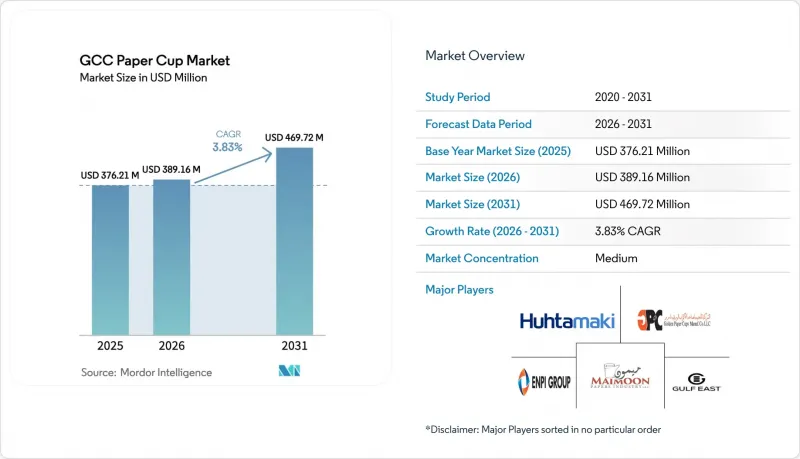
This report is Segmented by Cup Type (Hot Paper Cup, and Cold Paper Cup), Wall Type (Single Wall, and Double Wall), Capacity (Up To 7 Oz, 8-12 Oz, 13-20 Oz, and Above 20 Oz), Coating Type (PE-Coated, and More), Application (Quick Service Restaurants, Institutional, and More), Sales Channel (Direct B2B, and Distributors and Wholesalers), and Country. The Market Forecasts are Provided in Terms of Value (USD).
GCC Paper Cup Market Trends and Insights
Growth of Quick Service Restaurant Chains
Saudi Arabia hosted 3,550-plus branded coffee outlets in 2025 and continues to add stores nationwide, while Starbucks intends to open 500 additional Middle East units, creating a powerful volume engine for single-use cups. Dunkin' already operates more than 600 Saudi stores, and franchisee Alamar Foods reported 64% digital revenue in 2024, indicating that take-away beverages are integral to omnichannel growth. Density is surging in Riyadh, Jeddah, and Dubai, yet smaller cities such as Dammam and Sharjah are also attracting chains, broadening the served addressable market. This footprint expansion drives absolute cup demand and pushes chains toward premium double-wall or large-capacity formats to differentiate guest experience. Combined, these dynamics lift baseline consumption and underpin a structural leg of growth for the GCC paper cup market.
Mandatory Single-Use Plastics Regulations in GCC
Federal Decree-Law 18-2024 in the UAE bans plastic beverage cups and lids effective January 2026, with fines up to AED 200,000 for non-compliance, forcing immediate material substitution. Dubai Municipality mirrors the federal rule, and Saudi Arabia's Green Initiative similarly targets landfill diversion, prompting foodservice operators to accelerate paper adoption. Qatar's phased restrictions will culminate in a 2027 ban, aligning the bloc on paper as the de facto alternative. These mandates compress decision cycles, inflating spot pricing for compliant inventory by 20-30% when short supply collides with last-minute procurement. Uneven timelines also create regional arbitrage, as surplus PE-coated stock flows into Bahrain and Kuwait, where enforcement lags.
Volatile Pulp Prices Squeezing Margins
The pulp Producer Price Index fell 36% in four months during 2025, leaving converters that hedged at the peak unable to pass through costs, while others without hedges faced earlier liquidity strain. GCC converters import 80-90% of virgin pulp, so currency swings and freight spikes amplify margin risks. Middle East Paper Company leverages recovered-fiber inputs, thereby gaining cost insulation, advantaging integrated players over converters dependent on spot pulp. Rapid price moves also deter capital expenditure, as lenders tighten credit lines when working-capital volatility rises. The net effect is a drag on near-term profitability, limiting funds available for technology upgrades across the GCC paper cup market.
Other drivers and restraints analyzed in the detailed report include:
- Event-Driven Tourism Boosting Foodservice Volumes
- Emerging Demand for Home-Compostable Barrier Coatings
- Limited Regional Recycling Infrastructure
For complete list of drivers and restraints, kindly check the Table Of Contents.
Segment Analysis
Hot cups captured 57.43% of the GCC paper cup market share in 2025, tied to espresso-centric beverage menus, while cold cups are growing at a faster 4.32% CAGR as iced coffee and bubble tea appeal to the region's under-35 population. Cold applications demand enhanced condensation resistance, prompting converters to invest in dual-coating assets capable of handling both PE and PLA runs. The GCC paper cup market for hot cups is expected to expand steadily, but its growth rate lags the cold-cup surge, which adds incremental high-margin volume.
Double-digit store openings by chains such as Starbucks, which integrates seasonal cold drinks, reinforce cold-cup momentum, while hot-cup demand benefits from institutional vending and morning commuter traffic. Cost sensitivity keeps PE variants dominant across both segments, though multinational QSRs are increasingly piloting PLA coatings for flagship outlets in Dubai and Doha. The interplay of premiumization and regulation, therefore, drives product-mix complexity inside the GCC paper cup market.
Single-wall formats retained a 61.32% share in 2025, serving espresso shots, small vending sizes, and cost-focused institutional buyers. However, double-wall cups posted a robust 4.66% CAGR forecast, driven by QSR delivery models that require sustained beverage temperature during 15-30-minute transit times. The GCC paper cup market size is tied to double-wall cups, so it rises faster than overall demand, aided by chains substituting sleeves with integrated insulation to cut material costs.
Capital intensity of USD 1.5-2 million for sealing lines limits new entrants, concentrating value growth among larger converters. Municipal waste-volume fees under consideration in Dubai and Riyadh could temper double-wall uptake, yet brand-experience benefits still outweigh cost trade-offs for premium operators. As lightweight containerboard from PM5 becomes available, converters aim to shave 10-15% of fiber weight, protecting margins while meeting insulation specs, a critical lever inside the evolving GCC paper cup market.
Complete Report Scope:
- By Cup Type
- Hot Paper Cup
- Cold Paper Cup
- By Wall Type
- Single Wall
- Double Wall
- By Capacity
- Up to 7 oz
- 8-12 oz
- 13-20 oz
- Above 20 oz
- By Coating Type
- PE-Coated
- PLA-Coated
- Water-Based Barrier
- By Application
- Quick Service Restaurants
- Institutional
- Convenience Stores and Kiosks
- Vending Machines
- Other Applications
- By Sales Channel
- Direct B2B
- Distributors and Wholesalers
- By Country
- Saudi Arabia
- United Arab Emirates
- Qatar
- Kuwait
- Rest of GCC
List of Companies Covered in this Report:
- ENPI Group
- Huhtamaki Oyj
- Gulf East Paper & Plastic Industries LLC
- Hotpack Global LLC
- Golden Paper Cups Manufacturing LLC
- Maimoon Papers Industry LLC
- SAQR Pack
- Arkan Manufacturing Paper Cup Company
- Saham Group
- Ultracare LLC
- Falcon Pack
- Detpak (Detmold Group)
- Ecoware Solutions FZ-LLC
- Seda International Packaging Group SpA
- Dart Container Corporation
- Graphic Packaging International LLC
- International Paper Company
- Smurfit Westrock
Additional Benefits:
- The market estimate (ME) sheet in Excel format
- 3 months of analyst support
TABLE OF CONTENTS
1 INTRODUCTION
- 1.1 Study Assumptions and Market Definition
- 1.2 Scope of the Study
2 RESEARCH METHODOLOGY
3 EXECUTIVE SUMMARY
4 MARKET LANDSCAPE
- 4.1 Market Overview
- 4.2 Market Drivers
- 4.2.1 Rising Demand for On-the-Go Beverage Consumption
- 4.2.2 Growth of Quick Service Restaurant Chains
- 4.2.3 Mandatory Single-Use Plastics Regulations in GCC
- 4.2.4 Event-Driven Tourism Boosting Foodservice Volumes
- 4.2.5 Emerging Demand for Home-Compostable Barrier Coatings
- 4.2.6 Localization Incentives for Sustainable Packaging Manufacturing
- 4.3 Market Restraints
- 4.3.1 Volatile Pulp Prices Squeezing Margins
- 4.3.2 Limited Regional Recycling Infrastructure
- 4.3.3 Consumer Perception of Paper as "Not Fully Green"
- 4.3.4 High Initial Capex for Barrier-Coated Cup Lines
- 4.4 Industry Value Chain Analysis
- 4.5 Regulatory Landscape
- 4.6 Impact of Macroeconomic Factors on the Market
- 4.7 Technological Outlook
- 4.8 Porter's Five Forces Analysis
- 4.8.1 Bargaining Power of Suppliers
- 4.8.2 Bargaining Power of Consumers
- 4.8.3 Threat of New Entrants
- 4.8.4 Intensity of Competitive Rivalry
- 4.8.5 Threat of Substitute Products
5 MARKET SIZE AND GROWTH FORECASTS (VALUE)
- 5.1 By Cup Type
- 5.1.1 Hot Paper Cup
- 5.1.2 Cold Paper Cup
- 5.2 By Wall Type
- 5.2.1 Single Wall
- 5.2.2 Double Wall
- 5.3 By Capacity
- 5.3.1 Up to 7 oz
- 5.3.2 8-12 oz
- 5.3.3 13-20 oz
- 5.3.4 Above 20 oz
- 5.4 By Coating Type
- 5.4.1 PE-Coated
- 5.4.2 PLA-Coated
- 5.4.3 Water-Based Barrier
- 5.5 By Application
- 5.5.1 Quick Service Restaurants
- 5.5.2 Institutional
- 5.5.3 Convenience Stores and Kiosks
- 5.5.4 Vending Machines
- 5.5.5 Other Applications
- 5.6 By Sales Channel
- 5.6.1 Direct B2B
- 5.6.2 Distributors and Wholesalers
- 5.7 By Country
- 5.7.1 Saudi Arabia
- 5.7.2 United Arab Emirates
- 5.7.3 Qatar
- 5.7.4 Kuwait
- 5.7.5 Rest of GCC
6 COMPETITIVE LANDSCAPE
- 6.1 Market Concentration
- 6.2 Strategic Moves
- 6.3 Market Share Analysis
- 6.4 Company Profiles (Includes Global Level Overview, Market Level Overview, Core Segments, Financials as Available, Strategic Information, Market Rank/Share, Products and Services, and Recent Developments)
- 6.4.1 ENPI Group
- 6.4.2 Huhtamaki Oyj
- 6.4.3 Gulf East Paper & Plastic Industries LLC
- 6.4.4 Hotpack Global LLC
- 6.4.5 Golden Paper Cups Manufacturing LLC
- 6.4.6 Maimoon Papers Industry LLC
- 6.4.7 SAQR Pack
- 6.4.8 Arkan Manufacturing Paper Cup Company
- 6.4.9 Saham Group
- 6.4.10 Ultracare LLC
- 6.4.11 Falcon Pack
- 6.4.12 Detpak (Detmold Group)
- 6.4.13 Ecoware Solutions FZ-LLC
- 6.4.14 Seda International Packaging Group SpA
- 6.4.15 Dart Container Corporation
- 6.4.16 Graphic Packaging International LLC
- 6.4.17 International Paper Company
- 6.4.18 Smurfit Westrock
7 MARKET OPPORTUNITIES AND FUTURE OUTLOOK
- 7.1 White-Space and Unmet-Need Assessment

