PUBLISHER: Global Market Insights Inc. | PRODUCT CODE: 2101895

PUBLISHER: Global Market Insights Inc. | PRODUCT CODE: 2101895
Automatic Door Market Opportunity, Growth Drivers, Industry Trend Analysis, and Forecast 2026 - 2035
The Global Automatic Door Market was valued at USD 24.5 billion in 2025 and is estimated to grow at a CAGR of 6.4% to reach USD 45.8 billion by 2035.
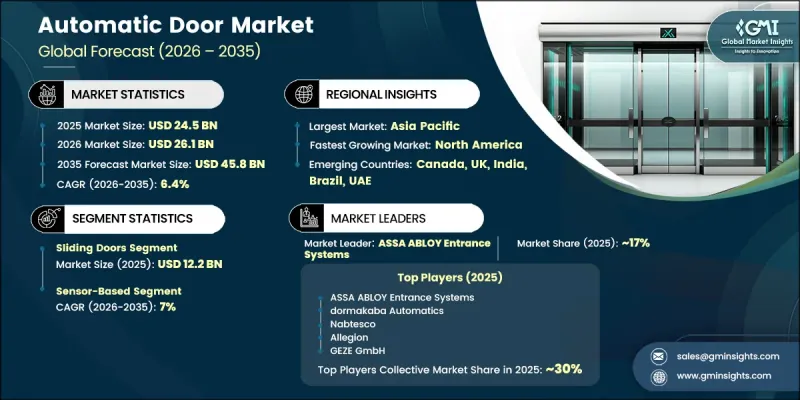
The market growth is supported by increasing construction activity, rising infrastructure spending, and growing demand for automated access solutions across commercial, industrial, institutional, and public spaces. Expanding urban populations and rapid development across emerging economies are encouraging investments in modern buildings, transportation facilities, healthcare centers, hospitality properties, educational campuses, and smart city infrastructure. At the same time, developed markets are experiencing higher adoption through renovation and modernization projects, as property owners and facility operators replace traditional entry systems with automated alternatives to improve convenience, accessibility, safety, and building efficiency. The increasing integration of smart building technologies and connected systems is further strengthening market expansion. Modern automatic doors are equipped with advanced sensors, intelligent controls, connectivity features, and automation capabilities that support seamless operation and improved energy management. The rising focus on touchless access, inclusive infrastructure, and digitally connected buildings is expected to continue creating growth opportunities for automatic door manufacturers worldwide.
| Market Scope | |
|---|---|
| Start Year | 2025 |
| Forecast Year | 2026-2035 |
| Start Value | $24.5 Billion |
| Forecast Value | $45.8 Billion |
| CAGR | 6.4% |
The sliding doors segment accounted for USD 12.2 billion in 2025 and is expected to grow at a CAGR of 6.3% from 2026 to 2035. These door systems are widely adopted in locations requiring efficient movement of large numbers of people because they offer smooth operation while maximizing available space. Unlike traditional swinging doors, sliding systems do not require additional opening clearance, making them suitable for facilities with high visitor traffic. Their ability to integrate with sensor technologies, automated controls, and contactless operation features has increased their popularity as businesses prioritize convenience, cleanliness, and improved user experiences.
The sensor-based automatic doors segment reached USD 10.7 billion in 2025 and is forecast to grow at a CAGR of 7% between 2026 and 2035. These systems use technologies such as motion detection, infrared sensing, and microwave sensors to enable automatic opening and closing without direct physical interaction. Their increasing adoption across healthcare facilities, airports, retail environments, hotels, and office buildings is driven by the need for efficient access management and improved hygiene practices. Sensor-enabled doors also provide enhanced accessibility for elderly users and individuals with mobility challenges while supporting compliance with accessibility requirements across various regions.
U.S. Automatic Door Industry captured USD 5.2 billion in 2025, supported by continued investment in airports, healthcare facilities, commercial buildings, retail developments, office spaces, and smart infrastructure projects. The increasing adoption of automated entry systems across these facilities is driven by the need to improve safety, accessibility, operational performance, and user convenience. Continued spending in non-residential construction activities, including healthcare buildings, educational facilities, commercial complexes, and retail properties, is contributing to consistent demand growth for automatic door solutions.
Major players operating in the global automatic door industry include ASSA ABLOY Entrance Systems, Panasonic Corporation, GEZE GmbH, Manusa, dormakaba Group, FAAC Group, Nabtesco Corporation, Horton Automatics, Stanley Access Technologies, Portalp International, Entrematic (Ditec Entrematic), TORMAX (Landert Group), Royal Boon Edam International B.V., Record Group (Agta Record), and Zhejiang Seacon Door Technology Co., Ltd. Companies operating in the automatic door industry are focusing on product innovation, strategic collaborations, geographic expansion, and technology integration to strengthen their market presence. Leading manufacturers are developing advanced automatic door systems with improved sensor capabilities, energy efficiency, connectivity features, and compatibility with smart building platforms. Businesses are also investing in research and development to introduce solutions that address growing demand for touchless access, enhanced security, and better accessibility. Expanding distribution networks and strengthening relationships with construction companies, facility managers, and infrastructure developers are helping companies increase market penetration.
Table of Contents
Chapter 1 Methodology & Scope
- 1.1 Market scope and definition
- 1.2 Research design
- 1.2.1 Research approach
- 1.2.2 Data collection methods
- 1.3 Data mining sources
- 1.3.1 Global
- 1.3.2 Regional/Country
- 1.4 Base estimates and calculations
- 1.4.1 Base year calculation
- 1.4.2 Key trends for market estimation
- 1.5 Primary research and validation
- 1.5.1 Primary sources
- 1.6 Forecast model
- 1.7 Research assumptions and limitations
Chapter 2 Executive Summary
- 2.1 Industry 360° synopsis
- 2.2 Key market trends
- 2.2.1 Regional
- 2.2.2 Door type
- 2.2.3 Material
- 2.2.4 Operation mechanism
- 2.2.5 Activation technology
- 2.2.6 End-user
- 2.2.7 Distribution channel
Chapter 3 Industry Insights
- 3.1 Industry ecosystem analysis
- 3.1.1 Supplier landscape
- 3.1.2 Profit margin
- 3.1.3 Value addition at each stage
- 3.1.4 Factor affecting the value chain
- 3.2 Industry impact forces
- 3.2.1 Growth drivers
- 3.2.1.1 Rising global construction activity & real estate infrastructure investment
- 3.2.1.2 Growing adoption of smart building technologies & IoT-enabled automation
- 3.2.1.3 Post-pandemic surge in demand for touchless & hygienic entry solutions
- 3.2.1.4 Rising focus on energy efficiency & building envelope performance
- 3.2.2 Industry pitfalls & challenges
- 3.2.2.1 Cybersecurity vulnerabilities in connected & access-control-integrated door systems
- 3.2.2.2 Supply chain disruptions & tariff pressure on aluminum, steel & sensor components
- 3.2.3 Opportunities
- 3.2.3.1 Integration with AI-driven predictive maintenance & building management systems
- 3.2.3.2 Large-scale retrofitting opportunity in aging commercial & institutional infrastructure
- 3.2.1 Growth drivers
- 3.3 Growth potential analysis
- 3.4 Future market trends
- 3.5 Technology and innovation landscape
- 3.5.1 Current technological trends
- 3.5.2 Emerging technologies
- 3.6 Regulatory landscape
- 3.6.1 Standards and compliance requirements
- 3.6.2 Regional regulatory frameworks
- 3.6.3 Certification standards
- 3.7 Trade data analysis (HS Code 7308.30)
- 3.7.1 Import/export volume & value trends
- 3.7.2 Key trade corridors & tariff impact
- 3.8 Pricing analysis
- 3.8.1 Historical price trend analysis (driven by primary research)
- 3.8.2 Pricing strategy by player type (premium / value / mass market)
- 3.9 Impact of AI & generative AI on the market
- 3.9.1 AI-driven disruption of existing business models
- 3.9.2 GenAI use cases & adoption roadmap by segment
- 3.9.3 Risks, limitations & regulatory considerations
- 3.10 Porter's analysis
- 3.11 PESTEL analysis
- 3.12 Consumer buying behavior analysis
- 3.12.1 Demographic trends
- 3.12.2 Factors affecting buying decisions
- 3.12.3 Consumer product adoption
- 3.12.4 Preferred distribution channel
Chapter 4 Competitive Landscape, 2025
- 4.1 Introduction
- 4.2 Company market share analysis
- 4.2.1 By Region
- 4.2.1.1 North America
- 4.2.1.2 Europe
- 4.2.1.3 Asia Pacific
- 4.2.1.4 Latin America
- 4.2.1.5 Middle East & Africa
- 4.2.1 By Region
- 4.3 Company matrix analysis
- 4.4 Competitive analysis of major market players
- 4.5 Competitive positioning matrix
- 4.6 Key developments
- 4.6.1 Mergers & acquisitions
- 4.6.2 Partnerships & collaborations
- 4.6.3 New product launches
- 4.6.4 Expansion plans
Chapter 5 Market Estimates & Forecast, By Door Type, 2022 - 2035, (USD Billion) (Million Units)
- 5.1 Key trends
- 5.2 Sliding doors
- 5.3 Swing doors
- 5.4 Revolving doors
- 5.5 Folding doors
- 5.6 Telescopic sliding doors
- 5.7 Others (hermetically sealed, high-speed industrial, fire-rated)
Chapter 6 Market Estimates & Forecast, By Material, 2022 - 2035, (USD Billion) (Million Units)
- 6.1 Key trends
- 6.2 Aluminum
- 6.3 Glass (frameless & semi-frameless)
- 6.4 Steel & stainless steel
- 6.5 Wood
- 6.6 Others (PVC, composite, fiberglass)
Chapter 7 Market Estimates & Forecast, By Operation Mechanism, 2022 - 2035, (USD Billion) (Million Units)
- 7.1 Key trends
- 7.2 Electromechanical
- 7.3 Hydraulic
- 7.4 Pneumatic
Chapter 8 Market Estimates & Forecast, By Activation Technology, 2022 - 2035, (USD Billion) (Million Units)
- 8.1 Key trends
- 8.2 Sensor-based
- 8.3 Access control integrated
- 8.4 Remote-controlled
- 8.5 Push button activated
Chapter 9 Market Estimates & Forecast, By End-User, 2022 - 2035, (USD Billion) (Million Units)
- 9.1 Key trends
- 9.2 Commercial
- 9.3 Healthcare
- 9.4 Transportation
- 9.5 Industrial
- 9.6 Residential
- 9.7 Institutional
Chapter 10 Market Estimates & Forecast, By Distribution Channel, 2022 - 2035, (USD Billion) (Million Units)
- 10.1 Key trends
- 10.2 Direct sales
- 10.3 Indirect sales
Chapter 11 Market Estimates & Forecast, By Region, 2022 - 2035, (USD Billion) (Million Units)
- 11.1 Key trends
- 11.2 North America
- 11.2.1 U.S.
- 11.2.2 Canada
- 11.3 Europe
- 11.3.1 Germany
- 11.3.2 UK
- 11.3.3 France
- 11.3.4 Italy
- 11.3.5 Spain
- 11.4 Asia Pacific
- 11.4.1 China
- 11.4.2 India
- 11.4.3 Japan
- 11.4.4 South Korea
- 11.4.5 Australia
- 11.4.6 Indonesia
- 11.4.7 Malaysia
- 11.5 Latin America
- 11.5.1 Brazil
- 11.5.2 Mexico
- 11.5.3 Argentina
- 11.6 MEA
- 11.6.1 Saudi Arabia
- 11.6.2 UAE
- 11.6.3 South Africa
Chapter 12 Company Profiles
- 12.1 Global Players
- 12.1.1 ASSA ABLOY Entrance Systems
- 12.1.2 dormakaba Group
- 12.1.3 GEZE GmbH
- 12.1.4 Nabtesco Corporation
- 12.1.5 Stanley Access Technologies
- 12.2 Regional Champions
- 12.2.1 TORMAX (Landert Group)
- 12.2.2 Royal Boon Edam International B.V.
- 12.2.3 Record Group (Agta Record)
- 12.2.4 FAAC Group
- 12.2.5 Portalp International
- 12.3 Emerging Players
- 12.3.1 Entrematic (Ditec Entrematic)
- 12.3.2 Manusa
- 12.3.3 Horton Automatics
- 12.3.4 Zhejiang Seacon Door Technology Co., Ltd.
- 12.3.5 Panasonic Corporation

