PUBLISHER: Global Market Insights Inc. | PRODUCT CODE: 2101896

PUBLISHER: Global Market Insights Inc. | PRODUCT CODE: 2101896
Smart Connected Drug Delivery Devices Market Opportunity, Growth Drivers, Industry Trend Analysis, and Forecast 2026 - 2035
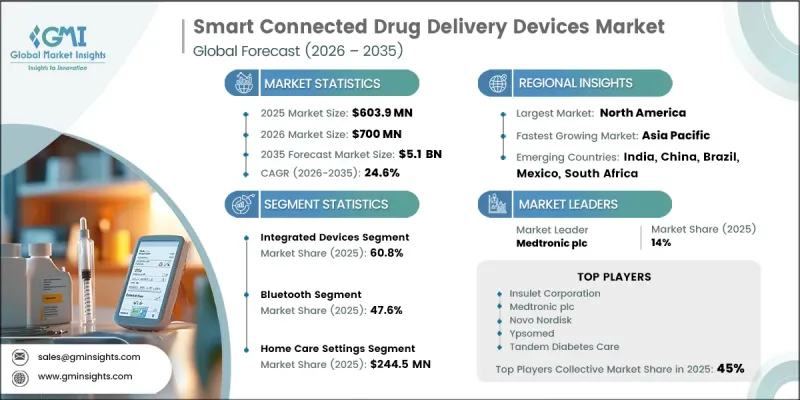
The Global Smart Connected Drug Delivery Devices Market was valued at USD 603.9 million in 2025 and is estimated to grow at a CAGR of 24.6% to reach USD 5.1 billion by 2035.
Market growth is supported by the rising burden of chronic diseases, increasing awareness regarding medication adherence, and continuous advancements in healthcare information technology infrastructure. The global smart connected drug delivery devices market is benefiting from growing demand for intelligent drug administration solutions that combine medication delivery with digital connectivity to improve treatment management. These devices enable healthcare providers and patients to monitor therapy, collect treatment-related information, and enhance medication compliance through connected digital platforms. Integration with mobile health applications, cloud-based systems, and remote patient monitoring technologies is further improving treatment efficiency while supporting personalized healthcare approaches. In addition, the increasing use of artificial intelligence and machine learning technologies is accelerating innovation across the market by enabling more accurate therapy management through advanced analysis of patient health information and medication usage patterns. The combination of digital healthcare transformation, expanding connected care ecosystems, and greater emphasis on personalized treatment continues to create strong long-term growth opportunities for the smart connected drug delivery devices market.
| Market Scope | |
|---|---|
| Start Year | 2025 |
| Forecast Year | 2026-2035 |
| Start Value | $603.9 Million |
| Forecast Value | $5.1 Billion |
| CAGR | 24.6% |
The integrated devices segment accounted for 60.8% share in 2025. Market demand for integrated systems continues to increase because these solutions combine drug administration and digital connectivity within a single device, providing a more efficient and convenient user experience. Automated recording of medication events, seamless transmission of treatment information, and enhanced support for personalized therapy management continue to strengthen adoption. Growing interest in connected healthcare models and self-administered therapies is further driving investment in integrated smart connected drug delivery technologies.
The home care settings segment generated USD 244.5 million in 2025. Increasing preference for home-based treatment and self-administration continues to support strong demand for smart connected drug delivery devices in this setting. Patients are increasingly adopting technologies that offer greater convenience, flexibility, and continuous treatment support outside traditional healthcare facilities. Expansion of remote patient monitoring services and broader adoption of digital healthcare solutions continue to accelerate market growth. Connected drug delivery devices also facilitate secure sharing of treatment information with healthcare professionals, helping improve medication adherence, strengthen disease management, and support better long-term clinical outcomes.
North America Smart Connected Drug Delivery Devices Market accounted for 43.4% share in 2025. Continued market expansion is supported by the increasing prevalence of chronic diseases and growing demand for advanced medication management solutions. Long-term treatment requirements associated with chronic conditions continue to encourage adoption of connected drug delivery technologies that improve medication adherence, enable continuous treatment monitoring, and support personalized patient care through real-time data collection and digital health integration.
Major companies operating in the global smart connected drug delivery devices market include Adherium, Aptar Pharma, Becton, Dickinson and Company, Bayer, Biocorp, Eli Lilly and Company, Enable Injections, Gerresheimer, Insulet Corporation, Medtronic, Nemera, Novo Nordisk, Philips Medisize, SHL Medical, Tandem Diabetes Care, West Pharmaceutical Services, and Ypsomed. Companies participating in the smart connected drug delivery devices market are strengthening their competitive position by investing in advanced connected technologies that improve medication management and patient engagement. Manufacturers continue to focus on integrating digital connectivity, artificial intelligence, and data analytics into drug delivery systems to enhance treatment accuracy and personalized care. Product innovation remains a key strategy, with companies developing user-friendly devices that simplify self-administration while improving treatment adherence. Strategic collaborations, expansion of digital healthcare capabilities, and stronger partnerships across healthcare ecosystems are helping companies broaden their market presence.
Table of Contents
Chapter 1 Research Methodology
- 1.1 Research approach
- 1.2 Quality commitments
- 1.2.1 GMI AI policy and data integrity commitment
- 1.2.1.1 Source consistency protocol
- 1.2.1 GMI AI policy and data integrity commitment
- 1.3 Research trail and confidence scoring
- 1.3.1 Research trail components
- 1.3.2 Scoring components
- 1.4 Data collection
- 1.4.1 Partial list of primary sources
- 1.5 Data mining sources
- 1.5.1 Paid sources
- 1.5.1.1 Sources, by region
- 1.5.1 Paid sources
- 1.6 Base estimates and calculations
- 1.6.1 Base year calculation for any one approach
- 1.7 Forecast model
- 1.7.1 Quantified market impact analysis
- 1.7.1.1 Mathematical impact of growth parameters on forecast
- 1.7.1 Quantified market impact analysis
- 1.8 Research transparency addendum
- 1.8.1 Source attribution framework
- 1.8.2 Quality assurance metrics
- 1.8.3 Our commitment to trust
Chapter 2 Executive Summary
- 2.1 Industry 360° synopsis
- 2.2 Key market trends
- 2.2.1 Device type trends
- 2.2.2 Technology trends
- 2.2.3 Application trends
- 2.2.4 End use trends
- 2.2.5 Regional trends
- 2.3 CXO perspectives: Strategic imperatives
Chapter 3 Industry Insights
- 3.1 Industry ecosystem analysis
- 3.2 Industry impact forces
- 3.2.1 Growth drivers
- 3.2.1.1 Rising patient awareness about adherence to prescribed therapies
- 3.2.1.2 Rapidly moving healthcare IT infrastructure
- 3.2.1.3 Soaring adoption of machine learning and artificial intelligence
- 3.2.1.4 Rising implementation of telehealth platforms integrated with AR/VR technologies
- 3.2.2 Industry pitfalls and challenges
- 3.2.2.1 Security concerns regarding patient data
- 3.2.2.2 High price of devices
- 3.2.3 Market opportunities
- 3.2.3.1 Expansion of home-based healthcare and self-administration
- 3.2.3.2 Growing adoption of remote patient monitoring
- 3.2.1 Growth drivers
- 3.3 Growth potential analysis
- 3.4 Regulatory landscape (Driven by primary research)
- 3.4.1 North America
- 3.4.2 Europe
- 3.4.3 Asia Pacific
- 3.4.4 Latin America
- 3.4.5 Middle East and Africa
- 3.5 Technology landscape (Driven by primary research)
- 3.5.1 Current technological trends
- 3.5.2 Emerging technologies
- 3.6 Future market trends (Driven by primary research)
- 3.7 Impact of AI and Generative AI on the market (Driven by primary research)
- 3.8 Patent analysis
- 3.9 Pricing trend analysis (Driven by primary research)
- 3.10 Porter's analysis
- 3.11 PESTEL analysis
Chapter 4 Competitive Landscape, 2025
- 4.1 Introduction
- 4.2 Company market share analysis
- 4.2.1 Global
- 4.2.2 North America
- 4.2.3 Europe
- 4.2.4 Asia Pacific
- 4.3 Company matrix analysis
- 4.4 Competitive analysis of major market players
- 4.5 Competitive positioning matrix
- 4.6 Key developments
- 4.6.1 Mergers and acquisitions
- 4.6.2 Partnerships and collaborations
- 4.6.3 New product launches
- 4.6.4 Expansion plans
Chapter 5 Market Estimates and Forecast, By Product, 2022 - 2035 ($ Mn)
- 5.1 Key trends
- 5.2 Connected sensors
- 5.2.1 Connected inhalation sensors
- 5.2.2 Connected injectable sensors
- 5.3 Integrated devices
- 5.3.1 Integrated inhalation devices
- 5.3.2 Integrated injectable devices
Chapter 6 Market Estimates and Forecast, By Technology, 2022 - 2035 ($ Mn)
- 6.1 Key trends
- 6.2 Bluetooth
- 6.3 Near field communication
- 6.4 Wi-Fi
Chapter 7 Market Estimates and Forecast, By Application, 2022 - 2035 ($ Mn)
- 7.1 Key trends
- 7.2 Anaphylaxis
- 7.3 Respiratory
- 7.4 Cardiovascular
- 7.5 Diabetes
- 7.6 Hormone replacement
- 7.7 Oncology
- 7.8 Other applications
Chapter 8 Market Estimates and Forecast, By End Use, 2022 - 2035 ($ Mn)
- 8.1 Key trends
- 8.2 Hospitals
- 8.3 Clinics
- 8.4 Home care settings
- 8.5 Other end users
Chapter 9 Market Estimates and Forecast, By Region, 2022 - 2035 ($ Mn)
- 9.1 Key trends
- 9.2 North America
- 9.2.1 U.S.
- 9.2.2 Canada
- 9.3 Europe
- 9.3.1 Germany
- 9.3.2 UK
- 9.3.3 France
- 9.3.4 Spain
- 9.3.5 Italy
- 9.3.6 Netherlands
- 9.4 Asia Pacific
- 9.4.1 China
- 9.4.2 Japan
- 9.4.3 India
- 9.4.4 Australia
- 9.4.5 South Korea
- 9.5 Latin America
- 9.5.1 Brazil
- 9.5.2 Mexico
- 9.5.3 Argentina
- 9.6 Middle East and Africa
- 9.6.1 South Africa
- 9.6.2 Saudi Arabia
- 9.6.3 UAE
Chapter 10 Company Profiles
- 10.1 Adherium
- 10.2 Aptar Pharma
- 10.3 Becton, Dickinson and Company
- 10.4 Bayer
- 10.5 Biocorp
- 10.6 Eli Lilly and Company
- 10.7 Enable Injections
- 10.8 Gerresheimer
- 10.9 Insulet Corporation
- 10.10 Medtronic
- 10.11 Nemera
- 10.12 Novo Nordisk
- 10.13 Philips Medisize
- 10.14 SHL Medical
- 10.15 Tandem Diabetes Care
- 10.16 West Pharmaceutical Services
- 10.17 Ypsomed

