PUBLISHER: Mordor Intelligence | PRODUCT CODE: 2113534

PUBLISHER: Mordor Intelligence | PRODUCT CODE: 2113534
Novel Drug Delivery Systems (NDDS) - Market Share Analysis, Industry Trends & Statistics, Growth Forecasts (2026 - 2031)
According to Mordor Intelligence, new drug delivery systems market size in 2026 is estimated at USD 311.65 billion, growing from 2025 value of USD 293.9 billion with 2031 projections showing USD 417.88 billion, growing at 6.04% CAGR over 2026-2031.
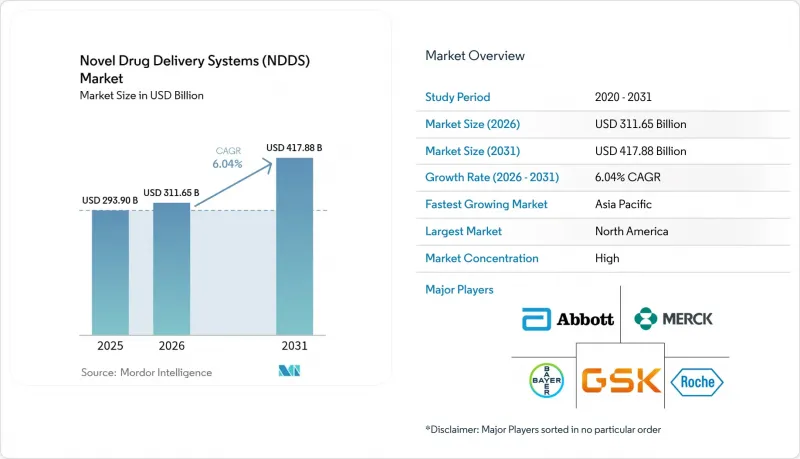
This report Segments the Industry Into by Route of Administration (Oral Drug Delivery Systems, Injectable Drug Delivery Systems, Pulmonary Drug Delivery Systems, Transdermal Drug Delivery Systems, Other Routes of Administration), by Mode of NDDS (Targeted Drug Delivery Systems, Controlled Drug Delivery Systems, Modulated Drug Delivery Systems), and Geography (North America, Europe, Asia-Pacific, and More).
Global Novel Drug Delivery Systems (NDDS) Market Trends and Insights
Rising Prevalence of Chronic Diseases
Cardiovascular and diabetic conditions affected more than 1.23 billion people globally in 2024 and continue to swell clinical demand for sustained-release therapies that reduce dosing frequency. Long-acting platforms such as the intravesical TAR-200 device illustrate this shift, delivering gemcitabine continuously over multiple months and achieving median response duration of 25.8 months, markedly higher than intermittent regimens. Regulators respond with guidance that favors integrated drug-device products able to improve adherence, reinforcing investment in implantable and transdermal formats.
Growing Adoption of Biologics & Large-Molecule Drugs
Escalation in monoclonal antibodies and RNA-based therapeutics elevates formulation complexity and stimulates nanoparticle innovation. Pfizer's ponsegromab trial underscores the benefit-optimized delivery improved performance in cancer cachexia patients. Vendors consequently expand lipid nanoparticle capacity; Lonza added multiple dedicated suites in 2025 to ease supply shortages. Cold-chain logistics and patient ease-of-use remain critical, widening prospects for temperature-controlled packaging and self-injecting wearables.
Stringent Combination-Product Regulations
Revised FDA and EMA guidelines require exhaustive drug-device interaction studies, inflating budgets by as much as USD 100 million and extending timelines up to two years. J&J secured Breakthrough Therapy Designation for TAR-200 yet still navigated extensive post-market commitments, highlighting the difficulty for smaller innovators. Divergent regional rules further complicate global launches.
Other drivers and restraints analyzed in the detailed report include:
- Digital-Therapeutic Integration Enabling Smart Delivery
- Expansion of mRNA / Gene-Therapy Pipelines
- High Device Cost in LMICs
For complete list of drivers and restraints, kindly check the Table Of Contents.
Segment Analysis
Oral therapies commanded 48.70% of New Drug Delivery Systems market share in 2025, yet growth moderates as digital implants and long-acting injectables demonstrate superior adherence. Implantable formats are projected to deliver a 8.72% CAGR to 2031, supported by breakthroughs such as Vivani Medical's GLP-1 implant that filled its first human study in four weeks. Injectable routes benefit from the biologics wave, while inhaled delivery attracts neurological and respiratory pipeline investments.
Patient preference, manufacturing scalability and reimbursement convenience underpin oral system resilience through 2030. However, smart pill sensors and micro-fluidic implants that log dosing create fresh value propositions for chronic disease management. Nasal and ocular options prosper in niche neurological and ophthalmic settings. Ultimately, route selection is increasingly dictated by molecular characteristics and personalized care models rather than historical convenience.
Auto-injectors retained 22.05% share of the New Drug Delivery Systems market size in 2025 on entrenched supply chains and clinician familiarity. Smart and connected devices, however, are advancing at a 9.18% CAGR as cloud-linked patches and app-integrated pens transform medication into data streams. Nanoparticle carriers, essential for mRNA therapeutics, underpin capacity expansions at Lonza and similar CDMOs.
Needle-free jet injectors reduce vaccination anxiety and speed mass-immunization programs, while microneedle patches gain traction in dermatology and vaccine delivery. Wearable infusers capable of delivering 5-50 mL biologics at home remove infusion-center bottlenecks. The technology race increasingly favors modular platforms adaptable across molecules, thereby compressing development cycles and enhancing portfolio ROI.
Complete Report Scope:
- By Route of Administration (Value)
- Oral
- Injectable
- Inhalation
- Transdermal
- Implantable
- Ocular
- Nasal
- Others
- By Technology / System Type (Value)
- Nanoparticle-based Systems
- Wearable Injectors
- Smart / Connected Devices
- Needle-Free Injection Systems
- Microneedle Patches
- Auto-Injectors
- Enteric-Coated Capsules
- Others
- By Therapeutic Application (Value)
- Oncology
- Diabetes
- Cardiovascular Diseases
- Infectious Diseases
- Respiratory Diseases
- Neurological Disorders
- Others
- By End User (Value)
- Hospitals
- Ambulatory Surgical Centers
- Home-Care Settings
- Specialty Clinics
- Others
- By Geography (Value)
- North America
- United States
- Canada
- Mexico
- Europe
- Germany
- United Kingdom
- France
- Italy
- Spain
- Rest of Europe
- Asia-Pacific
- China
- India
- Japan
- South Korea
- Australia
- Rest of Asia-Pacific
- South America
- Brazil
- Argentina
- Rest of South America
- Middle East and Africa
- GCC
- South Africa
- Rest of Middle East and Africa
- North America
Geography Analysis
North America retained 41.90% of New Drug Delivery Systems market revenue in 2025, supported by fast regulatory pathways and payer acceptance of high-value devices. Breakthrough Therapy designations accelerate adoption, yet rising scrutiny of cybersecurity prolongs time-to-market for connected delivery tools. Capacity shortfalls for lipid nanoparticles prompt partnerships with Asian CDMOs.
Asia-Pacific is projected to log a 10.66% CAGR through 2031. Regional governments expand universal health coverage and incentivize domestic manufacturing. China's policy to localize high-end medical technology has spurred joint ventures for smart auto-injectors, while India's generics producers eye value capture in cost-effective microneedle patches.
Europe remains mature but regulation-intense. The Medical Device Regulation introduces dual compliance needs that delay launches but elevate safety standards. Sustainability imperatives accelerate interest in recyclable packaging and long-acting formulations. Brexit's separate U.K. pathway demands parallel submissions, adding complexity but not materially eroding demand.
- Johnson & Johnson
- Pfizer
- Novartis
- Roche
- Merck
- Sanofi
- GlaxoSmithKline
- AstraZeneca
- Bayer
- Beckton Dickinson
- 3M
- Medtronic
- Insulet
- Amgen
- Teva Pharmaceutical Industries
- Abbvie
- Eli Lilly and Company
- Boston Scientific
- Antares Pharma
- West Pharmaceutical Services
Additional Benefits:
- The market estimate (ME) sheet in Excel format
- 3 months of analyst support
TABLE OF CONTENTS
1 Introduction
- 1.1 Study Assumptions & Market Definition
- 1.2 Scope of the Study
2 Research Methodology
3 Executive Summary
4 Market Landscape
- 4.1 Market Overview
- 4.2 Market Drivers
- 4.2.1 Rising prevalence of chronic diseases
- 4.2.2 Growing adoption of biologics & large-molecule drugs
- 4.2.3 Digital-therapeutic integration enabling smart delivery
- 4.2.4 Expansion of mRNA / gene-therapy pipelines
- 4.2.5 Patient preference for self-administration & home care
- 4.2.6 Decarbonization push favoring long-acting formulations
- 4.3 Market Restraints
- 4.3.1 Stringent combination-product regulations
- 4.3.2 High device cost in LMICs
- 4.3.3 Cyber-security risk in connected injectors
- 4.3.4 Limited LNP manufacturing capacity
- 4.4 Value / Supply-Chain Analysis
- 4.5 Regulatory Landscape
- 4.6 Technological Outlook
- 4.7 Porter's Five Forces
- 4.7.1 Bargaining Power of Suppliers
- 4.7.2 Bargaining Power of Buyers
- 4.7.3 Threat of Substitutes
- 4.7.4 Threat of New Entrants
- 4.7.5 Competitive Rivalry
5 Market Size & Growth Forecasts
- 5.1 By Route of Administration (Value)
- 5.1.1 Oral
- 5.1.2 Injectable
- 5.1.3 Inhalation
- 5.1.4 Transdermal
- 5.1.5 Implantable
- 5.1.6 Ocular
- 5.1.7 Nasal
- 5.1.8 Others
- 5.2 By Technology / System Type (Value)
- 5.2.1 Nanoparticle-based Systems
- 5.2.2 Wearable Injectors
- 5.2.3 Smart / Connected Devices
- 5.2.4 Needle-Free Injection Systems
- 5.2.5 Microneedle Patches
- 5.2.6 Auto-Injectors
- 5.2.7 Enteric-Coated Capsules
- 5.2.8 Others
- 5.3 By Therapeutic Application (Value)
- 5.3.1 Oncology
- 5.3.2 Diabetes
- 5.3.3 Cardiovascular Diseases
- 5.3.4 Infectious Diseases
- 5.3.5 Respiratory Diseases
- 5.3.6 Neurological Disorders
- 5.3.7 Others
- 5.4 By End User (Value)
- 5.4.1 Hospitals
- 5.4.2 Ambulatory Surgical Centers
- 5.4.3 Home-Care Settings
- 5.4.4 Specialty Clinics
- 5.4.5 Others
- 5.5 By Geography (Value)
- 5.5.1 North America
- 5.5.1.1 United States
- 5.5.1.2 Canada
- 5.5.1.3 Mexico
- 5.5.2 Europe
- 5.5.2.1 Germany
- 5.5.2.2 United Kingdom
- 5.5.2.3 France
- 5.5.2.4 Italy
- 5.5.2.5 Spain
- 5.5.2.6 Rest of Europe
- 5.5.3 Asia-Pacific
- 5.5.3.1 China
- 5.5.3.2 India
- 5.5.3.3 Japan
- 5.5.3.4 South Korea
- 5.5.3.5 Australia
- 5.5.3.6 Rest of Asia-Pacific
- 5.5.4 South America
- 5.5.4.1 Brazil
- 5.5.4.2 Argentina
- 5.5.4.3 Rest of South America
- 5.5.5 Middle East and Africa
- 5.5.5.1 GCC
- 5.5.5.2 South Africa
- 5.5.5.3 Rest of Middle East and Africa
- 5.5.1 North America
6 Competitive Landscape
- 6.1 Market Concentration
- 6.2 Market Share Analysis
- 6.3 Company Profiles (includes Global level Overview, Market level overview, Core Segments, Financials as available, Strategic Information, Market Rank/Share for key companies, Products & Services, and Recent Developments)
- 6.3.1 Johnson & Johnson
- 6.3.2 Pfizer Inc.
- 6.3.3 Novartis AG
- 6.3.4 F. Hoffmann-La Roche Ltd
- 6.3.5 Merck & Co., Inc.
- 6.3.6 Sanofi
- 6.3.7 GlaxoSmithKline plc
- 6.3.8 AstraZeneca plc
- 6.3.9 Bayer AG
- 6.3.10 Becton, Dickinson and Company
- 6.3.11 3M Company
- 6.3.12 Medtronic plc
- 6.3.13 Insulet Corporation
- 6.3.14 Amgen Inc.
- 6.3.15 Teva Pharmaceutical Industries Ltd.
- 6.3.16 AbbVie Inc.
- 6.3.17 Eli Lilly and Company
- 6.3.18 Boston Scientific Corporation
- 6.3.19 Antares Pharma, Inc.
- 6.3.20 West Pharmaceutical Services, Inc.
7 Market Opportunities & Future Outlook
- 7.1 White-space & Unmet-Need Assessment

