PUBLISHER: Global Market Insights Inc. | PRODUCT CODE: 2101903

PUBLISHER: Global Market Insights Inc. | PRODUCT CODE: 2101903
Data Center Infrastructure Market Opportunity, Growth Drivers, Industry Trend Analysis, and Forecast 2026 - 2035
The Global Data Center Infrastructure Market was valued at USD 234.2 billion in 2025 and is estimated to grow at a CAGR of 12.1% to reach USD 789.8 billion by 2035.
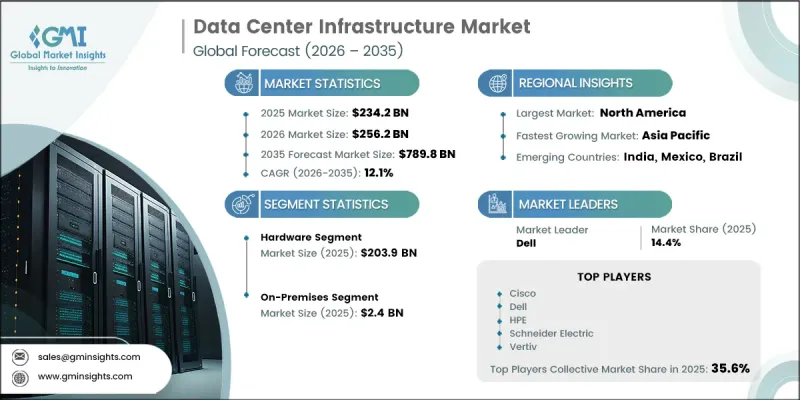
Market growth is driven by the exponential rise in AI workloads, hyperscale computing demand, and the rapid expansion of cloud and edge infrastructure. The market is undergoing a fundamental transformation as enterprises and cloud providers increasingly invest in high-density computing environments that require advanced power, cooling, and networking systems. The proliferation of generative AI, machine learning, and high-performance computing workloads is significantly increasing rack densities, pushing infrastructure requirements from traditional 10-15 kW to over 100 kW per rack. This shift is accelerating investments in liquid cooling technologies, high-capacity power systems, and next-generation networking fabrics. Additionally, the surge in hyperscale data center construction and edge deployments is creating sustained demand for modular, scalable, and energy-efficient infrastructure solutions. Governments and enterprises are also prioritizing sustainability and energy efficiency, further driving adoption of advanced cooling systems and DCIM solutions to optimize power usage effectiveness (PUE) and reduce carbon footprints.
| Market Scope | |
|---|---|
| Start Year | 2025 |
| Forecast Year | 2026-2035 |
| Start Value | $234.2 Billion |
| Forecast Value | $789.8 Billion |
| CAGR | 12.1% |
The market is further supported by continuous cloud migration, rising digital transformation initiatives, and the increasing need for data sovereignty across regions. Enterprises are modernizing legacy IT infrastructure and shifting toward hybrid and cloud-based deployments, which necessitate robust and flexible data center infrastructure. The growing importance of real-time data processing, IoT, and 5G networks is also fueling the deployment of edge data centers, thereby expanding the infrastructure footprint globally. Moreover, regulatory mandates on energy efficiency and carbon emissions are pushing operators to adopt innovative solutions such as immersion cooling, renewable energy integration, and AI-driven infrastructure management systems. These advancements are not only improving operational efficiency but also reducing the total cost of ownership, making data center infrastructure more resilient and scalable for future digital demands.
The hardware segment generated USD 203.9 billion in 2025 owing to its critical role in enabling power distribution, cooling, and networking within data centers. Hardware components such as servers, racks, cooling systems, and power infrastructure form the backbone of data center operations, making them indispensable for supporting high-performance workloads. The increasing deployment of hyperscale and colocation facilities is significantly boosting demand for advanced hardware solutions, particularly high-efficiency power systems and liquid cooling technologies. The need for continuous uptime and reliability is also driving investments in redundant and fault-tolerant hardware systems, further strengthening this segment's dominance.
The on-premises data center infrastructure segment captured USD 2.4 billion in 2025, accounting for 15% share. Despite the ongoing transition toward cloud-based environments, demand for on-premises infrastructure has remained relatively stable. This sustained investment is primarily driven by strict data sovereignty regulations across highly regulated industries and government organizations that require sensitive information to remain under direct organizational control.
North America Data Center Infrastructure Market generated USD 98.1 billion, accounting for 38.3% share in 2025. The region's leadership is supported by a strong presence of hyperscale cloud providers, widespread enterprise adoption of advanced technologies, and historically favorable electricity costs across several major data center hubs, contributing to continued investment and market expansion.
Key players operating in the Global Data Center Infrastructure Market include ABB, Cisco Systems, Dell Technologies, Eaton Corporation, Hewlett Packard Enterprise (HPE), IBM, Lenovo Group Limited, NetApp, Schneider Electric, Vertiv Holdings Co., Fujitsu, Huawei, Inspur, Legrand, and Rittal. Companies in the Data Center Infrastructure Market are focusing on strategic partnerships, mergers and acquisitions, and large-scale capacity expansions to strengthen their market presence. Collaborations with cloud providers and AI firms enable vendors to co-develop high-density infrastructure solutions tailored for next-generation workloads. Investments in liquid cooling and energy-efficient technologies are a major priority, helping companies align with sustainability goals and regulatory requirements. Additionally, firms are expanding manufacturing capabilities and global supply chains to reduce lead times and meet growing demand. Product innovation, particularly in AI-driven DCIM, modular infrastructure, and high-speed networking, is another key strategy. Companies are also entering emerging markets and edge data center segments to capture new growth opportunities and diversify revenue streams.
Table of Contents
Chapter 1 Methodology
- 1.1 Research approach
- 1.2 Quality Commitments
- 1.2.1 GMI AI policy & data integrity commitment
- 1.3 Research Trail & Confidence Scoring
- 1.3.1 Research Trail Components
- 1.3.2 Scoring Components
- 1.4 Data Collection
- 1.5 Data mining sources
- 1.5.1 Paid sources
- 1.6 Base estimates and calculations
- 1.6.1 Base year calculation
- 1.7 Forecast model
- 1.7.1 Quantified market impact analysis
- 1.8 Research transparency addendum
- 1.8.1 Source attribution framework
- 1.8.2 Quality assurance metrics
- 1.8.3 Our commitment to trust
Chapter 2 Executive Summary
- 2.1 Industry 360° synopsis
- 2.2 Key market trends
- 2.2.1 Regional
- 2.2.2 Component
- 2.2.3 Deployment Mode
- 2.2.4 Tier
- 2.2.5 Data Center
- 2.2.6 End Use Industry
- 2.3 TAM analysis, 2026-2035
- 2.4 CXO perspectives: Strategic imperatives
Chapter 3 Industry Insights
- 3.1 Industry ecosystem analysis
- 3.1.1 Supplier landscape
- 3.1.2 Profit margin
- 3.1.3 Cost structure
- 3.1.4 Value addition at each stage
- 3.1.5 Factor affecting the value chain
- 3.1.6 Disruptions
- 3.2 Industry impact forces
- 3.2.1 Growth drivers
- 3.2.1.1 Explosive growth of cloud computing & hyperscale deployments
- 3.2.1.2 AI & machine learning workload expansion driving GPU-dense infrastructure demand
- 3.2.1.3 Digital transformation across BFSI, healthcare & government verticals
- 3.2.1.4 5G rollout & edge computing proliferation fueling distributed infrastructure build-out
- 3.2.1.5 Data sovereignty regulations mandating in-country infrastructure investment
- 3.2.2 Industry pitfalls and challenges
- 3.2.2.1 Power supply constraints & escalating energy costs
- 3.2.2.2 High capital expenditure & long payback periods for infrastructure projects infrastructure
- 3.2.3 Market opportunities
- 3.2.3.1 Liquid & immersion cooling adoption for high-density ai racks
- 3.2.3.2 Green data centers & renewable energy integration (solar, wind, nuclear)
- 3.2.3.3 Edge data center expansion in emerging markets
- 3.2.1 Growth drivers
- 3.3 Technology and innovation landscape
- 3.3.1 Current technological trends
- 3.3.1.1 Liquid & immersion cooling technology advances
- 3.3.1.2 Software-defined data center (SDDC) & hyperconverged infrastructure (HCI)
- 3.3.2 Emerging technologies
- 3.3.2.1 Modular & prefabricated data center technology
- 3.3.2.2 Renewable energy integration & green infrastructure
- 3.3.1 Current technological trends
- 3.4 Growth potential analysis
- 3.5 Pricing analysis, 2022-2025 (Driven by Primary Research)
- 3.6 Regulatory landscape
- 3.6.1 North America
- 3.6.1.1 US — Federal Energy Regulatory Commission (FERC)
- 3.6.1.2 US — U.S. Department of Energy (DOE)
- 3.6.1.3 US — U.S. Environmental Protection Agency (EPA)
- 3.6.1.4 Canada — Innovation, Science and Economic Development Canada (ISED)
- 3.6.2 Europe
- 3.6.2.1 EU — European Commission (EC) — Energy Efficiency Directive (EED)
- 3.6.2.2 EU — European Green Deal & EU Taxonomy for Sustainable Finance
- 3.6.2.3 Germany — Federal Network Agency (Bundesnetzagentur)
- 3.6.2.4 Ireland — Commission for Regulation of Utilities (CRU)
- 3.6.3 Asia Pacific
- 3.6.3.1 China — Ministry of Industry and Information Technology (MIIT)
- 3.6.3.2 India — Ministry of Electronics and Information Technology (MeitY)
- 3.6.3.3 Singapore — Infocomm Media Development Authority (IMDA)
- 3.6.3.4 Australia — Australian Energy Regulator (AER)
- 3.6.4 LATAM
- 3.6.4.1 Brazil — Agencia Nacional de Telecomunicacoes (ANATEL)
- 3.6.4.2 Chile — Subsecretaria de Telecomunicaciones (SUBTEL)
- 3.6.5 MEA
- 3.6.5.1 UAE — Telecommunications and Digital Government Regulatory Authority (TDRA)
- 3.6.5.2 Saudi Arabia — Communications, Space & Technology Commission (CST)
- 3.6.5.3 South Africa — Department of Communications and Digital Technologies (DCDT)
- 3.6.1 North America
- 3.7 Porter’s analysis
- 3.8 PESTEL analysis
- 3.9 Patent analysis (Driven by Primary Research)
- 3.10 Cost breakdown analysis, 2025
- 3.11 Data center capacity & infrastructure landscape
- 3.11.1 Installed capacity (MW) by country, 2025
- 3.11.2 Expansion pipeline, 2026-2030
- 3.11.3 Utilization rates & supply-demand
- 3.12 Energy & power infrastructure analysis
- 3.12.1 Grid interconnection challenges & utility partnerships
- 3.12.2 Behind-the-meter power generation solutions (solar, gas, nuclear SMRs)
- 3.12.3 Power Purchase Agreement (PPA) trends among hyperscalers
- 3.12.4 Battery energy storage system (BESS) adoption in data centers
- 3.13 Impact of AI & generative AI on the market
- 3.13.1 AI-driven disruption of existing business models
- 3.13.2 GenAI use cases & adoption roadmap by segment
- 3.13.3 Risks, limitations & regulatory considerations
- 3.14 Forecast assumptions & scenario analysis (Driven by Primary Research)
- 3.14.1 Base Case- Key macro & industry variables driving CAGR
- 3.14.2 Optimistic Scenarios- Favorable macro and industry tailwinds
- 3.14.3 Pessimistic Scenario - Macroeconomic slowdown or industry headwinds
Chapter 4 Competitive Landscape, 2025
- 4.1 Introduction
- 4.2 Company market share analysis
- 4.2.1 North America
- 4.2.2 Europe
- 4.2.3 Asia Pacific
- 4.2.4 LATAM
- 4.2.5 MEA
- 4.3 Competitive analysis of major market players
- 4.4 Competitive positioning matrix
- 4.5 Key developments
- 4.5.1 Mergers & acquisitions
- 4.5.2 Partnerships & collaborations
- 4.5.3 New product launches
- 4.5.4 Expansion plans and funding
- 4.6 Company tier benchmarking
- 4.6.1 Tier classification criteria & qualifying thresholds
- 4.6.2 Tier positioning matrix by revenue, geography & innovation
Chapter 5 Market Estimates and Forecast, By Component, 2022 – 2035 ($ Bn)
- 5.1 Key trends
- 5.2 Hardware
- 5.2.1 IT infrastructure
- 5.2.1.1 Servers
- 5.2.1.1.1 Rack servers
- 5.2.1.1.2 Blade servers
- 5.2.1.1.3 Tower servers
- 5.2.1.2 Storage
- 5.2.1.2.1 Storage area network (SAN)
- 5.2.1.2.2 Network-attached storage (NAS)
- 5.2.1.2.3 Object storage arrays
- 5.2.1.3 Networking equipment
- 5.2.1.3.1 Switches & routers
- 5.2.1.3.2 Load balancers
- 5.2.1.3.3 Optical interconnects & transceivers
- 5.2.1.1 Servers
- 5.2.2 Power infrastructure
- 5.2.2.1 Uninterruptible power supplies (UPS)
- 5.2.2.2 Generators & transfer switches
- 5.2.2.3 Power distribution units (PDUs) & switchgear
- 5.2.2.4 Power & energy management systems
- 5.2.3 Cooling infrastructure
- 5.2.3.1 Computer room air conditioning/air handling (CRAC/CRAH)
- 5.2.3.2 Chiller & cooling tower systems
- 5.2.3.3 Liquid & immersion cooling systems
- 5.2.3.4 Adiabatic & free cooling systems
- 5.2.4 Support infrastructure
- 5.2.4.1 Racks & enclosures
- 5.2.4.2 Structured cabling & cable management
- 5.2.4.3 Physical security systems
- 5.2.4.4 Building management systems (BMS)
- 5.2.1 IT infrastructure
- 5.3 Software
- 5.3.1 Data center infrastructure management (DCIM) software
- 5.3.2 IT infrastructure management & automation software
- 5.3.3 Security & compliance software
- 5.3.4 AI-driven infrastructure optimization software
- 5.4 Services
- 5.4.1 Professional services
- 5.4.1.1 Consulting & advisory
- 5.4.1.2 Design & engineering
- 5.4.1.3 Installation & integration
- 5.4.1.4 Testing & commissioning
- 5.4.2 Managed services
- 5.4.1 Professional services
Chapter 6 Market Estimates and Forecast, By Deployment Mode, 2022 – 2035 ($ Bn)
- 6.1 Key trends
- 6.2 On-Premises
- 6.3 Cloud
- 6.4 Hybrid
Chapter 7 Market Estimates and Forecast, By Tier, 2022 – 2035 ($ Bn, GW)
- 7.1 Key trends
- 7.2 Tier 1
- 7.3 Tier 2
- 7.4 Tier 3
- 7.5 Tier 4
Chapter 8 Market Estimates and Forecast, By Data Center, 2022 – 2035 ($ Bn, GW)
- 8.1 Key trends
- 8.2 Enterprise Data Centers
- 8.3 Colocation Data Centers
- 8.4 Hyperscale Data Centers
- 8.5 Edge Data Centers
Chapter 9 Market Estimates and Forecast, By End Use Industry, 2022 – 2035 ($ Bn)
- 9.1 Key trends
- 9.2 BFSI
- 9.3 Colocation
- 9.4 Energy
- 9.5 Government
- 9.6 Healthcare
- 9.7 Manufacturing
- 9.8 IT & Telecom
- 9.9 Retail & E-commerce
- 9.10 Media & Entertainment
- 9.11 Others
Chapter 10 Market Estimates & Forecast, By Region, 2022 - 2035 ($ Mn)
- 10.1 Key trends
- 10.2 North America
- 10.2.1 US
- 10.2.2 Canada
- 10.3 Europe
- 10.3.1 Germany
- 10.3.2 UK
- 10.3.3 France
- 10.3.4 Italy
- 10.3.5 Spain
- 10.3.6 Netherlands
- 10.3.7 Belgium
- 10.3.8 Sweden
- 10.3.9 Poland
- 10.4 Asia Pacific
- 10.4.1 China
- 10.4.2 India
- 10.4.3 Japan
- 10.4.4 South Korea
- 10.4.5 Australia
- 10.4.6 Singapore
- 10.4.7 Thailand
- 10.4.8 Indonesia
- 10.4.9 Malaysia
- 10.5 Latin America
- 10.5.1 Brazil
- 10.5.2 Mexico
- 10.5.3 Argentina
- 10.5.4 Chile
- 10.6 MEA
- 10.6.1 South Africa
- 10.6.2 Saudi Arabia
- 10.6.3 UAE
Chapter 11 Company Profiles
- 11.1 Global Players
- 11.1.1 Schneider Electric SE
- 11.1.2 Vertiv Group Co.
- 11.1.3 Dell Technologies
- 11.1.4 Cisco Systems
- 11.1.5 Hewlett Packard Enterprise
- 11.1.6 Eaton Corporation
- 11.1.7 Juniper Networks
- 11.1.8 ABB Ltd.
- 11.1.9 Siemens AG
- 11.1.10 Honeywell International
- 11.2 Regional Players
- 11.2.1 Coherent Corp.
- 11.2.2 Rittal GmbH & Co. KG
- 11.2.3 NetApp Inc.
- 11.2.4 Arista Networks
- 11.2.5 Pure Storage
- 11.2.6 Legrand SA
- 11.2.7 Cummins Inc.
- 11.2.8 Ciena Corporation
- 11.2.9 Hyperview
- 11.2.10 LiquidStack

