PUBLISHER: Global Market Insights Inc. | PRODUCT CODE: 2109283

PUBLISHER: Global Market Insights Inc. | PRODUCT CODE: 2109283
Data Center Infrastructure Management (DCIM) Market Opportunity, Growth Drivers, Industry Trend Analysis, and Forecast 2026 - 2035
The Global Data Center Infrastructure Management Market was valued at USD 3.7 billion in 2025 and is estimated to grow at a CAGR of 21.7% to reach USD 27.4 billion by 2035.
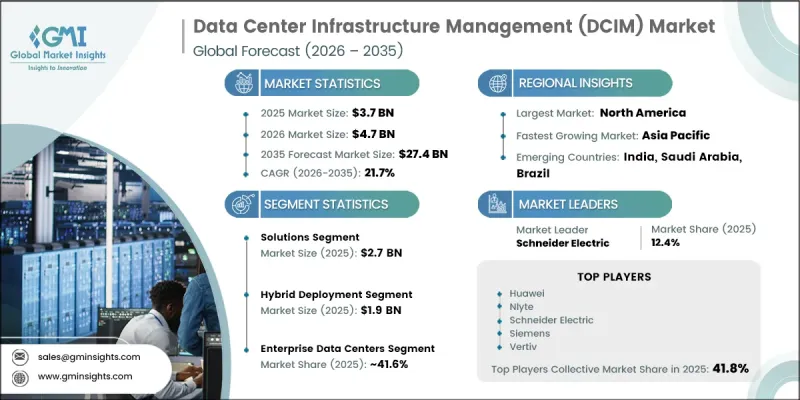
The data center infrastructure management market is experiencing substantial growth as hyperscale and edge data center deployments continue to accelerate worldwide. The rapid expansion of digital infrastructure has significantly increased the need for centralized platforms capable of monitoring, managing, and optimizing complex data center environments. As organizations expand their facility footprints, manual management methods are becoming increasingly impractical, creating strong demand for intelligent DCIM platforms that provide comprehensive asset management, real-time power monitoring, infrastructure visibility, and automated capacity planning. The market is also benefiting from rising investments in digital transformation, cloud computing, and high-performance computing infrastructure. Growing emphasis on operational efficiency, sustainability, and energy optimization is encouraging operators to adopt advanced management platforms that improve resource utilization while reducing operating costs. Furthermore, increasing requirements for infrastructure scalability, predictive maintenance, and centralized monitoring across distributed facilities continue to strengthen demand for modern DCIM solutions, positioning the market for sustained long-term growth throughout the forecast period.
| Market Scope | |
|---|---|
| Start Year | 2025 |
| Forecast Year | 2026-2035 |
| Start Value | $3.7 Billion |
| Forecast Value | $27.4 Billion |
| CAGR | 21.7% |
Another major factor supporting the data center infrastructure management market is the rapid evolution of high-density computing environments. Increasing deployment of artificial intelligence and machine learning workloads has significantly increased rack power density, creating greater requirements for advanced cooling systems, efficient power management, and continuous infrastructure monitoring. As cooling technologies and high-performance computing environments become more sophisticated, operators require intelligent management platforms capable of optimizing facility performance, improving operational reliability, and maintaining infrastructure efficiency. These changing operational requirements continue to accelerate adoption of DCIM platforms across enterprise, hyperscale, and colocation data centers worldwide.
The solutions segment accounted for a 73.8% share in 2025, generating USD 2.7 billion. The segment maintains its leading position because software platforms deliver the core capabilities required to efficiently manage modern data center operations. These solutions provide comprehensive functionality for power monitoring, thermal management, infrastructure visualization, asset tracking, sustainability reporting, and capacity optimization. Continuous innovation in integrated platforms and modular architectures is further strengthening adoption by allowing organizations to deploy flexible solutions that align with their operational requirements and long-term digital infrastructure strategies.
The hybrid deployment segment held a 52.8% share in 2025, generating USD 1.9 billion. Hybrid deployment continues to gain widespread acceptance because it combines the advantages of on-premises infrastructure management with cloud-based analytics and centralized visibility. This deployment model enables organizations to maintain local operational control while leveraging cloud capabilities for cross-site performance analysis, centralized monitoring, and enterprise-wide infrastructure optimization. As businesses continue expanding across multiple facilities, hybrid deployment offers the flexibility, scalability, and operational efficiency required to manage increasingly complex data center environments.
North America Data Center Infrastructure Management Market generated USD 2.1 billion in 2025 and is expected to grow at a CAGR of 22.2% between 2026 and 2035. The region continues to dominate the global market due to its extensive concentration of hyperscale data centers, advanced digital infrastructure, and sustained investments in cloud computing and artificial intelligence facilities. Continued expansion of enterprise data centers, increasing infrastructure modernization, supportive policy initiatives, and strong investment in digital technologies continue to reinforce North America's leadership while driving widespread adoption of advanced DCIM platforms across multiple industries.
Leading companies operating in the global data center infrastructure management market include Vertiv, Schneider Electric, Eaton, Siemens, Huawei, Johnson Controls, Sunbird Software, Panduit, FNT Software, and Nlyte Software. Companies operating in the data center infrastructure management market are strengthening their competitive position by expanding intelligent software capabilities, integrating artificial intelligence and predictive analytics, and enhancing cloud-based infrastructure management solutions. Vendors continue to invest in platform innovation to improve asset visibility, energy optimization, thermal management, and real-time operational monitoring across increasingly complex data center environments. Strategic partnerships with cloud providers, colocation operators, and enterprise customers are accelerating solution deployment while expanding global market reach. Organizations are also focusing on API-driven architectures, hybrid deployment capabilities, and sustainability management tools to address evolving customer requirements.
Table of Contents
Chapter 1 Research Methodology
- 1.1 Research approach
- 1.2 Quality Commitments
- 1.2.1 GMI AI policy & data integrity commitment
- 1.3 Research Trail & Confidence Scoring
- 1.3.1 Research Trail Components
- 1.3.2 Scoring Components
- 1.4 Data Collection
- 1.5 Data mining sources
- 1.5.1 Paid sources
- 1.6 Base estimates and calculations
- 1.6.1 Base year calculation
- 1.7 Forecast model
- 1.7.1 Quantified market impact analysis
- 1.8 Research transparency addendum
- 1.8.1 Source attribution framework
- 1.8.2 Quality assurance metrics
- 1.8.3 Our commitment to trust
Chapter 2 Executive Summary
- 2.1 Industry 360° synopsis
- 2.2 Key market trends
- 2.2.1 Regional
- 2.2.2 Offering
- 2.2.3 Deployment Mode
- 2.2.4 Data Center
- 2.2.5 Data Center Tier
- 2.2.6 End-Use Industry
- 2.3 TAM analysis, 2026-2035
- 2.4 CXO perspectives: Strategic imperatives
Chapter 3 Industry Insights
- 3.1 Industry ecosystem analysis
- 3.1.1 Supplier landscape
- 3.1.2 Profit margin
- 3.1.3 Cost structure
- 3.1.4 Value addition at each stage
- 3.1.5 Factor affecting the value chain
- 3.1.6 Disruptions
- 3.2 Industry impact forces
- 3.2.1 Growth drivers
- 3.2.1.1 Hyperscale & Edge Data Center Expansion Driving DCIM Demand
- 3.2.1.2 Rising Energy Costs Accelerating Power Optimization Adoption
- 3.2.1.3 AI/ML Workloads Increasing Rack Density & Thermal Management Needs
- 3.2.1.4 Regulatory Compliance Requirements Boosting DCIM Adoption
- 3.2.2 Industry pitfalls and challenges
- 3.2.2.1 High Deployment Costs & Legacy Infrastructure Integration Challenges
- 3.2.2.2 Shortage of Skilled DCIM & Data Center Management Professionals
- 3.2.3 Market opportunities
- 3.2.3.1 AI-Native DCIM Enabling Predictive Data Center Operations
- 3.2.3.2 Edge Data Center Growth Expanding DCIM Market Opportunities
- 3.2.3.3 Cloud-Based Modular DCIM Driving SME Adoption
- 3.2.1 Growth drivers
- 3.3 Technology and innovation landscape
- 3.3.1 Current technological trends
- 3.3.1.1 AI-Driven Data Center Monitoring and Predictive Analytics
- 3.3.1.2 IoT-Enabled Real-Time Infrastructure Monitoring
- 3.3.1.3 Cloud-Based DCIM and Integrated Data Center Management Platforms
- 3.3.2 Emerging technologies
- 3.3.2.1 Digital Twin Technology for Data Center Infrastructure Optimization
- 3.3.2.2 AI/ML-Based Predictive Maintenance and Autonomous Operations
- 3.3.2.3 Edge Computing and Intelligent Infrastructure Management
- 3.3.1 Current technological trends
- 3.4 Growth potential analysis
- 3.5 Regulatory landscape
- 3.5.1 North America
- 3.5.1.1 US - Environmental Protection Agency (EPA)
- 3.5.1.2 US - DOE (Department of Energy)
- 3.5.2 Europe
- 3.5.2.1 EU - European Commission (EC)
- 3.5.2.2 EU - CENELEC (European Committee for Electrotechnical Standardization)
- 3.5.3 Asia Pacific
- 3.5.3.1 China - MIIT (Ministry of Industry and Information Technology)
- 3.5.3.2 India - BEE (Bureau of Energy Efficiency)
- 3.5.4 LATAM
- 3.5.4.1 Brazil - ANEEL (National Electric Energy Agency)
- 3.5.4.2 Brazil - ANATEL
- 3.5.5 MEA
- 3.5.5.1 UAE - TRA (Telecommunications and Digital Government Regulatory Authority)
- 3.5.5.2 Saudi Arabia - CST (Communications, Space and Technology Commission)
- 3.5.1 North America
- 3.6 Porter’s analysis
- 3.7 PESTEL analysis
- 3.8 Cost breakdown analysis
- 3.9 Patent analysis (Driven by Primary Research)
- 3.10 Data Center Capacity & Infrastructure Landscape
- 3.10.1 Installed capacity (MW) by country, 2025
- 3.10.2 Expansion pipeline 2026-2030
- 3.10.3 Utilization rates & supply-demand
- 3.11 Impact of AI & generative AI on the market
- 3.11.1 AI-driven disruption of existing business models
- 3.11.2 GenAI use cases & adoption roadmap by segment
- 3.11.3 Risks, limitations & regulatory considerations
- 3.12 Forecast assumptions & scenario analysis (Driven by Primary Research)
- 3.12.1 Base Case- Key Macro & Industry Variables Driving CAGR
- 3.12.2 Optimistic Scenarios- Favorable macro and industry tailwinds
- 3.12.3 Pessimistic Scenario - Macroeconomic slowdown or industry headwinds
Chapter 4 Competitive Landscape, 2025
- 4.1 Introduction
- 4.2 Company market share analysis
- 4.2.1 North America
- 4.2.2 Europe
- 4.2.3 Asia Pacific
- 4.2.4 LATAM
- 4.2.5 MEA
- 4.3 Competitive analysis of major market players
- 4.4 Competitive positioning matrix
- 4.5 Key developments
- 4.5.1 Mergers & acquisitions
- 4.5.2 Partnerships & collaborations
- 4.5.3 New product launches
- 4.5.4 Expansion plans and funding
- 4.6 Company tier benchmarking
- 4.6.1 Tier classification criteria & qualifying thresholds
- 4.6.2 Tier positioning matrix by revenue, geography & innovation
Chapter 5 Market Estimates and Forecast, By Offering, 2022 – 2035 ($ Mn)
- 5.1 Key trends
- 5.2 Solutions
- 5.2.1 Asset & Capacity Management
- 5.2.2 Power & Energy Management
- 5.2.3 Network & Connectivity Management
- 5.2.4 Security & Access Management
- 5.2.5 Change Management & Workflow Automation
- 5.2.6 Environmental & Cooling Management
- 5.2.7 BI, Analytics & Reporting
- 5.3 Services
- 5.3.1 Professional Services
- 5.3.1.1 Design & Consulting
- 5.3.1.2 Integration & Deployment
- 5.3.2 Managed Services
- 5.3.1 Professional Services
Chapter 6 Market Estimates and Forecast, By Data Center, 2022 – 2035 ($ Mn)
- 6.1 Key trends
- 6.2 Enterprise Data Centers
- 6.3 Colocation Data Centers
- 6.4 Hyperscale Data Centers
- 6.5 Edge Data Centers
Chapter 7 Market Estimates and Forecast, By Deployment Mode, 2022 – 2035 ($ Mn)
- 7.1 Key trends
- 7.2 On-Premises
- 7.3 Cloud-based
- 7.4 Hybrid
Chapter 8 Market Estimates and Forecast, By Data Center Tier, 2022 – 2035 ($ Mn)
- 8.1 Key trends
- 8.2 Tier 1
- 8.3 Tier 2
- 8.4 Tier 3
- 8.5 Tier 4
Chapter 9 Market Estimates and Forecast, By End-Use Industry, 2022 – 2035 ($ Mn)
- 9.1 Key trends
- 9.2 BFSI
- 9.3 Colocation
- 9.4 Energy
- 9.5 Government
- 9.6 Healthcare
- 9.7 Manufacturing
- 9.8 IT & Telecom
- 9.9 Retail & E-commerce
- 9.10 Media & Entertainment
- 9.11 Others
Chapter 10 Market Estimates & Forecast, By Region, 2022 - 2035 ($ Mn)
- 10.1 Key trends
- 10.2 North America
- 10.2.1 US
- 10.2.2 Canada
- 10.3 Europe
- 10.3.1 Germany
- 10.3.2 UK
- 10.3.3 France
- 10.3.4 Italy
- 10.3.5 Spain
- 10.3.6 Netherlands
- 10.3.7 Belgium
- 10.3.8 Sweden
- 10.3.9 Poland
- 10.4 Asia Pacific
- 10.4.1 China
- 10.4.2 India
- 10.4.3 Japan
- 10.4.4 South Korea
- 10.4.5 Australia
- 10.4.6 Singapore
- 10.4.7 Thailand
- 10.4.8 Indonesia
- 10.4.9 Malaysia
- 10.5 Latin America
- 10.5.1 Brazil
- 10.5.2 Mexico
- 10.5.3 Argentina
- 10.5.4 Chile
- 10.6 MEA
- 10.6.1 South Africa
- 10.6.2 Saudi Arabia
- 10.6.3 UAE
Chapter 11 Company Profiles
- 11.1 Global players
- 11.1.1 Sunbird Software
- 11.1.2 Siemens
- 11.1.3 Johnson Controls
- 11.1.4 Huawei
- 11.1.5 Cisco Systems
- 11.1.6 Panduit
- 11.1.7 Fujitsu
- 11.1.8 Nlyte Software (Carrier Global)
- 11.1.9 Rittal
- 11.1.10 Modius
- 11.1.11 Vertiv
- 11.1.12 Eaton
- 11.2 Regional players
- 11.2.1 STULZ
- 11.2.2 GreenField Software
- 11.2.3 ISPsystem
- 11.2.4 Elipse Software
- 11.2.5 Mitsubishi Electric
- 11.3 Emerging players
- 11.3.1 Rit-Tech
- 11.3.2 EkkoSense
- 11.3.3 FNT Software

