PUBLISHER: Global Market Insights Inc. | PRODUCT CODE: 2101906

PUBLISHER: Global Market Insights Inc. | PRODUCT CODE: 2101906
Prefilled Syringes Market Opportunity, Growth Drivers, Industry Trend Analysis, and Forecast 2026 - 2035
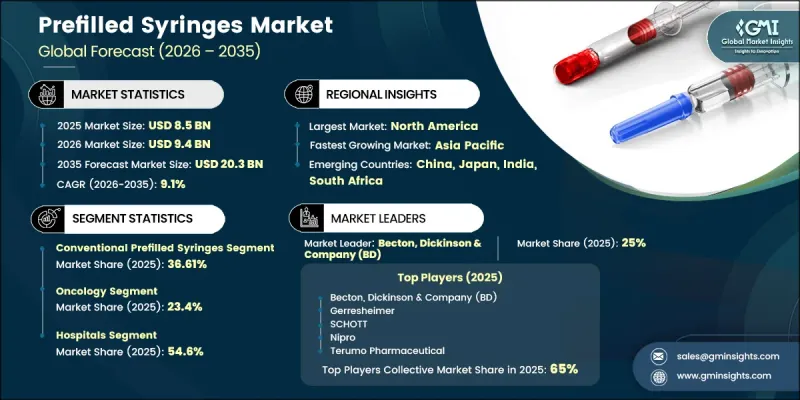
The Global Prefilled Syringe (PFS) Market was valued at USD 8.5 billion in 2025 and is estimated to grow at a CAGR of 9.1% to reach USD 20.3 billion by 2035.
Market expansion is driven by a structural transition toward patient-centric drug delivery systems, particularly the shift from hospital-based care to home healthcare and self-administration models. This transition is increasing demand for ready-to-use injectable formats that improve dosing accuracy, reduce preparation errors, and enhance patient convenience. At the same time, ongoing advancements in syringe engineering, including improved needle integration systems, enhanced plunger designs, and container integrity solutions, are elevating performance standards across the industry. The integration of digital and smart delivery features such as adherence tracking and dose monitoring is further reshaping product development strategies, encouraging pharmaceutical companies to adopt premium prefilled formats. These innovations are also contributing to higher value realization per unit, especially within specialty drug applications where precision and safety are critical.
| Market Scope | |
|---|---|
| Start Year | 2025 |
| Forecast Year | 2026-2035 |
| Start Value | $8.5 Billion |
| Forecast Value | $20.3 Billion |
| CAGR | 9.1% |
The conventional prefilled syringes accounted for 36.61% share in 2025 and is projected to grow at a CAGR of 9.3% through 2035. This segment remains widely used across multiple therapeutic areas where standard injection systems are sufficient and advanced safety mechanisms are not mandatory. Its strong position is supported by cost efficiency, scalable manufacturing capabilities, and compatibility with a wide range of pharmaceutical filling systems and dosage requirements.
The hospital segment held 54.6% share in 2025 and is expected to grow at a CAGR of 8.9% through 2035. Hospitals remain the primary point of administration for injectable therapies, particularly for high-acuity treatments, surgical procedures, and biologic drug initiation. Increasing emphasis on patient safety protocols and standardized injection practices has further strengthened the adoption of prefilled formats across institutional healthcare settings.
North America Prefilled Syringe (PFS) Market held 35.4% share in 2025 and is projected to grow at a CAGR of 8.6% through 2035. The region's dominance is supported by strong demand for biologic drugs, a well-established healthcare infrastructure, and widespread adoption of safety-engineered injectable devices. The United States remains the primary growth engine due to its advanced pharmaceutical ecosystem and increasing shift toward outpatient and home-based treatment models, while Canada contributes steady growth through expanding immunization and specialty care programs.
Major companies operating in the global prefilled syringe industry include Becton Dickinson and Company (BD), Baxter, B Braun, Fresenius Kabi, Gerresheimer, Nipro, SCHOTT, Terumo Pharmaceutical, Catalent, West Pharmaceutical Services, Datwyler Holding AG, Shandong Pharmaceutical Glass Co. Ltd., SiO2, Weigao Group, and APL (Associated Packaging, LLC). Companies operating in the prefilled syringe market are focusing on strengthening their market position through continuous innovation in drug delivery systems that improve safety, accuracy, and ease of administration. Manufacturers are investing in advanced material technologies, including high-quality glass and polymer solutions that enhance container integrity and compatibility with biologics. Expansion of automated and high-precision fill-finish manufacturing capabilities is helping companies increase production efficiency and meet rising global demand. Strategic partnerships with pharmaceutical firms are enabling co-development of drug-device combination products tailored for specific therapies.
Table of Contents
Chapter 1 Methodology & Scope
- 1.1 Market definitions
- 1.2 Research approach
- 1.3 Quality commitments
- 1.3.1 GMI AI policy & data integrity commitment
- 1.3.1.1 Source consistency protocol
- 1.3.1 GMI AI policy & data integrity commitment
- 1.4 Research trail & confidence scoring
- 1.4.1 Research trail components
- 1.4.2 Scoring components
- 1.5 Data collection
- 1.5.1 Partial list of primary sources
- 1.6 Data mining sources
- 1.6.1 Paid sources
- 1.6.1.1 Sources, by region
- 1.6.1 Paid sources
- 1.7 Base estimates and calculations
- 1.7.1 Base year calculation for any one approach
- 1.8 Forecast model
- 1.8.1 Quantified market impact analysis
- 1.8.1.1 Mathematical impact of growth parameters on forecast
- 1.8.1 Quantified market impact analysis
- 1.9 Research transparency addendum
- 1.9.1 Source attribution framework
- 1.9.2 Quality assurance metrics
- 1.9.3 Our commitment to trust
Chapter 2 Executive Summary
- 2.1 Industry 360° synopsis
- 2.1.1 Business trends
- 2.1.2 Type trends
- 2.1.3 Design trends
- 2.1.4 Material trends
- 2.1.5 Application trends
- 2.1.6 End use trends
- 2.1.7 Regional trends
Chapter 3 Industry Insights
- 3.1 Industry ecosystem analysis
- 3.2 Industry impact forces
- 3.2.1 Growth drivers
- 3.2.1.1 Expanding global burden of diabetes and rheumatoid arthritis
- 3.2.1.2 Technological advancements in syringe design
- 3.2.1.3 Self-injection trend and home healthcare shift
- 3.2.1.4 Expansion of global vaccination programs
- 3.2.2 Industry pitfalls and challenges
- 3.2.2.1 Stringent regulatory requirements
- 3.2.2.2 High production costs and operational complexity
- 3.2.3 Market opportunities
- 3.2.3.1 Adoption of polymer-based syringes (COP/COC) for sensitive biologics and high-value therapeutics
- 3.2.3.2 Silicone-free systems enhancing compatibility with advanced biologics and biosimilars
- 3.2.1 Growth drivers
- 3.3 Growth potential analysis
- 3.4 Regulatory landscape (Driven by primary research)
- 3.4.1 North America
- 3.4.2 Europe
- 3.4.3 Asia Pacific
- 3.4.4 Latin America
- 3.4.5 Middle East and Africa
- 3.5 Technology landscape
- 3.5.1 Current technological trends
- 3.5.2 Emerging technologies
- 3.6 Pricing trend analysis (Driven by primary research)
- 3.7 Future market trends
- 3.8 Porter's analysis
- 3.9 PESTEL analysis
- 3.10 Impact of AI and Generative AI on the market (Driven by primary research)
- 3.11 Value chain analysis (Driven by primary research)
- 3.12 Investment & funding analysis (Driven by primary research)
Chapter 4 Competitive Landscape, 2025
- 4.1 Introduction
- 4.2 Company market share analysis, by region, 2025
- 4.2.1 North America
- 4.2.2 Europe
- 4.2.3 Asia Pacific
- 4.3 Key developments
- 4.3.1 Key partnerships & collaborations
- 4.3.2 Major M&A activities
- 4.3.3 Product innovations & launches
- 4.3.4 Market expansion strategies
- 4.4 Competitive positioning matrix
Chapter 5 Market Size and Forecast, By Type, 2022 - 2035 (USD Million)
- 5.1 Key trends
- 5.2 Conventional prefilled syringes
- 5.3 Safety prefilled syringes
Chapter 6 Market Size and Forecast, By Design, 2022 - 2035 (USD Million)
- 6.1 Key trends
- 6.2 Single-chambers
- 6.3 Dual-chamber
Chapter 7 Market Size and Forecast, By Material, 2022 - 2035 (USD Million)
- 7.1 Key trends
- 7.2 Glass
- 7.3 Plastic
- 7.3.1 Cyclo olefin polymer (cop)
- 7.3.2 Cyclo olefin co polymer (coc)
- 7.3.3 Other plastic material
Chapter 8 Market Size and Forecast, By Application, 2022 - 2035 (USD Million)
- 8.1 Key trends
- 8.2 Oncology
- 8.3 Diabetes
- 8.4 Rheumatoid arthritis
- 8.5 Vaccines
- 8.6 Ophthalmology
- 8.7 Other applications
Chapter 9 Market Size and Forecast, By End Use, 2022 - 2035 (USD Million)
- 9.1 Key trends
- 9.2 Hospitals
- 9.3 Ambulatory surgery centers
- 9.4 Home healthcare
- 9.5 Other end use
Chapter 10 Market Size and Forecast, By Region, 2022 - 2035 (USD Million)
- 10.1 Key trends
- 10.2 North America
- 10.2.1 U.S.
- 10.2.2 Canada
- 10.3 Europe
- 10.3.1 Germany
- 10.3.2 France
- 10.3.3 UK
- 10.3.4 Netherlands
- 10.3.5 Spain
- 10.3.6 Italy
- 10.4 Asia Pacific
- 10.4.1 China
- 10.4.2 Japan
- 10.4.3 India
- 10.4.4 Australia
- 10.4.5 South Korea
- 10.5 Latin America
- 10.5.1 Brazil
- 10.5.2 Mexico
- 10.5.3 Argentina
- 10.6 Middle East and Africa
- 10.6.1 Saudi Arabia
- 10.6.2 South Africa
- 10.6.3 UAE
Chapter 11 Company Profiles
- 11.1 apl
- 11.2 B Braun
- 11.3 Baxter
- 11.4 Becton Dickinson & Company (BD)
- 11.5 Catalent
- 11.6 Datwyler Holding
- 11.7 Fresenius Kabi
- 11.8 Gerresheimer
- 11.9 Nipro
- 11.10 SCHOTT
- 11.11 Shandong Pharmaceutical Glass
- 11.12 SiO2
- 11.13 Terumo Pharmaceutical
- 11.14 Weigao Group
- 11.15 West Pharmaceutical

