PUBLISHER: Mordor Intelligence | PRODUCT CODE: 2122467

PUBLISHER: Mordor Intelligence | PRODUCT CODE: 2122467
Prefilled Syringes - Market Share Analysis, Industry Trends & Statistics, Growth Forecasts (2026 - 2031)
According to Mordor Intelligence, the prefilled syringes market size is expected to increase from USD 9.74 billion in 2025 to USD 10.77 billion in 2026 and reach USD 18.12 billion by 2031, growing at a CAGR of 10.96% over 2026-2031.
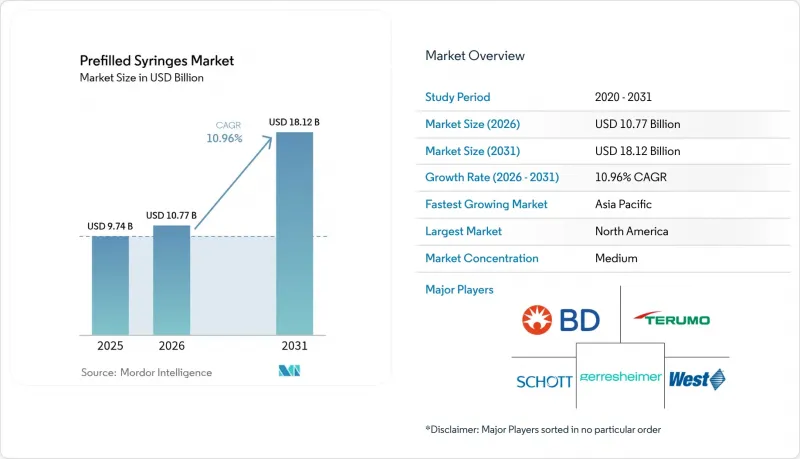
This report is Segmented by Material (Glass, Polymer), Application (Diabetes, Rheumatoid Arthritis, Vaccines, Anticoagulants, Other Applications), End-User (Hospitals & Clinics, Ambulatory Surgical Centers, Home Healthcare Settings, Other End Users), and Geography (North America, Europe, Asia-Pacific, Middle East & Africa, South America). The Market Forecasts are Provided in Terms of Value (USD).
Global Prefilled Syringes Market Trends and Insights
Rising Prevalence of Chronic Diseases
Diabetes prevalence doubled between 1990 and 2022, climbing to 14.0% of the global adult population and pushing weekly GLP-1 therapies into mainstream use. Prefilled syringes eliminate reconstitution errors and shorten training time, thereby lowering annual treatment costs by USD 8,000-12,000 per rheumatoid arthritis patient compared with infusion-center administration. Payer contracts in the United States and Germany already link reimbursement to adherence metrics pulled from Bluetooth-enabled autoinjectors, giving manufacturers a revenue-protection incentive to supply smart formats. Chronic-disease growth, therefore, delivers a structural lift to the prefilled syringes market, especially for long-acting biologics that require precise dosing. Forward pipelines of subcutaneous antibodies suggest a durable demand floor extending past 2031.
Shift Toward Self-Administration & Home-Healthcare Models
Medicare Part B coverage expanded in 2024 to support home-injected biologics, shifting an estimated 25-30% of specialty injectable volume out of hospital outpatient departments by 2028. Telehealth platforms paired with Bluetooth autoinjectors reduced readmissions due to non-compliance by up to 22% in U.S. pilots. European structural funds worth EUR 5 billion are earmarked for home-care infrastructure, accelerating the policy's export to the EU. Prefilled formats remove the final reconstitution barrier, lowering skill requirements and enabling direct-to-consumer channels. Combined, these factors expand the addressable market for prefilled syringes beyond hospital walls.
Complex Extractables / Leachables Compliance Elevating CMC Costs
ISO 10993-18:2020 compels exhaustive chemical characterization under worst-case temperature and time scenarios, often adding 6-9 months to CMC timelines. FDA guidance sets an analytical threshold of 0.15 µg/day above which toxicology justifications are mandatory. Redundant regional standards force duplicate testing for U.S., EU, and Asian submissions, consuming up to 12% of mid-tier biosimilar development budgets. Cyclic-olefin polymers lack the historical safety database of glass, so sponsors face even more scrutiny, extending review cycles. These delays temper near-term growth for the prefilled syringes market, especially for cash-constrained biotech entrants.
Other drivers and restraints analyzed in the detailed report include:
- Acceleration of Biologics / Biosimilars Pipeline Requiring Ready-To-Fill Containers
- Regulatory Emphasis on Needlestick-Injury Prevention
- Supply-Chain Constraints for Medical-Grade Borosilicate Glass
For complete list of drivers and restraints, kindly check the Table Of Contents.
Segment Analysis
Glass accounted for 68.63% of 2025 revenue, reflecting entrenched regulatory acceptance and mature extractables data. Nonetheless, polymer's 11.06% CAGR signals a decisive tilt in new capacity adds and future launches, particularly for high-viscosity monoclonal antibodies at fracture risk during autoinjector actuation. Polymer also shields sponsors from glass-particle recalls and borosilicate shortages, prompting parallel validation programs despite the upfront burden of extractables testing. SCHOTT and Gerresheimer are hedging by adding polymer lines while maintaining glass leadership, confirming a dual-track strategy. These moves ensure the prefilled syringes market retains supplier diversity and capacity resilience, even as glass remains indispensable for oxygen-sensitive vaccines requiring long shelf lives.
Complete Report Scope:
- By Material
- Glass Prefilled Syringes
- Polymer Prefilled Syringes
- By Application
- Diabetes
- Rheumatoid Arthritis
- Vaccines
- Anticoagulants
- Other Applications
- By End-user
- Hospitals & Clinics
- Ambulatory Surgical Centers
- Home Healthcare Settings
- Other End Users
- By Geography
- North America
- United States
- Canada
- Mexico
- Europe
- Germany
- United Kingdom
- France
- Italy
- Spain
- Rest of Europe
- Asia-Pacific
- China
- Japan
- India
- Australia
- South Korea
- Rest of Asia-Pacific
- Middle East & Africa
- GCC
- South Africa
- Rest of Middle East & Africa
- South America
- Brazil
- Argentina
- Rest of South America
- North America
Geography Analysis
North America captured 38.41% of 2025 revenue, buoyed by dense biologics clusters in New Jersey, North Carolina, and California, as well as OSHA safety mandates. Medicare home care coverage is projected to divert up to 30% of specialty injectable volume by 2028, cementing demand for patient-centric devices. Canada's regulatory reciprocity and Mexico's CDMO expansions extend the regional supply chain, supporting steady growth in the prefilled syringes market.
Europe's regulatory drivers include EU Directive 2010/32/EU and aggressive biosimilar adoption, keeping the region a stronghold for glass-to-polymer innovation. Structural funds of EUR 5 billion for home-care programs through 2027 will expand decentralized administration in underserved Eastern regions, though uneven compliance with sharps mandates continues to restrain uptake.
Asia-Pacific is the growth engine at a 12.27% CAGR. India's Production Linked Incentive scheme, China's shortened biosimilar approval windows, and Japan's reimbursement premium for connected devices combine to amplify local manufacturing and consumption. Australia and South Korea, with tight regulatory regimes, serve as beachheads for smart-device pilots that later scale across ASEAN.
- Abbvie
- Amgen
- AptarGroup Inc.
- Baxter
- Beckton Dickinson
- Catalent
- Fresenius
- Gerresheimer
- Johnson & Johnson
- Medtronic
- Nipro
- Novartis
- Pfizer
- Roche
- Sanofi
- SCHOTT
- Smiths Group
- Terumo
- Vetter Pharma International GmbH
- West Pharmaceutical Services
- Ypsomed
Additional Benefits:
- The market estimate (ME) sheet in Excel format
- 3 months of analyst support
TABLE OF CONTENTS
1 Introduction
- 1.1 Study Assumptions & Market Definition
- 1.2 Scope of the Study
2 Research Methodology
3 Executive Summary
4 Market Landscape
- 4.1 Market Overview
- 4.2 Market Drivers
- 4.2.1 Rising Prevalence of Chronic Diseases
- 4.2.2 Shift Toward Self-Administration & Home-Healthcare Models
- 4.2.3 Acceleration of Biologics/Biosimilars Pipeline Requiring Ready-To-Fill Containers
- 4.2.4 Regulatory Emphasis on Needlestick-Injury Prevention
- 4.2.5 Emergence of Connected "Smart" Syringes Enabling Dose-Tracking
- 4.2.6 Capacity Investments In Polymer PFS Lines to Mitigate Glass Shortages
- 4.3 Market Restraints
- 4.3.1 Complex Extractables/Leachables Compliance Elevating CMC Costs
- 4.3.2 Supply-Chain Constraints for Medical-Grade Borosilicate Glass
- 4.3.3 Tightening PFAS & Silicone-Oil Regulations Impacting Legacy Lubricants
- 4.3.4 Growing Environmental Scrutiny on Single-Use Plastics Disposal
- 4.4 Regulatory Landscape
- 4.5 Technological Outlook
- 4.6 Porter's Five Forces Analysis
- 4.6.1 Threat of New Entrants
- 4.6.2 Bargaining Power of Buyers
- 4.6.3 Bargaining Power of Suppliers
- 4.6.4 Threat of Substitute Products
- 4.6.5 Intensity of Competitive Rivalry
5 Market Size & Growth Forecasts
- 5.1 By Material
- 5.1.1 Glass Prefilled Syringes
- 5.1.2 Polymer Prefilled Syringes
- 5.2 By Application
- 5.2.1 Diabetes
- 5.2.2 Rheumatoid Arthritis
- 5.2.3 Vaccines
- 5.2.4 Anticoagulants
- 5.2.5 Other Applications
- 5.3 By End-user
- 5.3.1 Hospitals & Clinics
- 5.3.2 Ambulatory Surgical Centers
- 5.3.3 Home Healthcare Settings
- 5.3.4 Other End Users
- 5.4 By Geography
- 5.4.1 North America
- 5.4.1.1 United States
- 5.4.1.2 Canada
- 5.4.1.3 Mexico
- 5.4.2 Europe
- 5.4.2.1 Germany
- 5.4.2.2 United Kingdom
- 5.4.2.3 France
- 5.4.2.4 Italy
- 5.4.2.5 Spain
- 5.4.2.6 Rest of Europe
- 5.4.3 Asia-Pacific
- 5.4.3.1 China
- 5.4.3.2 Japan
- 5.4.3.3 India
- 5.4.3.4 Australia
- 5.4.3.5 South Korea
- 5.4.3.6 Rest of Asia-Pacific
- 5.4.4 Middle East & Africa
- 5.4.4.1 GCC
- 5.4.4.2 South Africa
- 5.4.4.3 Rest of Middle East & Africa
- 5.4.5 South America
- 5.4.5.1 Brazil
- 5.4.5.2 Argentina
- 5.4.5.3 Rest of South America
- 5.4.1 North America
6 Competitive Landscape
- 6.1 Market Concentration
- 6.2 Market Share Analysis
- 6.3 Company Profiles (includes Global Level Overview, Market Level Overview, Core Segments, Financials as Available, Strategic Information, Market Rank/Share for Key Companies, Products & Services, and Recent Developments)
- 6.3.1 AbbVie Inc.
- 6.3.2 Amgen Inc.
- 6.3.3 AptarGroup Inc.
- 6.3.4 Baxter International Inc.
- 6.3.5 Becton Dickinson & Company
- 6.3.6 Catalent Inc.
- 6.3.7 Fresenius Kabi AG
- 6.3.8 Gerresheimer AG
- 6.3.9 Johnson & Johnson
- 6.3.10 Medtronic
- 6.3.11 Nipro Corporation
- 6.3.12 Novartis AG
- 6.3.13 Pfizer Inc.
- 6.3.14 Roche Holding AG
- 6.3.15 Sanofi S.A.
- 6.3.16 SCHOTT AG
- 6.3.17 Smith & Nephew plc
- 6.3.18 Terumo Corporation
- 6.3.19 Vetter Pharma International GmbH
- 6.3.20 West Pharmaceutical Services Inc.
- 6.3.21 Ypsomed AG
7 Market Opportunities & Future Outlook
- 7.1 White-space & Unmet-Need Assessment

