PUBLISHER: Global Market Insights Inc. | PRODUCT CODE: 2101915

PUBLISHER: Global Market Insights Inc. | PRODUCT CODE: 2101915
Contactor Market Opportunity, Growth Drivers, Industry Trend Analysis, and Forecast 2026 - 2035
The Global Contactor Market was valued at USD 1 billion in 2025 and is estimated to grow at a CAGR of 6.9% to reach USD 2.1 billion by 2035.
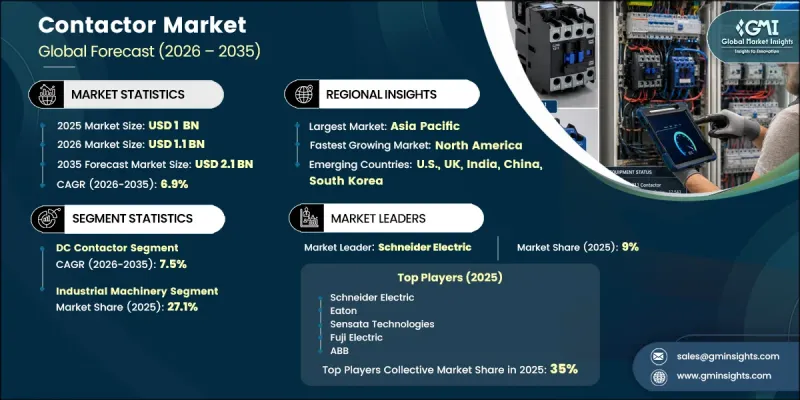
The contactor market is witnessing steady expansion as industries continue to prioritize automation, energy efficiency, and advanced electrical control systems across industrial, commercial, and residential applications. Growing investments in modern electrical infrastructure, rising demand for efficient power management solutions, and the increasing deployment of automated equipment are creating favorable conditions for market growth. The transition toward intelligent control systems is encouraging manufacturers to develop high-performance contactors that offer greater reliability, seamless integration, and improved operational efficiency. Continuous product innovation focused on compact designs, enhanced thermal performance, and extended service life is further supporting market development. Expanding electrification initiatives, growing investments in renewable energy infrastructure, and the rapid development of electric mobility are increasing demand for advanced switching components capable of handling higher power requirements. In addition, the ongoing digital transformation of manufacturing operations and the growing adoption of connected industrial systems are reinforcing the need for dependable electrical control solutions. Rising investments in battery manufacturing, advanced production facilities, and modern industrial infrastructure are expected to sustain long-term demand for contactors throughout the forecast period.
| Market Scope | |
|---|---|
| Start Year | 2025 |
| Forecast Year | 2026-2035 |
| Start Value | $1 Billion |
| Forecast Value | $2.1 Billion |
| CAGR | 6.9% |
Contactors play a critical role in controlling and switching electrical circuits while ensuring reliable operation across a broad range of electrical systems. Their ability to support efficient power distribution, improve operational safety, and simplify electrical control processes makes them an essential component in modern industrial and commercial infrastructure. As automation technologies continue to evolve, demand for highly efficient, durable, and intelligent contactor solutions is expected to increase steadily across multiple industries.
The DC contactor segment is projected to grow at a CAGR of 7.5% through 2035. Growing demand for dependable electrical switching solutions and the continued expansion of industrial automation are supporting the adoption of DC contactors across numerous end-use industries. Increasing requirements for reliable power control, improved equipment protection, and efficient electrical system performance continue to strengthen the growth outlook for this segment.
The industrial machinery end-use segment accounted for 27.1% share in 2025. Rising levels of industrial automation and the increasing use of advanced manufacturing technologies continue to drive demand for contactors across industrial machinery applications. The need for efficient electrical control systems capable of supporting modern production environments is expected to sustain segment growth over the coming years.
U.S. Contactor Market was valued at USD 138.3 million in 2025. Market expansion is being supported by continued investments in industrial automation, the modernization of electrical infrastructure, expanding renewable energy projects, and increasing electrification across multiple industries. The growing adoption of advanced manufacturing technologies and energy-efficient electrical systems continues to create strong demand for high-performance contactors throughout the country.
Major companies operating in the global contactor market include Rockwell Automation, Schneider Electric, Mitsubishi Electric, ABB, WEG, Siemens, CHINT Group, Sensata Technologies, Eaton, TDK Corporation, Lovato Electric, Schaltbau, Carlo Gavazzi, Fuji Electric, Sprecher + Schuh, LS Electric, Lauritz Knudsen, TE Connectivity, Kunshan GuoLi Electronic Technology, and Geya. Companies operating in the contactor market are strengthening their market position by investing in advanced product development, expanding manufacturing capabilities, and improving the performance of intelligent electrical control solutions. Market participants are focusing on compact product designs, higher switching efficiency, improved thermal management, and enhanced operational reliability to address evolving customer requirements. Strategic partnerships, distribution network expansion, and geographic diversification continue to support broader market penetration across industrial, commercial, and utility sectors. Companies are also investing in research and development to integrate smart monitoring capabilities, digital connectivity, and energy-efficient technologies into next-generation contactors.
Table of Contents
Chapter 1 Methodology & Scope
- 1.1 Research approach
- 1.2 Quality commitments
- 1.2.1 GMI AI policy & data integrity commitment
- 1.2.1.1 Source consistency protocol
- 1.2.1 GMI AI policy & data integrity commitment
- 1.3 Research trail & confidence scoring
- 1.3.1 Research trail components
- 1.3.2 Scoring components
- 1.4 Data collection
- 1.4.1 Partial list of primary sources
- 1.5 Data mining sources
- 1.5.1 Paid sources
- 1.5.1.1 Sources, by region
- 1.5.1 Paid sources
- 1.6 Base estimates and calculations
- 1.6.1 Base year calculation for any one approach
- 1.7 Market estimates & forecasts parameters
- 1.8 Forecast model
- 1.8.1 Quantified market impact analysis
- 1.8.1.1 Mathematical impact of growth parameters on forecast
- 1.8.1 Quantified market impact analysis
- 1.9 Research transparency addendum
- 1.9.1 Source attribution framework
- 1.9.2 Quality assurance metrics
- 1.9.3 Our commitment to trust
- 1.10 Market definitions
Chapter 2 Executive Summary
- 2.1 Industry synopsis, 2022 - 2035
- 2.1.1 Business trends
- 2.1.2 Product trends
- 2.1.3 End use trends
- 2.1.4 Regional trends
Chapter 3 Industry Insights
- 3.1 Industry ecosystem analysis
- 3.1.1 Raw material availability & sourcing analysis
- 3.1.2 Supply chain resilience & risk factors
- 3.1.3 Distribution network analysis
- 3.2 Regulatory landscape
- 3.3 Industry impact forces
- 3.3.1 Growth drivers
- 3.3.2 Industry pitfalls & challenges
- 3.4 Growth potential analysis
- 3.5 Porter's Analysis
- 3.5.1 Bargaining power of suppliers
- 3.5.2 Bargaining power of buyers
- 3.5.3 Threat of new entrants
- 3.5.4 Threat of substitutes
- 3.6 PESTEL Analysis
- 3.6.1 Political factors
- 3.6.2 Economic factors
- 3.6.3 Social factors
- 3.6.4 Technological factors
- 3.6.5 Environmental factors
- 3.6.6 Legal factors
- 3.7 Emerging opportunities & trends
- 3.8 Digitalization & IoT integration
- 3.9 Investment analysis & future prospects
- 3.10 Impact of AI & Generative AI on the market (Solution Core)
- 3.10.1 AI-driven production optimization
- 3.10.2 Predictive maintenance & fault detection
Chapter 4 Competitive Landscape, 2026
- 4.1 Introduction
- 4.2 Company market share analysis, 2025
- 4.2.1 By region
- 4.2.1.1 North America
- 4.2.1.2 Europe
- 4.2.1.3 Asia Pacific
- 4.2.1.4 Middle East & Africa
- 4.2.1.5 Latin America
- 4.2.2 Market concentration analysis
- 4.2.1 By region
- 4.3 Competitive analysis of major market players
- 4.4 Competitive positioning matrix
- 4.5 key developments
- 4.5.1 Merger & acquisition
- 4.5.2 Partnership & collaboration
- 4.5.3 New product launched
- 4.5.4 Expansion plans & funding
- 4.6 Company tier benchmarking
- 4.6.1 Tier classification criteria & qualifying thresholds
- 4.6.2 Tier positioning matrix by revenue, geography & innovation
Chapter 5 Market Size and Forecast, By Product, 2022 - 2035 (USD Million)
- 5.1 Key trends
- 5.2 DC contactor
- 5.2.1 Low-voltage DC contactor
- 5.2.2 High-voltage DC contactor
- 5.2.3 Industrial DC contactor
- 5.3 AC contactor
- 5.3.1 General purpose contactor
- 5.3.2 Definite purpose contactor
- 5.3.3 Motor control contactor
- 5.3.4 Lighting contactor
Chapter 6 Market Size and Forecast, By End use, 2022 - 2035 (USD Million)
- 6.1 Key trends
- 6.2 Electric vehicles
- 6.3 Aerospace & defense
- 6.4 Industrial machinery
- 6.5 Renewable energy
- 6.6 Others
Chapter 7 Market Size and Forecast, By Region, 2022 - 2035 (USD Million)
- 7.1 Key trends
- 7.2 North America
- 7.2.1 U.S.
- 7.2.2 Canada
- 7.3 Europe
- 7.3.1 Germany
- 7.3.2 France
- 7.3.3 UK
- 7.3.4 Spain
- 7.3.5 Italy
- 7.4 Asia Pacific
- 7.4.1 China
- 7.4.2 India
- 7.4.3 Japan
- 7.4.4 Australia
- 7.4.5 South Korea
- 7.5 Middle East & Africa
- 7.5.1 Saudi Arabia
- 7.5.2 UAE
- 7.5.3 South Africa
- 7.6 Latin America
- 7.6.1 Brazil
- 7.6.2 Argentina
Chapter 8 Company Profiles
- 8.1 ABB
- 8.2 Carlo Gavazzi
- 8.3 CHINT Group
- 8.4 Eaton
- 8.5 Fuji Electric
- 8.6 Geya
- 8.7 Kunshan GuoLi Electronic Technology
- 8.8 Lauritz Knudsen
- 8.9 Lovato Electric
- 8.10 LS Electric
- 8.11 Mitsubishi Electric
- 8.12 Rockwell Automation
- 8.13 Schaltbau
- 8.14 Schneider Electric
- 8.15 Sensata Technologies
- 8.16 Siemens
- 8.17 Sprecher + Schuh
- 8.18 TE Connectivity
- 8.19 TDK Corporation
- 8.20 WEG

