PUBLISHER: Global Market Insights Inc. | PRODUCT CODE: 2101916

PUBLISHER: Global Market Insights Inc. | PRODUCT CODE: 2101916
Multi Cancer Early Detection (MCED) Test Market Opportunity, Growth Drivers, Industry Trend Analysis, and Forecast 2026 - 2035
The Global Multi Cancer Early Detection (MCED) Test Market was valued at USD 1.3 billion in 2025 and is estimated to grow at a CAGR of 14.8% to reach USD 5.3 billion by 2035.
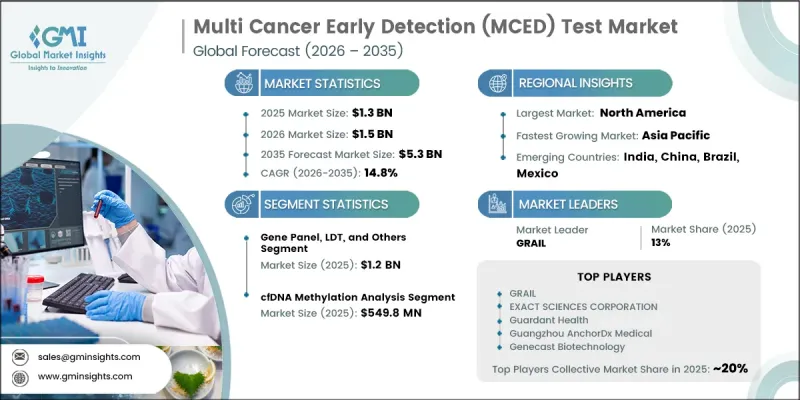
The market is witnessing momentum due to the rising global cancer burden, continuous improvements in diagnostic technologies, and increasing demand for efficient early detection solutions. Growing awareness regarding the importance of identifying cancer at earlier stages is encouraging healthcare providers, patients, and organizations to adopt advanced screening approaches. Changes in population demographics, lifestyle patterns, environmental factors, and genetic risks are contributing to the increasing need for improved cancer detection methods. Multi-cancer early detection tests are gaining attention because they provide a minimally invasive approach by identifying multiple cancer types through a single blood-based test. Expanding investments in precision medicine, molecular diagnostics, artificial intelligence, and advanced analytics are further supporting market development. Healthcare systems are increasingly exploring MCED technologies as potential tools for broader screening programs aimed at improving patient outcomes and enabling timely intervention. As innovation continues in biomarker identification and diagnostic accuracy, the multi-cancer early detection test market is expected to experience sustained growth over the coming years.
| Market Scope | |
|---|---|
| Start Year | 2025 |
| Forecast Year | 2026-2035 |
| Start Value | $1.3 Billion |
| Forecast Value | $5.3 Billion |
| CAGR | 14.8% |
Advancements in artificial intelligence and data analytics are playing an important role in accelerating the growth of the multi cancer early detection (MCED) test market. AI-based technologies are improving screening capabilities by processing extensive genomic, epigenomic, proteomic, and clinical datasets to identify complex patterns associated with cancer development. These advanced analytical methods are helping improve diagnostic accuracy, increase testing efficiency, and support faster interpretation of complex biological information compared with conventional approaches.
The gene panel, LDT, and other segment was valued at USD 1.2 billion in 2025 and accounted for 91.9% share. This segment maintains a leading position as these testing approaches are widely used to identify molecular changes associated with different cancer types. Most solutions within this category rely on genomic regions, molecular signatures, and cancer-related biomarkers to support detection. Their adaptability allows laboratories to customize testing procedures based on patient requirements, clinical applications, and population-specific needs.
The hospitals segment held a share of 48.7% in 2025. Hospitals remain a key end-use environment for MCED tests because they support cancer screening, diagnosis, treatment planning, and long-term patient management. Healthcare institutions are increasingly assessing MCED technologies for integration into oncology and preventive healthcare programs. The availability of specialized medical teams within hospitals also supports accurate interpretation of advanced test outcomes and enables appropriate follow-up procedures when additional evaluation is required.
North America Multi Cancer Early Detection (MCED) Test Market accounted for 42.3% share in 2025. The region continues to demonstrate strong growth due to its advanced healthcare infrastructure, increasing adoption of molecular diagnostic technologies, and expanding investment in clinical research. Growing acceptance of blood-based cancer screening methods among healthcare providers, along with advancements in liquid biopsy technologies, is supporting regional market development. The presence of leading biotechnology and diagnostic companies is also accelerating innovation in biomarker research, artificial intelligence-based analysis platforms, and next-generation cancer detection solutions.
Major companies operating in the global multi cancer early detection (MCED) test industry include GRAIL, EXACT SCIENCES CORPORATION, GUARDANT HEALTH, Freenome Holdings, AnPac Bio-Medical Science, Burning Rock Biotech, Early Diagnostics, Elypta, Genecast Biotechnology, Guangzhou AnchorDx Medical, Harbinger Health, Micronoma, SeekIn, and Singlera Genomics. Companies operating in the multi cancer early detection (MCED) test market are strengthening their competitive position through continuous research and development, strategic collaborations, and technological innovation. Market participants are focusing on improving biomarker discovery, enhancing artificial intelligence capabilities, and developing more accurate and scalable diagnostic platforms. Businesses are also investing in clinical validation studies, regulatory advancements, and partnerships with healthcare organizations to increase adoption of MCED technologies. Expansion of testing capabilities, improvement in affordability, and development of user-friendly solutions are becoming key strategies for increasing market penetration.
Table of Contents
Chapter 1 Methodology and Scope
- 1.1 Market scope and definition
- 1.2 Research design
- 1.2.1 Research approach
- 1.2.2 Data collection methods
- 1.3 Data mining sources
- 1.3.1 Global
- 1.3.2 Regional/Country
- 1.4 Base estimates and calculations
- 1.4.1 Base year calculation
- 1.4.2 Key trends for market estimation
- 1.5 Primary research and validation
- 1.5.1 Primary sources
- 1.6 Forecast model
- 1.7 Research assumptions and limitations
Chapter 2 Executive Summary
- 2.1 Industry 360° synopsis
- 2.2 Key market trends
- 2.2.1 Regional trends
- 2.2.2 Type trends
- 2.2.3 Biomarker class trends
- 2.2.4 End use trends
- 2.3 CXO perspectives: Strategic imperatives
Chapter 3 Industry Insights
- 3.1 Industry ecosystem analysis
- 3.2 Industry impact forces
- 3.2.1 Growth drivers
- 3.2.1.1 Increasing prevalence of cancer
- 3.2.1.2 High cancer detection rate coupled with growing demand for effective cancer tools
- 3.2.1.3 Advancements in data analytics and artificial intelligence (AI) utilized in cancer screening
- 3.2.2 Industry pitfalls and challenges
- 3.2.2.1 High cost of multi-cancer screening tests
- 3.2.2.2 Regulatory approval challenges
- 3.2.3 Market opportunities
- 3.2.3.1 Development of more affordable MCED tests
- 3.2.3.2 Expansion into preventive care and population health programs
- 3.2.1 Growth drivers
- 3.3 Growth potential analysis
- 3.4 Regulatory landscape
- 3.4.1 North America
- 3.4.2 Europe
- 3.4.3 Asia Pacific
- 3.4.4 Latin America
- 3.4.5 Middle East and Africa
- 3.5 Technological advancements
- 3.5.1 Current technological trends
- 3.5.2 Emerging technologies
- 3.6 Pricing trend analysis (Driven by primary research)
- 3.7 Future market trends (Driven by primary research)
- 3.8 Porter's analysis
- 3.9 PESTEL analysis
- 3.10 Impact of AI and Generative AI on the market (Driven by primary research)
- 3.11 Value chain analysis (Driven by primary research)
- 3.12 Treatment infrastructure and clinical adoption landscape (Driven by primary research)
Chapter 4 Competitive Landscape, 2025
- 4.1 Introduction
- 4.2 Company matrix analysis
- 4.3 Company market share analysis (Driven by primary research)
- 4.3.1 Global
- 4.3.2 North America
- 4.3.3 Europe
- 4.3.4 Asia Pacific
- 4.4 Competitive positioning matrix
- 4.5 Competitive analysis of major market players
- 4.6 Key developments
- 4.6.1 Mergers & acquisitions
- 4.6.2 Partnerships & collaborations
- 4.6.3 New product launches
- 4.6.4 Expansion plans
Chapter 5 Market Estimates and Forecast, By Type, 2022 - 2035 ($ Mn)
- 5.1 Key trends
- 5.2 Gene panel, LDT, and others
- 5.3 Liquid biopsy
Chapter 6 Market Estimates and Forecast, By Biomarker Class, 2022 - 2035 ($ Mn)
- 6.1 Key trends
- 6.2 cfDNA methylation analysis
- 6.3 Somatic mutation / ctDNA
- 6.4 Protein biomarker-based
- 6.5 Multi-analyte / multi-omics
- 6.6 Fragmentomics and CNV
Chapter 7 Market Estimates and Forecast, By End Use, 2022 - 2035 ($ Mn)
- 7.1 Key trends
- 7.2 Hospitals
- 7.3 Diagnostic laboratories
- 7.4 Other end users
Chapter 8 Market Estimates and Forecast, By Region, 2022 - 2035 ($ Mn)
- 8.1 Key trends
- 8.2 North America
- 8.2.1 U.S.
- 8.2.2 Canada
- 8.3 Europe
- 8.3.1 Germany
- 8.3.2 UK
- 8.3.3 France
- 8.3.4 Spain
- 8.3.5 Italy
- 8.3.6 Netherlands
- 8.4 Asia Pacific
- 8.4.1 China
- 8.4.2 India
- 8.4.3 Japan
- 8.4.4 Australia
- 8.4.5 South Korea
- 8.5 Latin America
- 8.5.1 Brazil
- 8.5.2 Mexico
- 8.5.3 Argentina
- 8.6 Middle East and Africa
- 8.6.1 Saudi Arabia
- 8.6.2 South Africa
- 8.6.3 UAE
Chapter 9 Company Profiles
- 9.1 AnPac Bio-Medical Science
- 9.2 Burning Rock Biotech
- 9.3 EarlyDiagnostics
- 9.4 Elypta
- 9.5 EXACT SCIENCES CORPORATION
- 9.6 Freenome Holdings
- 9.7 Genecast Biotechnology
- 9.8 GRAIL
- 9.9 Guangzhou AnchorDx Medical
- 9.10 GUARDANT HEALTH
- 9.11 Harbinger Health
- 9.12 Micronoma
- 9.13 SeekIn
- 9.14 Singlera Genomics

