PUBLISHER: Global Market Insights Inc. | PRODUCT CODE: 2101918

PUBLISHER: Global Market Insights Inc. | PRODUCT CODE: 2101918
Silicon Carbide Market Opportunity, Growth Drivers, Industry Trend Analysis, and Forecast 2026 - 2035
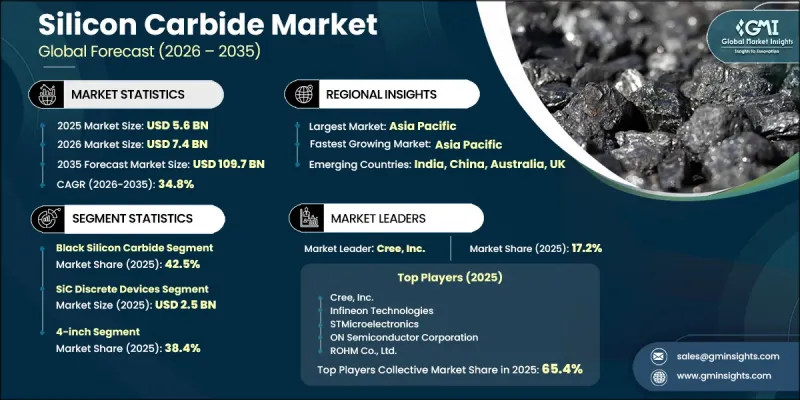
The Global Silicon Carbide Market was valued at USD 5.6 billion in 2025 and is estimated to grow at a CAGR of 34.8% to reach USD 109.7 billion by 2035.
This growth is driven by the accelerating shift toward electric vehicles, large-scale deployment of fast-charging infrastructure, and increasing integration of energy-efficient semiconductor materials in automotive and grid systems. Governments across major economies are actively supporting domestic semiconductor production, further strengthening supply-side capabilities. Rising investments in solar and wind energy projects, coupled with grid modernization programs, are also amplifying demand for silicon carbide-based power devices. The material's superior thermal conductivity, higher switching efficiency, and reduced energy losses compared to traditional silicon solutions are enabling its rapid adoption across high-voltage and high-frequency applications. Expanding use cases in aerospace systems, data centers, and industrial automation are further reinforcing long-term demand visibility. As industries transition toward electrification and decarbonization, silicon carbide is becoming a foundational technology in next-generation power electronics architectures.
| Market Scope | |
|---|---|
| Start Year | 2025 |
| Forecast Year | 2026-2035 |
| Start Value | $5.6 Billion |
| Forecast Value | $109.7 Billion |
| CAGR | 34.8% |
The market momentum is strongly supported by the electric vehicle ecosystem, where silicon carbide components are increasingly deployed in traction inverters, onboard chargers, and charging infrastructure. The expansion of global EV charging networks is further strengthening adoption, as silicon carbide devices enable higher switching speeds, improved energy efficiency, and reduced power dissipation compared to conventional silicon-based alternatives. These performance benefits contribute directly to improved vehicle range and faster charging cycles. Ongoing electrification initiatives in transportation, along with rising investments in smart grids, energy storage systems, and renewable integration, continue to expand application scope. Industrial sectors are also adopting silicon carbide solutions to enhance operational efficiency in high-power environments, while semiconductor manufacturers are scaling production capacity to meet accelerating global demand.
The black silicon carbide segment held a 42.5% share in 2025, supported by strong demand across abrasives, metallurgy, refractories, and industrial power applications. Its dominance is attributed to high hardness, strong wear resistance, excellent thermal conductivity, and cost efficiency, making it suitable for grinding, cutting, surface finishing, and high-temperature industrial operations. Its lower production cost compared to alternative grades further strengthens adoption across steel manufacturing, industrial processing, and heavy-duty applications.
The SiC discrete devices segment accounted for USD 2.5 billion in 2025 owing to strong demand for MOSFETs and Schottky diodes across electric vehicles, renewable energy systems, industrial motor drives, and advanced power supplies. These discrete solutions are widely preferred for their high efficiency, low switching losses, and superior performance under high-temperature conditions, making them essential for next-generation power electronics systems.
North America Silicon Carbide Market held a 29% share in 2025, driven by strong electric vehicle manufacturing capabilities, advanced semiconductor innovation ecosystems, and rising policy support for domestic chip production. The region continues to benefit from large-scale investments in clean energy infrastructure and electrified transportation systems, reinforcing long-term demand for silicon carbide technologies.
Major players operating in the global silicon carbide market include ROHM Co., Ltd., Infineon Technologies AG, Mitsubishi Electric Corporation, ON Semiconductor Corporation, STMicroelectronics N.V., Toshiba Corporation, Danfoss A/S, Fuji Electric Co., Ltd., Littelfuse, Inc., Power Integrations, Inc., Renesas Electronics Corporation, NXP Semiconductors N.V., GeneSiC Semiconductor Inc., Wolfspeed (formerly Cree, Inc.), II-VI Incorporated, Hitachi Power Semiconductor Device, Ltd., United Silicon Carbide, Inc. (USCi), Global Power Technologies Group, Central Semiconductor Corp., Taiyo Yuden Co., Ltd., General Electric Company (GE Aviation), and Microsemi Corporation. Companies operating in the silicon carbide market are focusing on vertical integration of wafer production and device manufacturing to improve supply chain control and reduce cost pressures. Many players are expanding fabrication capacity and investing in advanced SiC wafer technologies to meet rising automotive and industrial demand. Strategic partnerships with electric vehicle manufacturers and renewable energy companies are strengthening long-term supply agreements.
Table of Contents
Chapter 1 Methodology and Scope
- 1.1 Market scope and definition
- 1.2 Research design
- 1.2.1 Research approach
- 1.2.2 Data collection methods
- 1.3 Data mining sources
- 1.3.1 Global
- 1.3.2 Regional/Country
- 1.4 Base estimates and calculations
- 1.4.1 Base year calculation
- 1.4.2 Key trends for market estimation
- 1.5 Primary research and validation
- 1.5.1 Primary sources
- 1.6 Forecast model
- 1.7 Research assumptions and limitations
Chapter 2 Executive Summary
- 2.1 Industry 360° synopsis, 2022 – 2035
- 2.2 Key market trends
- 2.2.1 Product type trends
- 2.2.2 Device type trends
- 2.2.3 Wafer size trends
- 2.2.4 Application trend
- 2.2.5 Production method trend
- 2.2.6 End-use industry trends
- 2.2.7 Regional trends
- 2.3 TAM Analysis, 2026-2035
- 2.4 CXO perspectives: Strategic imperatives
Chapter 3 Industry Insights
- 3.1 Industry ecosystem analysis
- 3.1.1 Supplier Landscape
- 3.1.2 Profit Margin
- 3.1.3 Cost structure
- 3.1.4 Value addition at each stage
- 3.1.5 Factor affecting the value chain
- 3.1.6 Disruptions
- 3.2 Industry impact forces
- 3.2.1 Growth drivers
- 3.2.1.1 Rising adoption of electric vehicles (EVs)
- 3.2.1.2 Expansion of renewable energy infrastructure
- 3.2.1.3 Growing fast-charging network deployment
- 3.2.1.4 Government support for semiconductor manufacturing
- 3.2.1.5 Increasing demand for energy-efficient industrial power systems
- 3.2.2 Industry pitfalls and challenges
- 3.2.2.1 High manufacturing and wafer production costs
- 3.2.2.2 Supply chain constraints and limited substrate availability
- 3.2.3 Market opportunities
- 3.2.3.1 Expansion of 800V electric vehicle architectures
- 3.2.3.2 Increasing deployment in AI data centers and industrial electrification
- 3.2.1 Growth drivers
- 3.3 Growth potential analysis
- 3.4 Regulatory landscape
- 3.4.1 North America
- 3.4.2 Europe
- 3.4.3 Asia Pacific
- 3.4.4 Latin America
- 3.4.5 Middle East & Africa
- 3.5 Porter’s analysis
- 3.6 PESTEL analysis
- 3.7 Technology and Innovation landscape
- 3.7.1 Current technological trends
- 3.7.2 Emerging technologies
- 3.8 Price trends
- 3.8.1 By region
- 3.8.2 By product
- 3.9 Pricing Strategies
- 3.10 Emerging Business Models
- 3.11 Compliance Requirements
- 3.12 Patent and IP analysis
Chapter 4 Competitive Landscape, 2025
- 4.1 Introduction
- 4.2 Company market share analysis
- 4.2.1 By region
- 4.2.1.1 North America
- 4.2.1.2 Europe
- 4.2.1.3 Asia Pacific
- 4.2.1.4 Latin America
- 4.2.1.5 Middle East & Africa
- 4.2.2 Market concentration analysis
- 4.2.1 By region
- 4.3 Competitive benchmarking of key players
- 4.3.1 Financial performance comparison
- 4.3.1.1 Revenue
- 4.3.1.2 Profit margin
- 4.3.1.3 R&D
- 4.3.2 Product portfolio comparison
- 4.3.2.1 Product range breadth
- 4.3.2.2 Technology
- 4.3.2.3 Innovation
- 4.3.3 Geographic presence comparison
- 4.3.3.1 Global footprint analysis
- 4.3.3.2 Service network coverage
- 4.3.3.3 Market penetration by region
- 4.3.4 Competitive positioning matrix
- 4.3.4.1 Leaders
- 4.3.4.2 Challengers
- 4.3.4.3 Followers
- 4.3.4.4 Niche players
- 4.3.5 Strategic outlook matrix
- 4.3.1 Financial performance comparison
- 4.4 Key developments
- 4.4.1 Mergers and acquisitions
- 4.4.2 Partnerships and collaborations
- 4.4.3 Technological advancements
- 4.4.4 Expansion and investment strategies
- 4.4.5 Digital transformation initiatives
- 4.5 Emerging/ startup competitors landscape
Chapter 5 Market Estimates and Forecast, By Product Type, 2022 – 2035 (USD Million)
- 5.1 Key trends
- 5.2 Black silicon carbide
- 5.3 Green silicon carbide
- 5.4 Others
Chapter 6 Market Estimates and Forecast, By Device Type, 2022 – 2035 (USD Million)
- 6.1 Key trends
- 6.2 SiC Discrete Devices
- 6.2.1 Diodes
- 6.2.2 MOSFETs
- 6.2.3 BJTs (Bipolar Junction Transistors)
- 6.2.4 JFETs (Junction Field Effect Transistors)
- 6.2.5 Thyristors
- 6.3 SiC modules
- 6.4 Other SiC devices
Chapter 7 Market Estimates and Forecast, By Wafer size, 2022 – 2035 (USD Million)
- 7.1 Key trends
- 7.2 2-Inch
- 7.3 4-Inch
- 7.4 6-Inch
- 7.5 8-Inch
Chapter 8 Market Estimates and Forecast, By Application, 2022 – 2035 (USD Million)
- 8.1 Key trends
- 8.2 Power electronics
- 8.2.1 Power supply and inverter
- 8.2.2 Wireless charging
- 8.2.3 Power grid devices
- 8.2.4 Industrial motor drives
- 8.2.5 Electric vehicle charging infrastructure
- 8.2.6 Renewable energy systems
- 8.3 RF & microwave communications
- 8.3.1 5G base station power amplifiers
- 8.3.2 Radar & defense RF systems
- 8.4 Optical Devices
- 8.4.1 Led lighting
- 8.4.2 Photonics
- 8.4.3 Laser applications
- 8.4.4 UV detectors
- 8.5 Sensing
- 8.5.1 Pressure sensors
- 8.5.2 Temperature sensors
- 8.5.3 Gas sensors
- 8.5.4 Radiation detectors
- 8.6 Others
Chapter 9 Market Estimates and Forecast, By Production Method, 2022 – 2035 (USD Million)
- 9.1 Key trends
- 9.2 Bulk SiC material production
- 9.3 SiC crystal & substrate production
- 9.4 SiC epitaxial layer production
- 9.5 Others
Chapter 10 Market Estimates and Forecast, By End-Use Industry, 2022 – 2035 (USD Million)
- 10.1 Key trends
- 10.2 Automotive
- 10.3 Aerospace & defense
- 10.4 Telecommunications
- 10.5 Renewable energy & power grid
- 10.6 Healthcare
- 10.7 Electronics & semiconductors
- 10.8 Industrial manufacturing
- 10.9 Oil & gas
- 10.10 Mining
- 10.11 Chemical processing
- 10.12 Government & defense research & development
Chapter 11 Market Estimates and Forecast, By Region, 2022 – 2035 (USD Million)
- 11.1 Key trends
- 11.2 North America
- 11.2.1 U.S.
- 11.2.2 Canada
- 11.3 Europe
- 11.3.1 Germany
- 11.3.2 UK
- 11.3.3 France
- 11.3.4 Spain
- 11.3.5 Italy
- 11.4 Asia Pacific
- 11.4.1 China
- 11.4.2 India
- 11.4.3 Japan
- 11.4.4 Australia
- 11.4.5 South Korea
- 11.5 Latin America
- 11.5.1 Brazil
- 11.5.2 Mexico
- 11.6 Middle East and Africa
- 11.6.1 South Africa
- 11.6.2 Saudi Arabia
- 11.6.3 UAE
Chapter 12 Company Profiles
- 12.1 Global Key Players
- 12.1.1 Cree, Inc.
- 12.1.2 Infineon Technologies
- 12.1.3 STMicroelectronics
- 12.1.4 ON Semiconductor Corporation
- 12.2 Regional key players
- 12.2.1 North America
- 12.2.1.1 Central Semiconductor Corp.
- 12.2.1.2 General Electric Company
- 12.2.1.3 II-VI Incorporated
- 12.2.1.4 Littelfuse, Inc.
- 12.2.1.5 Microsemi Corporation
- 12.2.1.6 Power Integrations, Inc.
- 12.2.2 Asia Pacific
- 12.2.2.1 Fuji Electric Co., Ltd.
- 12.2.2.2 Hitachi Power Semiconductor
- 12.2.2.3 Mitsubishi Electric Corporation
- 12.2.2.4 Renesas Electronics Corporation
- 12.2.2.5 ROHM Co., Ltd.
- 12.2.2.6 Taiyo Yuden Co., Ltd.
- 12.2.2.7 Toshiba Corporation
- 12.2.3 Europe
- 12.2.3.1 Danfoss A/S
- 12.2.3.2 NXP Semiconductors
- 12.2.1 North America
- 12.3 Niche Players/Disruptors
- 12.3.1 GeneSiC Semiconductor Inc.
- 12.3.2 Global Power Technologies Group
- 12.3.3 United Silicon Carbide, Inc. (USCi)

