PUBLISHER: Global Market Insights Inc. | PRODUCT CODE: 2101926

PUBLISHER: Global Market Insights Inc. | PRODUCT CODE: 2101926
Cloud Migration Service Market Opportunity, Growth Drivers, Industry Trend Analysis, and Forecast 2026 - 2035
The Global Cloud Migration Service Market was valued at USD 15.1 billion in 2025 and is estimated to grow at a CAGR of 26.1% to reach USD 146.6 billion by 2035.
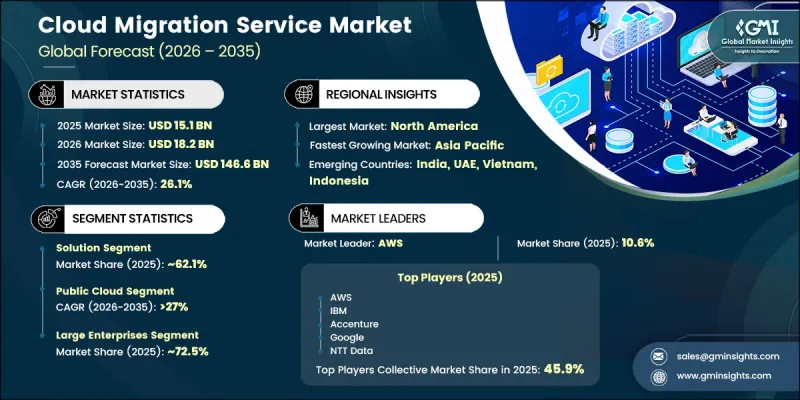
The Cloud Migration Service Market continues to gain momentum as organizations prioritize digital transformation and modernize aging IT environments to improve operational performance and support long-term business growth. Businesses are increasingly moving workloads, applications, and databases to cloud environments to improve efficiency while minimizing disruption to daily operations. Rising investments in advanced digital technologies are creating stronger demand for cloud consulting, deployment, and managed cloud services as organizations seek greater flexibility, scalability, and cost efficiency. Companies are also shifting away from traditional infrastructure to reduce capital spending associated with maintaining physical data centers and legacy systems. Flexible consumption-based pricing models available through cloud platforms allow enterprises to optimize IT spending by paying only for the resources they require. This approach enables organizations to scale computing capacity according to business needs without making significant upfront infrastructure investments. As a result, cloud migration services have become an essential component of enterprise modernization strategies focused on improving operational agility, financial efficiency, and technology scalability.
| Market Scope | |
|---|---|
| Start Year | 2025 |
| Forecast Year | 2026-2035 |
| Start Value | $15.1 Billion |
| Forecast Value | $146.6 Billion |
| CAGR | 26.1% |
The solution segment held 62.1% share in 2025 and is anticipated to register a CAGR of 25.3% between 2026 and 2035. Strong demand for cloud migration solutions is being driven by the growing use of migration platforms, automation technologies, and application modernization capabilities that simplify the transition of workloads from legacy environments to cloud infrastructure. Increasing implementation of virtualization, containerization, and cloud-native technologies is further accelerating cloud adoption by improving scalability, operational flexibility, and overall business efficiency.
The public cloud segment accounted for 48.3% share in 2025 and is forecast to grow at a CAGR of 27% from 2026 to 2035. Public cloud platforms continue to attract organizations because they provide scalable and cost-efficient IT resources suitable for businesses of different sizes. Enterprises are increasingly selecting public cloud environments to lower capital investment requirements while reducing deployment timelines compared with conventional on-premises infrastructure. These operational and financial benefits continue to support the expansion of the public cloud segment throughout the forecast period.
United States Cloud Migration Service Market and is expected to record a CAGR of 24.7% between 2026 and 2035. The country continues to represent the world's largest cloud computing market and serves as a major hub for leading cloud platform providers, including Amazon Web Services (AWS), Microsoft Azure, Google Cloud, and Salesforce. Organizations across banking and financial services, healthcare, retail, and manufacturing continue to accelerate cloud-first digital transformation initiatives, strengthening market growth and reinforcing the country's leadership position in cloud migration services.
Major companies operating in the Global Cloud Migration Service Market include Accenture, IBM, Infosys, Wipro, Capgemini, Deloitte, Amazon Web Services (AWS), Google, SAP, and NTT DATA. Companies operating in the Cloud Migration Service Market are strengthening their market position by expanding cloud migration capabilities, enhancing automation technologies, and investing in application modernization services. Many providers are focusing on improving consulting expertise and managed cloud offerings to deliver complete migration support across complex enterprise environments. Strategic partnerships with cloud platform providers remain a key approach for expanding service portfolios and improving customer reach. Companies are also investing in artificial intelligence-driven migration tools to accelerate deployment, reduce operational complexity, and improve migration accuracy. Continuous innovation in cloud-native technologies, virtualization, and containerization solutions enables vendors to deliver scalable and flexible migration services.
Table of Contents
Chapter 1 Research Methodology
- 1.1 Research approach
- 1.2 Quality Commitments
- 1.2.1 GMI AI policy & data integrity commitment
- 1.2.1.1 Source consistency protocol
- 1.2.1 GMI AI policy & data integrity commitment
- 1.3 Research Trail & Confidence Scoring
- 1.3.1 Research Trail Components
- 1.3.2 Scoring Components
- 1.4 Data Collection
- 1.4.1 Partial list of primary sources
- 1.5 Data mining sources
- 1.5.1 Paid sources
- 1.5.1.1 Sources, by region
- 1.5.1 Paid sources
- 1.6 Base estimates and calculations
- 1.6.1 Base year calculation
- 1.7 Forecast
- 1.7.1 Quantified market impact analysis
- 1.7.1.1 Mathematical impact of growth parameters on forecast
- 1.7.1 Quantified market impact analysis
- 1.8 Research transparency addendum
- 1.8.1 Source attribution framework
- 1.8.2 Quality assurance metrics
- 1.8.3 Our commitment to trust
Chapter 2 Executive Summary
- 2.1 Industry 360° synopsis, 2022 - 2035
- 2.2 Key market trends
- 2.2.1 Regional
- 2.2.2 Platform
- 2.2.3 Deployment Model
- 2.2.4 Enterprise Size
- 2.2.5 End-User
- 2.3 TAM Analysis, 2026-2035
- 2.4 CXO perspectives: Strategic imperatives
Chapter 3 Industry Insights
- 3.1 Industry ecosystem analysis
- 3.1.1 Supplier landscape
- 3.1.2 Profit margin analysis
- 3.1.3 Cost structure
- 3.1.4 Value addition at each stage
- 3.1.5 Factor affecting the value chain
- 3.1.6 Disruptions
- 3.2 Industry impact forces
- 3.2.1 Growth drivers
- 3.2.1.1 Accelerating Enterprise Digital Transformation Initiatives
- 3.2.1.2 Cost Optimization & OpEx-over-CapEx Shift Driving Cloud Adoption
- 3.2.1.3 Scalability, Agility & Business Continuity Requirements
- 3.2.1.4 Growth of Remote Work & Distributed IT Infrastructure
- 3.2.2 Industry pitfalls and challenges
- 3.2.2.1 Data Security & Regulatory Compliance Risks (GDPR, HIPAA, FedRAMP)
- 3.2.2.2 Legacy System Complexity & Interoperability Challenges
- 3.2.2.3 Escalating Cloud Egress Fees & TCO Concerns
- 3.2.2.4 Vendor Lock-In Fears Amid Sovereign-Cloud Mandates
- 3.2.3 Market opportunities
- 3.2.3.1 Rising Hybrid & Multi-Cloud Environment Adoption
- 3.2.3.2 Al/ML-Driven Automation in Migration Tools & Platforms
- 3.2.3.3 Expanding SME Cloud Migration Demand in Emerging Economies
- 3.2.3.4 Sovereign Cloud & Government Digital Infrastructure Programs
- 3.2.1 Growth drivers
- 3.3 Growth potential analysis
- 3.4 Technology and innovation landscape
- 3.4.1 Current technological trends
- 3.4.2 Emerging technologies
- 3.5 Pricing Analysis (Driven by primary research)
- 3.5.1 Historical Price Trend Analysis
- 3.5.2 Pricing Strategy by Player Type
- 3.6 Regulatory landscape
- 3.6.1 North America
- 3.6.1.1 FedRAMP Compliance Framework
- 3.6.1.2 U.S. CLOUD Act
- 3.6.1.3 HIPAA Cloud Compliance Requirements
- 3.6.2 Europe
- 3.6.2.1 EU Alternative Fuels Infrastructure Regulation
- 3.6.2.2 EU General Data Protection Regulation
- 3.6.2.3 EU NIS2 Cybersecurity Directive
- 3.6.2.4 EU Electricity Market Design Directive
- 3.6.2.5 EU Data Act
- 3.6.3 Asia Pacific
- 3.6.3.1 Digital India Program
- 3.6.3.2 India Central Electricity Authority Technical Standards
- 3.6.3.3 China Cybersecurity Law
- 3.6.3.4 China Network Data Security Regulations
- 3.6.3.5 Japan Act on Protection of Personal Information
- 3.6.4 Latin America
- 3.6.4.1 Brazil General Data Protection Law
- 3.6.4.2 Mexico Federal Data Protection Law
- 3.6.4.3 Brazil ANPD International Data Transfer Resolution
- 3.6.5 Middle East & Africa
- 3.6.5.1 UAE Personal Data Protection Law
- 3.6.5.2 UAE Information Assurance Regulation
- 3.6.5.3 Saudi Vision 2030 Digital Transformation Programs
- 3.6.5.4 South Africa POPIA
- 3.6.1 North America
- 3.7 Porter's analysis
- 3.8 PESTEL analysis
- 3.9 Patent analysis (Driven by primary research)
- 3.10 Cost breakdown analysis
- 3.11 Impact of AI and Generative AI on the Market
- 3.11.1 AI Driven Disruption of Existing Business Models
- 3.11.2 GenAI Use Cases and Adoption Roadmap by Segment
- 3.11.3 Risks Limitations and Regulatory Considerations
- 3.12 Sustainability and environmental aspects
- 3.12.1 Sustainable practices
- 3.12.2 Waste reduction strategies
- 3.12.3 Energy efficiency in production
- 3.12.4 Eco-friendly Initiatives
- 3.12.5 Carbon footprint considerations
- 3.13 Forecast assumptions & scenario analysis (Driven by Primary Research)
- 3.13.1 Base Case- Key Macro & Industry Variables Driving CAGR
- 3.13.2 Optimistic Scenarios- Favorable macro and industry tailwinds
- 3.13.3 Pessimistic Scenario - Macroeconomic slowdown or industry headwinds
Chapter 4 Competitive Landscape, 2025
- 4.1 Introduction
- 4.2 Company market share analysis
- 4.2.1 Asia Pacific
- 4.2.2 Europe
- 4.2.3 North America
- 4.2.4 LATAM
- 4.2.5 MEA
- 4.3 Competitive analysis of major market players
- 4.4 Competitive positioning matrix
- 4.5 Key developments
- 4.5.1 Mergers & acquisitions
- 4.5.2 Partnerships & collaborations
- 4.5.3 New Product Launches
- 4.5.4 Expansion Plans and funding
- 4.6 Company tier benchmarking
- 4.6.1 Tier classification criteria & qualifying thresholds
- 4.6.2 Tier positioning matrix by revenue, geography & innovation
Chapter 5 Market Estimates & Forecast, By Platform, 2022 - 2035 (USD Mn)
- 5.1 Key trends
- 5.2 Solution
- 5.2.1 Infrastructure Migration
- 5.2.2 Platform Migration
- 5.2.3 Database Migration
- 5.2.4 Application Migration
- 5.2.5 Storage Migration
- 5.3 Service
- 5.3.1 Professional Services
- 5.3.1.1 Assessment & Planning Services
- 5.3.1.2 Migration & Deployment Services
- 5.3.1.3 Training, Consulting & Support Services
- 5.3.2 Managed Services
- 5.3.1 Professional Services
Chapter 6 Market Estimates & Forecast, By Deployment Model, 2022 - 2035 (USD Mn)
- 6.1 Key trends
- 6.2 Public Cloud
- 6.3 Private Cloud
- 6.4 Hybrid Cloud
Chapter 7 Market Estimates & Forecast, By Enterprise Size, 2022 - 2035 (USD Mn)
- 7.1 Key trends
- 7.2 Large Enterprises
- 7.3 Small & Medium Enterprises (SMEs)
Chapter 8 Market Estimates & Forecast, By End User, 2022 - 2035 (USD Mn)
- 8.1 Key trends
- 8.2 BFSI
- 8.3 IT & Telecommunications
- 8.4 Healthcare & Life Sciences
- 8.5 Government & Public Sector
- 8.6 Manufacturing
- 8.7 Retail & Consumer Goods
- 8.8 Media & Entertainment
- 8.9 Others (Education, Energy, Logistics)
Chapter 9 Market Estimates & Forecast, By Region, 2022 - 2035 (USD Mn)
- 9.1 Key trends
- 9.2 North America
- 9.2.1 US
- 9.2.2 Canada
- 9.3 Europe
- 9.3.1 Germany
- 9.3.2 UK
- 9.3.3 France
- 9.3.4 Italy
- 9.3.5 Spain
- 9.3.6 Russia
- 9.3.7 Norway
- 9.3.8 Netherlands
- 9.3.9 Sweden
- 9.4 Asia Pacific
- 9.4.1 China
- 9.4.2 India
- 9.4.3 Japan
- 9.4.4 Australia
- 9.4.5 South Korea
- 9.4.6 Singapore
- 9.4.7 Thailand
- 9.4.8 Indonesia
- 9.4.9 Vietnam
- 9.5 Latin America
- 9.5.1 Brazil
- 9.5.2 Mexico
- 9.5.3 Argentina
- 9.6 MEA
- 9.6.1 South Africa
- 9.6.2 Saudi Arabia
- 9.6.3 UAE
Chapter 10 Company Profiles
- 10.1 Global Players
- 10.1.1 Accenture
- 10.1.2 IBM
- 10.1.3 Infosys
- 10.1.4 Wipro
- 10.1.5 Capgemini
- 10.1.6 Deloitte
- 10.1.7 Amazon Web Services (AWS)
- 10.1.8 Google
- 10.1.9 SAP
- 10.1.10 NTT DATA
- 10.2 Regional Players
- 10.2.1 Kyndryl
- 10.2.2 Cognizant
- 10.2.3 Nordcloud
- 10.2.4 T-Systems
- 10.2.5 HCL
- 10.2.6 Fujitsu
- 10.2.7 Bespin Global
- 10.2.8 DXC Technology
- 10.2.9 Lemongrass
- 10.2.10 Presidio

