PUBLISHER: Global Market Insights Inc. | PRODUCT CODE: 2101927

PUBLISHER: Global Market Insights Inc. | PRODUCT CODE: 2101927
Electric Scooters Market Opportunity, Growth Drivers, Industry Trend Analysis, and Forecast 2026 - 2035
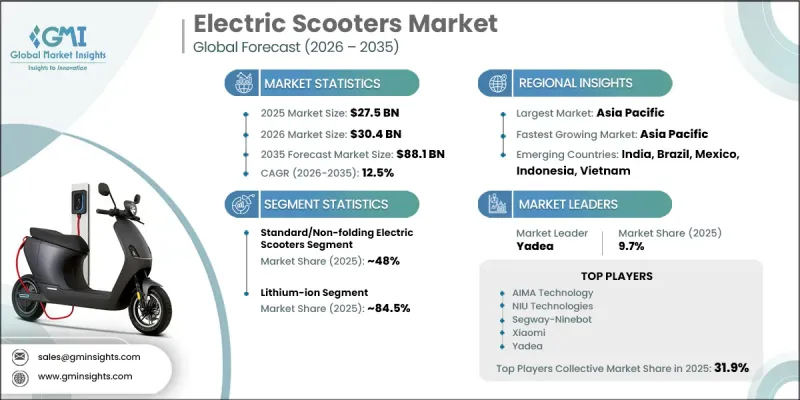
The Global Electric Scooters Market was valued at USD 27.5 billion in 2025 and is estimated to grow at a CAGR of 12.5% to reach USD 88.1 billion by 2035.
The electric scooters market is witnessing significant expansion as governments, consumers, and businesses increasingly shift toward sustainable and efficient urban mobility solutions. Supportive government programs, including purchase incentives, tax advantages, reduced ownership costs, and initiatives promoting domestic battery production, are improving the accessibility of electric scooters for a wider consumer base. Growing environmental concerns and stricter emission reduction targets are encouraging the transition from conventional two-wheelers to electric alternatives. The expansion of charging networks and battery-swapping infrastructure is further improving the practicality and adoption of electric scooters. Increasing urbanization, rising traffic congestion, and the need for affordable short-distance transportation are driving demand for compact and convenient mobility options. Electric scooters are becoming an effective solution for urban commuting by reducing travel time and lowering transportation expenses. The development of smart city initiatives, shared mobility services, and micro-mobility ecosystems is further supporting market growth. In addition, the rapid expansion of delivery services and e-commerce operations is increasing demand for efficient and economical electric transportation solutions.
| Market Scope | |
|---|---|
| Start Year | 2025 |
| Forecast Year | 2026-2035 |
| Start Value | $27.5 Billion |
| Forecast Value | $88.1 Billion |
| CAGR | 12.5% |
Continuous advancements in battery technologies are improving the overall performance, reliability, and usability of electric scooters. Innovations in lithium-ion batteries, battery management systems, and next-generation battery technologies are helping manufacturers achieve longer riding ranges, improved safety features, and shorter charging durations. These technological improvements are enhancing consumer confidence and supporting broader adoption of electric scooters across multiple applications.
The standard/non-folding electric scooters segment accounted for 48% share in 2025 and is expected to grow at a CAGR of 12.1% through 2035. This segment maintains the leading position due to its advantages in terms of durability, larger battery capacity, stronger load-handling capability, and enhanced riding comfort. Standard electric scooters are increasingly preferred for daily commuting, commercial operations, and shared mobility services because they provide better stability and longer travel distances compared with folding models. Manufacturers are continuously introducing improvements in battery technology, connectivity features, and vehicle components to enhance efficiency and overall performance.
The lithium-ion battery segment 84.5% share in 2025 and is projected to grow at a CAGR of over 12.8% from 2026 to 2035. Lithium-ion batteries continue to lead the market because of their high energy density, lightweight structure, extended lifespan, and efficient charging performance compared with alternative battery technologies. These batteries provide longer travel ranges, faster charging capabilities, and lower maintenance requirements, making them suitable for both premium and affordable electric scooter models. Falling battery costs and continuous improvements in battery management technologies are further accelerating the adoption of lithium-ion-powered electric scooters.
China Electric Scooters Market held 52.3% share, generating USD 10.8 billion in 2025. The country's strong market position is supported by its extensive electric two-wheeler manufacturing ecosystem, large consumer base, developed battery supply chain, and expanding charging infrastructure. Rising demand for environmentally friendly transportation solutions, increased adoption of shared mobility services, and growing preference for economical commuting options are contributing to market expansion. Ongoing advancements in battery performance and connected mobility technologies are further strengthening China's leadership in the electric scooters industry.
Major players operating in the global electric scooters market include Yadea, AIMA Technology, Ather Energy, Bajaj Auto, Hero MotoCorp, Honda Motor, NIU Technologies, Segway-Ninebot, TVS Motor (iQube), and Xiaomi. Companies operating in the electric scooters market are strengthening their competitive position through continuous product innovation, technology upgrades, strategic partnerships, and geographic expansion initiatives. Manufacturers are investing in advanced battery solutions, connected vehicle technologies, and smart mobility features to improve product performance and enhance user experience. Companies are also expanding their manufacturing capabilities, strengthening supply chain networks, and developing cost-effective models to attract a broader customer base. Strategic collaborations, investments in charging infrastructure, and expansion into emerging markets are helping businesses increase market penetration.
Table of Contents
Chapter 1 Methodology
- 1.1 Research approach
- 1.2 Quality Commitments
- 1.2.1 GMI AI policy & data integrity commitment
- 1.2.1.1 Source consistency protocol
- 1.2.1 GMI AI policy & data integrity commitment
- 1.3 Research Trail & Confidence Scoring
- 1.3.1 Research Trail Components
- 1.3.2 Scoring Components
- 1.4 Data Collection
- 1.4.1 Partial list of primary sources
- 1.5 Data mining sources
- 1.5.1 Paid sources
- 1.5.1.1 Sources, by region
- 1.5.1 Paid sources
- 1.6 Base estimates and calculations
- 1.6.1 Base year calculation
- 1.7 Forecast Model
- 1.7.1 Quantified market impact analysis
- 1.7.1.1 Mathematical impact of growth parameters on forecast
- 1.7.1 Quantified market impact analysis
- 1.8 Research transparency addendum
- 1.8.1 Source attribution framework
- 1.8.2 Quality assurance metrics
- 1.8.3 Our commitment to trust
Chapter 2 Executive Summary
- 2.1 Industry 360° synopsis, 2022 – 2035
- 2.2 Key market trends
- 2.2.1 Regional
- 2.2.2 Product
- 2.2.3 Battery technology
- 2.2.4 Application
- 2.2.5 Power output
- 2.2.6 Range
- 2.2.7 Speed
- 2.2.8 Distribution channel
- 2.3 TAM Analysis, 2026-2035
- 2.4 CXO perspectives: Strategic imperatives
Chapter 3 Industry Insights
- 3.1 Industry ecosystem analysis
- 3.1.1 Supplier landscape
- 3.1.2 Profit margin analysis
- 3.1.3 Cost structure
- 3.1.4 Value addition at each stage
- 3.1.5 Factor affecting the value chain
- 3.1.6 Disruptions
- 3.2 Industry impact forces
- 3.2.1 Growth drivers
- 3.2.1.1 Rising government incentives and supportive policies promoting electric mobility
- 3.2.1.2 Increasing fuel prices and lower operating costs compared to conventional scooters
- 3.2.1.3 Growing urbanization and demand for affordable last-mile transportation
- 3.2.1.4 Advancements in battery technology improving range, safety, and charging speed
- 3.2.2 Industry pitfalls and challenges
- 3.2.2.1 Limited charging infrastructure in developing and rural regions
- 3.2.2.2 High upfront purchase cost compared to internal combustion engine (ICE) scooters
- 3.2.3 Market opportunities
- 3.2.3.1 Expansion of battery swapping ecosystems and fast-charging infrastructure
- 3.2.3.2 Increasing adoption of electric scooters for e-commerce and last-mile delivery fleets
- 3.2.3.3 Growing penetration in emerging markets across Asia, Latin America, and Africa
- 3.2.3.4 Development of connected, AI-enabled, and autonomous mobility features
- 3.2.1 Growth drivers
- 3.3 Growth potential analysis
- 3.4 Technology and Innovation landscape
- 3.4.1 Current technological trends
- 3.4.2 Emerging technologies
- 3.5 Pricing Analysis (Driven by Primary Research)
- 3.5.1 Historical Price Trend Analysis
- 3.5.2 Pricing Strategy by Player Type (Premium / Value / Cost-plus)
- 3.6 Regulatory guideline
- 3.6.1 North America
- 3.6.1.1 U.S.: Consumer Product Safety Commission (CPSC) Safety Standards & UL 2272/UL 2849 Certification Requirements
- 3.6.1.2 Canada: Motor Vehicle Safety Act (where applicable), Provincial Micromobility Regulations & Transport Canada Safety Guidelines.
- 3.6.2 Europe
- 3.6.2.1 Germany: eKFV (Electric Small Vehicles Ordinance) & EU Machinery Regulation Compliance
- 3.6.2.2 UK: Department for Transport (DfT) E-scooter Trial Regulations & Road Traffic Act
- 3.6.2.3 France: Code de la Route (French Highway Code) & Personal Mobility Device Regulations
- 3.6.2.4 Italy: Highway Code (Codice della Strada) & Electric Scooter Operational Regulations
- 3.6.3 Asia Pacific
- 3.6.3.1 China: GB National Standards for Electric Scooters & CCC (China Compulsory Certification)
- 3.6.3.2 India: Central Motor Vehicles Rules (CMVR), AIS Standards & FAME II/FAME PM E-DRIVE Scheme
- 3.6.3.3 Japan: Road Traffic Act & Specified Small Motorized Bicycle Regulations
- 3.6.3.4 South Korea: Personal Mobility Device Safety Regulations & KCs Certification Standards
- 3.6.3.5 Australia: Australian Consumer Law (ACL) Product Safety Requirements & State/Territory E-scooter Regulations
- 3.6.4 Latin America
- 3.6.4.1 Brazil: CONTRAN Electric Mobility Regulations & INMETRO Product Certification
- 3.6.4.2 Mexico: NOM Safety Standards & State-Level Micromobility Regulations
- 3.6.4.3 Argentina: National Road Safety Agency (ANSV) Electric Scooter Operating Guidelines
- 3.6.5 MEA
- 3.6.5.1 UAE: Dubai RTA E-scooter Regulations & UAE Standardization Requirements
- 3.6.5.2 Saudi Arabia: SASO Electric Vehicle Product Standards & Municipal Micromobility Regulations
- 3.6.5.3 South Africa: National Road Traffic Act & SABS Electrical Safety Standards for Electric Scooters
- 3.6.1 North America
- 3.7 Porter’s analysis
- 3.8 PESTEL analysis
- 3.9 Patent Landscape (Driven by Primary Research)
- 3.10 Trade data analysis (Driven by Paid Research)
- 3.10.1 Import/export volume & value trends
- 3.10.2 Key trade corridors & tariff impact
- 3.11 Capacity & production landscape (Driven by Primary Research)
- 3.11.1 Installed capacity by region & key producer
- 3.11.2 Capacity utilization rates & expansion pipelines
- 3.12 Impact of AI & Generative AI on the Market (Driven by Primary Research)
- 3.12.1 AI-Driven Disruption of Existing Business Models
- 3.12.2 GenAI Use Cases & Adoption Roadmap by Segment
- 3.12.3 Risks, Limitations & Regulatory Considerations
- 3.13 Charging technology standards and infrastructure ecosystem
- 3.13.1 Dc fast charging standards regional adoption analysis
- 3.13.2 Proprietary charging solutions and market fragmentation
- 3.13.3 Vehicle-to-grid integration and smart charging
- 3.14 Forecast assumptions & scenario analysis (Driven by Primary Research)
- 3.14.1 Base Case - Key Macro & Industry Variables Driving CAGR
- 3.14.2 Optimistic Scenarios - Favourable macro and industry tailwinds
- 3.14.3 Pessimistic Scenario - Macroeconomic slowdown or industry headwinds
Chapter 4 Competitive Landscape, 2025
- 4.1 Introduction
- 4.2 Company market share analysis
- 4.2.1 North America
- 4.2.2 Europe
- 4.2.3 Asia Pacific
- 4.2.4 Latin America
- 4.2.5 MEA
- 4.3 Competitive analysis of major market players
- 4.4 Competitive positioning matrix
- 4.5 Key developments
- 4.5.1 Mergers & acquisitions
- 4.5.2 Partnerships & collaborations
- 4.5.3 New Product Launches
- 4.5.4 Expansion Plans and funding
- 4.6 Company Tier Benchmarking
- 4.6.1 Tier Classification Criteria & Qualifying Thresholds
- 4.6.2 Tier Positioning Matrix by Revenue, Geography & Innovation
Chapter 5 Market Estimates & Forecast, By Product, 2022 - 2035 ($Bn, Units)
- 5.1 Key trends
- 5.2 Standard/non-folding electric scooters
- 5.3 Folding electric scooters
- 5.4 Seated electric scooters
- 5.5 Self-balancing electric scooters
- 5.6 Three-wheeled electric scooters
Chapter 6 Market Estimates & Forecast, By Battery Technology, 2022 - 2035 ($Bn, Units)
- 6.1 Key trends
- 6.2 Lithium-ion (Li-ion)
- 6.3 Sealed lead acid (SLA)
- 6.4 Nickel metal hydride (NiMH)
- 6.5 Others
Chapter 7 Market Estimates & Forecast, By Application, 2022 - 2035 ($Bn, Units)
- 7.1 Key trends
- 7.2 Personal mobility
- 7.3 Recreational
- 7.4 Ride sharing
- 7.5 Last-mile delivery
- 7.6 Fleet operations
Chapter 8 Market Estimates & Forecast, By Power Output, 2022 – 2035 ($Bn, Units)
- 8.1 Key trends
- 8.2 Below 250W
- 8.3 250W–500W
- 8.4 Above 500W
Chapter 9 Market Estimates & Forecast, By Range, 2022 – 2035 ($Bn, Units)
- 9.1 Key trends
- 9.2 Below 50 km
- 9.3 50–100 km
- 9.4 Above 100 km
Chapter 10 Market Estimates & Forecast, By Speed, 2022 – 2035 ($Bn, Units)
- 10.1 Key trends
- 10.2 Below 25 km/h
- 10.3 25–50 km/h
- 10.4 Above 50 km/h
Chapter 11 Market Estimates & Forecast, By Distribution Channel, 2022 – 2035 ($Bn, Units)
- 11.1 Key trends
- 11.2 Online
- 11.3 Offline
Chapter 12 Market Estimates & Forecast, By Region, 2022 - 2035 ($Bn, Units)
- 12.1 Key trends
- 12.2 North America
- 12.2.1 US
- 12.2.2 Canada
- 12.3 Europe
- 12.3.1 Germany
- 12.3.2 UK
- 12.3.3 France
- 12.3.4 Italy
- 12.3.5 Spain
- 12.3.6 Russia
- 12.3.7 Netherlands
- 12.3.8 Belgium
- 12.4 Asia Pacific
- 12.4.1 China
- 12.4.2 India
- 12.4.3 Japan
- 12.4.4 Australia
- 12.4.5 South Korea
- 12.4.6 New Zealand
- 12.5 Latin America
- 12.5.1 Brazil
- 12.5.2 Mexico
- 12.5.3 Argentina
- 12.6 MEA
- 12.6.1 South Africa
- 12.6.2 Saudi Arabia
- 12.6.3 UAE
Chapter 13 Company Profiles
- 13.1 Global Players
- 13.1.1 AIMA Technology
- 13.1.2 Gogoro
- 13.1.3 Honda Motor
- 13.1.4 Ninebot
- 13.1.5 NIU Technologies
- 13.1.6 Piaggio
- 13.1.7 Vmoto
- 13.1.8 Xiaomi
- 13.1.9 Yadea
- 13.1.10 Yamaha Motor
- 13.2 Regional Players
- 13.2.1 Ather Energy
- 13.2.2 Bajaj Auto
- 13.2.3 Hero MotoCorp
- 13.2.4 Horwin Global
- 13.2.5 Ola Electric Mobility
- 13.2.6 Silence Urban Ecomobility
- 13.2.7 TVS Motor Company
- 13.3 Emerging Players
- 13.3.1 Askoll EVA
- 13.3.2 BGauss Electric
- 13.3.3 Simple Energy

