PUBLISHER: Mordor Intelligence | PRODUCT CODE: 2117452

PUBLISHER: Mordor Intelligence | PRODUCT CODE: 2117452
Electric Scooters - Market Share Analysis, Industry Trends & Statistics, Growth Forecasts (2025 - 2030)
According to Mordor Intelligence, the electric scooters market size stands at USD 20.35 billion in 2025 and is projected to reach USD 33.61 billion by 2030, reflecting a 10.56% CAGR during the forecast period.
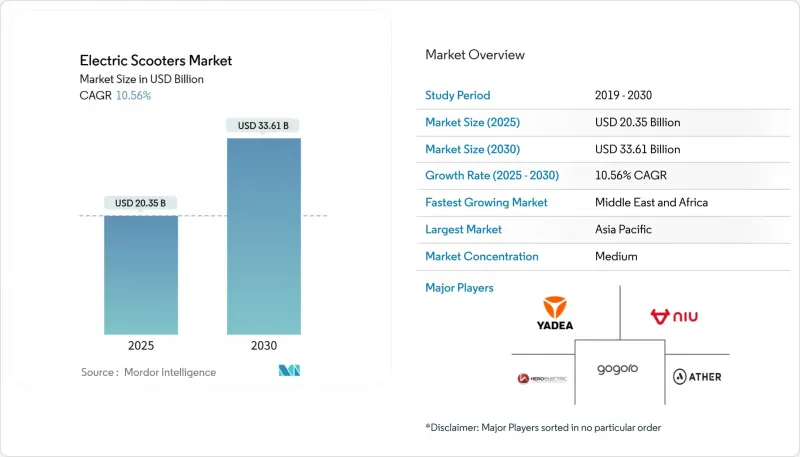
This report is Segmented by Battery Type (Lead-Acid, Lithium-Ion, and More), Power Output (Less Than 3. 6 KW, 3. 6-7. 2 KW, and More), Motor/Drive Type (Hub Motor, Belt Drive, and More), End-Use (Personal/Individual, Commercial and Corporate Fleets, and More), and Geography (North America, South America, and More). The Market Forecasts are Provided in Terms of Value (USD) and Volume (Units).
Global Electric Scooters Market Trends and Insights
Growing Urban Congestion and Last-Mile Mobility Demand
Commuters often find themselves ensnared in major metropolitan areas in lengthy traffic jams, leading to significant time loss and frustration. Electric scooters, however, offer an efficient alternative by deftly navigating through congested streets, reducing parking duration, and seamlessly connecting with public transport systems. These benefits make electric scooters an increasingly popular choice in the electric scooters market for urban mobility. Recognizing this trend, city administrations are implementing measures to support their adoption. For instance, Paris has designated 2,500 parking bays exclusively for scooters, a strategic move aimed at reducing urban clutter, improving safety, and promoting organized usage. Such initiatives highlight the growing role of electric scooter in addressing urban transportation challenges.
Government Incentives and Subsidy Programs
Financial support is accelerating adoption. India's Electric Mobility Promotion Scheme 2024 set aside INR 10,900 crore (USD 1.3 billion) for electric two-wheelers, reducing retail prices and improving financing access . In the United Kingdom, mandates on number plates and helmets establish compliance rules, effectively reducing operational risks for fleet operators. These regulations ensure safety and standardization and foster a predictable demand, enabling manufacturers to optimize their production capacity. Additionally, the consistency in demand allows manufacturers to negotiate more favorable supply contracts, ensuring cost efficiency and streamlined operations. Such policies contribute to a stable and well-regulated market environment, benefiting manufacturers and fleet operators.
Limited Public Charging / Swapping Infrastructure
Many cities face a shortage of designated charging points, making it difficult for users without private parking access. This scarcity forces reliance on public infrastructure, which often can't keep pace with the rising demand for electric vehicles (EVs) charging. While battery swap networks of fer a potential solution, they have high establishment and maintenance costs. Moreover, the lack of brand interoperability limits riders to a single brand's ecosystem, curtailing their flexibility and convenience. This predicament heightens range anxiety, deterring potential buyers from embracing EVs. As a result, this reluctance hampers the expansion of EV fleets, especially in crowded urban centers where housing and parking challenges are already pronounced.
Other drivers and restraints analyzed in the detailed report include:
- Rapid Expansion of E-commerce Delivery Fleets
- Declining Lithium-ion Battery Prices
- High Upfront Acquisition Cost vs. ICE Alternatives
For complete list of drivers and restraints, kindly check the Table Of Contents.
Segment Analysis
Lithium-ion technology controlled 79.33% of the electric scooters market in 2024, backed by energy density peaks of 300 Wh/kg and steady cost declines. Lead-acid packs persist in price-led models, but shrinking premiums for lithium-ion erode their appeal. Sodium-ion cells are projected to expand at a 14.25% CAGR by 2030, driven by cheaper kilowatt-hour pricing and improved thermal stability. Manufacturers such as CATL and BYD integrated sodium-ion into fleet-targeted models, broadening raw-material options and cushioning lithium supply swings .
Energy-dense lithium-polymer cells support premium scooters where slim form factors matter, while LFP variants gain share for cost-sensitive fleets needing long cycle life. As sodium-ion capacity scales, its share of the electric scooter market size could outpace earlier projections without major design overhauls. Safety records and operating-temperature breadth make sodium-ion attractive for tropical regions, positioning it to capture municipal fleet tenders from 2026.
Scooters rated 3.6-7.2 kW held 39.45% share of the electric scooters market in 2024, balancing 45-60 km/h top speeds with lenient licensing thresholds in many countries. Owners favor the segment for daily commutes, while fleet buyers appreciate simplified operator requirements. The electric scooters market size for models above 10 kW is smaller, but is forecast to expand at 11.66% CAGR as riders demand expressway-capable machines.
Premium entries like BMW's CE 04 deliver 31 kW and 130 km range, validating appetite for higher-output mobility. Regulatory updates in the EU's L3e category cap power at 15 kW, offering room for performance growth within scooter norms. Rising adoption in peri-urban zones where longer journeys are common will continue to pull demand toward the upper-power bracket.
Complete Report Scope:
- By Battery Type
- Lead-acid
- Lithium-ion
- Lithium-ion Polymer
- Sodium-ion and Emerging Chemistries
- By Power Output
- Less than 3.6 kW
- 3.6-7.2 kW
- 7.2-10 kW
- More than 10 kW
- By Motor / Drive Type
- Hub Motor
- Belt Drive
- Chain Drive
- Mid-drive Motor
- By End-Use
- Personal / Individual
- Commercial and Corporate Fleets
- Micromobility Service Providers
- Delivery and Logistics
- By Geography
- North America
- United States
- Canada
- Rest of North America
- South America
- Brazil
- Argentina
- Rest of South America
- Europe
- United Kingdom
- Germany
- Spain
- Italy
- France
- Russia
- Rest of Europe
- Asia-Pacific
- India
- China
- Japan
- South Korea
- Rest of Asia-Pacific
- Middle East and Africa
- United Arab Emirates
- Saudi Arabia
- Turkey
- Egypt
- South Africa
- Rest of Middle-East and Africa
- North America
Geography Analysis
Asia-Pacific held a 75.14% share of the electric scooter market in 2024 as China leveraged its battery supply chain and India recorded significant sales under pro-EV incentives. Ola Electric is aided by domestic sourcing and aggressive retail financing. Southeast Asian nations such as Indonesia and Vietnam are rolling out tax cuts and assembling plants, lifting regional demand.
Europe remains a steady growth engine. In 2024, Europe clarified insurance coverage, smoothing fleet operations. Germany revised licensing standards to streamline category definitions. Italy's Highway Code update introduced plate and helmet rules that enhance safety compliance while supporting commercial insurance underwriting. Mature charging networks and low-emission zones fortify consumer confidence.
North America shows incremental gains as states harmonize rules. California's rebate inclusion slashed ownership costs and spurred dealer inventories. The Middle East and Africa, forecast to post an 11.36% CAGR through 2030, benefits from Dubai's Green Mobility Strategy and Riyadh's pilot corridors that install curbside swap cabinets. Infrastructure gaps persist but rapid urban development offers a blank slate for purpose-built charging clusters.
- Yadea Technology Group
- NIU Technologies
- Hero Electric Vehicles Private Limited
- Gogoro Inc.
- Ather Energy Limited
- Okinawa Autotec Private Limited
- TVS Motor Company
- Bajaj Auto Limited
- Yamaha Motor Co. Ltd.
- BMW Motorrad
- Piaggio & C. SpA
- Ola Electric Mobility Limited
- Vmoto Limited
- Silence Urban Ecomobility
Additional Benefits:
- The market estimate (ME) sheet in Excel format
- 3 months of analyst support
TABLE OF CONTENTS
1 Introduction
- 1.1 Study Assumptions & Market Definition
- 1.2 Scope of the Study
2 Research Methodology
3 Executive Summary
4 Market Landscape
- 4.1 Market Overview
- 4.2 Market Drivers
- 4.2.1 Growing Urban Congestion and Last-Mile Mobility Demand
- 4.2.2 Government Incentives and Subsidy Programs
- 4.2.3 Rapid Expansion of E-commerce Delivery Fleets
- 4.2.4 Declining Lithium-ion Battery Prices
- 4.2.5 Battery-as-a-Service and Swappable-Pack Ecosystems
- 4.2.6 IoT-enabled Predictive Maintenance Boosting Fleet Uptime
- 4.3 Market Restraints
- 4.3.1 Limited Public Charging / Swapping Infrastructure
- 4.3.2 High Upfront Acquisition Cost vs. ICE Alternatives
- 4.3.3 Safety Recalls and Fire Incidents Triggering Stricter Certifications
- 4.3.4 Critical-Mineral Supply Constraints for Next-Gen Chemistries
- 4.4 Value / Supply-Chain Analysis
- 4.5 Regulatory Landscape
- 4.6 Technological Outlook
- 4.7 Porter's Five Forces
- 4.7.1 Threat of New Entrants
- 4.7.2 Bargaining Power of Suppliers
- 4.7.3 Bargaining Power of Buyers
- 4.7.4 Threat of Substitutes
- 4.7.5 Competitive Rivalry
5 Market Size & Growth Forecasts (Value (USD) and Volume (Units))
- 5.1 By Battery Type
- 5.1.1 Lead-acid
- 5.1.2 Lithium-ion
- 5.1.3 Lithium-ion Polymer
- 5.1.4 Sodium-ion and Emerging Chemistries
- 5.2 By Power Output
- 5.2.1 Less than 3.6 kW
- 5.2.2 3.6-7.2 kW
- 5.2.3 7.2-10 kW
- 5.2.4 More than 10 kW
- 5.3 By Motor / Drive Type
- 5.3.1 Hub Motor
- 5.3.2 Belt Drive
- 5.3.3 Chain Drive
- 5.3.4 Mid-drive Motor
- 5.4 By End-Use
- 5.4.1 Personal / Individual
- 5.4.2 Commercial and Corporate Fleets
- 5.4.3 Micromobility Service Providers
- 5.4.4 Delivery and Logistics
- 5.5 By Geography
- 5.5.1 North America
- 5.5.1.1 United States
- 5.5.1.2 Canada
- 5.5.1.3 Rest of North America
- 5.5.2 South America
- 5.5.2.1 Brazil
- 5.5.2.2 Argentina
- 5.5.2.3 Rest of South America
- 5.5.3 Europe
- 5.5.3.1 United Kingdom
- 5.5.3.2 Germany
- 5.5.3.3 Spain
- 5.5.3.4 Italy
- 5.5.3.5 France
- 5.5.3.6 Russia
- 5.5.3.7 Rest of Europe
- 5.5.4 Asia-Pacific
- 5.5.4.1 India
- 5.5.4.2 China
- 5.5.4.3 Japan
- 5.5.4.4 South Korea
- 5.5.4.5 Rest of Asia-Pacific
- 5.5.5 Middle East and Africa
- 5.5.5.1 United Arab Emirates
- 5.5.5.2 Saudi Arabia
- 5.5.5.3 Turkey
- 5.5.5.4 Egypt
- 5.5.5.5 South Africa
- 5.5.5.6 Rest of Middle-East and Africa
- 5.5.1 North America
6 Competitive Landscape
- 6.1 Market Concentration
- 6.2 Strategic Moves
- 6.3 Market Share Analysis
- 6.4 Company Profiles (Includes Global Level Overview, Market Level Overview, Core Segments, Financials as Available, Strategic Information, Market Rank/Share for Key Companies, Products and Services, SWOT Analysis, and Recent Developments)
- 6.4.1 Yadea Technology Group
- 6.4.2 NIU Technologies
- 6.4.3 Hero Electric Vehicles Private Limited
- 6.4.4 Gogoro Inc.
- 6.4.5 Ather Energy Limited
- 6.4.6 Okinawa Autotec Private Limited
- 6.4.7 TVS Motor Company
- 6.4.8 Bajaj Auto Limited
- 6.4.9 Yamaha Motor Co. Ltd.
- 6.4.10 BMW Motorrad
- 6.4.11 Piaggio & C. SpA
- 6.4.12 Ola Electric Mobility Limited
- 6.4.13 Vmoto Limited
- 6.4.14 Silence Urban Ecomobility
7 Market Opportunities & Future Outlook
- 7.1 White-space & Unmet-Need Assessment

